
When it comes to combating visible signs of aging—especially deep wrinkles—few ingredients have the proven track record of vitamin A derivatives. Among them, retinol and retinal (also known as retinaldehyde) are two of the most talked-about forms in skincare. Both are celebrated for their ability to accelerate cell turnover, boost collagen production, and smooth fine lines. But when the goal is fast, effective results on deeper facial wrinkles, one stands out for its speed and potency. Understanding the biochemical differences, conversion pathways, and real-world efficacy can help you make an informed decision about which form delivers the best anti-aging performance.
The Vitamin A Pathway: How Retinoids Work in Skin
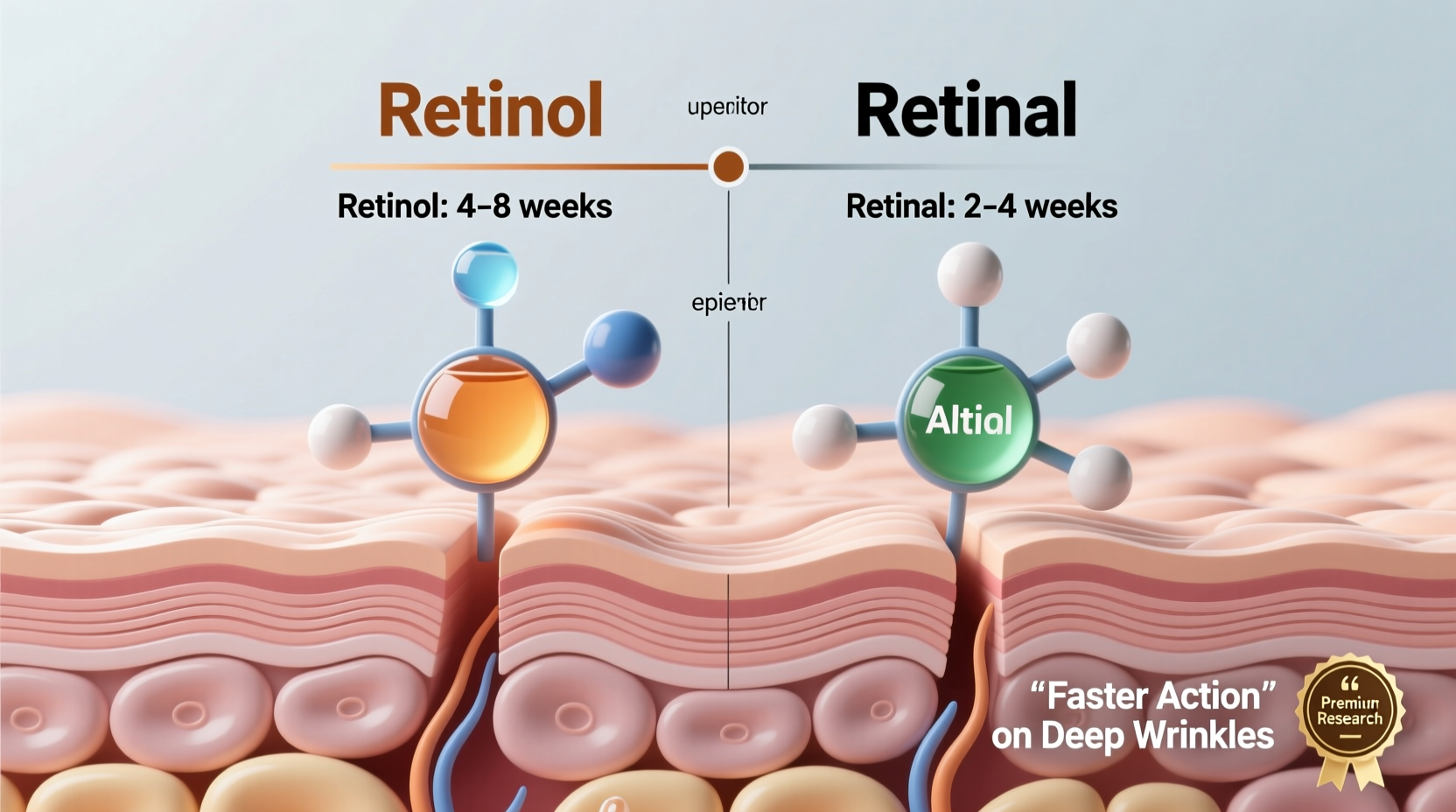
All topical vitamin A derivatives must ultimately convert into retinoic acid—the biologically active form that binds to retinoic acid receptors in the skin and triggers cellular renewal. However, not all forms begin at the same starting point in this metabolic pathway. The closer a compound is to retinoic acid, the fewer conversion steps required, and the faster it can exert its effects.
The standard conversion sequence is:
- Retinyl esters (e.g., retinyl palmitate) →
- Retinol →
- Retinal (retinaldehyde) →
- Retinoic acid (active form)
Each step involves enzymatic reactions that vary in efficiency depending on age, skin health, and genetics. This means that compounds further back in the chain—like retinyl esters—take longer to become active, while those closer to retinoic acid act more quickly.
Tip: If your skin is sensitive or new to retinoids, start with a lower-concentration retinal product to minimize irritation while still benefiting from faster activation.Retinol: The Classic Anti-Aging Staple
Retinol has long been the gold standard in over-the-counter anti-aging skincare. It’s widely available, extensively studied, and generally well-tolerated when introduced gradually. Once applied, retinol penetrates the epidermis and is converted by skin enzymes into retinal, then into retinoic acid. This two-step process limits how quickly results appear.
Clinical studies show that consistent use of 0.3% to 1% retinol can improve skin texture, reduce fine lines, and increase collagen density—but typically only after **8 to 12 weeks** of nightly application. For deeper wrinkles, especially around the mouth, forehead, and eyes, the timeline may extend even further.
One of retinol’s advantages is its gentler profile. Because conversion is slow, it produces less immediate irritation than prescription retinoids like tretinoin. However, this same slowness means delayed action—particularly problematic when targeting established, structural wrinkles.
“Retinol is excellent for maintenance and prevention, but if you’re aiming for significant wrinkle reduction, you’ll want something that acts faster and more directly.” — Dr. Lena Park, Board-Certified Dermatologist
Retinal: The Faster-Acting Alternative
Retinal, or retinaldehyde, sits one step away from retinoic acid in the metabolic pathway. Unlike retinol, which requires two conversions, retinal needs only one enzymatic step to become active. This proximity translates to quicker onset of action and greater potency at lower concentrations.
Studies have demonstrated that 0.05% retinal can deliver results comparable to 0.05% tretinoin—with significantly less irritation. In a 12-week clinical trial published in the British Journal of Dermatology, participants using retinal showed measurable improvements in wrinkle depth and skin firmness within **just 4 weeks**, outperforming retinol users in both speed and magnitude of change.
Moreover, retinal possesses antimicrobial properties, making it uniquely beneficial for individuals concerned with both aging and acne. Its dual functionality allows for broader skin compatibility without sacrificing anti-wrinkle efficacy.
Why Retinal Works Faster on Deep Wrinkles
- Fewer conversion steps: Only one enzymatic reaction needed vs. two for retinol.
- Higher bioavailability: More molecules reach the active stage per application.
- Greater stability: Less prone to oxidation than retinol, maintaining potency over time.
- Stronger collagen stimulation: Clinical data shows superior upregulation of Type I and III procollagen.
This combination makes retinal particularly effective for deeper dermal folds where structural remodeling is essential. While no topical agent can match injectables for severe volume loss, retinal comes closest among OTC options in stimulating meaningful dermal repair.
Comparative Analysis: Retinol vs Retinal
| Feature | Retinol | Retinal |
|---|---|---|
| Conversion Steps to Retinoic Acid | Two (retinol → retinal → retinoic acid) | One (retinal → retinoic acid) |
| Onset of Visible Results | 8–12 weeks | 4–6 weeks |
| Irritation Potential | Moderate (increases with concentration) | Low to moderate (better tolerated than tretinoin) |
| Typical Concentration Range | 0.1% – 1.0% | 0.01% – 0.1% |
| Photostability | Poor (degrades in light) | Moderate to good (more stable formulation possible) |
| Antimicrobial Activity | No | Yes (effective against acne-causing bacteria) |
| Best For | Prevention, mild texture issues, beginners | Deep wrinkles, mature skin, faster results |
Real-World Application: A Case Study
Sarah, a 48-year-old marketing executive, had been using a 0.5% retinol serum nightly for nearly six months. While she noticed improved radiance and smoother texture, her nasolabial folds and crow’s feet remained stubbornly deep. Frustrated, she consulted a dermatologist who recommended switching to a 0.05% retinal serum.
Within three weeks, Sarah observed tighter skin around her eyes. By week six, her husband commented that she looked “more rested.” A follow-up skin analysis at eight weeks showed a 22% reduction in wrinkle depth compared to baseline—nearly double the improvement seen during her retinol phase. She experienced only mild dryness during the first week, which resolved with added hydration.
This case reflects a growing trend: consumers achieving faster, more noticeable anti-aging benefits by upgrading from retinol to retinal without resorting to prescription-strength tretinoin.
Step-by-Step Guide to Transitioning from Retinol to Retinal
If you're ready to enhance your anti-aging regimen, transitioning to retinal can be simple and effective. Follow this timeline for optimal results:
- Week 1: Patch Test – Apply a pea-sized amount of retinal to a small area (e.g., jawline) every other night. Monitor for redness, peeling, or stinging.
- Week 2: Introduce Slowly – Use retinal twice weekly after cleansing, followed by a nourishing moisturizer. Skip other actives (vitamin C, acids).
- Week 3–4: Build Frequency – Increase to every other night. Watch for tolerance. If irritation occurs, return to twice weekly and extend the adjustment period.
- Week 5+: Full Integration – Use retinal 4–5 nights per week. Layer with ceramide-rich creams and always apply SPF 30+ daily.
- Ongoing: Monitor & Maintain – After 8–12 weeks, assess changes in wrinkle depth and skin firmness. Adjust usage based on seasonal needs or sensitivity.
“Retinal bridges the gap between OTC retinol and prescription retinoids. It offers accelerated benefits with a manageable side effect profile.” — Dr. Nadia Kassam, Cosmetic Dermatology Researcher
Common Myths About Retinal and Retinol
Despite increasing popularity, misconceptions persist:
- Myth: Retinal is just as irritating as tretinoin.
Reality: While stronger than retinol, retinal causes less irritation than tretinoin due to controlled conversion rates.
- Myth: Higher retinol concentration always means better results.
Reality: Beyond 1%, additional retinol increases irritation without proportional gains in efficacy.
- Myth: You can’t use retinal with other active ingredients.
Reality: Once acclimated, retinal can be paired with peptides and antioxidants—just avoid simultaneous use with exfoliating acids.
FAQ: Retinol vs Retinal for Deep Wrinkles
Can I use retinal every night?
After your skin adapts (typically 4–6 weeks), using retinal 4–5 nights per week is safe and effective. Daily use may cause over-exfoliation in sensitive individuals, so listen to your skin’s response.
Is retinal safe for sensitive skin?
Yes, but start slowly. Use once or twice a week initially and pair with a barrier-supporting moisturizer. Look for formulations with soothing agents like niacinamide or squalane.
Do I still need sunscreen when using retinal?
Absolutely. All retinoids increase photosensitivity. Apply broad-spectrum SPF 30+ every morning—even on cloudy days—to prevent UV-induced damage and maximize anti-aging outcomes.
Checklist: Choosing the Right Vitamin A for Your Wrinkles
- ✅ Assess your wrinkle depth: Are they fine lines or deep creases?
- ✅ Consider your experience with retinoids: Beginner or seasoned user?
- ✅ Evaluate sensitivity: Do you react easily to actives?
- ✅ Prioritize speed: Do you want faster results?
- ✅ Check product stability: Is the formula air-tight and opaque?
- ✅ Confirm concentration: Aim for 0.05%–0.1% retinal or 0.3%–1% retinol.
- ✅ Commit to consistency: Use nightly for at least 8 weeks to judge effectiveness.
Conclusion: Why Retinal Wins for Fast Wrinkle Correction
While retinol remains a reliable option for gradual skin renewal, retinal emerges as the superior choice when targeting deep wrinkles with urgency. Its strategic position in the vitamin A cascade enables faster activation, stronger collagen induction, and earlier visible improvements—all with a favorable tolerance profile. Supported by clinical evidence and increasingly embraced by dermatologists, retinal represents the next evolution in accessible anti-aging science.
Switching from retinol to retinal doesn’t mean compromising safety for speed—it means optimizing your routine with smarter chemistry. Whether you're addressing decade-deep folds or seeking preventative power with precision, retinal delivers results that matter, sooner.
🚀 Ready to upgrade your anti-aging game? Try a stabilized retinal serum tonight and track your progress weekly. Share your journey in the comments—your experience could inspire someone else to finally see real change.