
For fitness enthusiasts and health-conscious users, choosing between the Apple Watch Series 9 and the Apple Watch SE isn't just about price—it's about precision, progression, and long-term value. Both watches deliver core Apple Watch functionality: heart rate monitoring, activity tracking, sleep analysis, and seamless integration with the iPhone. But when it comes to fitness tracking, subtle differences in hardware, software, and sensor capabilities can significantly impact your experience. Whether you're training for a marathon, managing chronic conditions, or simply aiming to stay active, understanding these distinctions is essential.
The Apple Watch SE offers excellent value with many of the same foundational features as its more expensive sibling. However, the Series 9 includes advanced sensors, improved algorithms, and exclusive health tools that may justify the premium—especially if fitness is a central part of your lifestyle.
Sensor Technology: The Core Difference in Fitness Accuracy
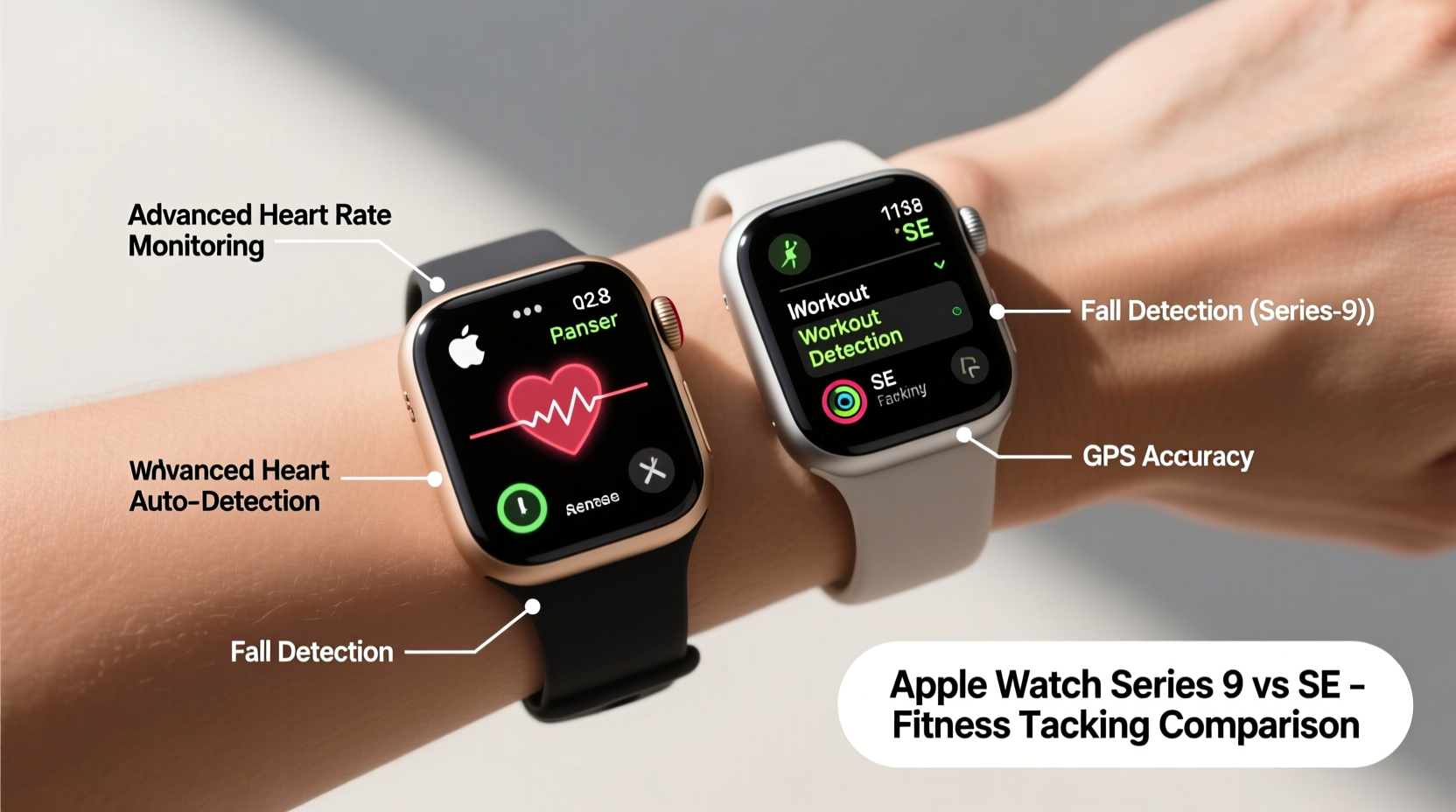
The most significant gap between the Series 9 and the SE lies in their sensor arrays. While both models include an optical heart rate sensor, accelerometer, gyroscope, and GPS, the Series 9 adds a third-generation blood oxygen (SpO₂) sensor and an upgraded electrical heart sensor used for ECG readings. These aren’t just marketing extras—they directly influence how accurately and comprehensively your fitness data is captured.
The Series 9’s heart rate sensor uses larger photodiodes and improved infrared technology, allowing for more consistent readings during high-intensity workouts or in low-light conditions. This means fewer gaps in data during interval training or outdoor runs where lighting changes rapidly. In contrast, the SE uses older-generation hardware that can struggle with rapid heart rate fluctuations, occasionally missing spikes or averaging out peaks incorrectly.
Tip: For runners and HIIT athletes, consistent heart rate sampling matters more than peak specs—choose the watch with superior sensor stability.Additionally, only the Series 9 supports on-wrist temperature sensing (via the new temperature sensor located on the back crystal), which contributes to cycle tracking improvements and recovery insights. While not directly used during exercise, this data helps correlate physical performance with physiological states like ovulation or illness onset—critical for holistic fitness planning.
Fitness Tracking Features: What Each Watch Can Actually Do
Both watches support all standard workout types: running, cycling, swimming, elliptical, rowing, and more. They track duration, calories burned, heart rate zones, elevation gain, and distance via built-in GPS. You’ll get haptic alerts at milestone intervals, auto-pause during runs, and post-workout summaries synced instantly to the Health app.
But the Series 9 goes further with advanced metrics:
- Advanced Running Metrics: Ground contact time, vertical oscillation, stride length (when paired with iPhone or supported Bluetooth foot pod)
- Low Power Mode for Workouts: Extends battery life during long activities like ultramarathons or triathlons
- Crash Detection & Fall Detection: Uses dual-core acceleration and precise motion algorithms to detect severe impacts
- ECG App: Provides medical-grade electrocardiograms to detect signs of atrial fibrillation (AFib)
- Blood Oxygen Monitoring: Tracks SpO₂ levels periodically in the background, useful for altitude training or sleep apnea screening
The SE lacks ECG and continuous blood oxygen monitoring. It also doesn’t support Low Power Mode, meaning you’re more likely to run out of juice during extended hikes or endurance events. Crash Detection is available on GPS + Cellular models but uses less refined algorithms compared to the Series 9.
“Accurate, continuous biometrics are no longer luxury features—they’re baseline tools for serious fitness tracking.” — Dr. Lena Patel, Sports Cardiologist and Wearable Researcher at Stanford Medicine
Comparison Table: Apple Watch Series 9 vs. SE for Fitness Use
| Feature | Apple Watch Series 9 | Apple Watch SE (2nd Gen) |
|---|---|---|
| Heart Rate Sensor | 3rd-gen with improved IR and green LED array | 2nd-gen, standard sensitivity |
| Blood Oxygen (SpO₂) | Yes – background and on-demand | No |
| ECG App | Yes – FDA-cleared | No |
| Temperature Sensing | Yes – for cycle tracking and recovery trends | No |
| GPS Accuracy | Improved dual-frequency GPS | Standard GPS |
| Low Power Mode | Yes – extends workout battery life by ~30% | No |
| Crash Detection | Yes – on all models | Only on Cellular models |
| Fall Detection | Yes – enhanced algorithm | Yes – basic detection |
| Advanced Running Metrics | Yes – with compatible devices | Limited to pace, HR, distance |
| Water Resistance | 50m WR – swim-ready | 50m WR – swim-ready |
Real-World Performance: A Runner’s Perspective
Consider Maya, a 34-year-old trail runner training for her first 50K ultramarathon. She started with the Apple Watch SE but noticed inconsistencies in her heart rate data during steep climbs. Her resting HR appeared artificially low one day, then spiked inexplicably the next. After upgrading to the Series 9, she began receiving notifications about elevated HR variability and poor recovery scores—data points tied to her upcoming illness. Thanks to the background blood oxygen tracking and improved sensor fusion, the watch detected early signs of fatigue and immune stress.
During races, the dual-frequency GPS kept her route accurate even under dense tree cover, while Low Power Mode let her complete a 7-hour event without charging. She also used the ECG app after a particularly grueling session when she felt palpitations, ruling out AFib with a clinician-reviewed reading.
For casual walkers or gym-goers, the SE would have sufficed. But for someone pushing physical limits, every metric counts. The Series 9 didn’t just track her progress—it helped prevent overtraining injuries and informed smarter pacing strategies.
Tip: Enable \"Workout Recovery\" in the Fitness app to see post-exercise guidance based on heart rate trends and respiratory rate.When the SE Is Enough—and When It’s Not
The Apple Watch SE remains one of the best values in wearable tech. If your routine includes daily step goals, occasional gym sessions, weekly jogs, and general wellness tracking, the SE delivers 90% of what most users need. Its integration with Apple Fitness+ and Activity Rings keeps motivation high, and automatic workout detection works reliably across common exercises.
However, the decision shifts if you:
- Train competitively or follow structured coaching plans
- Have cardiovascular concerns or a family history of heart disease
- Live at high altitudes or frequently travel to varying climates
- Want deeper insights into recovery, sleep quality, and hormonal cycles
- Participate in endurance sports lasting more than two hours
In these cases, the Series 9’s additional sensors and smarter algorithms provide measurable advantages. The ability to catch irregular rhythms early, monitor oxygen saturation during sleep, or analyze running form over time translates into actionable intelligence—not just numbers on a screen.
Step-by-Step: How to Decide Which Watch Fits Your Fitness Goals
- Assess your current fitness level and goals: Are you walking daily, training for a race, rehabbing an injury, or managing a condition?
- List the metrics you rely on: Heart rate? VO₂ max estimates? Sleep stages? Menstrual cycle predictions?
- Determine how often you exceed 90-minute workouts: If frequently, battery optimization becomes critical.
- Check if you’d use ECG or SpO₂: Those with hypertension, asthma, or arrhythmias benefit from regular checks.
- Compare total cost of ownership: Consider potential healthcare savings from early detection versus upfront price difference (~$150–$200).
- Test both in-store (if possible): Try wearing each during a brisk walk or stair climb to feel responsiveness differences.
- Review long-term upgrade path: The Series 9 will receive software updates longer and support future health features.
Expert Insight: Why Precision Matters in Long-Term Health
“The difference between good data and great data is the difference between awareness and intervention. With higher-fidelity sensors, we can spot trends before symptoms arise.” — Dr. Arjun Mehta, Digital Health Director at Johns Hopkins “Wearables like the Series 9 are becoming preventive tools, not just trackers. For patients with pre-diabetes or hypertension, consistent, reliable monitoring changes outcomes.”
Frequently Asked Questions
Can the Apple Watch SE track swimming accurately?
Yes, the SE fully supports swim tracking in pools and open water. It records laps, stroke type (automatically), distance, and calories. Water lock and auto-start/stop work well. However, it lacks advanced metrics like SWOLF score or underwater pace splits unless paired with third-party apps.
Does the Series 9 last longer on a single charge during workouts?
Not dramatically—but with Low Power Mode enabled, you can extend battery life by up to 30% during prolonged activities. For example, a full-day hike might drain the SE completely, while the Series 9 could still have 15–20% remaining. This buffer can be crucial in emergencies.
Is the ECG feature worth it if I’m healthy?
Even healthy individuals experience undetected arrhythmias. One study found that 1 in 4 users who received an irregular rhythm notification later confirmed AFib through clinical testing. Early detection allows for timely treatment and reduces stroke risk. If you're over 40 or have lifestyle risks (stress, sedentary job, family history), ECG access adds meaningful peace of mind.
Final Verdict: Who Should Upgrade?
If fitness is a hobby, the Apple Watch SE is more than capable. It tracks steps, heart rate, workouts, and sleep with solid reliability. For under $250 (on sale), it’s hard to beat for general wellness.
But if fitness is a passion—or a necessity for health management—the Series 9 earns its premium. The combination of better sensors, richer data, and proactive health tools creates a feedback loop that enhances performance, prevents setbacks, and promotes longevity. Over time, those incremental gains in accuracy compound into smarter decisions, safer training, and greater confidence in your body’s signals.
Moreover, the Series 9 represents Apple’s current technological ceiling for wearables. It supports the latest watchOS features, integrates with HomeKit for ambient health environments, and includes UWB for Precision Finding—a small but growing utility. Choosing the Series 9 isn’t just about today’s needs; it’s about staying relevant for the next four to five years of software evolution.
Take Action: Choose Based on Your Future Self
Ask yourself: Who do you want to become in the next year? A stronger runner? A healthier parent? A more resilient professional? Your choice of wearable should align with that vision.
If your answer involves pushing limits, optimizing recovery, or gaining deeper self-knowledge, the Apple Watch Series 9 isn’t just worth the extra cost—it’s an investment in your body’s future. But if you’re building habits from scratch and need simplicity and affordability, the SE remains a smart starting point.
💬 What’s your priority: cutting-edge fitness insights or everyday motivation? Share your thoughts and experiences below—your journey might help others make their own decision.








