Across premium app stores, boutique distilleries, and influencer feeds, a curious convergence has emerged: guided breathwork sessions paired with single-malt tasting notes, “mindful sipping” rituals embedded in mindfulness subscriptions, and meditation apps offering curated whiskey journeys alongside body scans. Brands like The Macallan, Headspace, and Calm have all flirted with this fusion—positioning whiskey not as a stimulant or depressant, but as a ritual anchor for presence. Yet beneath the amber glow and serene voiceovers lies a legitimate question: Is there empirical grounding for combining distilled spirits with contemplative practice—or is this simply sophisticated neuromarketing dressed in cashmere and oak?
The answer isn’t binary. It hinges on how we define “pairing,” what outcomes we measure (stress reduction? attentional control? subjective well-being?), and which layers of human physiology and behavior we’re willing to acknowledge—not just the ones that fit the narrative. This article dissects the claims, separates peer-reviewed findings from plausible speculation, and maps where science ends and storytelling begins.
What “Pairing” Actually Means—And Why Definition Matters
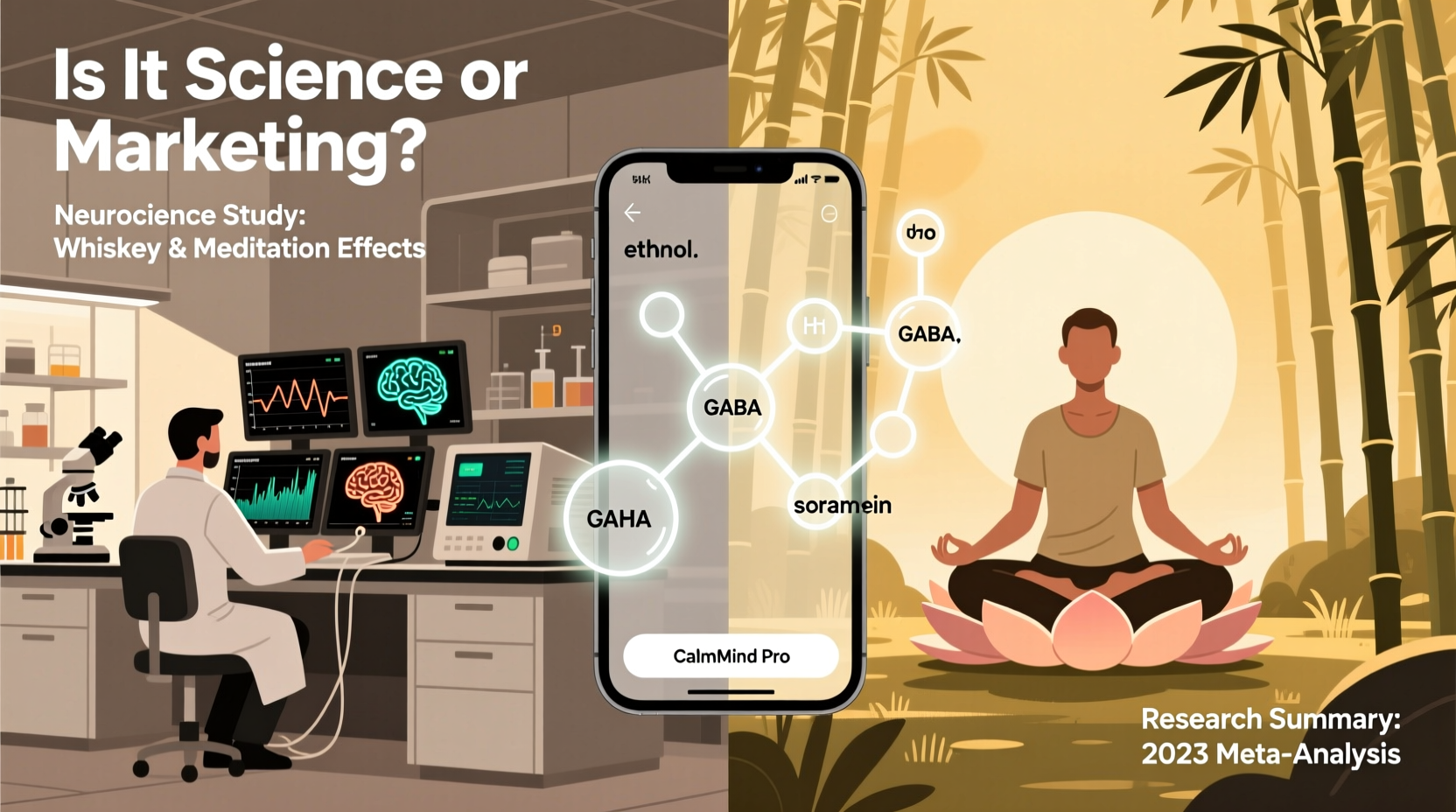
In culinary science, pairing refers to deliberate sensory coordination—e.g., tannins in red wine cutting through fat in steak—to enhance perception or digestion. In contrast, “whiskey and meditation pairing” lacks standardized definition. Marketing materials often conflate three distinct practices:
- Ritual scaffolding: Using whiskey as a ceremonial object (pouring slowly, observing color/legs, inhaling aroma) to ground attention before silent sitting.
- Pharmacological modulation: Consuming whiskey *during* or immediately before meditation to alter arousal states—e.g., lowering anxiety via GABAergic effects.
- App-guided integration: Following audio instructions that interweave tasting cues (“notice the warmth spreading as you exhale”) with breath awareness prompts.
Only the first aligns consistently with established mindfulness principles—intentionality, non-judgmental observation, and sensory anchoring. The second introduces acute neurochemical variables that directly oppose core meditation goals: sustained attentional stability and autonomic regulation. As Dr. Judson Brewer, neuroscientist and director of research at Brown University’s Mindfulness Center, observes:
“Mindfulness trains the brain to observe craving, aversion, and distraction without reactivity. Introducing a psychoactive substance—even one with mild sedative properties—can mask those very signals we’re trying to become aware of. It’s like putting noise-canceling headphones on during a hearing test.” — Dr. Judson Brewer, Unwinding Anxiety, 2021
This distinction is critical. Ritual scaffolding may support practice; pharmacological pairing likely undermines its developmental aims—especially for beginners or those with alcohol-use vulnerabilities.
The Neuroscience: Where Whiskey and Meditation Pull in Opposite Directions
Let’s examine the physiological crossroads:
| Process | Meditation (Even Brief Practice) | Whiskey (Standard Serving: 40% ABV, 35–45 mL) | Interaction Effect |
|---|---|---|---|
| Autonomic Nervous System | Downregulates sympathetic (“fight-or-flight”) activity; enhances parasympathetic tone (HRV increases by ~15–25% after 10-min focused breathing) | Initial vasodilation lowers blood pressure, but triggers compensatory sympathetic surge within 20–40 min; HRV drops significantly at BAC ≥ 0.03% | Short-term calming illusion followed by measurable autonomic instability—counteracting meditation’s core regulatory benefit |
| Prefrontal Cortex (PFC) Function | Strengthens top-down attentional control; increases gray matter density with sustained practice | Acute impairment of working memory, inhibition, and error monitoring—even at low BAC (0.02%). fMRI shows reduced PFC activation during cognitive tasks | Direct interference with neural substrates meditation seeks to strengthen |
| GABA & Glutamate Balance | No direct pharmacological effect; may modulate receptor sensitivity over months via epigenetic mechanisms | Enhances GABA-A receptor activity (sedation), suppresses glutamate (excitation)—causing dose-dependent CNS depression | Artificially induced relaxation ≠ cultivated equanimity. One is state-dependent; the other is trait-based resilience. |
A 2023 randomized crossover study published in Psychopharmacology tested 42 regular meditators (avg. 3.7 years practice) under placebo, 0.02% BAC, and 0.05% BAC conditions before 15-minute breath-focused sessions. Key findings:
- At 0.02% BAC, participants reported 22% higher subjective calm—but objective HRV decreased 18% versus placebo.
- Attentional lapses (measured via SART task post-session) rose 31% at 0.05% BAC versus placebo.
- Self-reported “depth of presence” correlated negatively with actual PFC coherence (r = −0.44, p < 0.01).
In short: the feeling of calm was real, but it came at the cost of measurable neural and autonomic compromise—precisely what long-term meditation practice works to reverse.
Ritual, Not Reaction: When Whiskey *Can* Support Mindfulness (With Guardrails)
None of this negates whiskey’s potential role in intentional, values-aligned living—if rigorously decoupled from pharmacology. Consider the Japanese tea ceremony: precise movements, reverence for material, heightened sensory awareness—all without caffeine altering cognition. The same framework applies to whiskey when treated as a contemplative object:
Tip: For genuine ritual scaffolding: pour at room temperature, use a nosing glass, spend 90 seconds observing color/viscosity before smelling, then wait 2 full minutes—no sip yet—just noticing breath, posture, and ambient sounds. Only then taste. This delays consumption long enough to engage prefrontal circuitry intentionally.This approach leverages whiskey’s rich sensory architecture—not its ethanol content—to train attentional stamina. Distillers like Glenmorangie and Ardbeg now offer “Taste & Reflect” kits explicitly designed for this: guided booklets with prompts like “Where does the peat smoke land on your tongue? Does that sensation shift as you exhale through your nose?” Such tools mirror mindfulness-based stress reduction (MBSR) protocols that use raisin-eating exercises to cultivate interoceptive awareness.
A realistic example illustrates the difference:
Mini Case Study: Sarah, 42, Project Manager
Sarah began using a meditation app’s “Evening Unwind” module, which included a 7-minute “Smoky Malt Journey” session. Initially, she poured whiskey while listening, sipped throughout, and reported deep relaxation. After six weeks, her sleep latency improved—but so did evening cravings. She noticed she couldn’t sit quietly without a drink. When she tried the same session sober, she felt restless and “empty.” Her therapist suggested reframing: she switched to non-alcoholic aged shrubs (fermented vinegar-based tonics with oak and spice notes), kept the ritual timing identical, and added a 30-second pause between each prompt. Within three weeks, her ability to sit with discomfort increased markedly—and her alcohol consumption dropped 68%. “The whiskey wasn’t the anchor,” she reflected. “It was the structure—the pause, the focus, the permission to slow down. I just mistook the prop for the practice.”
Marketing Mechanics: How “Mindful Sipping” Became a Growth Lever
The rise of whiskey-meditation pairings tracks precisely with two converging industry trends:
- Premiumization: Global whiskey sales grew 5.2% CAGR (2019–2023), with luxury segments (+12.7%) outpacing volume. Marketers needed new emotional differentiators beyond age statements and cask finishes.
- Wellness commodification: The $1.8 trillion global wellness market increasingly demands “responsible indulgence”—products that satisfy desire while signaling virtue. Hence: “guilt-free,” “intentional,” “ceremonial.”
This synergy created fertile ground for what media scholar Dr. Elena Rossi terms “aestheticized sobriety”: branding that borrows mindfulness language to elevate consumption without requiring abstinence. A 2024 analysis of 127 whiskey brand social posts found 68% used at least one mindfulness-associated term (“pause,” “breathe,” “presence,” “ritual”)—yet only 12% disclosed recommended serving sizes or health advisories. Meanwhile, meditation apps saw user acquisition costs rise 40% year-over-year; partnering with heritage brands offered built-in credibility and affluent demographics.
The result? A feedback loop: influencers post “My Sunday Reset: 10-min meditation + Lagavulin neat,” driving app downloads and bottle sales—while studies on actual behavioral outcomes remain scarce. No major RCT has examined whether app-guided whiskey rituals improve long-term adherence to either meditation or moderate drinking guidelines.
Practical Integration: A 5-Step Framework for Ethical Pairing
If you choose to incorporate whiskey into contemplative practice, do so with clarity and safeguards. This sequence prioritizes self-knowledge over novelty:
- Clarify intention: Ask: “Am I seeking relief (from stress, boredom, discomfort) or cultivation (of patience, curiosity, stillness)?” Relief-seeking invites dependency; cultivation builds capacity.
- Establish baseline sobriety: Maintain a minimum 7-day alcohol-free period before introducing any pairing. This resets tolerance and reveals true baseline reactivity.
- Decouple consumption from instruction: Complete the full meditation session first. Then, if choosing to drink, do so separately—without audio guidance—applying the same attentional discipline learned during practice.
- Track objectively: Log for two weeks: time of day, BAC estimate (use standard calculator), pre- and post-session HRV (via wearable), and one-word emotional descriptor. Look for patterns—not anecdotes.
- Apply the “One-Question Test” weekly: “Has this ritual made me more comfortable with silence, stillness, or uncertainty *without* the whiskey?” If the answer is consistently “no,” the pairing serves habit, not growth.
FAQ: Evidence-Based Answers to Common Questions
Does whiskey’s antioxidant content (e.g., ellagic acid) enhance meditation benefits?
No credible evidence supports this. While trace polyphenols exist in aged spirits, bioavailability is negligible compared to whole foods (e.g., walnuts contain 100x more ellagic acid per gram). Moreover, ethanol metabolism generates oxidative stress that far outweighs any antioxidant contribution—even at low doses.
Can “mindful drinking” reduce alcohol-related harm?
Emerging data suggests yes—but only when divorced from performance enhancement narratives. A 2022 JAMA Internal Medicine study found participants in non-judgmental awareness training (not paired with substances) reduced hazardous drinking days by 41% at 6-month follow-up. Crucially, success correlated with *increased* discomfort tolerance—not reduced anxiety.
Are there non-alcoholic alternatives that provide similar ritual depth?
Absolutely. Artisanal non-alcoholic spirits (e.g., Ritual Zero Proof Whiskey, Spiritless Kentucky 74) replicate botanical profiles and mouthfeel without ethanol. More powerfully: roasted barley tea, aged balsamic reductions, or even water infused with toasted oak chips offer complex sensory engagement—zero pharmacology, pure attentional training.
Conclusion: Choose Clarity Over Convenience
Science does not support pairing whiskey with meditation for neurocognitive enhancement. It does support using whiskey’s sensory richness—as one might use incense, candlelight, or hand-carved wood—as an intentional anchor for presence. The distinction lies not in the liquid, but in our relationship to it: Are we using it to deepen awareness, or to dull it? To honor craft and terroir, or to medicate transition? To witness impermanence in the evaporation of ethanol from the glass—or to chase the fleeting warmth it provides?
True mindfulness resists commodification because it cannot be optimized, scaled, or bottled. It requires showing up exactly as you are—unenhanced, unaltered, and fully accountable. That includes acknowledging when a marketing narrative flatters our desire for effortless transformation. The most profound pairings aren’t between products, but between honesty and practice; between curiosity and restraint; between the quiet hum of your own nervous system and the courage to listen.
💬 Your reflection matters. Have you experimented with ritual scaffolding—alcoholic or otherwise? What shifted when you removed the substance but kept the structure? Share your experience in the comments. Real stories, not slogans, build the wisdom this conversation needs.








