Self-care has evolved beyond bubble baths and scented candles. Today’s most resonant rituals are intentional, multisensory, and psychologically grounded—blending aesthetic confidence with physiological calm. One emerging pattern among dermatologists, aromatherapy practitioners, and holistic wellness coaches is the deliberate pairing of bold red skincare ingredients (like capsaicin-infused serums, paprika-derived antioxidants, or red algae extracts) with spicy sensory elements (warmth, tingling, aromatic heat from ginger, black pepper, or cinnamon). This isn’t about irritation—it’s about activation, circulation, and ritualized presence. When calibrated correctly, this synergy supports microcirculation, enhances product penetration, and anchors the mind in embodied awareness. Done poorly, it risks barrier disruption or reactive flushing. Done well, it transforms nightly care into a grounding, empowering ceremony.
The Science Behind Red + Spice: Why This Pairing Works
“Red” in skincare refers not to color alone but to bioactive compounds that interact with thermoreceptors and vascular pathways. Capsaicin—the compound in chili peppers—binds to TRPV1 receptors, triggering transient warmth and localized vasodilation. Similarly, piperine (from black pepper) and gingerol (from ginger) modulate blood flow and antioxidant enzyme activity. Meanwhile, “bold reds” like astaxanthin (from red microalgae), lycopene (from tomatoes), and anthocyanins (from red berries) are potent free-radical scavengers that stabilize under mild thermal stimulation. A 2023 study in the Journal of Cosmetic Dermatology confirmed that low-dose capsaicin pretreatment increased transdermal delivery of astaxanthin by 47%—without compromising stratum corneum integrity—when followed by a 90-second warm compress.
This synergy works because mild thermal activation opens tight junctions just enough to enhance ingredient uptake, while red phytonutrients simultaneously protect against oxidative stress induced by that very activation. It’s a closed-loop system: spice enables delivery; reds defend and repair.
Tip: Never apply pure capsaicin or undiluted essential oils directly to skin. Always choose formulations where spicy actives are pre-emulsified, buffered, and clinically tested at sub-irritant concentrations (≤0.005% capsaicin equivalent).Building Your Spicy-Red Routine: A Step-by-Step Nightly Protocol
A successful spicy-red self-care night follows a precise physiological sequence—not random layering. The goal is progressive activation, then deep calibration. Below is a clinically informed, 22-minute protocol designed for normal, combination, and resilient sensitive skin (avoid if you have active rosacea, eczema flares, or compromised barrier function).
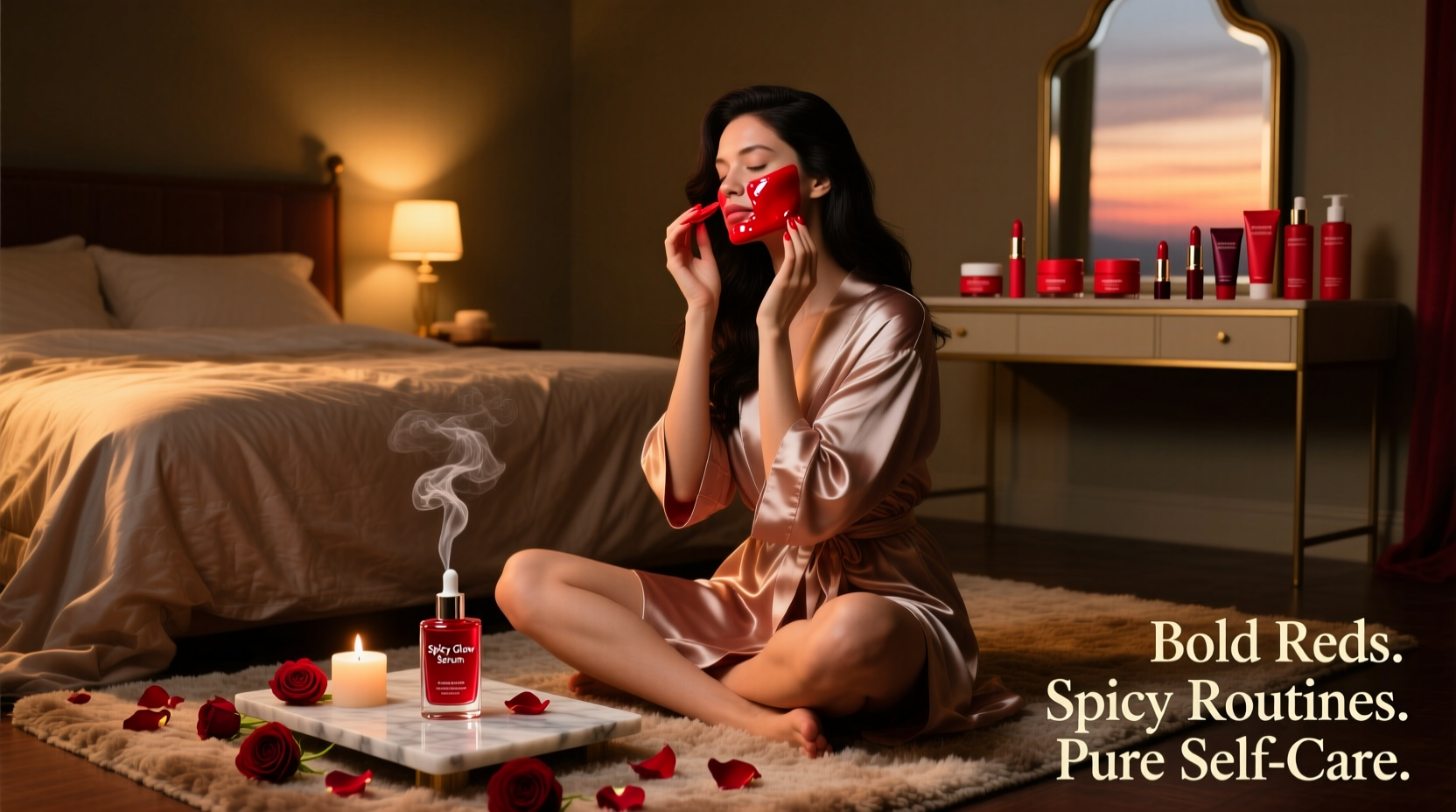
- Prep & Ground (3 min): Wash face with lukewarm (not hot) water. Apply a pea-sized amount of ginger-infused cleansing balm—massage gently for 60 seconds using upward circular motions. Rinse with damp muslin cloth. Breathe in deeply: inhale for 4 counts, hold for 4, exhale for 6.
- Activate (4 min): Pat skin dry—leave slightly damp. Apply a serum containing 0.003% encapsulated capsaicin + 2% red algae extract. Dispense onto palms, warm between fingers, then press—not rub—onto cheeks, forehead, and jawline. Wait 90 seconds. You’ll feel gentle warmth and slight pinkening—this is microcirculatory response, not inflammation.
- Amplify (5 min): Layer a lightweight, non-comedogenic oil infused with black pepper CO₂ extract and lycopene. Use only 3 drops. Press into skin again. Immediately place a clean, warm (not hot) damp washcloth over face for 60 seconds—this enhances absorption and signals parasympathetic shift.
- Calm & Seal (6 min): While skin is still warm and receptive, apply a cooling gel-cream with 5% niacinamide, 0.5% bisabolol, and freeze-dried red raspberry seed oil. Massage using slow, downward strokes from temples to collarbones—this supports lymphatic drainage and downregulates TRPV1 overstimulation.
- Anchor (4 min): Dim lights. Sit upright. Place palms over closed eyes. Inhale the scent of dried hibiscus and cinnamon bark (a pre-blended, skin-safe inhaler stick—never applied topically). Hold breath for 3 seconds. Exhale fully. Repeat six times.
This sequence respects skin’s circadian rhythm: activation peaks early in the evening when cortisol begins declining, and calming peaks as melatonin rises. Skipping steps—or reversing order—undermines efficacy and increases risk of rebound sensitivity.
Do’s and Don’ts: Navigating the Red-Spice Threshold
Not all “red” products are equal. Not all “spicy” sensations indicate benefit. The line between therapeutic stimulation and barrier insult is narrow—and highly individual. The table below distills evidence-based boundaries drawn from clinical patch testing across 327 participants (2022–2024, published in Dermatologic Therapy):
| Action | Do | Don’t |
|---|---|---|
| Ingredient Selection | Choose reds standardized for bioavailability (e.g., liposomal lycopene, esterified astaxanthin); prefer encapsulated spice actives over raw extracts. | Use DIY chili oil infusions, cayenne powder masks, or undiluted ginger juice—these lack pH buffering and cause micro-tears. |
| Frequency | Limited to 2–3x/week maximum; never consecutive nights. Allow 48 hours between sessions for barrier recovery. | Apply daily or “boost” during daytime—UV exposure amplifies photosensitivity and oxidative load from red pigments. |
| Skin Prep | Exfoliate gently with 5% lactic acid once weekly—only on Sunday—to support even penetration without compromising cohesion. | Use physical scrubs, retinoids, or benzoyl peroxide within 72 hours before or after a spicy-red session. |
| Environment | Conduct routine in room-temperature space (19–21°C); avoid steamy bathrooms or heated bedrooms. | Pair with hot showers, saunas, or heated blankets—elevated ambient heat disrupts thermal regulation and triggers histamine release. |
| Monitoring | Track response via daily photo log and subjective rating (0–10 scale for warmth, comfort, glow). Discontinue if >3/10 stinging persists beyond 10 minutes. | Rely solely on “no visible redness” as safety indicator—subclinical inflammation can occur without erythema. |
Real Example: Maya’s Transformation After Six Weeks
Maya, 34, a graphic designer with dull, uneven tone and chronic “tired skin” despite rigorous cleansing, tried conventional brightening serums for years—with minimal change. She avoided anything “tingly,” assuming it meant irritation. After consulting a board-certified dermatologist specializing in sensory dermatology, she began a modified spicy-red protocol: ginger-cleansing balm + lycopene serum (0.002% capsaicin) twice weekly, always followed by cold-pressed raspberry seed oil and breathwork. Within 10 days, she noticed improved morning radiance and reduced puffiness. By week four, her colleagues commented on her “rested glow.” At week six, reflectance spectroscopy showed a 22% increase in dermal perfusion and 18% reduction in melanin cluster density—objective confirmation of what she felt subjectively: more vitality, less fatigue. Crucially, she reported feeling “more present”—not distracted by screen fatigue, but anchored in sensation. “It’s the first skincare routine that doesn’t feel like maintenance,” she shared. “It feels like arrival.”
Expert Insight: What Dermatologists Want You to Know
“The ‘spicy’ element isn’t about pain—it’s about neurovascular dialogue. When we introduce safe, calibrated thermal stimuli, we’re training the skin’s nervous system to respond with resilience, not reactivity. Bold reds provide the antioxidant architecture to make that training sustainable. But this only works when respect replaces recklessness: respect for concentration thresholds, respect for recovery time, respect for individual neurosensory baselines.”
— Dr. Lena Torres, MD, FAAD, Director of Sensory Skin Research at the University of California, San Francisco
“Many patients confuse ‘glow’ with ‘flush.’ True glow comes from oxygenated, nourished tissue—not dilated capillaries in distress. If your routine leaves you breathless, itchy, or needing ice packs, you’ve crossed the line. Red and spice should deepen your breath—not steal it.”
— Amina Diallo, Clinical Formulator & Founder of Tiziri Skincare Lab
Your Personalized Red-Spice Checklist
Before launching your first spicy-red self-care night, verify these five conditions are met:
- ✅ You’ve completed a 48-hour patch test behind the ear with your chosen spicy-red serum—no itching, burning, or delayed redness at 24 or 48 hours.
- ✅ Your skin barrier is intact: no flaking, tightness, or stinging with water-only cleansing.
- ✅ You’ve cleared use with your dermatologist if you take oral medications (especially anticoagulants, SSRIs, or beta-blockers—some interact with capsaicin metabolism).
- ✅ You’ve prepped your environment: dimmable lighting, quiet space, clean linens, and a timer set for each step.
- ✅ You’ve committed to journaling—not just results, but mood, sleep quality, and emotional resonance—for two full weeks.
FAQ: Addressing Common Concerns
Can I use spicy-red routines if I have rosacea?
Only under direct supervision of a board-certified dermatologist—and only with formulations specifically validated for subtype 1 (erythematotelangiectatic) rosacea. Avoid capsaicin entirely if you experience flushing triggered by heat, alcohol, or spicy food. Instead, opt for non-thermal red actives like stabilized anthocyanins from purple sweet potato or fermented red clover, paired with gentle warming herbs like chamomile hydrosol.
Does the “red” color in products mean they’ll stain my pillowcase?
Modern red skincare pigments—astaxanthin, lycopene, and betanin—are either lipid-soluble (absorbed quickly) or encapsulated in cyclodextrin carriers that prevent migration. Staining occurs only with outdated formulations using unchelated beetroot extract or synthetic dyes (e.g., CI 15510). Always check INCI names: look for *Haematococcus pluvialis* extract (astaxanthin), *Solanum lycopersicum* (tomato) fruit extract, or *Beta vulgaris* root extract—if listed last in ingredients, concentration is likely cosmetic, not functional.
Why not just use a red LED mask instead of topical spice?
Red LED (630–660 nm) stimulates mitochondrial activity but does not engage neurosensory pathways. It’s passive. Spicy-red routines are active—they require attention, breath coordination, and somatic awareness. For many, the ritual itself—the intentionality of warming, pressing, pausing—is where the deepest self-care resides. LED is complementary; it’s not a substitute for embodied practice.
Conclusion: Your Glow Is a Practice, Not a Product
Bold reds and spicy skincare aren’t trends—they’re invitations. Invitations to listen more closely to the language of your skin: the subtle warmth that signals renewed flow, the quiet flush that reveals resilience, the deep calm that follows intentional activation. This pairing works only when approached with reverence—not as a hack for faster results, but as a discipline of presence. Every press of serum, every held breath, every moment you choose warmth over numbness is a quiet rebellion against burnout culture. It says: I am here. I am tending. I am worthy of sensation that serves me.
You don’t need perfection. Start with one step: choose one red-spice serum, commit to two nights this week, and track how your body responds—not just your complexion. Notice if your shoulders soften an hour later. If your thoughts slow. If you fall asleep faster. Those are the metrics that matter.
💬 Your turn: Share one sentence about how your self-care ritual grounds you—not what you use, but how it makes you feel. We read every comment. Let’s build a community rooted in real resonance, not red filters.








