
The Great Depression, which began with the U.S. stock market crash in 1929, was more than an economic catastrophe—it became a catalyst for one of the most devastating conflicts in human history. While World War II officially erupted in 1939, its roots stretch deep into the global financial turmoil of the 1930s. The collapse of economies, widespread unemployment, and shattered confidence in democratic institutions created fertile ground for authoritarian regimes to rise. In nations desperate for stability and national revival, extremist leaders exploited public suffering to gain power, ultimately leading to militarization, expansionism, and war.
Economic Collapse and Political Instability
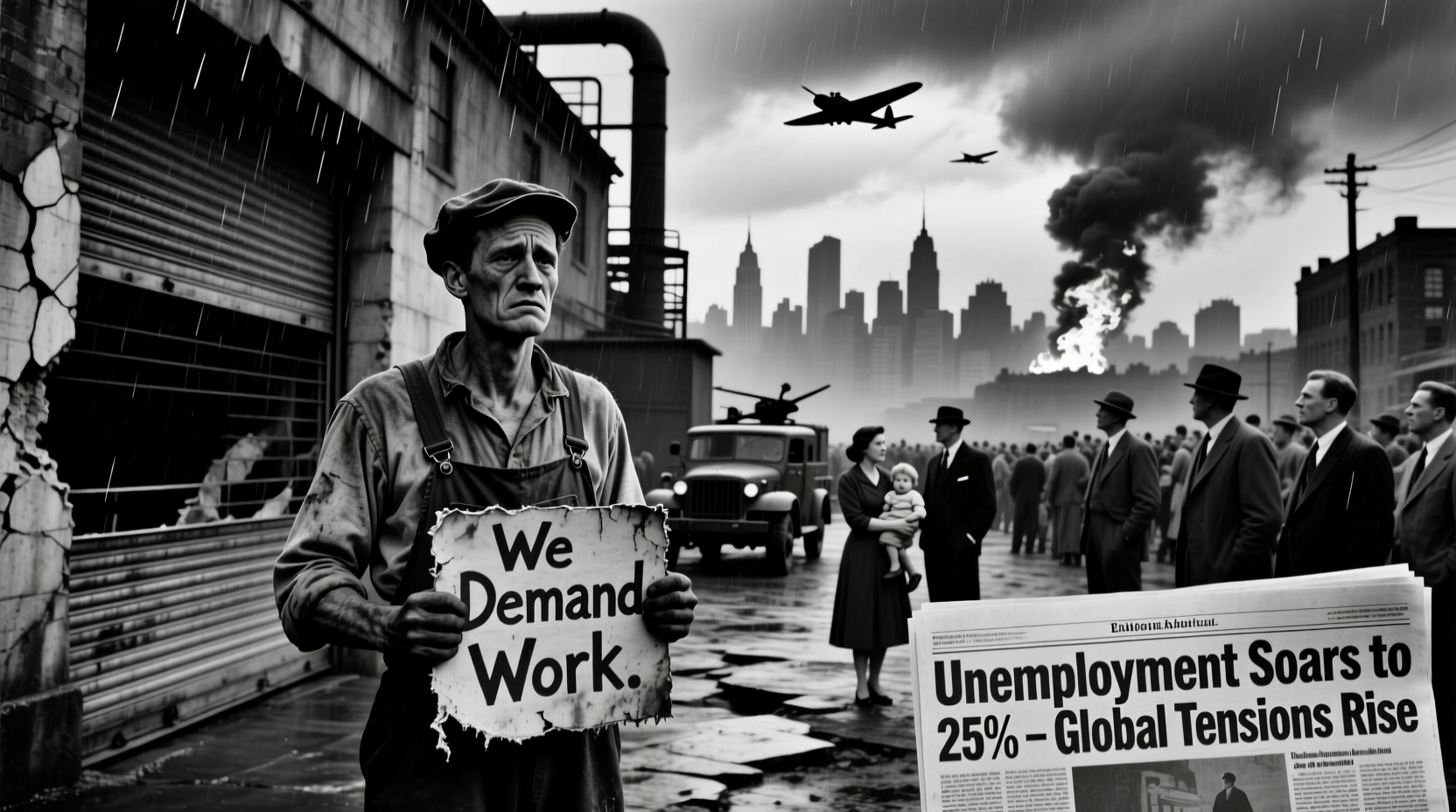
The Great Depression did not affect all countries equally, but its reach was nearly universal. By 1932, global industrial production had dropped by nearly 40%, international trade fell by over 60%, and unemployment soared—reaching 25% in the United States and even higher in Germany and Austria. These figures were not just statistics; they represented millions of people who lost jobs, homes, and hope.
In democracies already weakened by post-World War I treaties and social fragmentation, the crisis undermined faith in liberal governance. Voters grew disillusioned with traditional parties that seemed unable to restore prosperity. This erosion of trust opened the door for radical alternatives. In Germany, where reparations from the Treaty of Versailles had already strained the economy, the Depression intensified resentment and desperation. The Weimar Republic, fragile under normal conditions, collapsed under the weight of hyperinflation, mass unemployment, and political gridlock.
Tip: When studying historical turning points, always consider how economic distress can amplify political extremism.Rise of Authoritarian Regimes
Authoritarian leaders across Europe capitalized on economic despair. Adolf Hitler’s Nazi Party in Germany, Benito Mussolini’s Fascists in Italy, and militarist factions in Japan all promised national renewal through strong leadership, job creation, and restored pride.
Hitler’s ascent is perhaps the clearest example. In 1928, the Nazi Party won less than 3% of the vote. By July 1932, after years of worsening unemployment and social unrest, it captured 37% of the electorate, becoming the largest party in the Reichstag. Hitler was appointed Chancellor in January 1933, not through revolution, but through legal means enabled by a collapsing democratic system.
“The Great Depression transformed a marginal extremist movement into a mainstream political force.” — Dr. Margaret Higonnet, Historian of 20th Century Europe
Similarly, in Japan, economic hardship fueled militarism. The collapse of silk exports—a major source of income—and falling rice prices devastated rural communities. The military, positioning itself as a protector of national honor and economic self-sufficiency, staged coups and pushed for imperial expansion into Manchuria (1931) and later China (1937).
Global Trade Collapse and Nationalism
One of the most damaging consequences of the Depression was the breakdown of international cooperation. As nations turned inward to protect their economies, they adopted protectionist policies that worsened the global downturn.
The U.S. Smoot-Hawley Tariff Act of 1930 raised import duties on over 20,000 goods, prompting retaliatory tariffs from trading partners. Global trade contracted sharply, deepening the crisis. Countries abandoned the gold standard, devalued currencies, and formed exclusive economic blocs, further fragmenting the world economy.
This retreat from globalization fostered xenophobia and economic nationalism. Governments promoted “autarky”—economic self-sufficiency—as a solution. For expansionist regimes like Nazi Germany and Imperial Japan, this meant territorial conquest to secure resources. Hitler’s concept of *Lebensraum* (living space) in Eastern Europe was framed as both a racial imperative and an economic necessity to feed and sustain the German people.
Timeline: From Economic Crisis to War
The progression from economic collapse to global conflict followed a disturbingly logical path. Below is a key timeline showing how economic despair translated into geopolitical aggression.
- 1929: U.S. stock market crashes, triggering global financial panic.
- 1931: Japan invades Manchuria, beginning expansion in Asia.
- 1932–1933: Nazi Party gains massive support in Germany amid 30%+ unemployment.
- January 1933: Hitler appointed Chancellor of Germany.
- 1933–1934: Nazis dismantle democracy, establish totalitarian state.
- 1935: Germany reintroduces conscription, violating the Treaty of Versailles.
- 1936: Germany remilitarizes the Rhineland; Italy invades Ethiopia.
- 1937: Full-scale war begins between Japan and China.
- 1938: Germany annexes Austria (Anschluss) and occupies Czechoslovakia.
- September 1, 1939: Germany invades Poland; Britain and France declare war.
Case Study: Germany’s Descent into Totalitarianism
Germany offers the most direct illustration of how economic collapse enabled war. After World War I, the country faced massive reparations, inflation, and political chaos. The 1920s brought temporary stability through foreign loans, especially from the United States. But when the American economy crashed in 1929, those funds dried up overnight.
German banks failed, industries shut down, and unemployment reached six million by 1932. Breadlines stretched for blocks. Middle-class families lost savings to hyperinflation. Veterans and youth felt betrayed by a government they saw as weak and corrupt.
The Nazi Party offered simple answers: blame the Treaty of Versailles, Jews, communists, and the Weimar \"traitors.\" They promised jobs through rearmament, national dignity through strength, and unity through ideology. Once in power, Hitler launched massive public works programs and accelerated military spending, reducing unemployment to near zero by 1936. This economic recovery, however, was built on debt and preparation for war—not sustainable peace.
| Factor | Impact on Germany | Long-Term Consequence |
|---|---|---|
| Mass Unemployment | Over 6 million jobless by 1932 | Erosion of democratic legitimacy |
| Reparations & Debt | Crushing burden from Versailles | National humiliation, economic fragility |
| U.S. Loan Withdrawal | Bank collapses, industry shutdowns | Dependence on extremist solutions |
| Political Fragmentation | Dozens of parties, unstable coalitions | Parliamentary paralysis |
| Nazi Propaganda | Exploited fear and anger | Rise of totalitarian regime |
Expert Insight: The Psychology of Crisis and Extremism
Historians emphasize that economic hardship alone does not cause war—but it creates conditions where dangerous ideologies thrive.
“People don’t vote for dictators because they love tyranny. They vote for them because they are afraid, angry, and promised salvation.” — Timothy Snyder, historian and author of *On Tyranny*
The Great Depression didn’t directly start World War II, but it destroyed the belief that liberal democracy could deliver security and prosperity. In that vacuum, leaders who promised order, national pride, and economic revival gained legitimacy—even when their methods were violent and expansionist.
Frequently Asked Questions
Did the Treaty of Versailles contribute to the Great Depression’s impact?
Yes. The harsh reparations imposed on Germany after World War I destabilized its economy long before 1929. When the Depression hit, Germany was already vulnerable due to war debt, loss of territory, and reliance on foreign loans. The treaty created a sense of injustice that extremists like Hitler exploited.
Could World War II have been prevented if the Great Depression had been managed differently?
Many historians believe so. More coordinated international response—such as coordinated stimulus, debt relief, and open trade—might have preserved democratic governments. The failure of Western powers to intervene early in Japanese or German aggression also signaled weakness, encouraging further expansion.
How did the U.S. New Deal affect global perceptions of democracy?
Roosevelt’s New Deal restored some faith in democratic governance by providing jobs, regulating finance, and supporting labor. While it didn’t end the Depression alone, it demonstrated that democracies could respond to crisis without abandoning civil liberties—a contrast to fascist models.
Conclusion: Learning from History
The link between economic collapse and global conflict is not inevitable, but it is dangerously real. The Great Depression showed how quickly societal trust can erode when livelihoods vanish and institutions fail. It revealed that economic policy is not separate from peace and security—it is foundational to them.
Today, as nations face rising inequality, climate-driven disruptions, and geopolitical tensions, the lessons of the 1930s remain urgent. Strong democracies require not just elections, but economic fairness, international cooperation, and resilience against scapegoating and extremism.
🚀 Understand the past to shape a better future. Share this article to spark discussion on how economic justice and global solidarity can prevent history from repeating itself.








