
In an age of constant stimulation and stress, a simple notebook and pen may be one of the most powerful tools for mental transformation. Gratitude journaling—writing down things you're thankful for on a regular basis—is often dismissed as a feel-good habit with no real impact. But mounting scientific evidence suggests otherwise: the act of writing down gratitude doesn't just shift your mood—it changes your brain chemistry at a neurological level.
This isn’t about wishful thinking or self-help platitudes. It’s about neuroplasticity, dopamine regulation, and the measurable effects of focused attention on emotional health. When done consistently, gratitude journaling can recalibrate your brain’s reward system, reduce activity in stress-related regions, and even strengthen neural pathways associated with long-term well-being.
The Neuroscience of Gratitude
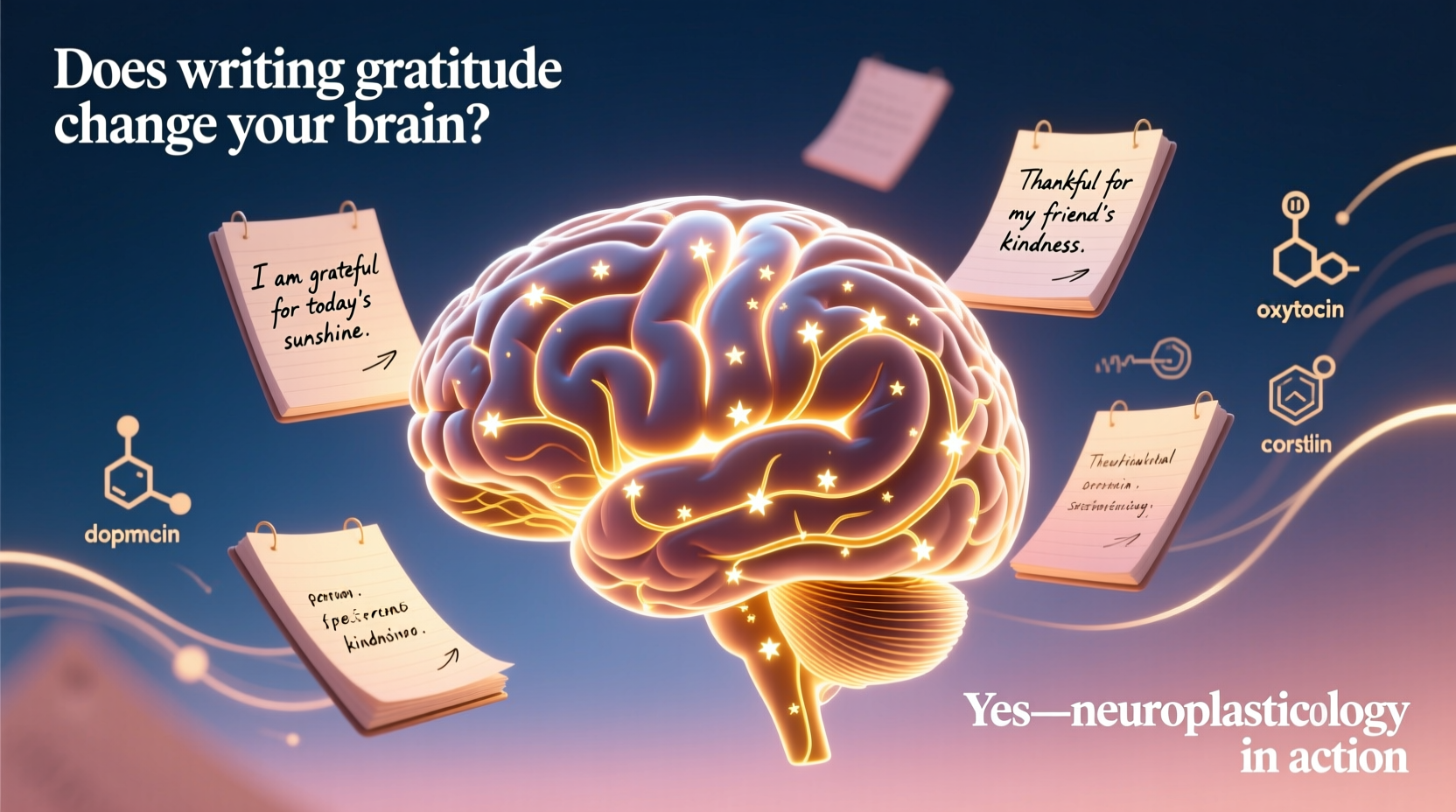
Gratitude is more than a social nicety—it’s a cognitive and emotional process that activates specific areas of the brain. Functional MRI studies have shown that when people engage in gratitude exercises, two key regions light up: the prefrontal cortex and the anterior cingulate cortex. These areas are involved in decision-making, emotional regulation, moral reasoning, and reward processing.
A landmark 2015 study published in NeuroImage found that participants who completed a gratitude intervention showed increased neural sensitivity in the medial prefrontal cortex—three months after the exercise ended. This suggests that gratitude doesn’t just produce a fleeting emotional response; it creates lasting changes in brain function.
One reason lies in neurotransmitter activity. Expressing gratitude triggers the release of dopamine and serotonin—the brain’s “feel-good” chemicals. Dopamine reinforces rewarding behaviors by making us want to repeat them, while serotonin stabilizes mood and reduces anxiety. Writing down what you’re grateful for turns a passive feeling into an active behavior, amplifying this neurochemical effect.
“Gratitude journaling is a form of cognitive training. Over time, it retrains the brain to scan for positives rather than threats.” — Dr. Alex Korb, Neuroscientist and author of *The Upward Spiral*
How Writing Enhances the Brain’s Response
You might think that mentally acknowledging gratitude would be enough. But research shows that the physical act of writing intensifies the impact. Why? Because writing engages multiple brain systems simultaneously: motor control, language processing, and memory encoding.
When you write by hand, you activate the reticular activating system (RAS), a network in the brainstem that filters incoming information based on relevance. By putting pen to paper, you signal to your brain that this thought matters. This increases retention and emotional salience. In contrast, simply thinking about gratitude is less likely to leave a lasting imprint.
Additionally, writing forces specificity. Instead of vaguely feeling “happy,” you must articulate *why*—e.g., “I’m grateful my coworker brought me coffee today.” That detail strengthens memory traces and deepens emotional resonance, further boosting dopamine release.
Tip: Use a dedicated notebook for your gratitude journal. The tactile experience enhances mindfulness and signals intentionality to your brain.Structural Brain Changes from Regular Practice
Just as physical exercise reshapes muscle tissue, consistent gratitude journaling reshapes the brain. Longitudinal studies indicate that people who practice gratitude daily for 8–12 weeks show measurable differences in gray matter density and functional connectivity.
For example, a 2016 study from Indiana University followed participants through a six-week gratitude letter-writing program. Those who continued journaling showed improved connectivity between the prefrontal cortex and the ventral tegmental area (VTA)—a core hub of the brain’s reward circuitry. Stronger connectivity here correlates with greater resilience to depression and anxiety.
Moreover, gratitude reduces activity in the amygdala, the brain region responsible for fear and threat detection. Over time, this can lead to lower baseline cortisol levels—a biomarker of chronic stress. One study found that individuals who journaled gratitude nightly had 10–15% lower cortisol compared to controls after just three weeks.
| Brain Region | Function | Effect of Gratitude Journaling |
|---|---|---|
| Prefrontal Cortex | Decision-making, emotional regulation | Increased activity and gray matter density |
| Ventral Tegmental Area (VTA) | Dopamine production, reward processing | Enhanced connectivity with prefrontal cortex |
| Amygdala | Stress, fear response | Reduced activation and reactivity |
| Hippocampus | Memory consolidation | Improved encoding of positive experiences |
A Step-by-Step Guide to Rewire Your Brain Through Journaling
To harness these neurological benefits, structure matters. Random notes won’t yield the same results as a deliberate, consistent practice. Follow this science-backed timeline to build a transformative routine:
- Week 1: Establish the Habit
Choose a quiet time—morning or before bed—and write three specific things you’re grateful for. Be concrete: not “I’m grateful for my family,” but “I’m grateful my daughter hugged me after school.” - Week 2–3: Add Emotional Depth
For each item, write one sentence about how it made you feel. Example: “Her hug reminded me I’m loved, which eased my work stress.” This deepens emotional processing and strengthens neural encoding. - Week 4–6: Reflect and Expand
Once a week, reread past entries. Notice patterns. Did small moments bring more joy than big events? This reflection activates the default mode network, integrating gratitude into your self-narrative. - Week 7+: Introduce Challenges
On difficult days, write one thing you’re grateful for *despite* the struggle. Example: “Even though I failed the presentation, I’m grateful my colleague offered feedback.” This builds cognitive flexibility and resilience.
Real Impact: A Mini Case Study
Sarah, a 38-year-old project manager, began gratitude journaling after being diagnosed with mild anxiety. Initially skeptical, she committed to five minutes each night. For the first week, her entries were generic: “good weather,” “had dinner with friends.”
By week three, she started noticing subtle shifts. She wrote: “I’m grateful my boss acknowledged my report. It felt validating after weeks of silence.” This awareness led her to reflect on how rarely she recognized her own achievements.
After eight weeks, Sarah reported better sleep, reduced rumination, and increased motivation. Her therapist noted improved emotional regulation during sessions. An optional follow-up saliva test (measuring cortisol) showed a 12% decrease in stress markers. While not a clinical trial, Sarah’s experience mirrors findings from larger studies: structured gratitude practice leads to tangible psychological and physiological improvements.
Best Practices Checklist
- ✅ Write at the same time daily to reinforce habit formation
- ✅ Focus on specifics, not generalities
- ✅ Include sensory details (what you saw, heard, felt)
- ✅ Limit entries to 3–5 items to maintain quality over quantity
- ✅ Revisit old entries monthly to reinforce positive memory networks
- ✅ Combine with deep breathing for enhanced parasympathetic activation
Common Misconceptions About Gratitude Journaling
Despite growing evidence, myths persist. Some believe gratitude journaling is only for people already happy, or that it encourages toxic positivity. Neither is true.
Gratitude isn’t about denying pain. It’s about balancing your brain’s natural negativity bias—the tendency to focus on threats and problems. Our brains evolved to prioritize danger for survival, but in modern life, this bias often leads to chronic stress. Gratitude acts as a counterweight, not a replacement.
Another myth: more entries equal better results. Research shows diminishing returns beyond 5–7 items per session. The quality of reflection matters far more than volume. A single deeply felt entry can trigger stronger neurochemical responses than a list of ten shallow ones.
“Gratitude doesn’t erase suffering. It expands your emotional bandwidth so you can hold both pain and appreciation at once.” — Dr. Kristin Neff, researcher in self-compassion and mindfulness
FAQ
Can gratitude journaling help with depression?
While not a substitute for therapy or medication, gratitude journaling has been shown to reduce symptoms of mild to moderate depression. Studies indicate it increases activity in brain regions linked to emotional regulation and decreases rumination. However, those with clinical depression should use it as a complementary practice under professional guidance.
Is typing as effective as handwriting?
Handwriting generally produces stronger cognitive and emotional engagement due to slower processing and motor involvement. Typing can still be beneficial, especially for those with physical limitations, but may lack the full neurocognitive integration of pen-and-paper journaling.
What if I don’t feel grateful when I write?
That’s normal. Emotions often follow action, not the other way around. The act of writing—even mechanically at first—can initiate a feedback loop that gradually shifts your internal state. Think of it as mental strength training: consistency builds capacity over time.
Conclusion: Rewriting Your Brain, One Sentence at a Time
Gratitude journaling is not magic. It’s neuroscience in motion. By writing down what you appreciate, you’re not just recording moments—you’re rewiring your brain’s default settings. You’re strengthening circuits that promote calm, connection, and clarity, while weakening those tied to stress and scarcity.
The beauty lies in its simplicity. No app, subscription, or equipment is needed. Just a notebook and the willingness to pause, reflect, and commit thoughts to paper. Over weeks and months, this small ritual compounds into profound shifts: not just in how you feel, but in how your brain functions at a biological level.
🚀 Start tonight. Write three things you’re grateful for. Don’t wait for motivation—create it. Your brain will begin changing before you even notice. Share your journey in the comments and inspire others to pick up a pen.








