
In an age where productivity is currency, people are increasingly turning to nootropics—substances marketed to enhance memory, attention, and mental clarity. From college students cramming for exams to executives chasing peak performance, the allure of a cognitive edge is powerful. But beneath the glossy claims and anecdotal success stories lies a critical question: can you really boost your focus with nootropics, or is most of what we experience just a placebo effect?
The answer isn’t simple. While some compounds show measurable neurochemical activity, others rely heavily on expectation and belief. The line between pharmacology and psychology in this space is often blurred. To understand what’s real and what’s imagined, we need to look at clinical evidence, user experiences, and the mechanisms by which these substances interact with the brain.
What Are Nootropics, Really?
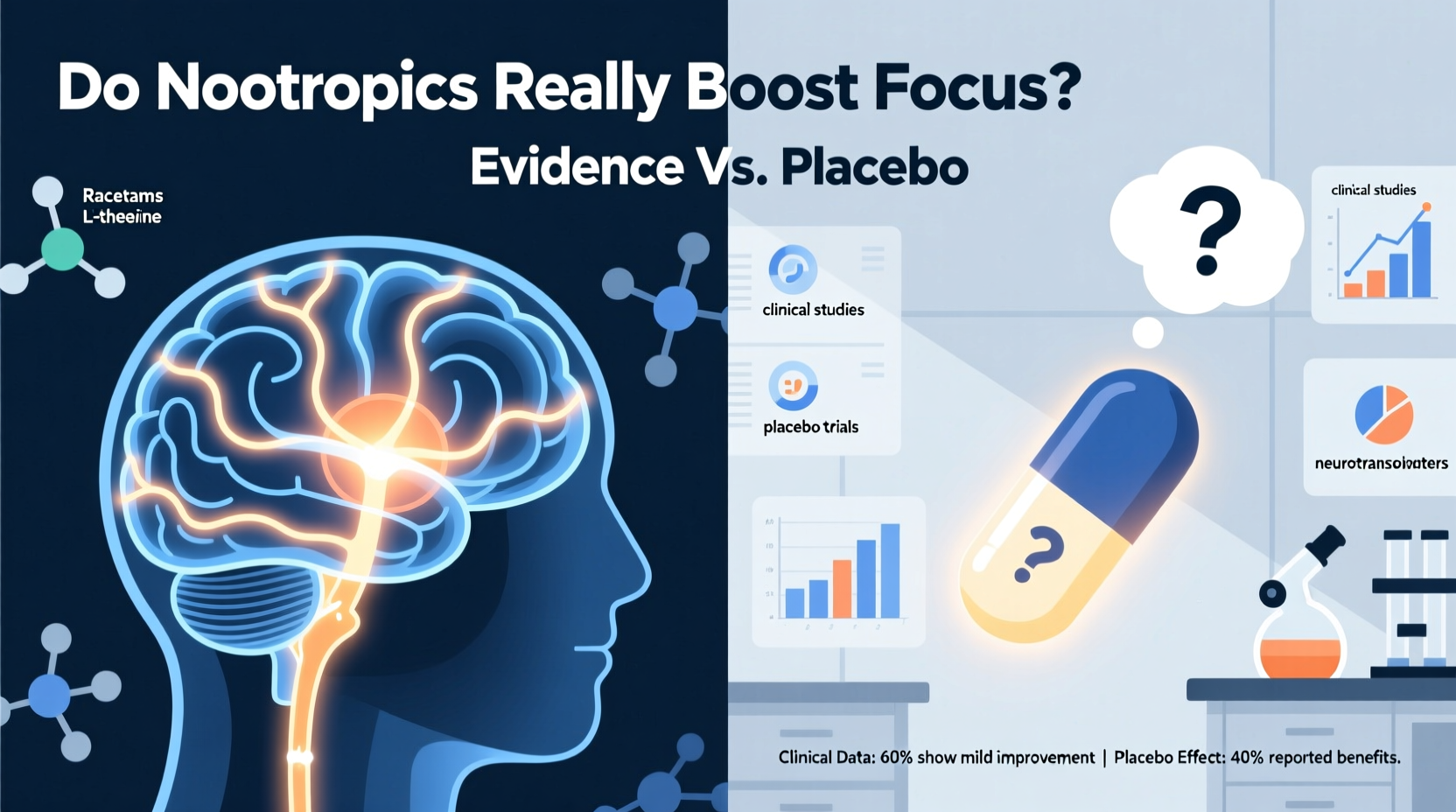
The term “nootropic” was coined in 1972 by Romanian chemist Corneliu Giurgea, who defined them as substances that enhance learning and memory while being non-toxic and having minimal side effects. Originally, this applied only to specific synthetic compounds like piracetam. Today, the definition has broadened to include everything from prescription stimulants to herbal extracts and even common nutrients.
Nootropics fall into three main categories:
- Synthetic racetams: Piracetam, aniracetam, oxiracetam—these modulate neurotransmitter systems like acetylcholine and glutamate.
- Natural supplements: Bacopa monnieri, rhodiola rosea, lion’s mane mushroom—often used in traditional medicine and now studied for cognitive benefits.
- Pharmaceuticals: Modafinil, Adderall, Ritalin—prescription drugs repurposed off-label for focus enhancement.
Each group operates differently. Some alter brain chemistry directly; others support long-term brain health through antioxidant or anti-inflammatory pathways. Understanding these differences is key to separating genuine cognitive gains from perceived improvements driven by expectation.
The Science Behind Cognitive Enhancement
Several well-studied nootropics have demonstrated measurable effects in controlled trials. For example:
- Modafinil: A wakefulness-promoting agent approved for narcolepsy, studies show it improves executive function, working memory, and attention in healthy adults, particularly under sleep-deprived conditions.
- Bacopa monnieri: Multiple randomized trials suggest it enhances memory consolidation after several weeks of use, likely due to bacoside-induced neuroprotection and synaptic modulation.
- L-theanine + caffeine: This combination, commonly found in tea, has been shown to improve alertness while reducing jitteriness—a synergistic effect supported by EEG data showing increased alpha wave activity.
However, not all results are consistent. Many studies suffer from small sample sizes, short durations, or lack of replication. Moreover, individual variability plays a significant role. One person may report laser-like focus on a racetam stack, while another notices nothing—or feels anxious and unfocused.
“Nootropics aren't magic pills. Their efficacy depends on baseline cognition, dosage, timing, and even gut microbiota.” — Dr. Elena Torres, Cognitive Neuroscientist, University of Cambridge
Placebo Power: How Belief Shapes Brain Performance
The placebo effect is more than just “feeling better because you think you should.” It involves real neurobiological changes. Expectation can trigger dopamine release in the prefrontal cortex—the same region involved in motivation and attention. In one study, participants given a sugar pill labeled as a “cognitive enhancer” performed significantly better on attention tasks than those who received no intervention.
This raises a provocative idea: if believing you’ve taken a smart drug improves your focus, does it matter whether the substance is pharmacologically active?
Possibly not—for some users. But there's a crucial distinction: placebo effects tend to be short-lived and context-dependent. They work best when novelty is high and expectations are strong. Over time, as the initial excitement fades, so too can the perceived benefit—unless the compound has actual physiological activity.
A 2020 double-blind trial tested this directly. Researchers gave participants either a popular over-the-counter nootropic blend or a placebo, but told half of each group they were receiving the real product. Those who believed they were taking the active supplement reported higher focus—even when they weren’t. However, only the group that actually consumed the active ingredients showed improved performance on objective neuropsychological tests.
Tip: If you're testing a new nootropic, run a self-blinded trial using identical capsules filled with starch to see if effects persist beyond expectation.Real-World Example: Alex’s Experiment with Modafinil
Alex, a 32-year-old software developer in Berlin, began using modafinil during crunch periods at work. He started with 100 mg every other day, tracking his focus levels, task completion, and mood using a journal and a Pomodoro timer.
For the first two weeks, the results were striking. He completed coding sprints 40% faster, stayed engaged during long debugging sessions, and felt mentally sharper. But by week four, the effects diminished. He still felt more awake, but the sense of “effortless concentration” had faded.
Curious, he took a two-week break and reintroduced the drug. This time, the boost returned—but only partially. When he compared his logs to days when he used structured work techniques (like time-blocking and distraction-free environments), he realized that environmental factors accounted for nearly as much productivity gain as the drug itself.
His takeaway? “Modafinil helped me break through mental fatigue, but it didn’t make me smarter. It just made me willing to push harder. And eventually, my brain adapted.”
Comparing Common Focus-Boosting Options
| Substance | Onset Time | Duration | Evidence Level | Risk of Dependence |
|---|---|---|---|---|
| Caffeine | 15–45 min | 3–5 hrs | High | Low–Moderate |
| L-theanine | 30–60 min | 4–6 hrs | Moderate | Negligible |
| Modafinil | 60–90 min | 10–12 hrs | High | Low |
| Adderall | 30–60 min | 4–6 hrs | High | High |
| Bacopa monnieri | 4–6 weeks | Ongoing | Moderate | Negligible |
| Piracetam | 60+ min | 6–8 hrs | Low–Moderate | Negligible |
This comparison highlights a key insight: immediate-acting stimulants offer fast results but come with tolerance and crash risks. Slower-acting adaptogens may lack dramatic immediacy but contribute to sustained cognitive resilience.
How to Evaluate a Nootropic Honestly
Determining whether a nootropic works—or whether its effects are psychological—requires discipline. Here’s a step-by-step method:
- Define your goal: Is it sustained attention? Faster processing? Reduced mental fatigue? Be specific.
- Choose one compound: Avoid stacks initially. Test single ingredients to isolate effects.
- Establish a baseline: Track focus using objective metrics—task completion time, error rates, or digital tools like attention-monitoring apps.
- Blind your test: Use identical capsules (one active, one placebo) rotated randomly over 4-week cycles.
- Log daily outcomes: Record subjective feelings (clarity, energy) alongside objective performance.
- Review after 4 weeks: Look for patterns. Did performance improve consistently on active days?
This approach minimizes bias and helps distinguish real neurochemical effects from wishful thinking.
Common Pitfalls and Misconceptions
Many people misunderstand how nootropics work. Here are frequent errors:
- Stack overload: Combining too many compounds masks individual effects and increases side effect risk.
- Expecting instant miracles: Most natural nootropics require weeks to build up in the system.
- Ignoring lifestyle foundations: Sleep, diet, exercise, and stress management are far more impactful than any supplement.
- Overestimating safety: Just because something is “natural” doesn’t mean it’s harmless. St. John’s Wort, for instance, interferes with dozens of medications.
Checklist: Responsible Nootropic Use
Before trying any cognitive enhancer, consider this checklist:
- ✅ Consult a healthcare provider, especially if you have medical conditions or take medications.
- ✅ Research the compound thoroughly—look for peer-reviewed studies, not influencer testimonials.
- ✅ Buy from reputable suppliers with third-party lab testing.
- ✅ Begin with a single ingredient, not a proprietary blend.
- ✅ Track both subjective and objective outcomes for at least 3–4 weeks.
- ✅ Take regular breaks to assess dependency or diminishing returns.
- ✅ Prioritize foundational habits: sleep quality, hydration, physical activity, and mindfulness.
Frequently Asked Questions
Are nootropics safe for long-term use?
Safety varies widely by substance. Compounds like creatine and bacopa have been studied for months with few adverse effects. Others, like unregulated synthetic stimulants, lack long-term safety data. Always research chronic use implications and cycle usage when possible.
Can nootropics replace good sleep or focus habits?
No. No supplement can compensate for chronic sleep deprivation or poor work routines. At best, nootropics are tools to optimize an already healthy foundation—not substitutes for it.
Is the placebo effect valid if it works?
If believing in a treatment improves performance, that’s still a real outcome—just not one tied to biochemistry. However, relying solely on placebo leaves gains unstable and vulnerable to doubt. Sustainable improvement requires both mindset and physiology.
Conclusion: Clarity Beyond the Hype
The truth about nootropics isn’t binary. They aren’t miracle brain boosters, nor are they entirely placebo. Some compounds do enhance focus through measurable biological pathways. Others succeed primarily because we believe they will. The most effective approach combines scientific rigor with self-awareness.
Focus isn’t something you can simply buy. It’s cultivated through consistency, environment, and intention. Nootropics may offer a temporary lift, but lasting mental clarity comes from aligning your habits, health, and goals. If you choose to explore cognitive enhancers, do so thoughtfully—test objectively, respect your biology, and never lose sight of the bigger picture.
🚀 Ready to take control of your focus? Start by auditing your current routine—sleep, screen time, stress—and introduce one change at a time. Share your journey or ask questions in the comments below.








