Spills happen. A glass of Cabernet tips over during a dinner party. A bottle of rubbing alcohol knocks over in the studio. What follows is often panic—then resignation. But what if that moment wasn’t an accident to erase, but a prompt to reimagine? Alcohol ink art and wine staining sit at opposite ends of the intention spectrum: one is a precise, solvent-based medium honed by professional artists; the other is an organic, unpredictable reaction rooted in chemistry and chance. Yet both rely on pigment migration through porous surfaces—and both offer legitimate, teachable pathways to expressive mark-making. This isn’t about salvaging stained tablecloths. It’s about recognizing that control and surrender aren’t opposites—they’re complementary tools in the creative process.
The Chemistry Behind the Color: Why Alcohol Ink and Wine Behave So Differently
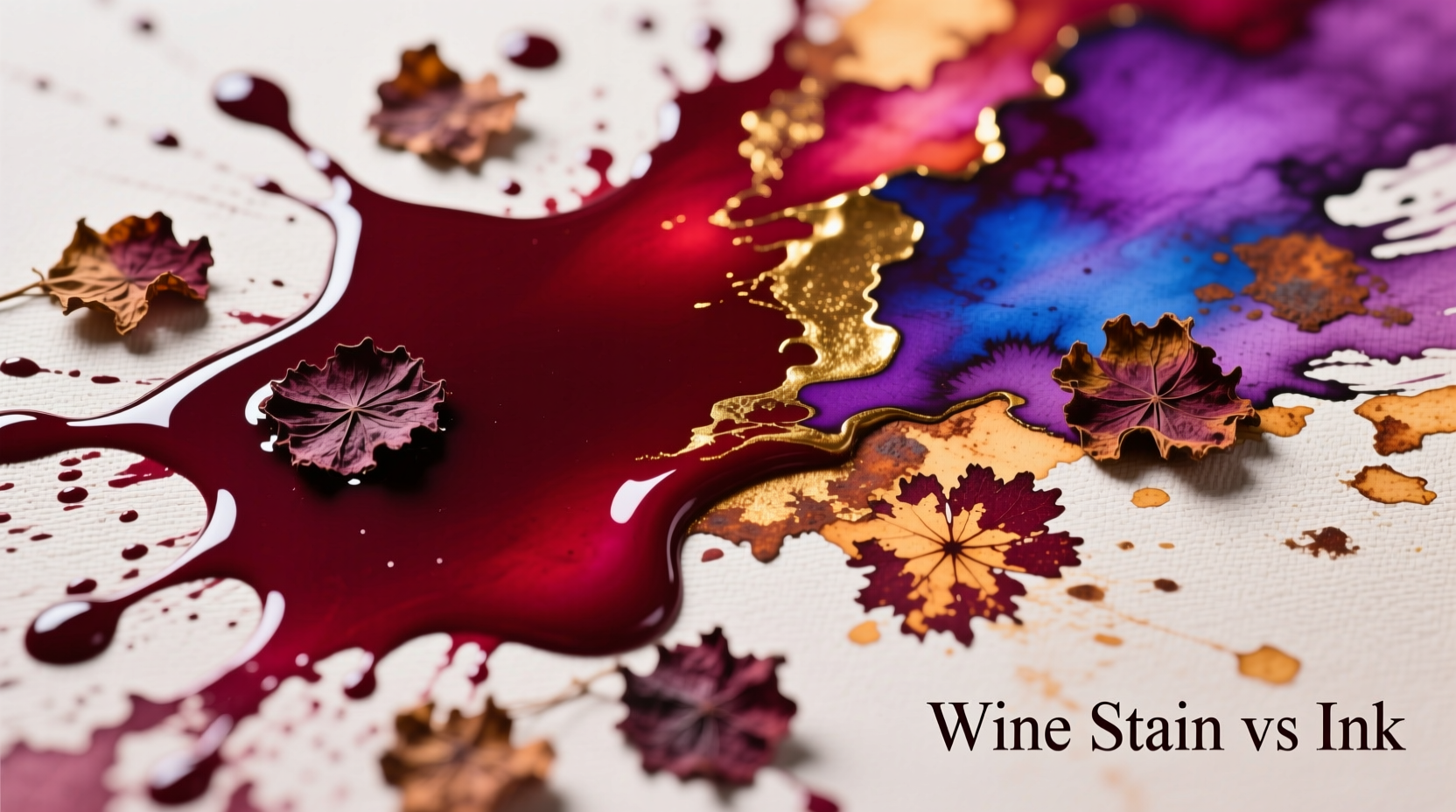
At their core, both substances deliver pigment to a surface—but their vehicles (the liquids carrying color) dictate everything: speed, spread, permanence, and response to manipulation. Alcohol inks use isopropyl alcohol or ethanol as a carrier solvent. This volatile liquid evaporates rapidly—often within seconds—leaving behind highly concentrated dye-based pigments that bond weakly to non-porous surfaces like Yupo paper, ceramic, or glass. Because the solvent dries so fast, artists exploit its behavior: they tilt panels, blow air, drop blending solution (90% isopropyl alcohol), or layer inks while still wet to create fluid gradients and cellular textures.
Wine, by contrast, is a complex aqueous solution—roughly 85–90% water, with ethanol (12–15%), acids (tartaric, malic), tannins, sugars, and anthocyanin pigments (responsible for red-purple hues). When spilled onto absorbent substrates like untreated cotton, watercolor paper, or raw wood, the water component migrates first, carrying soluble pigments outward in a characteristic “coffee-ring effect.” Tannins react with iron in tap water or metal fixtures, sometimes yielding grayish or bluish halos. Unlike alcohol inks, wine’s drying time spans minutes to hours—and its final appearance depends heavily on pH, mineral content, fabric weave, and ambient humidity.
Tip: Never use wine directly on archival paper or fine textiles unless you’ve pre-tested for bleeding, acidity damage, or irreversible tannin oxidation. Always blot—not rub—to minimize fiber disruption.Intentional Use Cases: From Studio Practice to Domestic Experimentation
Alcohol ink art thrives in controlled environments where repeatability matters. Artists use it for greeting cards, resin coasters, ceramic tile murals, and mixed-media backgrounds. Its predictability—when paired with proper substrates and ventilation—makes it scalable and commercially viable. Wine staining, however, finds its strength in context-driven, one-off interventions: documenting seasonal harvests on handmade paper, creating ephemeral wall installations in vineyard galleries, or transforming thrifted linens into heirloom napkins marked by shared meals.
One compelling intersection lies in *hybrid techniques*. Some contemporary textile artists soak silk scarves in diluted red wine, then apply heat-set alcohol inks over select areas—using the wine’s natural mordant properties to anchor certain pigments while allowing others to float freely. The result is layered depth no single medium could achieve alone.
Practical Comparison: Alcohol Ink Art vs. Wine Staining
| Factor | Alcohol Ink Art | Wine Staining |
|---|---|---|
| Primary Carrier | Isopropyl or ethyl alcohol (volatile, fast-evaporating) | Water + ethanol + organic acids (slow-drying, reactive) |
| Pigment Type | Synthetic dyes (brilliant, lightfastness varies) | Natural anthocyanins (pH-sensitive, fade over months without UV protection) |
| Substrate Preference | Non-porous: Yupo, ceramic, glass, sealed metal | Absorbent: Cotton, linen, watercolor paper, unsealed wood |
| Control Level | High (with practice): directional flow, layering, lifting | Low-to-moderate: responsive to tilt, blotting, pH shifts, but inherently capillary-driven |
| Safety & Ventilation | Mandatory: fumes are flammable and respiratory irritants; use respirator and airflow | Minimal: food-grade, non-toxic, no special ventilation needed |
| Archival Stability | Variable: many dyes fade under UV; sealing required for longevity | Poor without intervention: anthocyanins degrade with light, alkalinity, and oxygen exposure |
Mini Case Study: The Vineyard Residency Project
In 2022, interdisciplinary artist Lena Ruiz was invited to a three-week residency at Sonoma’s Dry Creek Valley. Her brief: interpret terroir through material transformation. Rather than photograph vines or paint landscapes, she collected daily wine samples from six varietals—Zinfandel, Syrah, Pinot Noir, Sangiovese, Nebbiolo, and Tempranillo—each at different stages of fermentation. She applied them to handmade abaca paper, varying pH with baking soda (alkaline) and lemon juice (acidic) washes before and after application. The resulting series, Vinum Chroma, revealed dramatic hue shifts: Pinot Noir turned violet in alkaline zones and brick-red in acidic ones; Nebbiolo bloomed into deep plum only when layered over a base of dried grape must. Ruiz didn’t “fix” the stains—she documented their evolution over seven days using time-lapse photography and micro-sampling. Her work demonstrated that wine staining isn’t passive residue—it’s a slow-motion chemical dialogue between plant chemistry and substrate biology.
“Wine isn’t just pigment—it’s a living archive of soil, sun, and human decision. When we treat it as a medium rather than a mistake, we stop erasing evidence and start reading it.” — Dr. Aris Thorne, Enologist & Material Historian, UC Davis Department of Viticulture
Step-by-Step Guide: Turning a Wine Spill into a Documented Art Piece
- Assess & Contain: Immediately place clean, absorbent paper towels beneath and atop the spill. Do not scrub—lift gently to draw liquid upward.
- Record Baseline: Photograph the stain at 0, 5, and 30 minutes. Note ambient temperature, humidity, and substrate type (e.g., “organic cotton napkin, room temp 22°C, RH 48%”).
- Introduce Variable: Apply one controlled intervention: a drop of vinegar (acid), baking soda paste (alkaline), salt crystals (to disrupt capillary flow), or a hairdryer on cool (to accelerate edge formation).
- Observe & Map: Sketch the stain’s expansion every 15 minutes for 2 hours. Label zones: “halo,” “core,” “feathering,” “crystallization.”
- Stabilize (Optional): Once fully dry (24–48 hrs), spray lightly with dilute alum solution (1 tsp alum per cup distilled water) to partially fix anthocyanins—or accept its ephemerality as part of the work.
- Contextualize: Mount the stained fabric or paper on acid-free board. Add a small plaque noting vintage, varietal, date, and intervention. This transforms accident into artifact.
FAQ: Addressing Real Concerns
Can I mix alcohol inks with wine?
No—alcohol inks are hydrophobic and will bead up or repel on aqueous wine solutions. More critically, combining solvents unpredictably increases VOC emissions and may produce unstable compounds. If layering, always let wine dry completely (minimum 48 hours) before applying alcohol ink—and do so in a ventilated space with appropriate PPE.
Why does my wine stain turn brown instead of purple?
Browning signals oxidation of anthocyanins, accelerated by exposure to air, light, or alkaline conditions (e.g., hard water, baking soda). It’s not a flaw—it’s a predictable stage in the pigment’s life cycle. To preserve red tones longer, store stained works in dark, low-oxygen environments and avoid framing under UV glass.
Are alcohol inks safe for children or home use?
Not without strict safeguards. Isopropyl alcohol fumes can cause dizziness, headaches, and respiratory irritation, especially in poorly ventilated rooms. The CDC advises against unsupervised use by minors and recommends using alcohol inks only in dedicated studios with exhaust fans or open windows. For family-friendly alternatives, consider water-based inks or food-grade beetroot powder suspensions.
What You Can Control—and What You Must Release
Alcohol ink art teaches discipline: timing, substrate prep, solvent ratios, and tool calibration. Mastery comes from repetition and data tracking—measuring droplet size, recording drying times across temperatures, logging brand-specific pigment lift rates. Wine staining teaches humility: it asks us to observe, document, and respond—not command. A spilled Merlot on your grandmother’s tablecloth isn’t ruined; it’s a timestamp, a pH map, a record of that evening’s humidity and the iron content of your faucet water. The most compelling creative work today doesn’t choose between control and chaos. It designs frameworks where both operate in concert—like setting parameters for a wine stain (substrate, pre-treatment, drying method) while leaving room for the liquid’s innate intelligence to express itself.
This duality extends beyond the studio. In an era obsessed with optimization and instant results, embracing wine staining is quietly radical. It affirms that meaning emerges not only from execution, but from attention to consequence—how a substance interacts, changes, and settles. Alcohol ink gives us velocity; wine gives us duration. One helps us make marks quickly; the other teaches us how to witness them deepen.
💬 Your spill is already speaking. Are you listening? Try one intentional wine stain this week—document it, name it, and share your observation in the comments. Let’s build a collective archive of beautiful accidents.








