Many people reach for a glass of wine or a small whiskey after a stressful day—not to celebrate, but to quiet the static in their minds. The ritual feels comforting, familiar, even rational: “It helps me unwind.” Yet clinical psychologists and neuroscientists observe a consistent paradox: while alcohol may blunt anxiety in the moment, it reliably intensifies it within hours—and over time, rewires the brain’s stress response in ways that deepen vulnerability. This isn’t about moral judgment or abstinence dogma. It’s about understanding a well-documented neurobiological cascade—one that explains why 40% of individuals with generalized anxiety disorder also meet criteria for alcohol use disorder (National Institute on Alcohol Abuse and Alcoholism, 2023). What psychology reveals is not just correlation, but causation rooted in GABA modulation, cortisol dysregulation, and sleep architecture disruption.
The Immediate Relief Illusion: How Alcohol Hijacks Calm
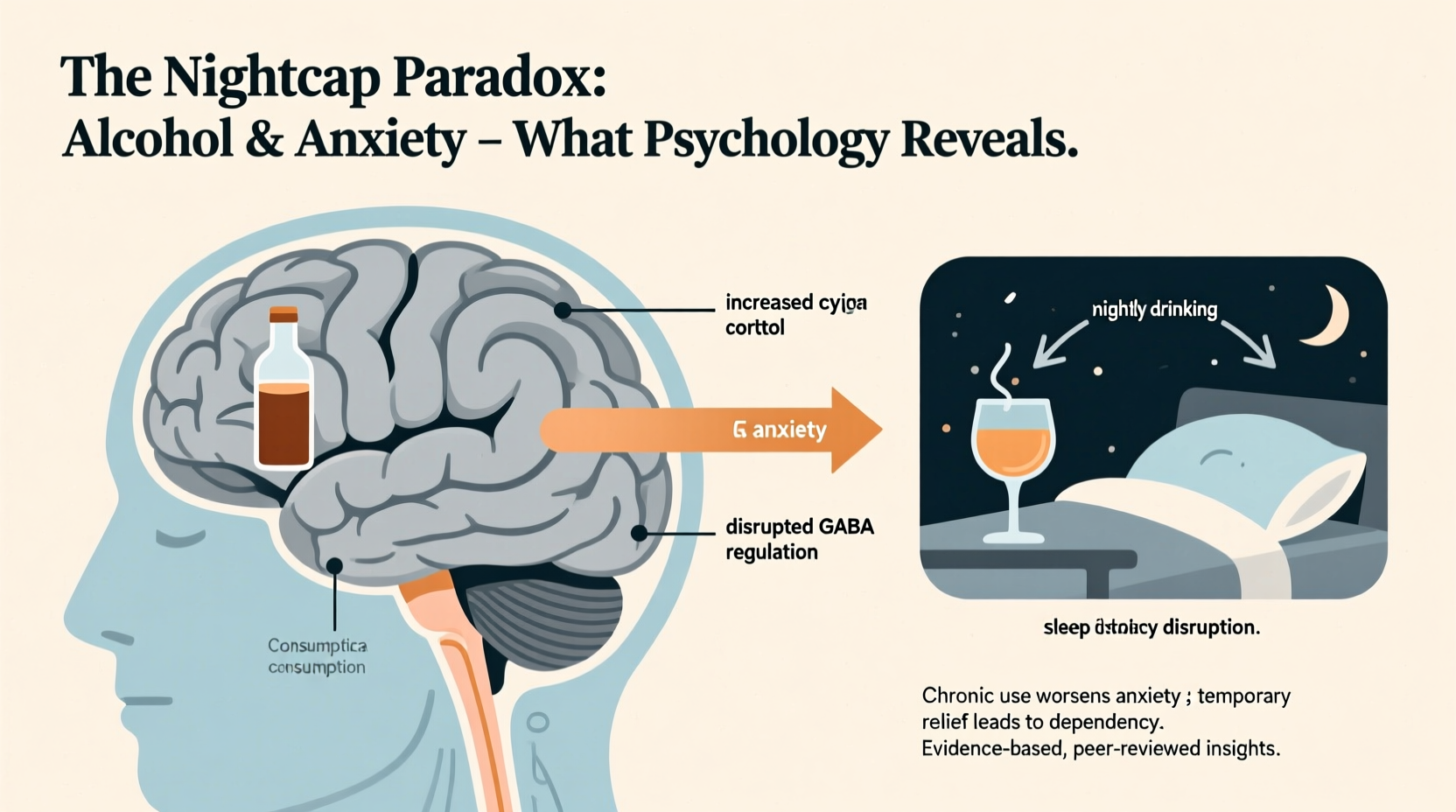
Alcohol enhances the effect of gamma-aminobutyric acid (GABA), the brain’s primary inhibitory neurotransmitter. In low-to-moderate doses, this produces sedation, slowed reaction time, and subjective relaxation—especially in the prefrontal cortex, where worry loops originate. That initial dip in mental chatter feels like relief. But unlike targeted anxiolytics (e.g., benzodiazepines, which are prescribed cautiously for short-term use), alcohol lacks selectivity. It simultaneously suppresses glutamate—the brain’s main excitatory neurotransmitter—while disrupting serotonin, dopamine, and norepinephrine systems. The result? A broad-spectrum neural dampening that masks symptoms without resolving underlying triggers.
This masking creates a behavioral trap. When someone repeatedly uses alcohol to downregulate acute anxiety—before meetings, after arguments, or as a nightly wind-down—they reinforce a learned association: “Alcohol = safety.” Psychology calls this negative reinforcement: removing an aversive state (anxiety) increases the likelihood of repeating the behavior. Over time, the brain begins to expect alcohol as the default coping mechanism, weakening natural resilience pathways like diaphragmatic breathing, cognitive reframing, or interoceptive awareness.
Tip: Track your “anxiety-alcohol lag”: Note how anxious you feel 3–5 hours after your last drink—and again upon waking. Most people discover their lowest baseline anxiety occurs on nights they abstain.The Rebound Effect: Why Anxiety Returns Stronger
Within 4–6 hours of drinking, as blood alcohol concentration declines, the brain initiates a compensatory surge in glutamate activity and norepinephrine release. This rebound hyperarousal is clinically measurable: heart rate increases by 12–18 bpm, skin conductance rises, and cortisol levels spike—often peaking between 2 a.m. and 4 a.m. For those already prone to anxiety, this physiological surge can trigger full-blown nocturnal panic attacks or early-morning dread with no apparent cause.
Sleep architecture compounds the problem. Alcohol fragments REM sleep—the stage critical for emotional memory processing and fear extinction. One study published in Alcoholism: Clinical and Experimental Research (2022) found that even one standard drink reduced REM duration by 22% and increased nighttime awakenings by 37%. Without restorative REM, the amygdala remains hypersensitive the next day, lowering the threshold for threat perception. A neutral email subject line (��Quick follow-up”) may register as ominous; background noise becomes intrusive. This isn’t “just tiredness”—it’s neurobiological priming for anxiety.
“People don’t realize their morning anxiety isn’t ‘just stress’—it’s often the direct neurochemical aftermath of last night’s drink. We see this daily in our clinic: patients who cut out alcohol for two weeks report not only better sleep, but a measurable reduction in anticipatory worry and physical tension.” — Dr. Lena Torres, Clinical Neuropsychologist, Stanford Anxiety Disorders Program
The Tolerance Trap: When ‘One Drink’ Stops Working
Chronic alcohol use triggers adaptive changes in GABA-A receptor subunits—specifically, a downregulation of α2 and α3 subtypes linked to anxiolysis. Simultaneously, NMDA glutamate receptors become upregulated. The net effect? Diminished calming response to alcohol and heightened baseline excitability. What began as “one glass of wine” to relax now requires two—or three—to achieve the same effect. Meanwhile, the brain’s natural GABA production decreases, and its ability to self-regulate stress without external chemical input erodes.
This tolerance shift has real-world consequences. A person who once felt calm after a single drink may, after six months of nightly use, experience significant anxiety *during* consumption—alongside irritability, restlessness, and insomnia. They misinterpret these symptoms as “stress worsening,” when in fact they reflect emerging neuroadaptation. At this stage, skipping the nightcap can provoke mild withdrawal: shakiness, nausea, racing thoughts—symptoms easily mistaken for anxiety itself.
| Stage | Neurochemical Change | Subjective Experience | Timeframe |
|---|---|---|---|
| Initial Use | GABA enhancement; glutamate suppression | Relaxation, lowered inhibition, mental quiet | 0–2 hrs post-consumption |
| Early Rebound | Glutamate surge; norepinephrine spike; REM suppression | Midnight wakefulness, heart palpitations, dread | 4–8 hrs post-consumption |
| Chronic Adaptation | GABA receptor downregulation; NMDA upregulation | Need for more alcohol to feel calm; daytime jitteriness | Weeks to months of regular use |
| Withdrawal Sensitivity | Hyperexcitable neural state; HPA axis dysregulation | Anxiety spikes without alcohol; sleep fragmentation even after cessation | Days to weeks after stopping |
A Real-World Pattern: Sarah’s Nightcap Cycle
Sarah, 34, a project manager, began using a 5-ounce glass of pinot noir most evenings in her second year of remote work. Her rationale was practical: “It helped me switch off from Slack notifications and stop replaying team conflicts.” Within three months, she noticed she needed the wine earlier—by 7:30 p.m.—and felt restless if she skipped it. By month six, she’d started waking at 3:15 a.m. with tight chest and catastrophic thoughts about deadlines. She attributed it to “burnout” and increased caffeine intake. Only after a routine blood test revealed elevated liver enzymes—and a candid conversation with her therapist—did she connect her 3 a.m. panic to the wine. With medical support, she tapered over 10 days, tracked symptoms daily, and discovered something unexpected: her baseline anxiety dropped 60% by day 14. More significantly, she regained the ability to sit with discomfort—pausing before replying to tense emails, noticing muscle tension without needing to medicate it.
Sarah’s experience mirrors findings from the 2021 Journal of Affective Disorders longitudinal study of 1,247 adults with mild-to-moderate anxiety: participants who eliminated alcohol for four weeks showed greater reductions in GAD-7 scores than those who continued moderate drinking—even when both groups engaged in identical CBT protocols. The takeaway wasn’t that alcohol “caused” anxiety, but that it actively interfered with the brain’s capacity to benefit from evidence-based interventions.
Actionable Alternatives: Rewiring Without Replacement
Replacing a nightcap isn’t about substitution—it’s about restoring agency. Neuroscience confirms that the brain’s prefrontal cortex regains regulatory strength within 72 hours of alcohol cessation. Leveraging that window with intentional, non-pharmacological practices yields durable results. Below is a step-by-step protocol grounded in behavioral activation and autonomic regulation research:
- Evening Wind-Down Ritual (Starts 90 min before bed): Dim lights, put devices in another room, and engage in 10 minutes of paced breathing (4-second inhale, 6-second exhale).
- Body Scan Integration (5 min): Lie supine, mentally scan from toes to scalp, noting sensations without judgment. If anxiety arises, label it (“tightness,” “heat,” “buzzing”)—this engages the prefrontal cortex and reduces amygdala reactivity.
- Worry Time Containment (If rumination persists): Set a timer for 7 minutes. Write every anxious thought verbatim. At the buzzer, close the notebook. This contains cognitive loops instead of reinforcing them.
- Morning Anchoring (First 10 minutes awake): Before checking your phone, name three sensory inputs you notice (e.g., cool pillow, distant birdcall, taste of toothpaste). This grounds attention in the present and counters anticipatory anxiety.
- Weekly Reflection (Sunday evening): Review your anxiety log. Identify one situation where you used a new tool instead of reaching for alcohol—and note the outcome.
Frequently Asked Questions
Does “moderate drinking” still affect anxiety if I don’t have an alcohol use disorder?
Yes. Even low-dose alcohol (≤1 drink/day for women, ≤2 for men) disrupts REM sleep and elevates next-day cortisol in susceptible individuals. A 2023 meta-analysis in Psychosomatic Medicine confirmed that anxiety sensitivity—the fear of anxiety-related sensations—increases linearly with weekly alcohol intake, regardless of diagnostic status.
What if I only drink during high-stress periods—like tax season or family visits?
Episodic use carries unique risk. Stress elevates baseline cortisol and sympathetic tone; adding alcohol creates a volatile neurochemical interaction. Research shows binge-pattern drinkers (≥4 drinks/occasion) are 3.2x more likely to develop panic disorder within 12 months than matched controls—particularly during recovery phases from acute stress.
Are there supplements or herbs that safely replace the nightcap effect?
No herb or supplement replicates alcohol’s GABA-enhancing effect without trade-offs. Valerian and kava carry FDA warnings for hepatotoxicity and sedation risks. Magnesium glycinate (200–400 mg) and L-theanine (100–200 mg) show modest support for relaxation—but only when paired with behavioral strategies. Relying on supplements alone reinforces the belief that anxiety must be “turned off,” rather than understood and regulated.
Conclusion: Reclaiming Your Neural Baseline
The nightcap habit persists because it works—until it doesn’t. Psychology doesn’t frame this as weakness or failure. It sees a perfectly logical, biologically reinforced strategy that eventually collides with human neurochemistry. The good news is that the brain is profoundly adaptable. Within days of pausing alcohol, GABA receptor sensitivity begins to normalize. Within weeks, sleep architecture improves, cortisol rhythms stabilize, and the prefrontal cortex regains its capacity to modulate emotional responses—not by suppressing them, but by contextualizing them. You don’t need to eliminate all uncertainty to reduce anxiety. You need to restore trust in your own nervous system’s ability to navigate it. Start tonight—not with deprivation, but with presence. Notice the weight of your body in the chair. Feel the air move in and out. Let the quiet that follows be enough.
💬 Your experience matters. Have you observed shifts in your anxiety after changing alcohol habits? Share one insight in the comments—your observation could help someone else recognize their own pattern.








