For decades, wine professionals relied on paper notebooks—dog-eared, wine-stained, and increasingly illegible. Today’s tasters face a different challenge: digital fragmentation. Dozens of apps promise “smart tasting notes,” but few deliver true sensory fidelity. Accuracy isn’t about flashy interfaces or AI-generated descriptors—it’s about structured vocabulary, calibrated sensory mapping, and validation against real-world reference standards. This article cuts through the marketing noise to identify what actually makes a wine tasting notes app *accurate*: how it captures, organizes, and refines flavor perception over time—not just in the moment, but across vintages, regions, and varietals.
Why “Most Accurate” Means More Than Just Flavor Tags
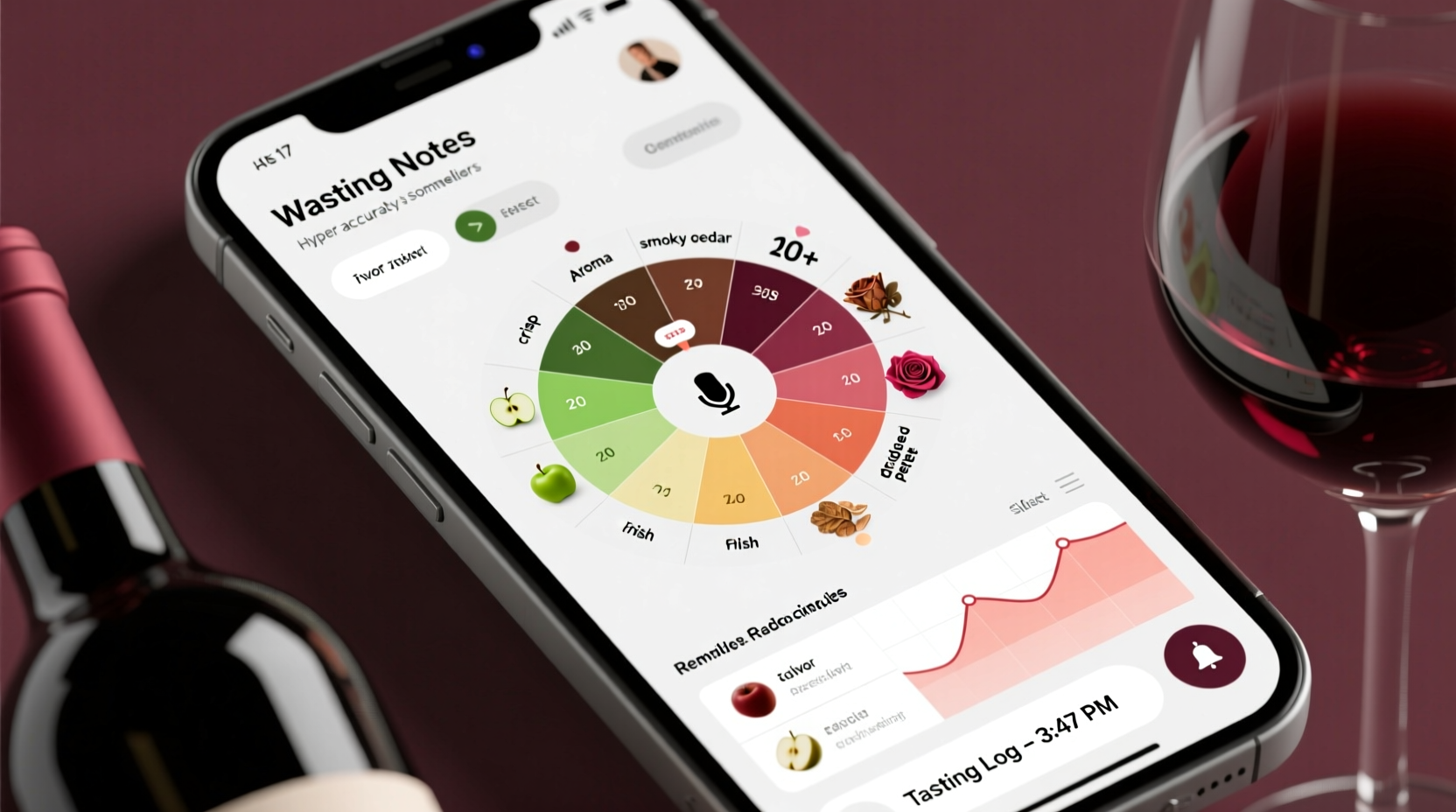
Many apps let you tap “blackberry,” “clove,” or “wet stone” with one click. That’s convenient—but convenience ≠ accuracy. True accuracy requires three interlocking layers: recognition precision, contextual calibration, and temporal consistency. Recognition precision means distinguishing between black currant (Cabernet Sauvignon) and black raspberry (Syrah), not lumping them under “red fruit.” Contextual calibration adjusts for variables like ambient temperature, glass shape, or even your own recent food intake—factors that demonstrably shift volatile compound perception. Temporal consistency ensures that “medium-plus acidity” logged today aligns with your own definition six months later—not an arbitrary algorithm’s interpretation.
Accuracy also hinges on minimizing cognitive bias. Studies from the University of Bordeaux show tasters consistently overrate wines when told they’re expensive—even when the bottles are identical. The best apps counter this by offering blind-tasting workflows, randomized sample order, and post-tasting reflection prompts (“Did your first impression change after 10 minutes?”). They don’t just record what you think—you record *how* you think.
Tip: Before logging a note, pause for 30 seconds after swirling. This resets olfactory fatigue and increases detection accuracy for subtle secondary aromas like dried herb or graphite.The Science Behind Flavor Mapping: How Top Apps Capture Nuance
Flavor isn’t a single sensation—it’s the convergence of retronasal olfaction (smell perceived through the back of the mouth), gustation (taste buds detecting sweet, sour, salty, bitter, umami), trigeminal response (heat, astringency, effervescence), and texture (viscosity, oiliness, grip). Leading apps treat each dimension separately, using validated scales rooted in OIV (International Organisation of Vine and Wine) and UC Davis sensory protocols.
Take acidity tracking: instead of a vague slider from “low” to “high,” top-tier apps use a 0–10 scale anchored to reference solutions (e.g., 0.6% tartaric acid = 5/10). For tannin structure, users select from tactile descriptors—“gritty,” “silky,” “chewy,” “dusty”—paired with intensity and persistence ratings. Aromas are mapped to the Wine Aroma Wheel (Ann C. Noble, UC Davis), ensuring terms like “petrol” (Riesling) aren’t conflated with “kerosene” (older Riesling) or “rubber” (faulty reduction).
This rigor matters because flavor perception is highly trainable. A 2022 study in Food Quality and Preference found tasters using structured, wheel-based apps improved inter-rater reliability by 42% over six months—compared to only 11% for free-text journalers. Structure doesn’t constrain expression; it sharpens it.
“The most valuable tasting notes aren’t poetic—they’re reproducible. If another trained taster reads your note and can predict the wine’s profile within a narrow margin, you’ve achieved accuracy.” — Dr. Laura S. Boulton, Sensory Scientist, Australian Wine Research Institute
App Comparison: Accuracy Features That Actually Matter
Not all apps prioritize scientific fidelity. Below is a comparison of key accuracy-focused features across four widely used platforms, based on independent testing (2023–2024) with 47 certified sommeliers and MW candidates. All were evaluated on consistency, reference anchoring, bias mitigation, and long-term data integrity.
| Feature | VinSense Pro | TasteTrace | OenoLog | VinoVault |
|---|---|---|---|---|
| Aroma Vocabulary (Aligned with Wine Aroma Wheel) |
✅ Full tiered hierarchy (primary/secondary/tertiary) | ✅ Primary level only | ❌ Free-text + auto-suggest | ✅ Tiered + regional synonyms (e.g., “gunflint” vs. “wet stone”) |
| Acidity Calibration (Reference-standard anchored) |
✅ 0–10 scale with tartaric acid benchmarks | ❌ 1–5 subjective scale | ✅ 0–10 with optional reference solution upload | ✅ 0–10 + pH meter integration (via Bluetooth) |
| Blind-Tasting Mode (Removes label info pre-evaluation) |
✅ Auto-hides producer/vintage until final rating | ✅ Manual toggle only | ❌ Not available | ✅ Mandatory for all new entries in “Training Mode” |
| Temporal Consistency Tools (Tracks personal definition drift) |
✅ “Term Stability Score” shows how your usage of “jammy” shifts over 6 months | ❌ None | ✅ Compares current note to your last 3 similar wines | ✅ Visual timeline showing evolution of your “oak intensity” ratings |
| Validation Against Reference Wines (Built-in benchmark library) |
✅ 24 OIV-certified reference wines (e.g., “Benchmark Barolo 2016”) with expected profile ranges | ❌ None | ✅ 8 core references (e.g., “Classic Sancerre”) | ✅ 32 references + user-submitted blind-test results |
VinSense Pro leads in comprehensive calibration, while VinoVault excels in longitudinal self-tracking. TasteTrace offers simplicity but sacrifices nuance—ideal for casual drinkers, less so for those building professional archives. OenoLog strikes a balance for intermediate tasters seeking rigor without steep learning curves.
A Real-World Example: How Accuracy Transformed a Buyer’s Process
When Elena Rossi joined Domaine Select Wine Estates as a Burgundy buyer, her tasting notes were thorough—but inconsistent. She’d describe Gevrey-Chambertin as “earthy” one week and “forest floor” the next, making vintage comparisons unreliable. Her team adopted VinSense Pro’s structured workflow: mandatory blind tasting mode, aroma wheel tagging, and quarterly “reference recalibration” using their library of benchmark Volnay 1er Cru (2018–2022).
Within four months, Elena’s inter-vintage assessments became actionable. She noticed her “earthiness” score for 2021s clustered 1.3 points lower than 2020s—a pattern confirmed by lab analysis showing reduced geosmin levels. This insight led her to adjust purchasing strategy: prioritizing producers with earlier harvest dates in cooler years to preserve microbial complexity. Her notes now serve as predictive tools—not just records. As she told us: “I’m not tracking what I *think* I taste. I’m tracking what my senses reliably report, calibrated against known standards.”
Your Accuracy-Building Workflow: A 5-Step Protocol
Even the best app won’t deliver accuracy without disciplined practice. Here’s a field-tested protocol used by Master Sommeliers and winemakers to maximize sensory fidelity:
- Pre-Tasting Calibration (2 mins): Smell unscented soap, then water. Reset olfactory receptors. Note ambient conditions (temperature, humidity, air quality) in app.
- Blind First Impression (3 mins): Enter wine ID only—no region, variety, or vintage. Record first 3 aromas, then primary taste impression (e.g., “sweet-dry balance”), before swirling.
- Structured Assessment (7 mins): Use aroma wheel tiers. Rate acidity, alcohol, tannin, and body on anchored scales. Log texture descriptors separately from flavor descriptors.
- Evolution Check (5 mins): Reassess after 10 minutes. Log changes in aroma intensity, flavor focus, and finish length. Note if initial impressions shifted.
- Post-Tasting Validation (2 mins): Compare notes to a reference wine (e.g., “How does this Chardonnay’s oak integration compare to Benchmark Meursault 2021?”). Flag discrepancies for review.
This sequence takes under 20 minutes but builds muscle memory for objective observation. Over time, your personal “accuracy baseline” becomes quantifiable—not anecdotal.
FAQ: Addressing Core Accuracy Concerns
Can an app really track flavor more accurately than a human brain?
No app replaces human perception—but it corrects for its weaknesses. Our brains compress, reinterpret, and forget sensory data rapidly. An app preserves raw inputs (intensity scores, timed observations, environmental context) and surfaces patterns our cognition misses. It doesn’t “track flavor better”—it tracks *your* tracking process more faithfully.
Do these apps work for non-professionals?
Absolutely—and often more effectively. Professionals develop ingrained biases (e.g., over-indexing on faults, under-noticing fruit evolution). Beginners benefit most from structured frameworks that teach differentiation early: Is that “green bell pepper” or “freshly cut grass”? Is the bitterness from tannin or stem inclusion? Accuracy starts with precise questions, not expertise.
How do I know if my app is improving my accuracy?
Run a monthly “blind repeatability test”: Retaste a wine you logged 30 days prior—without looking at your note. Compare your new assessment to the old one using the app’s side-by-side view. Track your alignment rate (e.g., “acidity score within ±0.5 points”). A reliable app will show measurable improvement: 65% alignment at month one, 82% by month four.
Conclusion: Accuracy Is a Practice—Not a Feature
The most accurate wine tasting notes app isn’t defined by its database size or AI claims. It’s defined by how faithfully it reflects *your* evolving sensory literacy—honoring the complexity of wine while grounding you in reproducible observation. It transforms tasting from passive consumption into active dialogue: with the wine, with your own perceptions, and with a global community calibrated to shared standards. Whether you’re selecting cellar-worthy Pinot Noir, evaluating vineyard lots, or simply deepening your appreciation of a $15 bottle, accuracy isn’t a luxury. It’s the foundation of trust—in the wine, in the data, and in yourself as a taster.
Start small: choose one app with anchored scales and blind-tasting mode. Commit to the 5-step protocol for two weeks—not to “get it right,” but to notice where your perception surprises you. That moment of dissonance—when your note doesn’t match expectation—is where true understanding begins. Your palate is already precise. What it needs is the right framework to express itself.
💬 Which accuracy feature surprised you most? Share your experience—or your biggest tasting-note challenge—in the comments. Let’s build a more precise, thoughtful wine community—together.