Wine has always been a conversation between place and time—terroir expressed through vintage. But that conversation is changing. Across Bordeaux, Burgundy, Napa, Barossa, and Mendoza, vineyards are no longer experiencing predictable seasonal rhythms. Spring frosts arrive later but strike harder; harvests begin two to three weeks earlier than in the 1980s; droughts intensify while flash floods erode topsoil; and heatwaves now regularly push grapes beyond physiological ripeness—altering sugar-acid balance, tannin structure, and aromatic complexity. These are not anomalies. They are signals of an accelerating shift, one that challenges centuries-old viticultural logic and forces winemakers to rethink everything from rootstock selection to cellar protocols. Understanding how climate change reshapes wine regions isn’t just about anticipating warmer vintages—it’s about preserving authenticity, safeguarding livelihoods, and redefining what “classic” means in a warming world.
How Climate Shifts Are Reshaping Key Growing Regions
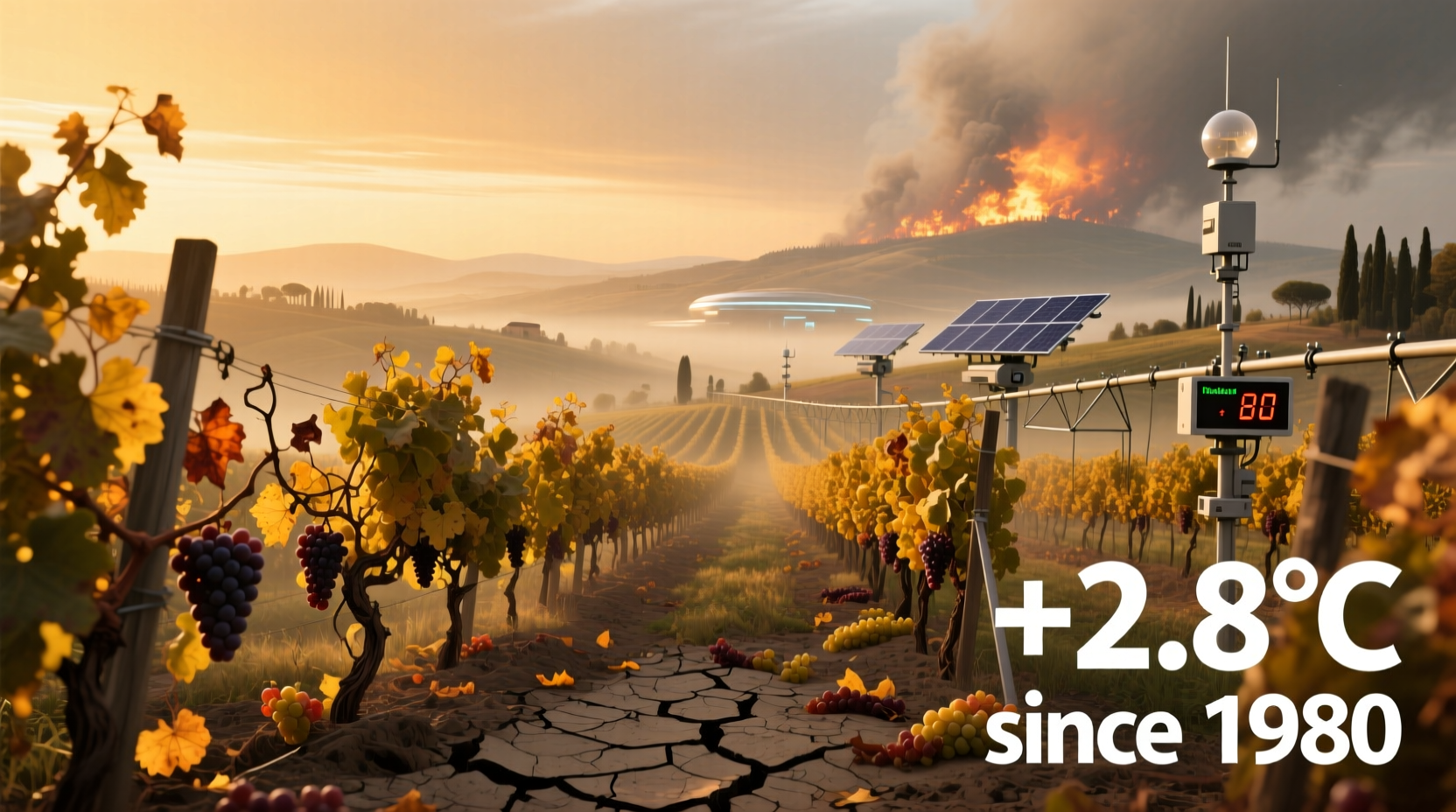
Climate change does not affect all wine regions uniformly. Its impact manifests through distinct regional stressors: Mediterranean zones face intensified aridity and fire risk; continental climates endure greater temperature volatility; maritime-influenced areas confront altered ocean currents and storm tracks. Each pressure point alters grape development, phenology, and disease pressure in measurable ways.
In Bordeaux, average growing-season temperatures have risen by 1.4°C since 1950. The 2022 vintage saw record-breaking heat—reaching 41.2°C in Saint-Émilion—causing sunburned berries and rapid sugar accumulation without corresponding phenolic maturity. As a result, many châteaux harvested Merlot earlier than ever before, yet struggled with green tannins and low anthocyanin concentration. Meanwhile, in Germany’s Mosel, warmer autumns have extended the ripening window for Riesling, allowing more consistent sugar development—but also increasing the risk of botrytis in humid years and diminishing the signature racy acidity that defines the region’s elegance.
California’s North Coast tells a starker story. Between 2017 and 2023, five major wildfire seasons blanketed Sonoma and Napa in smoke during critical ripening periods. Smoke-taint compounds—volatile phenols like guaiacol and 4-methylguaiacol—bind to grape sugars and become perceptible as ash, burnt rubber, or medicinal notes in wine. Unlike heat or drought, smoke exposure is irreversible post-fermentation. Winemakers now deploy real-time air quality monitoring, early harvest triggers, and experimental fining agents—but none offer full mitigation.
Tip: Monitor local phenological indicators—not just calendar dates—to guide harvest decisions. Budbreak, flowering, and veraison timing now vary by up to 18 days compared to historical averages in many regions.Three Primary Climate-Driven Challenges for Future Vintages
1. Accelerated Sugar Accumulation vs. Stalled Phenolic Ripening
Higher average temperatures speed photosynthesis and sugar synthesis, often outpacing the slower biochemical processes required for tannin polymerization, anthocyanin stabilization, and aroma precursor development. This mismatch leads to wines with elevated alcohol (15%+ ABV), unbalanced pH, and hollow midpalates—despite high Brix readings at harvest.
2. Increased Hydric Stress and Soil Degradation
Drought reduces vine transpiration, triggering stomatal closure and limiting nutrient uptake. Prolonged water deficit also accelerates soil organic matter loss and increases salinity in irrigated regions like South Africa’s Swartland. In 2023, over 70% of vineyards in the Douro Valley reported reduced yields due to compaction-induced root restriction and diminished microbial activity in topsoil.
3. Expansion of Pest and Disease Pressure
Warmer winters allow pests like the European grapevine moth (Lobesia botrana) and mealybugs to survive and multiply across more generations per season. Humidity fluctuations also favor fungal pathogens: Plasmopara viticola (downy mildew) now appears earlier and persists longer in Bordeaux, while Botrytis cinerea expresses unpredictably—sometimes beneficially for Sauternes, often detrimentally in cooler, wetter years elsewhere.
Adaptation Strategies: From Vineyard to Cellar
Adaptation is no longer optional—it’s operational. Forward-thinking producers are deploying layered strategies across three domains: site selection, canopy and soil management, and winemaking flexibility.
Vineyard-Level Responses
- Elevational migration: In Argentina’s Uco Valley, new plantings have shifted from 900m to 1,350m above sea level to access cooler microclimates and retain acidity in Malbec.
- Rootstock innovation: Researchers at INRAE in Montpellier are testing drought-tolerant hybrids like 110R and 140Ru, which reduce vine water use by up to 30% without compromising yield.
- Canopy architecture redesign: Vertical shoot positioning is being replaced by “smart canopies”—asymmetric leaf removal, strategic hedging, and fruit-zone shading—to protect clusters from direct solar radiation while maintaining airflow.
Cellar Innovations
Winemakers increasingly treat fermentation as a climate-responsive process. De-alcoholization via spinning cone or reverse osmosis is used sparingly—not to correct flaws, but to recalibrate balance when natural ripeness thresholds exceed stylistic goals. Others embrace partial whole-cluster fermentation to add structural freshness, or ferment at lower temperatures to preserve volatile thiols in Sauvignon Blanc and Syrah. Crucially, these tools are deployed with restraint: the goal remains expression of place, not technological intervention.
| Challenge | Traditional Response | Climate-Informed Adaptation |
|---|---|---|
| Rapid sugar rise + low acidity | Harvest based on Brix targets | Harvest based on pH, titratable acidity, and seed lignification; use malolactic fermentation timing to modulate final acidity |
| Drought stress | Supplemental irrigation | Drip irrigation paired with soil moisture sensors + cover cropping to improve water retention |
| Smoke exposure risk | Standard pre-harvest testing | Real-time airborne particulate monitoring + predictive modeling of smoke arrival windows |
| Unpredictable disease pressure | Calendar-based fungicide sprays | Weather-driven disease models (e.g., EPI model for downy mildew) + copper-sulfur alternatives to reduce soil toxicity |
Mini Case Study: Domaine Tempier in Bandol, France
For over 80 years, Domaine Tempier has defined Provençal rosé through Mourvèdre-dominant blends grown on limestone terraces overlooking the Mediterranean. But by 2016, the estate recorded its first-ever consecutive years of harvests beginning before August 15—nearly three weeks earlier than the long-term average. That same year, a late-July heatwave pushed cluster temperatures above 38°C for 72 hours, causing premature shriveling and reducing Mourvèdre yields by 40%. Faced with declining acidity and increased alcohol, then-winemaker Daniel Ravier made two pivotal decisions: First, he grafted 12 hectares of old-vine Mourvèdre onto 110R rootstock to improve drought resilience. Second, he began co-fermenting small lots with native Cinsault and Carignan—varieties historically undervalued but proven more heat-tolerant and acid-retentive. By 2021, the estate’s flagship Bandol Rosé had regained its hallmark tension and saline finish—not by resisting change, but by reinterpreting tradition within new climatic boundaries. As Ravier told La Revue du Vin de France: “We didn’t abandon Mourvèdre. We asked it to speak in a different dialect—one shaped by wind, heat, and memory.”
Expert Insight: What Science Says About Long-Term Viability
“The most robust projection isn’t about ‘winning’ or ‘losing’ regions—it’s about functional relocation. By 2050, suitable climates for premium Pinot Noir may shift 200–300km north in Europe and upward in elevation globally. But suitability alone doesn’t guarantee quality. Soil health, water access, and human knowledge remain irreplaceable. A vineyard planted in a newly ‘ideal’ zone today will take 12–15 years to express terroir meaningfully—if managed with ecological integrity.” — Dr. Elizabeth Thibert, Senior Climate Viticulturist, University of Adelaide & CSIRO Wine Futures Initiative
Dr. Thibert’s research underscores a critical nuance: climate models identify where vines *can* grow, but not where they will *thrive*. Soil microbiome diversity, slope aspect, fog frequency, and even pollinator presence determine whether a relocated vineyard becomes exceptional—or merely viable. Her team’s 2023 study of 21 emerging sites in Tasmania, southern England, and Patagonia confirmed that only those with pre-existing volcanic or glacial soils, coupled with multi-generational viticultural stewardship, achieved benchmark quality within ten years of planting.
Practical Checklist: What Winemakers and Growers Can Do Now
- Conduct a climate vulnerability audit: Map historical frost, heat, drought, and flood events against vineyard blocks; overlay soil maps and rootstock data.
- Install microclimate monitoring stations: Deploy at least one sensor per 5 hectares measuring temperature, humidity, leaf wetness, and soil moisture at multiple depths.
- Test alternative varieties in small plots: Prioritize those with proven performance in hotter/drier analogues (e.g., Assyrtiko for white, Touriga Nacional for red).
- Reassess irrigation infrastructure: Replace flood systems with pressure-compensating drip lines and integrate smart controllers linked to evapotranspiration forecasts.
- Build collaborative regional response networks: Share real-time pest/disease alerts, smoke monitoring data, and labor resources during crisis seasons.
FAQ
Will classic wine regions disappear?
No—but their definitions will evolve. Bordeaux will still produce Cabernet Sauvignon, but likely with higher alcohol, riper tannins, and less pronounced pyrazine character. The question isn’t extinction, but reinterpretation: how much stylistic continuity can be maintained while adapting to physical reality? Regulatory bodies like the INAO are already updating appellation rules to permit limited blending of heat-tolerant varieties in certain AOCs—a pragmatic acknowledgment of shifting baselines.
Can technology fully offset climate impacts?
Technology mitigates, but cannot replace ecological intelligence. Drones, AI-driven yield prediction, and precision viticulture optimize resource use—but they cannot regenerate degraded soils, restore lost biodiversity, or replicate the slow, complex relationship between vine, mycorrhizae, and geology. The most resilient operations combine digital tools with regenerative practices: compost application, insectary plantings, and minimal tillage.
What does this mean for consumers?
Expect greater vintage variability, especially in marginal climates. Wines from traditionally cool regions (e.g., England sparkling, Oregon Pinot) may gain consistency and depth. At the same time, value will shift toward producers transparent about adaptation—those who disclose rootstock choices, irrigation methods, and harvest decision frameworks. Look for certifications like Sustainable Winegrowing New Zealand or Terra Vitis, which verify climate-resilience metrics alongside environmental stewardship.
Conclusion
The story of wine has always been one of adaptation—of responding to phylloxera, mildew, market shifts, and political upheaval. Climate change is the latest, most pervasive chapter. It asks not whether we can make wine, but whether we can make wine that honors both its origins and its future. The vintages ahead will bear the imprint of our choices: to double down on extraction and correction, or to deepen observation, diversify ecosystems, and listen more closely to what the land reveals under new conditions. Every bottle from 2030 onward will carry traces of this transition—not as flaw, but as testimony. The most compelling wines of tomorrow won’t be those that ignore the heat, but those that translate it into clarity, resilience, and quiet conviction.
💬 Your voice matters in this evolution. If you’re a grower, winemaker, researcher, or passionate enthusiast—share your observations, adaptations, or questions in the comments. Real-world experience is the most vital data point we have.