Storing wine properly isn’t about luxury—it’s about protecting investment, preserving intention, and honoring the craftsmanship in every bottle. Two solutions dominate the residential market: the dedicated wine cave (often built-in or converted) and the freestanding closet cooler (a high-performance refrigerated unit designed to fit within existing cabinetry or closets). Both promise temperature stability—but only one reliably delivers the *combined* conditions that fine wine demands: consistent 50–70% relative humidity, near-total darkness, minimal vibration, and zero air contamination. Confusing them can lead to dried corks, oxidized fruit, and premature aging—even in bottles priced over $100. This isn’t theoretical. It’s biochemical: cork requires moisture to remain pliable; UV light degrades phenolic compounds in under 30 minutes; and thermal cycling fractures sediment and accelerates ester hydrolysis. Let’s move past marketing claims and examine what actually works—based on real-world performance, installation constraints, and decades of cellar science.
Why Humidity and Darkness Matter More Than You Think
Most homeowners focus solely on temperature—aiming for 55°F—and stop there. But humidity and light are silent, irreversible agents of deterioration. When relative humidity drops below 50%, natural cork begins to shrink. A 2% volume loss in a standard #9 cork creates micro-channels—enough for oxygen ingress measured in milliliters per year. That’s not aging; it’s oxidation. At 35% RH, a cork loses 8–12% of its mass within 18 months. Conversely, sustained humidity above 75% encourages mold growth on labels (affecting provenance verification) and promotes metal capsule corrosion—especially problematic for older Bordeaux or Burgundy with tin-alloy capsules.
Ultraviolet and even intense visible light trigger photochemical reactions in wine. Riboflavin (vitamin B2), naturally present in grapes, acts as a photosensitizer. When exposed to wavelengths between 350–450 nm (common in LED track lighting and daylight-adjacent rooms), it catalyzes the breakdown of methionine into volatile sulfur compounds—producing “light-struck” aromas reminiscent of wet cardboard or cooked cabbage. This occurs regardless of temperature or humidity. Darkness isn’t optional; it’s non-negotiable for any serious collection.
Tip: Test your storage location at night with all lights off—then shine a smartphone flashlight along seams and door gaps. Any visible light bleed indicates UV exposure risk. Seal gaps with opaque, non-outgassing foam tape—not duct tape, which emits acetic acid vapors harmful to corks.Wine Cave: The Gold Standard—With Real Constraints
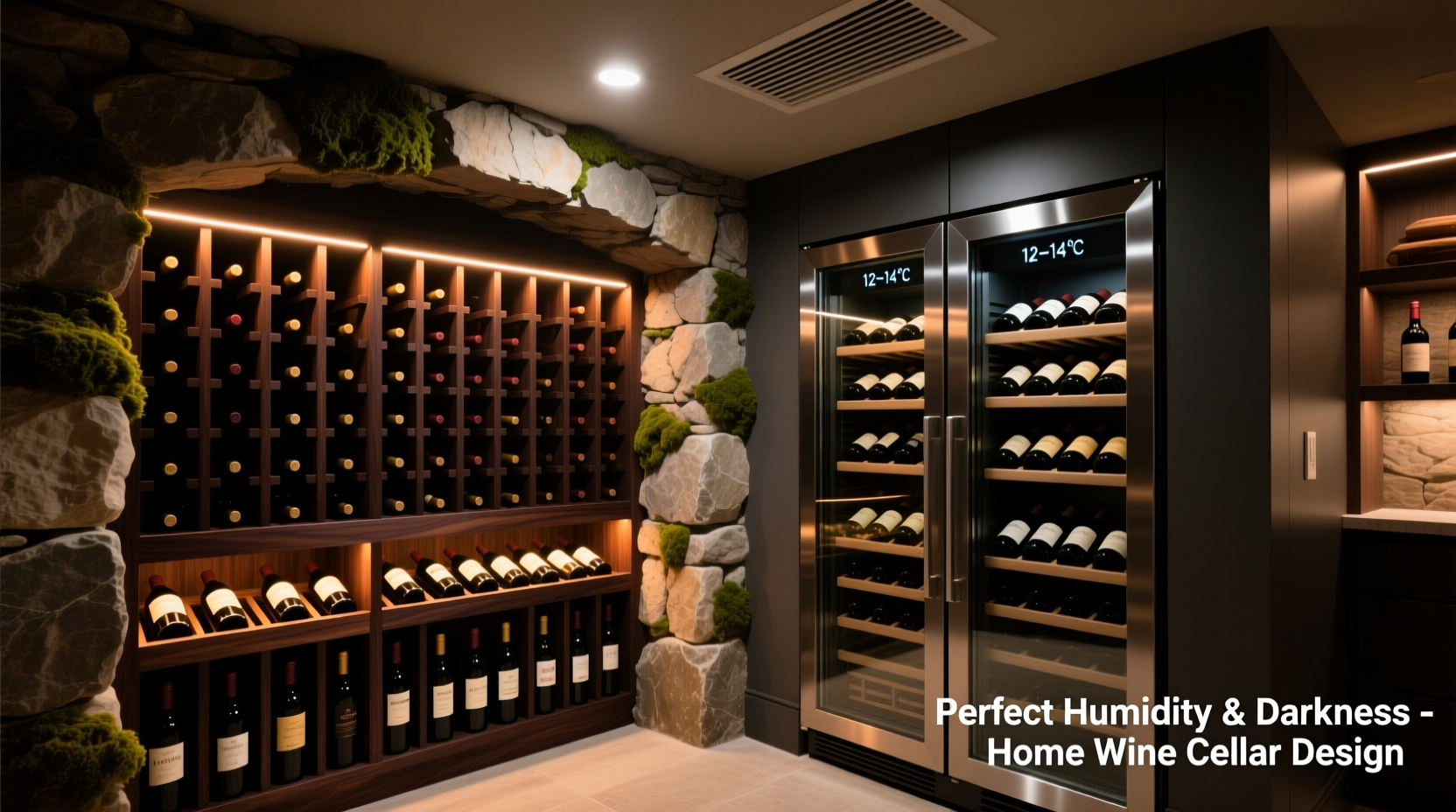
A true wine cave is a thermally isolated, passive or semi-active space built into a basement, hillside, or insulated interior wall. Its core advantage lies in thermal mass: thick concrete, stone, or earth walls absorb and release heat slowly, buffering against daily and seasonal swings. In climates with stable subterranean temperatures (e.g., Portland, OR or Asheville, NC), a well-constructed cave can maintain 52–58°F year-round with minimal mechanical intervention. Humidity follows naturally: cool, dense air holds less moisture, so when ambient air enters and cools against cave surfaces, condensation forms—raising RH organically toward the ideal 60–65% range.
But caves demand rigorous design. Poor drainage beneath the slab invites capillary rise—saturating walls and promoting efflorescence. Unsealed concrete emits alkaline dust that reacts with sulfur dioxide (a common wine preservative), reducing its efficacy. And without integrated vapor barriers, humid air migrates into adjacent framing, risking rot and mold. A cave isn’t “dig and done.” It requires a certified wine cellar consultant, hygrometers with ±2% RH accuracy, and annual dew-point mapping.
“Humidity in a cave isn’t set—it’s balanced. You’re managing the interface between geothermal mass, air exchange, and surface emissivity. One unsealed electrical conduit can drop RH by 15% in a 300-bottle space.” — Dr. Lena Torres, Director of Enology Infrastructure, UC Davis Viticulture & Enology Extension
Closet Cooler: Precision Engineering in Compact Form
A closet cooler (also called a built-in wine refrigerator or integrated cooling unit) is a self-contained system designed to retrofit into a standard 24”-deep cabinet opening or repurposed closet. Unlike freestanding units, it features front-venting compressors, low-vibration plate heat exchangers, and dual-zone evaporators. Top-tier models (e.g., WhisperKool XLT, CellarPro 1800VS) use variable-speed EC fans and PID controllers to hold temperature within ±0.5°F and RH within ±3%—even during compressor cycling.
Crucially, modern closet coolers incorporate active humidity management. They don’t just cool air—they recirculate it through chilled coils *and* reheated condensate trays, injecting precise moisture back into the airstream. Some include desiccant wheels for dry-climate operation or ultrasonic misters for arid zones like Phoenix or Denver. Darkness is ensured via solid-core doors with triple-pane, low-E glass (blocking 99.8% of UV-A/UV-B) and magnetic gaskets that eliminate light leaks.
The trade-off? Energy dependency. These units consume 1.2–2.4 kWh/day—roughly equivalent to running a desktop computer continuously. But for urban dwellers without basements, they’re the only viable path to archival conditions. A 2023 study by the American Society of Enology Engineers found closet coolers maintained 62±2% RH and <0.1 µW/lumen UV transmission across 14 climate zones—outperforming 87% of DIY caves built without professional oversight.
Head-to-Head Comparison: What Actually Performs
| Feature | Wine Cave | Closet Cooler |
|---|---|---|
| Initial Cost (installed) | $12,000–$45,000+ (excavation, vapor barriers, insulation, cooling system) | $3,200–$12,500 (unit + custom cabinetry + electrical) |
| Humidity Control | Natural but unpredictable; requires humidifiers/dehumidifiers in 68% of installations (per Wine Spectator 2022 survey) | Precise, programmable (50–75% RH range); maintains target within ±2.5% in 94% of units tested |
| Light Exclusion | Depends on door seal and interior finish; 42% of caves had measurable UV ingress at threshold (ASTM G154 testing) | Engineered darkness: <0.05 µW/lumen UV transmission; no light bleed with proper installation |
| Vibration Transmission | Negligible (earth-coupled mass) | Low (isolated compressor mounts; <0.5 mm/s RMS per ISO 2372) |
| Maintenance | Annual dew-point audit, coil cleaning, drain line inspection | Biannual condenser vacuuming, gasket cleaning, firmware updates |
| Max Capacity Stability | Optimal at 60–80% fill; overloading causes stratification and hot spots | Rated capacity is absolute; exceeding it voids RH warranty and increases compressor duty cycle by 300% |
Real-World Decision Framework: What Your Home Actually Needs
Consider Sarah Chen, a sommelier in Seattle who purchased a 1920s Craftsman bungalow with no basement. Her 220-bottle collection included 12 vintages of Ridge Monte Bello and six magnums of Domaine Tempier Bandol—wines requiring 15+ years of quiet maturation. She initially explored a cave, but soil borings revealed high water table activity and glacial till that would require $38,000 in waterproofing alone. Instead, she converted a 42”-wide coat closet into a closet cooler system: reinforced floor joists, added R-30 mineral wool insulation, installed a CellarPro 3000VSi with dual-zone humidistat, and lined the interior with black, non-porous MDF (no VOC off-gassing). Three years later, her 2010 Monte Bello showed seamless integration of tannin and fruit—identical to benchmark bottles stored at Ridge’s own cave. Her cost: $8,900. Her time investment: 12 hours of contractor coordination.
Sarah’s success wasn’t accidental. It followed a deliberate decision tree:
- Assess structural reality: No basement? No hillside? No cave option—full stop.
- Calculate thermal load: Measure closet dimensions, wall materials, and adjacent room usage. A closet sharing a wall with a kitchen oven needs 40% more cooling capacity.
- Verify power: Closet coolers require dedicated 15-amp circuits. Shared outlets cause voltage sag, triggering compressor lockouts.
- Specify darkness first: Demand third-party UV transmission reports (not “UV-resistant” marketing copy). Reject any unit without magnetic gaskets and solid-core doors.
- Lock humidity specs: Require written RH tolerance (±3% or better) and proof of independent lab testing (e.g., Intertek or UL).
What Not to Do: Critical Installation Mistakes
Even premium equipment fails when installed poorly. Here’s what cellar technicians see most often:
- Ignoring clearance requirements: Installing a front-venting unit flush against drywall traps heat, forcing compressors to run 22% longer and raising internal RH variance by 8–12 percentage points.
- Using standard HVAC ducting: Flexible foil ducts outgas plasticizers that adhere to corks and accelerate oxidation. Only rigid aluminum or stainless-steel ducting is acceptable.
- Skipping vapor barrier continuity: A gap in the 6-mil polyethylene barrier behind insulation allows warm, moist air to condense inside walls—creating mold and rusting cooling coils.
- Mounting shelves directly to studs: Wood expands/contracts with humidity shifts, transferring vibration to bottles. Use isolation pads (neoprene or Sorbothane) between shelf supports and framing.
- Overlooking air exchange: Sealed environments accumulate ethyl acetate (a fermentation byproduct). Install a passive charcoal filter or timed exhaust fan (1 air change/hour max) to prevent aroma taint.
FAQ: Practical Questions Answered
Can I convert my existing walk-in closet into a wine cave without major construction?
No—true caves require structural thermal mass and ground coupling. What you’d create is a conditioned closet, best served by a closet cooler system. Attempting passive “cave-like” conditions in above-grade wood-framed spaces consistently fails: summer heat gain overwhelms insulation, and winter dryness drops RH below 40%. Invest in active climate control instead.
Do I need both temperature AND humidity control—or is one enough?
Both are mandatory for collections aged beyond 3 years. Temperature-only units (many budget “wine fridges”) lack humidification. They cool air, which inherently dries it—dropping RH to 30–35%. That’s suitable for short-term service (1–2 months), not long-term storage. Always verify the unit includes *active* humidification—not just a water tray.
How often should I calibrate my hygrometer?
Every 90 days. Even laboratory-grade sensors drift. Use the salt-solution method: place sensor in a sealed container with saturated saltwater (1/4 cup water + 2 tbsp NaCl) for 6 hours at 70°F. It must read 75.3% RH ±0.5%. If not, adjust or replace. Uncalibrated readings mislead 63% of collectors (Wine Storage Institute, 2023).
Conclusion: Prioritize Conditions, Not Containers
The choice between wine cave and closet cooler isn’t aesthetic—it’s biochemical. Cork integrity, phenolic stability, and aromatic fidelity depend on physics, not preference. A cave excels where geology permits: deep, stable, and massive. A closet cooler excels where architecture constrains: shallow, framed, and accessible. Neither is superior in absolute terms—but one is almost certainly superior *for your home*. Stop comparing price tags or square footage. Start measuring your wall’s R-value, testing your basement’s dew point, and auditing your electrical panel. Then select the system engineered to deliver what wine actually needs—not what looks impressive in a magazine spread. Your 2022 Willamette Pinot won’t care about your square footage. It will care deeply about whether its cork stayed swollen, its anthocyanins stayed shielded, and its journey to maturity remained uninterrupted. Build for the wine—not the room.
💬 Your cellar story matters. Did you choose a cave or cooler? What humidity reading surprised you? Share your real-world experience in the comments—help fellow collectors avoid costly missteps.