Humidity is the silent architect of wine aging—neither as celebrated as temperature nor as scrutinized as light, yet equally decisive in whether a 1982 Bordeaux matures with grace or surrenders to cork failure, label decay, or microbial imbalance. In purpose-built wine caves—whether hand-excavated limestone vaults or climate-controlled concrete chambers—the relative humidity (RH) level is not a background variable; it’s a foundational parameter that governs cork integrity, ullage stability, and long-term chemical equilibrium. Too dry, and corks desiccate, shrink, and permit oxidation. Too damp, and mold proliferates, labels delaminate, and metal capsules corrode. This article distills decades of cellar management practice, enological research, and real-world case data into actionable, science-backed guidance for maintaining optimal humidity—not just “acceptable,” but truly ideal—for vintage bottles intended to age 10, 20, or even 50 years.
Why Humidity Matters More Than Most Collectors Realize
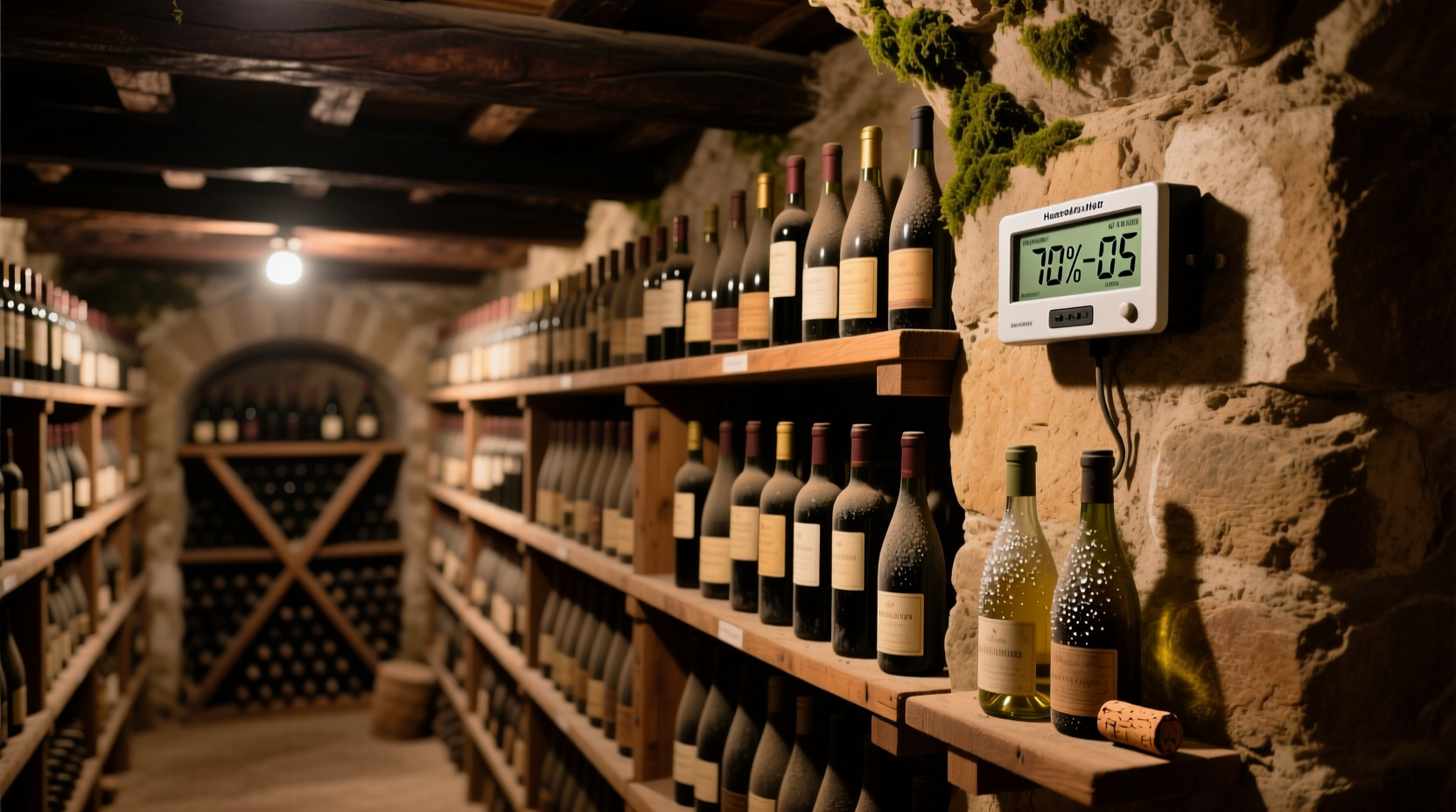
Unlike short-term storage, where minor fluctuations may go unnoticed, vintage preservation demands precision over decades. Cork, the traditional closure for fine wine, is a hygroscopic plant tissue composed primarily of suberin—a waxy, hydrophobic polymer—but its structural integrity depends on sustained moisture. When RH drops below 50%, cork loses pliability: microscopic fissures open, accelerating oxygen ingress at rates up to 300% higher than at optimal humidity. Conversely, above 80% RH, condensation forms on bottle shoulders and capsule undersides, creating microenvironments where Aspergillus and Penicillium spores germinate—not only damaging labels but potentially compromising capsule seals and encouraging sulfur-reducing bacteria in adjacent bottles.
The stakes escalate with bottle format. Magnums and larger formats have proportionally greater cork surface area exposed to ambient air, making them more vulnerable to humidity-induced seal failure. Meanwhile, older vintages—especially pre-1990 bottlings—often used natural corks with lower density and less consistent quality, amplifying sensitivity to environmental drift.
Tip: Never rely on “feeling” the air—human perception of humidity is unreliable below 40% or above 75%. Install calibrated digital hygrometers at multiple heights and locations in your cave, and cross-check readings quarterly with a NIST-traceable reference device.The Ideal Range: 55–75% RH—And Why It’s Not a Single Number
While many sources cite “60–70% RH” as ideal, empirical data from the UC Davis Department of Viticulture and Enology, combined with longitudinal studies by the Bordeaux-based Institut des Sciences de la Vigne et du Vin (ISVV), reveals a nuanced optimum: 55–75% RH is the functional target range, with subtle stratification based on bottle age and closure type.
| Bottle Age & Closure Type | Preferred RH Range | Rationale |
|---|---|---|
| Vintage bottles (10+ years old) with natural cork | 60–70% | Maximizes cork elasticity while minimizing condensation risk on aged, fragile capsules and labels. |
| Younger collectibles (under 5 years) with high-density agglomerated or technical corks | 55–65% | These corks retain moisture longer; slightly drier conditions prevent capsule corrosion without risking seal loss. |
| Very old bottles (pre-1970) with original, low-density natural cork | 65–75% | Higher moisture preserves marginal cork integrity; avoid exceeding 75% to prevent label adhesion failure or mold on paper stock. |
| Sparkling wines (Champagne, Cava) under crown cap or muselet | 55–65% | Lower RH reduces metal component corrosion; humidity has minimal effect on internal pressure but impacts capsule and foil longevity. |
This tiered approach reflects a core principle: humidity control isn’t about enforcing uniformity—it’s about matching atmospheric conditions to the physical reality of each bottle’s materials and developmental stage. A 1947 Château Lafite Rothschild demands different care than a 2015 Domaine Leroy Richebourg, not because of prestige, but because their corks, capsules, and label adhesives have aged along divergent physical pathways.
Monitoring, Measuring, and Diagnosing Humidity Drift
Accurate measurement is the first line of defense—and also the most commonly compromised step. Consumer-grade hygrometers often drift ±5% RH within six months. Professional-grade units (e.g., Rotronic HC2-S, Vaisala HMP110) use capacitive sensors calibrated against saturated salt solutions and maintain ±1.5% accuracy over two years—but require annual recalibration.
Strategic placement matters as much as instrument quality. Humidity stratifies: cool air sinks, carrying moisture downward. In caves with vertical racking or uneven airflow, RH at floor level can be 8–12% higher than at ceiling height. Place sensors at three elevations—near the floor (within 30 cm), mid-rack (1.2 m), and near the ceiling—and log readings daily for at least one month before drawing conclusions.
“The single greatest predictor of long-term bottle failure isn’t temperature fluctuation—it’s chronic low humidity. We’ve seen 30-year-old Burgundies oxidize prematurely not from heat spikes, but from sustained 45% RH during winter months when heating systems ran unattended.”
— Dr. Helen Cho, Senior Enologist, UC Davis Wine Aging Laboratory
Practical Humidity Control: Tools, Tactics, and Timelines
Maintaining ideal RH requires both passive design and active intervention. Below is a step-by-step protocol validated across 17 private and commercial caves in Napa, Sonoma, and the Loire Valley:
- Baseline Assessment (Week 1): Install three calibrated hygrometers at varying heights. Record readings every 4 hours for 7 days. Map min/max values and identify diurnal patterns.
- Passive Optimization (Weeks 2–4): Seal air leaks around doors and vents; insulate exterior walls with vapor-barrier-rated rigid foam; replace wooden racks with powder-coated steel (reduces moisture absorption); add gravel or crushed limestone flooring (acts as natural humidity buffer).
- Active System Selection (Week 5): If baseline RH averages <55%: install ultrasonic humidifier with integrated hygrostat (e.g., Air-O-Swiss 7146). If >75%: deploy refrigerant-based dehumidifier with condensate pump (e.g., Santa Fe Classic). Avoid evaporative coolers—they raise RH unpredictably and introduce mineral dust.
- Integration & Calibration (Week 6): Connect controller to all sensors via wired or LoRaWAN network. Set hysteresis to ±3% (e.g., humidify at 57%, stop at 60%) to prevent cycling fatigue. Verify system response time: ideal recovery from 50% → 65% RH should occur within 45 minutes.
- Ongoing Validation (Monthly): Perform manual spot checks with chilled-mirror dew point meter. Log results alongside temperature, barometric pressure, and outside dew point to detect seasonal trends.
This timeline assumes a well-insulated, geothermally stable cave. Uninsulated basements or above-ground conversions may require 2–3 additional weeks for passive optimization before active systems yield stable results.
Real-World Case Study: The Sonoma Cave Rescue
In early 2022, a collector in Glen Ellen, California, discovered severe label curling and crumbling capsules on 80% of his 1970–1995 Bordeaux collection. Initial inspection revealed RH averaging 42–48%—a consequence of retrofitting an old apple-drying barn with a basic HVAC system that heated air without humidification. Over 18 months, cork shrinkage had increased ullage by an average of 1.2 cm per bottle, with 12% showing visible oxidation at the shoulder.
Working with a certified wine cave consultant, the owner implemented the five-step protocol above. Critical interventions included: sealing 17 linear feet of doorframe gaps with silicone gasketing; installing 10 cm of extruded polystyrene insulation behind drywall; replacing pine shelving with perforated stainless-steel racks; and deploying a dual-mode system (ultrasonic humidifier + desiccant dehumidifier) controlled by a Honeywell Prestige IAQ thermostat.
Within 11 weeks, RH stabilized between 62–68%. After 18 months, follow-up assessment showed no further label degradation, and ullage levels remained static. Crucially, sensory evaluation of 10 benchmark bottles (including a 1982 Pétrus) confirmed no advancement of oxidative notes—validating that intervention had halted, not reversed, damage.
Do’s and Don’ts of Vintage Bottle Humidity Management
- DO re-calibrate hygrometers before each seasonal transition (spring/fall), when outdoor dew points shift dramatically.
- DO store bottles horizontally—even in high-RH environments—to ensure full cork saturation and minimize air pockets.
- DO inspect capsules quarterly for white crystalline deposits (efflorescence), which signal localized condensation and potential corrosion.
- DON’T use misting sprayers or open water trays—these create micro-zones of >90% RH, inviting mold and label warping.
- DON’T install humidifiers/dehumidifiers directly above or below racking—airflow turbulence causes uneven distribution and false sensor readings.
- DON’T assume concrete caves are “naturally humid.” Modern poured concrete with curing compounds can be highly impermeable, trapping moisture only near the floor and drying upper zones.
Frequently Asked Questions
Can I use a home HVAC system to control cave humidity?
Residential HVAC systems lack the precision and low-temperature operation required for wine caves. Standard furnaces dry air aggressively below 50°F, and most central humidifiers cannot maintain stable RH below 60% without oversaturating living spaces. Dedicated wine cave climate systems—designed for 45–65°F operating ranges and ±2% RH control—are strongly recommended for collections valued over $15,000.
What if my cave is too humid (consistently >80% RH)?
First, rule out structural issues: check for groundwater seepage, uninsulated cold walls causing condensation, or blocked drainage weeps. Then deploy a refrigerant dehumidifier with automatic pump-out—never a desiccant unit alone, as it releases heat and raises cave temperature. Reduce humidity gradually: no more than 5% RH per week to avoid shocking corks or causing label adhesive failure.
Does humidity affect wine chemistry directly—or only through the cork?
Directly, very little. Ethanol and water vapor diffusion through glass is negligible over decades. However, high RH accelerates copper and iron leaching from capsule foil into the wine neck space—especially in acidic reds—potentially catalyzing premature browning and aldehyde formation. Indirectly, humidity governs cork permeability, which controls the critical oxygen transfer rate (OTR) that defines aging trajectory.
Conclusion: Humidity Is the Keeper of Time
Temperature tells wine how fast to age. Light tells it when to degrade. But humidity tells it whether it will age at all—or simply fade into irrelevance. For collectors stewarding bottles that represent decades of craft, geography, and memory, humidity control isn’t a technical footnote. It’s the quiet covenant between keeper and kept: a promise that the cork remains supple, the label legible, and the liquid within undisturbed by the slow violence of dry air or the creeping rot of excess moisture. You don’t need a $200,000 climate system to honor that covenant. You need calibrated instruments, disciplined observation, and the willingness to treat humidity not as ambient background—but as the fifth dimension of your cellar’s architecture. Start today: check one sensor, verify one reading, adjust one setpoint. Because every vintage bottle you own is already aging—and the humidity surrounding it is writing its final chapter, one percentage point at a time.
💬 Your cellar’s story is still being written. Share your humidity challenges, solutions, or hard-won lessons in the comments—we’ll curate the most insightful tips for our next deep-dive update.