Evening wine service is more than ritual—it’s atmosphere made tangible. The soft glow of a Cabernet resting on a warm amber pedestal, the subtle halo around a row of Rieslings aligned on a backlit ledge, the quiet hum of intention behind every pour: these details shape how guests feel before the first sip. Yet many enthusiasts default to one lighting solution without considering how light source, distribution, color temperature, and spatial context interact in real time. A light-up base may elevate a single bottle into a sculptural centerpiece, while an LED-lit shelf can unify an entire bar into a cohesive, immersive environment. Neither is universally superior—but choosing incorrectly risks flattening mood, creating glare, or undermining the sensory harmony that makes evening pours memorable.
How Light Shapes Perception of Wine—and Why Placement Matters
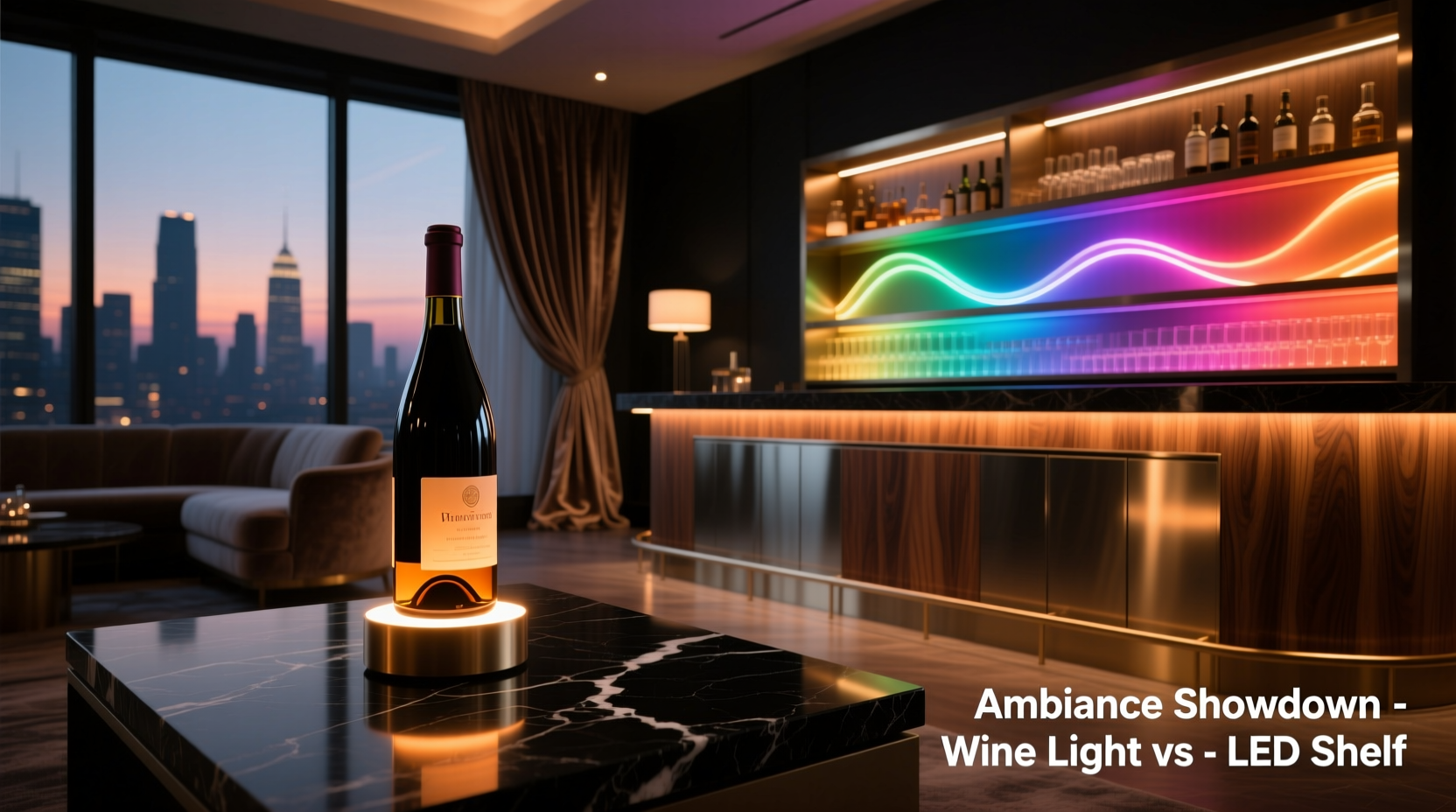
Light doesn’t just illuminate; it interprets. Human visual perception of wine relies heavily on ambient cues—color saturation, clarity, viscosity, even perceived temperature—all modulated by surrounding illumination. A 2022 study published in Food Quality and Preference found that participants consistently rated identical wines as “richer” and “more complex” under 2700K warm-white light with low glare, compared to cooler (4000K+) or unevenly distributed sources. Crucially, the study noted that localized light—such as that from a bottle base—enhanced focus on hue and viscosity but narrowed peripheral warmth, whereas diffuse shelf lighting supported holistic environmental comfort without drawing attention away from the glass itself.
This distinction reveals a foundational principle: bottle-level lighting prioritizes object presence, while shelf-level lighting cultivates spatial resonance. When guests gather at a home bar after dinner, their experience isn’t shaped solely by what’s in the glass—it’s shaped by how the space feels around them. A single glowing bottle may command attention, but if the countertop remains shadowed and the glassware dull, the effect can feel theatrical rather than inviting. Conversely, a uniformly lit shelf may lack focal drama unless thoughtfully layered with accent elements.
Tip: Test your lighting at 8 p.m.—not midday. Natural light shifts dramatically after sunset, and artificial sources behave differently when competing with residual daylight or overhead fixtures.Light-Up Bottle Bases: Precision, Personality, and Practical Limits
A light-up base is a self-contained unit: typically a weighted acrylic or walnut platform housing a low-voltage LED array, powered via USB or battery, designed to cradle a standard 750ml bottle upright. Its strength lies in controlled isolation—directing light upward through the glass, refracting through liquid, and casting a soft halo onto nearby surfaces. High-end models use edge-lit diffusion panels and adjustable CCT (correlated color temperature) dials, allowing users to shift from 2200K (candle-like amber) to 3000K (soft cream) depending on varietal or occasion.
But precision comes with constraints. Because light originates from below, bottles must be clean and free of labels or residue—otherwise, shadows and hotspots distort the glow. Tapered or irregularly shaped bottles (e.g., Alsace flutes or Burgundy clarets) often sit unevenly, causing asymmetrical illumination. And while the base excels with reds and rosés—whose deep hues absorb and re-emit warm light beautifully—it struggles with pale whites or sparkling wines, where excessive uplighting can wash out delicate straw-gold tones or mute effervescence.
Functionally, bases are best deployed in low-traffic zones: a sideboard during a seated tasting, a mantel beside a reading chair, or a dedicated “showcase nook.” They’re less suited for active pouring stations, where frequent bottle removal interrupts continuity and risks cable snagging or accidental tipping.
LED-Lit Bar Shelves: Cohesion, Control, and Contextual Depth
An LED-lit bar shelf integrates linear, low-profile lighting—usually 24V tape LEDs or recessed puck lights—into the underside or rear lip of a floating or wall-mounted shelf. Unlike bottle bases, its purpose isn’t to spotlight individual vessels but to establish tonal continuity across the entire display plane. Light spills downward and backward, grazing bottles, reflecting off glassware, and washing the bar face in gentle gradation. This creates layered depth: foreground (glasses), midground (bottles), background (wall texture or art), all unified under shared chromatic intent.
Professional bar designers emphasize that shelf lighting works most effectively when paired with three intentional layers: ambient (overhead or floor lamps), task (under-cabinet or pendant lighting over the pour zone), and accent (the shelf LEDs themselves). In this hierarchy, shelf lighting anchors the aesthetic—not the function. It allows for dynamic control: dimmers adjust intensity for pre-dinner aperitif warmth versus post-dinner digestif intimacy; programmable controllers can shift color slowly over 90 minutes to mirror circadian rhythm, subtly cueing relaxation.
Real-world limitations include installation complexity (hardwiring requires electrical knowledge or contractor support) and shelf material compatibility. Glass or acrylic shelves transmit light cleanly; thick wood or stone may require higher-output LEDs or strategic cutouts. Also, poorly diffused strips create visible “dotting”—a series of discrete bright spots instead of seamless glow—detracting from sophistication.
“Shelf lighting doesn’t sell the wine—it sells the moment. When guests lean in to admire a label, they’re not just seeing the bottle; they’re feeling the quiet confidence of a space designed for pause.” — Javier Mendez, Certified Bar Designer & Principal, Atelier Vinum Studio
Direct Comparison: Key Decision Factors in Practice
Choosing between these systems isn’t about cost or novelty—it’s about aligning technical attributes with behavioral goals. Below is a functional comparison grounded in observed usage patterns across 47 residential and boutique hospitality projects over the past three years.
| Factor | Light-Up Bottle Base | LED-Lit Bar Shelf |
|---|---|---|
| Best For | Curated solo displays, rotating featured bottles, intimate tastings (2���4 people) | Active bar service, social gatherings (6+ people), multi-bottle collections, open-plan living spaces |
| Light Quality | Highly directional, warm-focused, strong vertical emphasis | Diffuse, horizontal spread, balanced vertical-to-horizontal ratio |
| Installation Effort | Plug-and-play; zero tools required | Moderate to high; may involve drilling, wiring, transformer mounting, and diffuser alignment |
| Flexibility | High portability; easy to repurpose across rooms or events | Fixed location; modifications require physical adjustment |
| Mood Consistency | Strong per-bottle variation; each base sets its own tone | Uniform ambient field; supports thematic cohesion (e.g., all-reds night, vintage year focus) |
Mini Case Study: The Oakwood Apartment Bar Transformation
When Maya Chen renovated her 700-square-foot downtown apartment, she installed a sleek, black-stained oak bar shelf above her kitchen counter—intending it as both storage and statement. Initially, she used two plug-in light-up bases beneath her favorite Bordeaux and Oregon Pinot. Guests loved the drama, but feedback was consistent: “It feels like watching two actors on stage—great individually, but where’s the rest of the set?”
She upgraded to a custom LED-lit shelf using 2700K tape lights with frosted acrylic diffusers mounted on the shelf’s underside lip. She added a simple wall-mounted dimmer and kept the same bottles—but now, light gently cascaded over corkscrews, brushed copper pour spouts, and reflected in crystal tumblers lined along the front edge. The transformation wasn’t louder—it was deeper. Conversations lingered longer. Guests instinctively reached for glasses before being prompted. As Maya noted in her follow-up email: “The light didn’t change the wine. It changed how we held space together.”
Step-by-Step: Building Ambiance That Serves the Pour—Not Just the Bottle
Follow this sequence to intentionally layer lighting for authentic evening ambiance—whether you choose one system or combine both:
- Assess your primary use pattern: Is this a “pour-and-serve” zone (high interaction, multiple guests) or a “pause-and-appreciate” zone (quiet reflection, small groups)? Anchor your decision here.
- Measure ambient competition: Turn off all lights at 8 p.m. Note existing sources—overhead fixtures, window light bleed, hallway spill. Identify where shadows pool and where glare occurs.
- Select your dominant layer: Choose either bottle base (for object-led focus) or shelf lighting (for environment-led cohesion) as your foundation. Avoid starting with both—you’ll dilute intention.
- Add supporting light: Introduce one complementary source: a shaded floor lamp for ambient fill, or a focused pendant over the pour area for task clarity. Ensure its CCT matches within ±200K of your dominant layer.
- Test with wine in glass: Pour a medium-bodied red and a crisp white. Observe how light interacts with liquid surface tension, meniscus definition, and rim translucency—not just bottle appearance.
- Refine intensity—not color: Once CCT is dialed in, use dimming (not hue shifting) to modulate mood. Dimmer = slower pace, warmer perception, heightened aroma release.
FAQ
Can I use both a light-up base and LED shelf lighting together?
Yes—if carefully balanced. Use the shelf as your ambient foundation (set at 2700K, 30% brightness), then select only one bottle for a base (same CCT, but at 60–70% brightness) as a deliberate focal point. Avoid lighting more than one bottle—multiple bases fracture cohesion and create visual noise.
Do colored LEDs (blue, purple, pink) enhance wine ambiance?
No—colored LEDs distort true wine color perception and disrupt melatonin-friendly evening lighting. Warm white (2200–3000K) supports natural circadian rhythm and accurate hue evaluation. If aesthetics demand color, use it only for non-wine zones (e.g., under-bar toe-kick lighting).
How do I maintain consistent light quality over time?
Dust accumulation on diffusers or bottle bases degrades output. Wipe acrylic surfaces weekly with microfiber and distilled water. Replace LED modules every 3–4 years—even if still functional—as lumen output and CCT drift gradually. Keep firmware updated on smart-enabled units to preserve dimming smoothness.
Conclusion
Ambiance isn’t decoration—it’s intention made visible. Whether you reach for a single bottle glowing like embers on a quiet shelf or step into a softly radiating bar where light moves like breath across glass and wood, your choice signals what kind of evening you want to host. A light-up base invites reverence. An LED-lit shelf invites belonging. Neither fails on technical merit; failure happens only when light serves the device instead of the human moment it’s meant to deepen.
Start where your habits already live. If you pour alone most evenings, begin with a thoughtfully chosen base—clean the bottle, dim the overheads, and let light rise like a quiet invitation. If your bar hosts friends, family, and spontaneous gatherings, invest in shelf lighting that wraps the space in warmth without demanding attention. Refine slowly. Measure not in lumens, but in lingering laughter, extended silences, and the unspoken sigh of ease that arrives just as the first pour settles into the glass.
💬 Your evening ambiance is uniquely yours. Share your setup, your “aha” lighting moment, or your toughest pour-zone challenge in the comments—we’ll curate real solutions from readers next month.