Champagne’s reputation for elegance and celebration often overshadows a fundamental truth: it is not inherently sweet. In fact, most Champagne produced today—over 90%—is classified as “Brut,” meaning dry. Yet walk into any wine shop or scan a restaurant list, and you’ll encounter terms like “Extra Brut,” “Sec,” and “Demi-Sec” that seem to contradict one another—or worse, mislead. A bottle labeled “Extra Dry” may actually taste sweeter than one marked “Brut.” This paradox isn’t marketing trickery; it’s history, regulation, and chemistry converging on the same bottle. Understanding why some Champagne tastes sweeter than others requires looking past flavor impressions and into the precise dosage—the final step in production where a measured amount of sugar (and wine) is added before corking. What follows is a grounded, practical guide to decoding Champagne’s sweetness scale—not as a hierarchy of quality, but as a deliberate language of balance, style, and intention.
The Dosage: Where Sweetness Is Decided
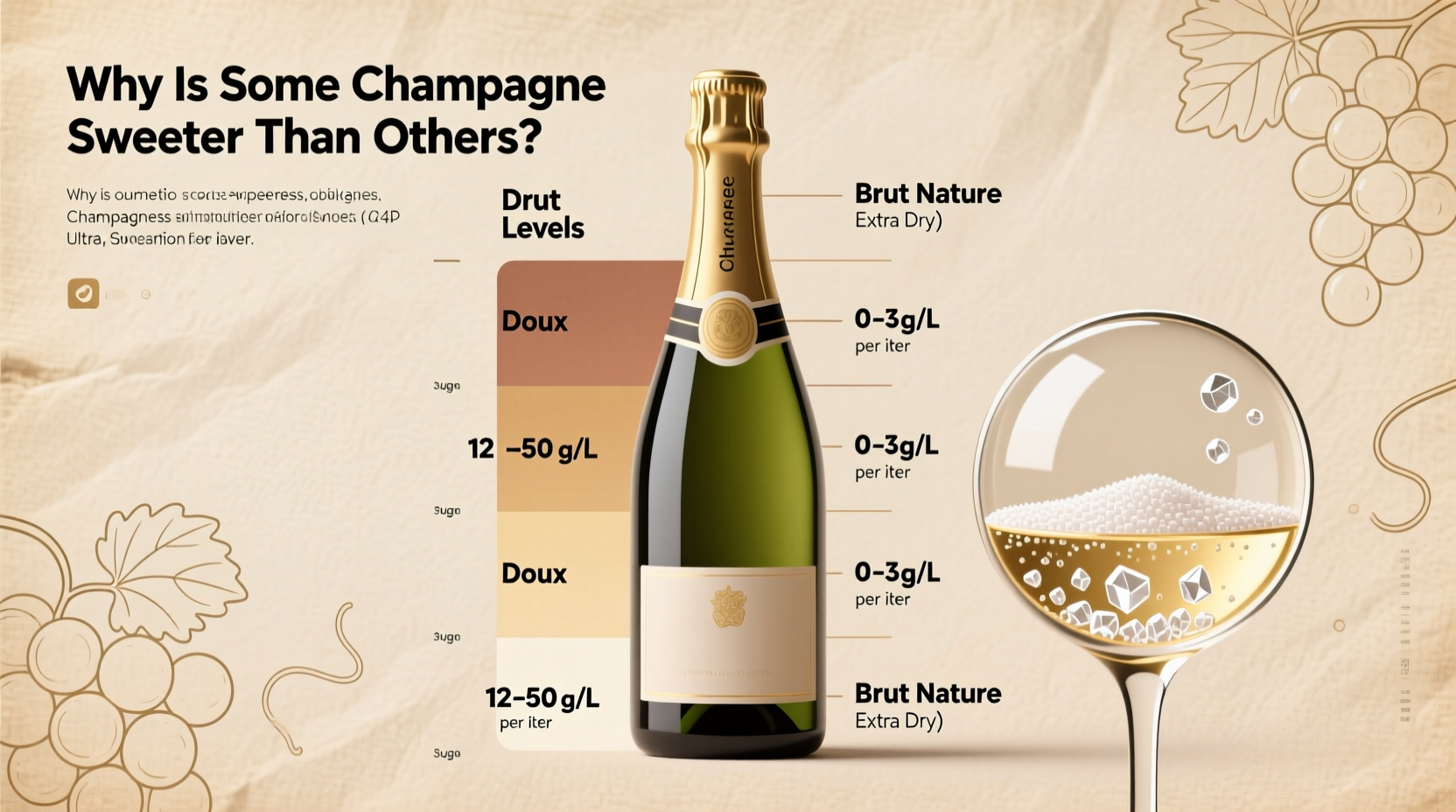
Contrary to popular belief, Champagne’s sweetness is not determined by the grapes or fermentation alone. The base wine—made from Chardonnay, Pinot Noir, and Pinot Meunier—is almost always fermented to full dryness. Residual sugar is negligible at this stage. The defining moment comes after secondary fermentation in bottle and disgorgement, when the yeast sediment is removed. At that point, the winemaker adds a mixture called the liqueur d’expédition: a blend of wine (often from the same vintage or cuvée) and cane sugar or beet sugar. This addition, known as the dosage, fills the void left by the expelled lees and fine-tunes the wine’s final balance.
The amount of sugar in the dosage—measured in grams per liter (g/L)—determines the official sweetness category. These categories are legally defined by the Comité Champagne and apply to all wines bearing the AOC Champagne designation. Crucially, they reflect objective sugar content—not subjective perception. A wine with higher acidity (like many from cooler vintages or Chardonnay-dominant blends) can carry more sugar without tasting overtly sweet, while a lower-acid wine with the same dosage may feel noticeably richer.
Tip: When selecting Champagne, look beyond the label’s sweetness term—check the technical sheet or producer website for the exact g/L dosage. A “Brut” at 6 g/L will taste markedly drier than a “Brut” dosed at 11 g/L.Decoding the Official Sweetness Categories (From Driest to Sweetest)
The Champagne appellation defines seven legal sweetness categories, each with strict g/L thresholds. These standards have evolved over time, especially since the 1980s, when consumer preference shifted decisively toward drier styles. Today, “Brut” dominates global markets—but its range is wider than most realize.
| Sweetness Term | Sugar Range (g/L) | Practical Description |
|---|---|---|
| Zero Dosage / Brut Nature | 0–3 g/L | No added sugar; only naturally occurring residual sugar. Often intensely crisp, saline, and mineral-driven. May show subtle autolytic bitterness. |
| Extra Brut | 0–6 g/L | Dry and austere, with emphasis on structure and tension. Increasingly favored by sommeliers and producers seeking purity. |
| Brut | 0–12 g/L | The most common category. Encompasses enormous stylistic variation—from bone-dry (3 g/L) to softly rounded (11.9 g/L). Most non-vintage Champagnes fall here. |
| Extra Dry (or Extra Sec) | 12–20 g/L | Misleadingly named: this is perceptibly off-dry. Historically created for 19th-century British and American palates; now rare outside specialty cuvées. |
| Dry (Sec) | 17–35 g/L | Noticeably sweet, with ripe fruit and honeyed notes. Rare in modern production—mostly seen in historic-style or dessert-focused bottlings. |
| Demi-Sec | 33–50 g/L | Distinctly sweet, balancing richness with acidity. Traditionally paired with fruit tarts or blue cheese—not an aperitif wine. |
| Doux | 50+ g/L | Very sweet, almost syrupy. Nearly extinct; fewer than ten producers still make it, usually as a novelty or heritage release. |
Note the overlap between “Extra Dry” (12–20 g/L) and “Dry” (17–35 g/L): a wine at 18 g/L could legally be labeled either, though producers now almost universally choose “Extra Dry” for clarity. Also observe that “Brut” has the widest possible range—nearly four times broader than “Extra Brut.” That flexibility explains why two bottles both labeled “Brut” can deliver such different experiences on the palate.
Why “Extra Dry” Isn’t Extra Dry—A Historical Quirk
The confusion around “Extra Dry” stems directly from 19th-century trade practices. When Champagne first gained popularity in London and New York, British merchants found traditional French “Brut” (then ~15–22 g/L) too austere. They requested softer, rounder wines—and producers obliged by adding more sugar. To distinguish these sweeter versions from standard “Brut,” they were labeled “Extra Dry”—a tongue-in-cheek nod to their British clientele’s ironic sense of humor. The term stuck, even as Champagne itself grew drier over time.
By the 1970s, as French producers reclaimed stylistic control and acidity-focused winemaking rose, “Brut” was redefined downward—to 0–15 g/L, then later to 0–12 g/L. But “Extra Dry” remained anchored at 12–20 g/L, preserving its ironic legacy. As wine educator and Master of Wine Sarah Ahmed explains:
“‘Extra Dry’ is Champagne’s most enduring inside joke—a label born from transatlantic negotiation, not sensory description. It reminds us that wine terminology is never neutral: it’s shaped by market forces, translation errors, and the quiet power of importers.” — Sarah Ahmed MW, author of Champagne Guide
This historical context matters because it reveals how deeply Champagne’s identity is tied to dialogue—not just between vineyard and cellar, but between grower and merchant, France and the world. A bottle labeled “Extra Dry” isn’t flawed or outdated; it’s a conscious stylistic choice echoing over 150 years of cross-cultural exchange.
A Real-World Example: How Dosage Transforms a Single Cuvée
In 2021, the grower-producer Pierre Péters released three versions of its single-vineyard Blanc de Blancs “Les Chetillons,” all from the same base wine, same aging period (48 months on lees), and identical disgorgement date. The only variable? Dosage.
- Version A (Brut Nature): 0 g/L dosage. Tasted with searing acidity, crushed oyster shell, green almond, and a chalky finish. Paired brilliantly with raw scallops and lemon oil.
- Version B (Brut): 7 g/L dosage. The same wine, now with gentle roundness—ripe pear and brioche emerging, acidity still vibrant but integrated. A versatile aperitif and food wine.
- Version C (Demi-Sec): 42 g/L dosage. Unmistakably sweet, with candied citrus peel, gingerbread, and marzipan. Served chilled with Roquefort and quince paste—it transformed from celebratory fizz into a contemplative digestif.
This experiment illustrates a critical principle: dosage doesn’t “sweeten” Champagne in a simplistic way. It modulates texture, lengthens finish, softens phenolic grip, and can even amplify perceived fruit intensity—even as it increases measurable sugar. The same base wine became three distinct expressions—not better or worse, but calibrated for different moments, moods, and meals.
How to Choose the Right Sweetness Level—A Practical Checklist
Selecting Champagne isn’t about chasing “dryness” or “sweetness” as virtues—but about matching structure to intention. Use this checklist before your next purchase:
- Consider the occasion: Brut Nature or Extra Brut for oysters or sushi; Brut for canapés or pre-dinner; Demi-Sec for dessert or cheese service.
- Assess the food pairing: High-acid dishes (ceviche, goat cheese) balance well with higher dosage; rich, fatty foods (foie gras, duck confit) gain harmony from Extra Brut or Brut.
- Check the grape composition: Chardonnay-dominant Champagnes often handle higher dosage gracefully due to natural acidity; Pinot Meunier-dominant wines tend to taste fruitier at lower dosages.
- Read beyond the label: Look for dosage figures on producer websites, importer tech sheets, or apps like Vivino or Wine-Searcher.
- Taste before committing: If buying by the glass or at a tasting, ask for comparisons—try the same house’s Brut and Extra Brut side-by-side to train your palate.
FAQ: Clarifying Common Misconceptions
Does “Brut” mean the same thing across all sparkling wines?
No. While Champagne’s sweetness categories are strictly regulated, other sparkling wines—including Cava, Crémant, and Prosecco—use similar terms but with different legal definitions. For example, Cava’s “Brut” allows up to 12 g/L (same as Champagne), but its “Brut Nature” permits up to 3 g/L—identical—whereas some New World sparklers use “Brut” loosely with no legal oversight. Always verify origin and appellation.
Can I tell sweetness by smelling or tasting alone?
Not reliably. Acidity, temperature, alcohol level, and even glass shape profoundly influence perceived sweetness. A warm, low-acid Brut at 10 g/L may taste sweeter than a chilled, high-acid Extra Brut at 5 g/L. Professional tasters rely on lab analysis—not palate alone—to assign categories. Trust the g/L figure over first impressions.
Do vintage Champagnes tend to be drier than non-vintage?
Not inherently. Vintage Champagnes often receive slightly lower dosage to preserve their expressive terroir and structural integrity—but dosage decisions remain stylistic, not formulaic. Some prestige vintage cuvées (e.g., Krug Grande Cuvée) maintain consistent dosage year after year, while others (e.g., Bollinger La Grande Année) adjust based on vintage character. Always consult the producer’s stated dosage for that release.
Conclusion: Taste With Precision, Not Assumption
Understanding Champagne’s sweetness levels isn’t about memorizing numbers—it’s about reclaiming agency in how you experience one of the world’s most nuanced wines. When you recognize that “Extra Dry” carries centuries of Anglo-French negotiation, or that a “Brut” at 4 g/L and one at 11 g/L represent radically different philosophies of balance, you move beyond passive consumption into engaged appreciation. You begin to see dosage not as a compromise, but as the final brushstroke in a complex portrait—one that accounts for soil, season, variety, and vision. Next time you lift a flute, pause before the first sip. Ask not “Is this sweet?” but “What role does sugar play here—and what does that tell me about the grower’s intent?” That shift in perspective transforms every bubble into a story waiting to be read.
💬 Have you tasted the same Champagne at different dosage levels? Share your comparison—what surprised you? What food pairing worked best? Your real-world insights help fellow enthusiasts decode the bubbles, one bottle at a time.