
It’s a familiar scene: the lights dim, the overture swells, and your child—previously excited about “seeing the ballet”—bursts into tears at the first appearance of the Mouse King’s shadow or the sudden thunderclap of the cannon. Or perhaps it’s not live performance but the 1993 animated film, where Clara’s wide-eyed wonder gives way to unsettling transformations: toy soldiers marching with rigid precision, Drosselmeyer’s knowing gaze lingering just a beat too long, or the Nutcracker’s face shifting from wooden stillness to something eerily sentient. These aren’t isolated reactions. Developmental psychologists report a marked spike in anxiety-related behaviors around holiday performances between ages 2½ and 7—particularly tied to stylized animation, abrupt tonal shifts, and symbolic representations of power, transformation, and loss of control.
Fear in this context isn’t a sign of fragility or overprotection. It’s neurologically grounded, emotionally intelligent, and often deeply meaningful. The Animated Nutcracker—whether in film, stage adaptation, or classroom video—functions as a potent cultural vessel carrying centuries of folklore, Romantic-era symbolism, and psychological archetypes. For young children still consolidating their understanding of reality versus fantasy, intention versus accident, and safety versus threat, its imagery can feel viscerally real. This article explores not only *why* these fears arise, but how to meet them—not by dismissing, distracting, or overriding, but by anchoring the experience in co-regulation, narrative clarity, and respectful developmental scaffolding.
The Developmental Roots of Nutcracker Anxiety
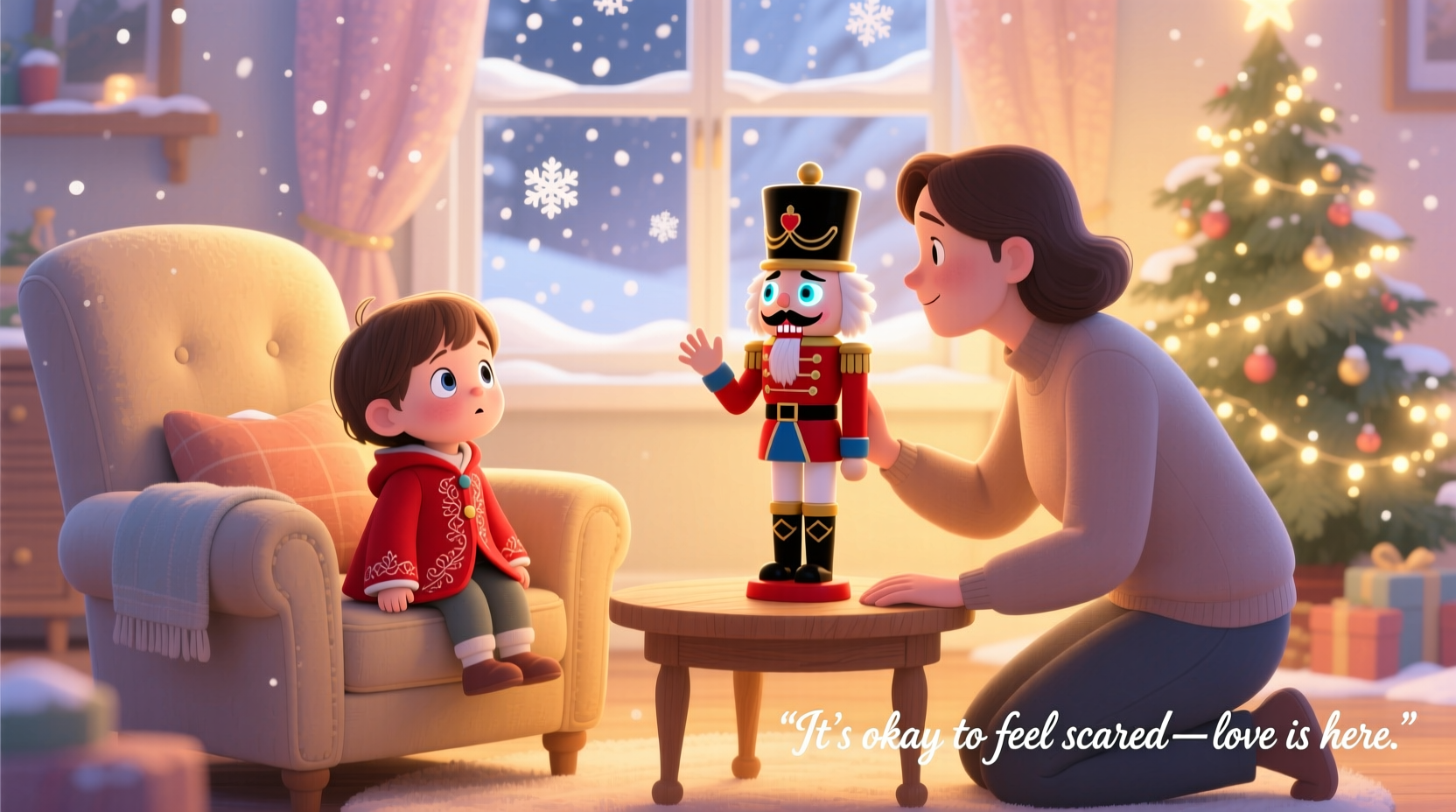
Children under age 7 operate primarily in Piaget’s preoperational stage: concrete thinking dominates, imagination is inseparable from perception, and cause-and-effect reasoning remains incomplete. A roaring mouse isn’t “just pretend”—it registers physiologically as danger. The Nutcracker’s narrative hinges on precisely the themes that trigger core childhood vulnerabilities:
- Loss of bodily autonomy: Clara falls asleep and awakens in a world where she cannot speak, move freely, or influence outcomes—mirroring real-life experiences of medical procedures, transitions (e.g., new school), or even bedtime routines.
- Uncertain boundaries between animate and inanimate: Toys come alive, furniture grows, and clocks chime with intention. For children still mastering object permanence and agency attribution, this blurs a foundational cognitive line.
- Unpredictable authority figures: Drosselmeyer is kind, then cryptic; benevolent, then inscrutable. His gifts carry weight and consequence—echoing real-world adult figures whose motives children cannot yet decode.
- Sudden scale shifts: Clara shrinks; mice tower; the Christmas tree grows to celestial height. These visual metaphors for powerlessness resonate with children’s lived experience of being small in a large, fast-moving world.
This isn’t irrational fear—it’s pattern-matching at work. The brain detects threat cues (deep bass tones, rapid camera movement, asymmetrical faces, looming shadows) and activates the amygdala before the prefrontal cortex can contextualize them. As Dr. Laura Kirmayer, pediatric neuropsychologist and author of Childhood Anxiety in Context, explains:
“The Nutcracker doesn’t frighten children because it’s ‘scary’—it frightens them because it speaks their unspoken language: the terror of being unseen, the exhaustion of constant adaptation, the quiet grief of childhood transitions. When we label that fear ‘irrational,’ we silence the very signal we need to hear.” — Dr. Laura Kirmayer, Pediatric Neuropsychologist
Why Animation Amplifies the Fear (Compared to Live Performance)
Many parents assume animation would be gentler than live theater—softer edges, brighter colors, controlled pacing. Yet research from the Child Media Lab at NYU shows animated adaptations of classic stories elicit stronger physiological stress responses (elevated heart rate, cortisol spikes) in children aged 4–6 than live counterparts. Why?
| Feature | Live Performance Effect | Animated Adaptation Effect |
|---|---|---|
| Visual Consistency | Human performers retain recognizable facial structure and micro-expressions—even when costumed, eyes and mouth remain readable. | Stylized proportions (e.g., exaggerated mouse teeth, glassy doll eyes) violate the “uncanny valley” threshold, triggering subconscious unease. |
| Sound Design | Ambient acoustics soften sharp sounds; audience presence provides social referencing (“others aren’t fleeing”). | Digital audio compression intensifies low-frequency rumbles (cannon blasts, growls); silence feels heavier and more intentional. |
| Pacing & Editing | Natural pauses, breaths, and imperfections allow cognitive reset between intense moments. | Quick cuts, zooms, and dissolves prevent emotional regulation—no time to process one image before the next overwhelms. |
| Agency Cues | Children see performers choose expressions, adjust timing, and respond to audience energy—reinforcing human control. | Animation feels autonomous, inevitable, and unchangeable—heightening helplessness. |
This isn’t a flaw in animation—it’s a feature of its medium. But it demands different preparation strategies than live theater.
Tip: Watch the first 90 seconds of your chosen Nutcracker adaptation *without sound*, observing only visuals. Note which frames make you pause or lean back. That’s your child’s likely stress point—prepare for it explicitly.A Real Example: Maya, Age 5, and the “Shiny Eyes” Moment
Maya loved storybooks about toys and had attended two gentle holiday concerts without incident. Her parents chose the 2018 animated special—bright, modern, and marketed as “preschool-friendly.” At minute 8:42, the Nutcracker’s eyes gleam with unnatural silver light as he turns toward Clara. Maya froze. Then whispered, “His eyes are stealing mine.” She covered her own eyes with both hands and refused to uncover them for 17 minutes—even when the scene shifted to dancing flowers. Her parents paused the video, knelt beside her, and asked, “What do shiny eyes mean to you?” Maya replied, “They mean he sees what I’m thinking and won’t let me forget.”
Instead of saying “It’s not real,” they validated: “That *would* feel scary—to think someone could see your private thoughts.” They then co-created a “thought shield”: Maya drew a circle around her eyes on paper, labeled it “My Mind Door,” and decided only people she invited could look through it. Two days later, she watched the scene again—pausing at the shiny eyes, tracing her “Mind Door” on her temples, and whispering, “I’m keeping my thoughts safe.” She finished the film, asked to rewatch the snowflake dance, and drew three Nutcrackers—all with soft, sleepy eyes.
Maya’s response wasn’t about the animation—it was about sovereignty. Her fear named a real developmental need: the right to mental privacy. The solution wasn’t exposure or desensitization. It was narrative repair.
Practical, Developmentally Grounded Strategies
Effective support requires moving beyond “don’t worry” to active, collaborative meaning-making. These approaches integrate neuroscience, attachment theory, and early childhood pedagogy:
Step-by-Step Preparation Timeline (Start 10 Days Before Viewing)
- Day 10–8: Introduce the *story skeleton*—not characters, but relationships: “Clara has a grown-up friend who gives gifts. One gift helps her see the world differently.” Avoid naming the Nutcracker or Mouse King.
- Day 7–5: Co-create “feeling maps.” Draw Clara’s face at different moments (sleeping, surprised, curious). Ask: “Where do you feel surprise in your body? What helps it settle?” Name sensations—not emotions (“butterflies” vs. “scared”).
- Day 4: Watch a 60-second clip *with sound off*. Identify shapes, colors, movements. “Which part feels heavy? Which part feels light? Where does the music live in your shoulders?”
- Day 3: Introduce one potentially challenging image (e.g., Mouse King silhouette) as a “story symbol.” Discuss: “What might this shadow protect? What might it hide? What would make it feel less alone?”
- Day 2: Practice “pause power.” Use a remote with a large, tactile button. Press it together at moments of tension. Breathe. Name one thing you see that feels safe (e.g., “the red ribbon,” “Clara’s sock”).
- Day 1: Set “viewing conditions”: dimmed (not dark) lights, favorite blanket, no expectations to watch continuously. Say: “You get to decide when your eyes need a break—and that’s wise, not weak.”
Do’s and Don’ts During and After Viewing
| Action | Do | Don’t |
|---|---|---|
| When fear arises | “Your body is telling you something important. Let’s sit with it quietly.” Offer deep pressure (hand squeeze, weighted lap pad). | Say “There’s nothing to be scared of” or “Big kids aren’t scared.” |
| Explaining symbolism | “The big mouse isn’t real—but sometimes our worries feel that big. What makes your worry feel big right now?” | Explain allegory literally (“The mice represent greed”) or impose adult interpretations. |
| After viewing | Invite drawing, clay, or movement: “Show me how Clara’s courage felt in her feet/hands/voice.” | Ask “Did you like it?” or demand verbal processing before the child initiates. |
| Repetition requests | Honor them. Re-watch the *same scene* with new focus: “This time, let’s count all the blue things.” | Limit repeats assuming “overexposure” will cause harm—ritualistic re-engagement builds mastery. |
FAQ: Addressing Common Caregiver Concerns
“Should I skip the Nutcracker entirely if my child is anxious?”
No—unless avoidance itself becomes the primary coping strategy. The goal isn’t exposure for its own sake, but relational attunement within challenge. Many children who initially resist later seek out Nutcracker-themed books, crafts, or music once they’ve co-authored their own sense of safety. Skipping may inadvertently signal that their feelings are too overwhelming to hold alongside you—reinforcing isolation rather than resilience.
“My child says the Nutcracker is ‘watching them’ after watching. Is this normal?”
Yes—and profoundly developmentally appropriate. Children aged 3–6 commonly experience “psychological continuity”: the belief that representations (photos, drawings, animations) retain awareness of them. This isn’t magical thinking—it’s evidence of emerging theory of mind. Gently affirm: “You’re noticing how powerful images can feel. That’s how artists make stories stick. Would you like to draw *your* version—the one who watches over *you*?”
“We already watched and it went badly. Can we repair it?”
Absolutely. Initiate a “story revision” session: “What if Clara had a tiny whistle to call help? What if the Nutcracker blinked slowly, like a sleepy friend? What if the snowflakes sang her favorite song?” Co-creation rebuilds neural pathways associated with safety and agency. Research shows children who engage in narrative repair after distress show 40% higher emotional regulation scores in subsequent novel stressors (Journal of Early Childhood Development, 2022).
Conclusion: Honoring Fear as a Compass, Not a Barrier
The Animated Nutcracker doesn’t ask children to be brave. It asks them to be present—to witness transformation, navigate ambiguity, and hold space for both wonder and unease. When your child trembles at the Mouse King’s entrance or hides during the battle scene, they aren’t failing at holiday joy. They’re practicing one of childhood’s most vital skills: discerning what feels true in their body, and trusting that an adult will honor that truth without fixing it away.
Gentle accompaniment doesn’t mean shielding from intensity—it means anchoring intensity in relationship. It means letting the cannon blast echo, then naming the vibration in your own chest. It means pausing the screen to trace the curve of your child’s knuckles, saying, “This hand is real. This breath is real. We’re here together.” In those moments, the Nutcracker ceases to be a source of fear and becomes something far more enduring: a shared language for the tender, complicated work of growing up.
💬 Your experience matters. Have you navigated Nutcracker anxiety with creativity or compassion? Share one sentence of what worked—or what you wish you’d known—in the comments. Your insight could be the lifeline another parent needs this season.