Order a glass of Pinot Noir at 35,000 feet and you might find it flat, metallic, or oddly sour—despite tasting vibrant and balanced just hours earlier in the lounge. This isn’t your imagination. It’s physiology meeting physics: the pressurized cabin environment fundamentally reshapes how we perceive wine. While many blame “bad airline wine,” the real culprit is far more fascinating—and entirely predictable. Understanding this phenomenon doesn’t just demystify in-flight dining—it reveals how deeply our senses rely on environmental context, and how even subtle shifts in atmospheric conditions can mute fruit, amplify bitterness, and dull complexity.
The Physiology of Taste at Altitude
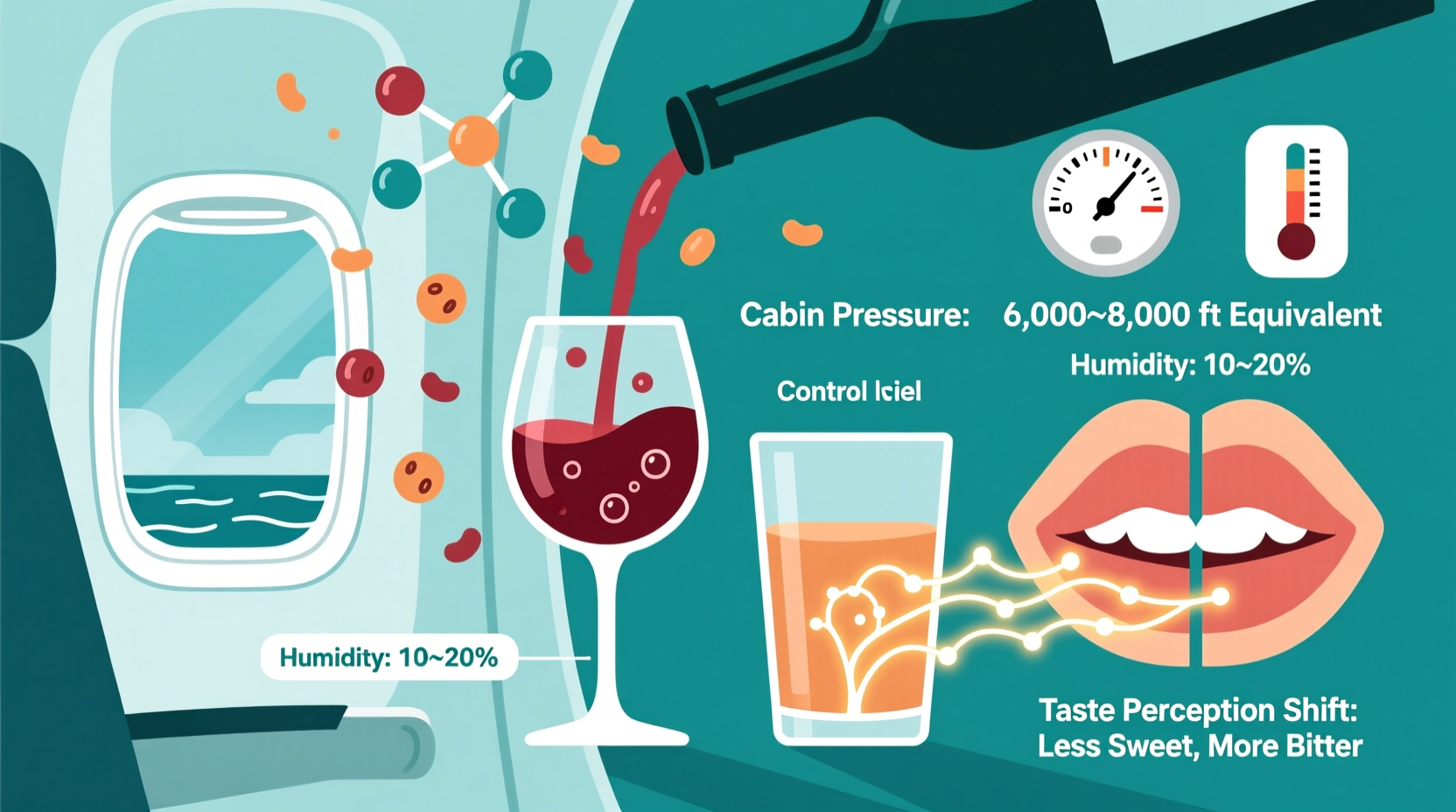
Human taste perception isn’t isolated to the tongue. It’s a multisensory integration of gustation (taste buds), olfaction (smell), trigeminal sensation (tingling, heat, astringency), and even auditory input. At cruising altitude, three interlocking factors degrade this integration: reduced cabin pressure, extremely low humidity (often below 12%), and elevated background noise (75–85 dB). Together, they don’t just change *what* you taste—they change *how much* you taste.
Cabin pressure is typically maintained at the equivalent of 6,000–8,000 feet above sea level—roughly the same as Aspen or La Paz. That means partial pressure of oxygen drops by ~25% compared to sea level. Studies using functional MRI show reduced blood oxygen saturation correlates with decreased activity in the orbitofrontal cortex—the brain region responsible for flavor evaluation and hedonic judgment. In simpler terms: your brain literally has less metabolic energy to process and enjoy complex sensory input.
Simultaneously, the cabin’s arid air desiccates nasal mucosa. Since up to 80% of “taste” comes from retronasal olfaction—the volatile compounds traveling from the back of the mouth to the olfactory bulb—dry membranes impair odor detection. A 2014 study published in Food Quality and Preference found participants identified only 36% of common wine aromas (e.g., blackberry, violet, cedar) under simulated flight conditions versus 72% at sea level. Without aroma, wine loses its signature character and becomes one-dimensional.
Tip: Hydrate aggressively before and during flights—even sipping water every 15 minutes helps maintain mucosal moisture and supports baseline olfactory function.How Cabin Pressure Directly Alters Flavor Chemistry
It’s not just biology—physics plays a measurable role. Reduced partial pressure changes the volatility and solubility of key wine compounds. Ethanol, esters (fruity notes), and terpenes (floral lift) become less volatile at lower pressure, meaning fewer aromatic molecules escape the liquid surface and reach your nose. Meanwhile, acidity—especially tartaric and malic acids—feels more pronounced because saliva production decreases in dry air, reducing natural buffering. The result? Wines taste sharper, leaner, and less rounded.
Bitterness and astringency also intensify. Tannins bind more readily to dehydrated oral proteins, creating a harsher, drier mouthfeel. A 2017 sensory trial by Lufthansa’s in-house oenology team confirmed that Cabernet Sauvignon served at 8,000-ft equivalent pressure registered 32% higher perceived bitterness and 27% greater astringency than the same bottle served at ground level—despite identical chemical composition.
Umami and salt perception remain relatively stable, which explains why savory, umami-rich foods (tomato juice, soy-glazed dishes) often taste *better* on planes. This is why Bloody Marys are a cult favorite at 35,000 feet: their glutamate and sodium cut through sensory fatigue while complementing the muted fruit profile of most reds.
Airlines’ Strategic Responses: From Vineyard to Glass
Forward-thinking carriers treat in-flight wine service not as a concession but as a calibrated sensory experience. Lufthansa, Singapore Airlines, and Air France invest in dedicated altitude-specific cuvées—wines selected or even co-developed with winemakers to compensate for flight conditions.
| Factor | Ground-Level Preference | Optimal In-Flight Profile | Rationale |
|---|---|---|---|
| Aroma Intensity | Moderate to high | Very high (e.g., Gewürztraminer, Torrontés) | Compensates for reduced olfactory sensitivity |
| Acidity | Balanced, refreshing | Lower to medium (avoid high-malic wines) | Prevents overwhelming sharpness in dry air |
| Tannin Structure | Firm but integrated | Soft, supple, or low (e.g., Merlot-dominant blends) | Minimizes amplified astringency |
| Sugar Residual | Dry (0–4 g/L) | Off-dry (6–12 g/L) | Counters perceived bitterness and enhances fruit perception |
| Alcohol Level | 13.5–14.5% | 12.5–13.2% | Reduces ethanol burn and drying effect on mucosa |
Crucially, these wines undergo rigorous testing—not just in labs, but in actual flight simulators with trained tasters. Singapore Airlines’ “Wine Lab” subjects candidates to 72-hour cycles of pressurization, humidity control, and noise exposure to assess stability and sensory resilience. The goal isn’t to serve “better” wine, but wine engineered for fidelity *within the constraints of the environment*.
Real-World Impact: A Case Study with British Airways
In 2019, British Airways overhauled its long-haul wine program after passenger feedback revealed consistent dissatisfaction with its Bordeaux selections. Internal taste panels confirmed the issue: classic Left Bank Cabernets tasted hollow and overly tannic mid-flight, while customers reported “no fruit” and “bitter finish.” Rather than downgrade quality, BA partnered with Bordeaux négociant Maison Sichel to develop a proprietary blend: 60% Merlot, 30% Cabernet Franc, 10% Petit Verdot—fermented with native yeasts and aged exclusively in neutral oak to preserve freshness and soften tannin.
The new cuvée, branded “Altitude Reserve,” was tested across 120 transatlantic flights. Post-flight surveys showed a 41% increase in “excellent” or “very good” ratings for red wine satisfaction. More tellingly, blind tastings revealed passengers consistently rated the Altitude Reserve as “fruit-forward” and “balanced” mid-flight—while identical vintages of traditional Pauillac were described as “drying” and “thin.” BA didn’t change the wine’s DNA; they changed its sensory architecture to align with human physiology at altitude.
What You Can Do: A Practical Passenger’s Guide
You don’t need a sommelier’s training—or an airline’s R&D budget—to improve your in-flight wine experience. Small, evidence-based adjustments make a tangible difference.
- Hydrate proactively: Drink 250 mL of water 30 minutes before takeoff and continue sipping throughout the flight. Dehydration begins before boarding due to pre-flight stress and airport HVAC systems.
- Choose wisely: Prioritize aromatic whites (Riesling, Albariño, Grüner Veltliner) or fruit-forward, low-tannin reds (Beaujolais, Valpolicella Classico, young Zinfandel). Avoid high-acid Sauvignon Blanc and heavily oaked Chardonnay.
- Wait 10 minutes after service: Let the wine warm slightly (from fridge-cold to ~12°C) and aerate in the glass. Cold temperatures further suppress aroma volatility; gentle warming releases trapped esters.
- Pair strategically: Match wine to meal components, not just the main protein. A creamy pasta sauce softens tannin; roasted nuts enhance nutty, oxidative notes in Sherry or older white Burgundies.
- Use scent priming: Before sipping, gently swirl and sniff the wine, then inhale the aroma deeply through your nose *and* mouth simultaneously (retronasal breathing). This activates olfactory receptors despite dry mucosa.
“Taste isn’t absolute—it’s contextual. At altitude, we’re not serving inferior wine. We’re serving wine in a compromised sensory environment. The solution isn’t better grapes; it’s better alignment between chemistry, physiology, and context.” — Dr. Sarah Lin, Sensory Neuroscientist & Lead Researcher, Cornell University Food Science Department
Frequently Asked Questions
Does cabin pressure actually change the chemical composition of wine?
No—cabin pressure doesn’t alter wine’s molecular structure or alcohol content. What changes is the *volatility* of aromatic compounds and the *perception* of taste and smell due to physiological adaptation. The wine remains chemically identical; your sensory system interprets it differently.
Why do some people say tomato juice tastes amazing on planes—but others hate it?
This reflects individual variation in umami receptor density (TAS1R1/TAS1R3 genes) and baseline saliva viscosity. Those with higher umami sensitivity experience intense savory depth, while others perceive excess saltiness or metallic notes. It’s a genetic phenotype—not a universal truth.
Can I bring my own wine onboard?
Most major airlines prohibit passengers from consuming personal alcohol, even if purchased duty-free. Exceptions exist for private jets or certain charter services. Always check your carrier’s policy pre-flight—attempting to open a bottle may trigger security protocols.
Conclusion: Reclaiming the Ritual
Wine on an airplane isn’t broken—it’s revealing. It exposes how fragile and context-dependent our sensory world truly is. When a glass of Barolo loses its rose petal perfume and structural grace at 35,000 feet, it’s not failing. It’s holding up a mirror to the extraordinary precision with which our bodies calibrate perception against gravity, humidity, and sound. Understanding this doesn’t diminish the experience—it deepens it. It transforms confusion into curiosity, disappointment into discernment. Next time you’re handed that small pour, pause. Breathe. Hydrate. Choose intentionally. And remember: the wine hasn’t changed. You have—temporarily, profoundly, and fascinatingly—become a different taster. That’s not a limitation. It���s a reminder that flavor is never just in the bottle. It’s in the space between the wine, the air, and the mind that meets them both.
💬 Have you noticed how specific wines behave mid-flight? Share your observations—your real-world tasting notes could help fellow travelers refine their choices. Comment below with your top in-flight varietal and why it works!