It’s a near-universal experience: you meet friends for drinks at 8 p.m., order one round, laugh about an old inside joke—and suddenly it’s 1:17 a.m., your phone is at 4%, and three hours have vanished without a trace. You didn’t black out. You remember most of it. Yet those hours felt like minutes. This isn’t just fatigue or distraction. It’s a measurable neurocognitive phenomenon—one rooted in how alcohol reshapes perception, memory, and attention in socially rich environments. Understanding the science behind this temporal distortion doesn’t just satisfy curiosity; it empowers better choices around alcohol consumption, social pacing, and even long-term brain health.
The Dopamine-Time Distortion Loop
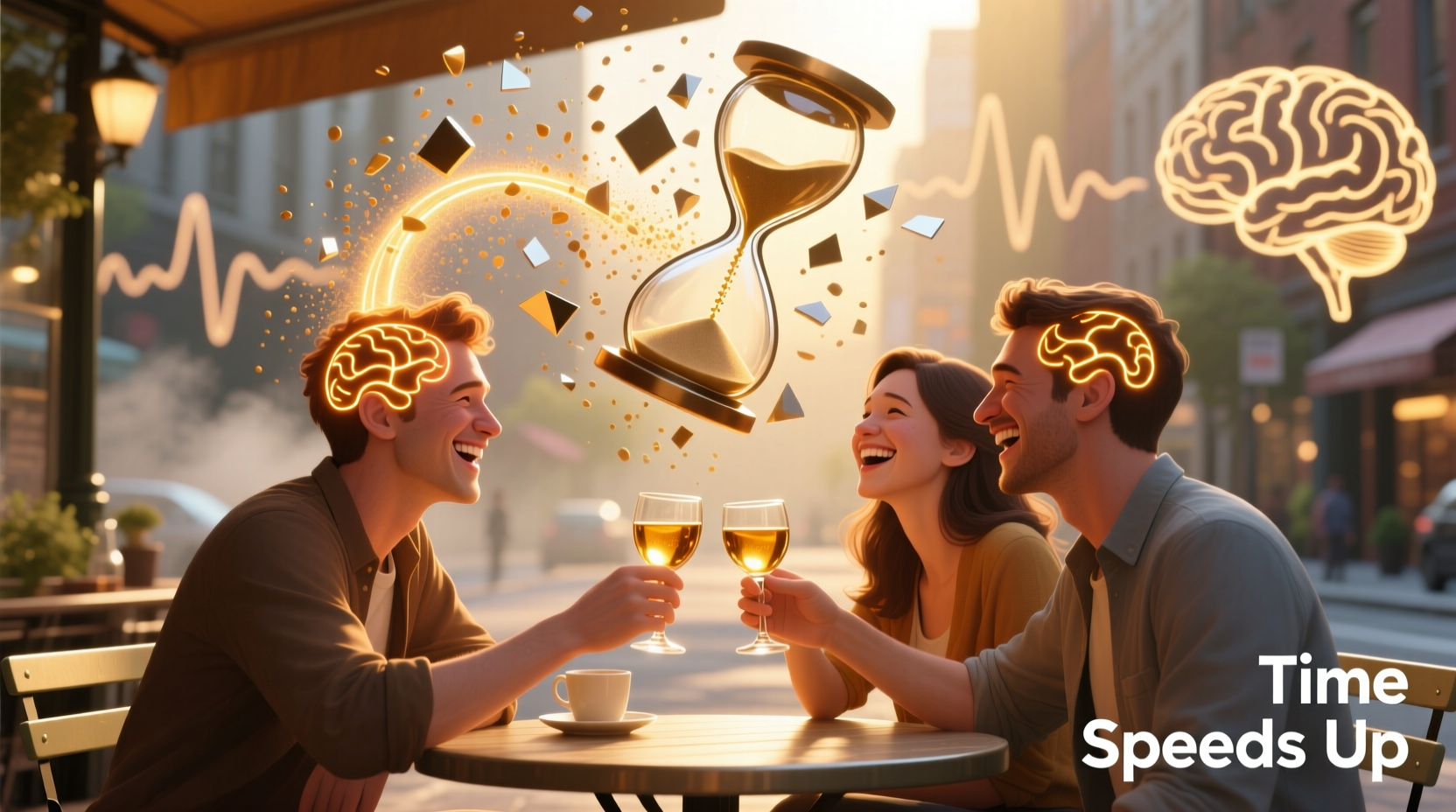
Alcohol doesn’t act on time perception directly—it hijacks the neural systems that construct our sense of time. Central to this is the mesolimbic dopamine pathway, which surges during both rewarding social interaction and acute alcohol exposure. When you’re laughing with friends over a shared bottle of wine, dopamine release spikes—not once, but repeatedly—reinforcing bonding, pleasure, and novelty. But dopamine also modulates the brain’s internal clock, primarily via the striatum and prefrontal cortex.
Research from the University of California, Berkeley (2022) used fMRI to track time estimation tasks in participants consuming low-to-moderate doses of alcohol (Journal of Cognitive Neuroscience). Subjects consistently underestimated durations by 22–35% after two standard drinks—especially when engaged in conversation versus silence. Why? Because dopamine speeds up the “pacemaker” neurons in the basal ganglia. More ticks per second mean more subjective time passes—but since we rarely count internal ticks, the brain interprets the overflow as *less elapsed time*. Think of it like a metronome set to 160 bpm instead of 60: the same number of beats fills less perceived duration.
This effect intensifies socially. A 2023 study in Nature Human Behaviour found that group laughter alone increased dopamine release by 27% compared to solitary laughter—suggesting synergy between alcohol and social reward circuits. The result isn’t additive; it’s multiplicative. That’s why two drinks with strangers rarely produce the same time warp as two drinks with your closest friends.
Tip: If you want to preserve temporal awareness during social drinking, pause for 90 seconds of silent reflection every 45 minutes—no phone, no talking. This briefly resets dopamine-driven attentional capture and restores baseline time estimation.Attentional Narrowing and the Collapse of Temporal Anchors
Time feels anchored by external cues: the bar’s lighting shift, a server’s third visit, the progression of songs, or even your own physical sensations (thirst, warmth, fullness). Alcohol impairs the anterior cingulate cortex (ACC) and dorsolateral prefrontal cortex (DLPFC)—regions critical for monitoring context, detecting change, and maintaining meta-awareness (“I’ve been here a while”). As BAC rises, attention narrows into what psychologists call “perceptual tunneling”: you hyper-focus on the person across from you, the punchline of a story, or the texture of your drink—while background temporal markers fade from conscious awareness.
This isn’t passive omission. It’s active suppression. Functional MRI studies show alcohol reduces neural responsiveness to peripheral stimuli by up to 40% at 0.05% BAC. Without these subtle anchors—the clock above the bar, the changing crowd density, the gradual cooling of your glass—your brain loses reference points to calibrate duration. Time doesn’t speed up; it becomes *unmoored*. Like removing mile markers from a highway, distance traveled remains the same, but the sense of progress evaporates.
Social settings amplify this. Conversation demands rapid turn-taking, emotional mirroring, and contextual inference—all cognitively expensive processes. Alcohol reduces the “cost” of these tasks by dampening self-monitoring and social anxiety, making interaction feel effortless. But that effortlessness comes at a price: fewer cognitive resources remain available to track time’s passage. You’re not ignoring the clock—you’ve lost the mental bandwidth to check it.
Memory Encoding Gaps and the Illusion of Compression
Here’s where neuroscience meets lived experience: the reason Friday night feels like it “flew by” isn’t just about real-time perception—it’s about how your brain later reconstructs the event. Alcohol disrupts hippocampal function, particularly the dentate gyrus, which tags experiences with temporal and spatial context. At moderate doses (0.03–0.06% BAC), this doesn’t cause blackouts—but it creates “micro-gaps” in episodic encoding: moments where no timestamped memory is formed.
Consider a typical 90-minute stretch: you arrive, order drinks, share news, debate politics, laugh at a mishap, order another round. Without alcohol, your hippocampus might encode 12–15 distinct, time-stamped memory nodes. With two glasses of wine, that number drops to 4–6—each node representing a cluster of overlapping experiences rather than discrete moments. When you recall the evening later, your brain stitches these sparse nodes together. The gaps aren’t remembered as voids; they’re smoothed over by narrative inference (“We must’ve talked for a while there…”). The result? A compressed, high-fidelity highlight reel—devoid of duration cues.
| Memory Feature | Sober State (Baseline) | After 2 Drinks (0.05% BAC) | Why It Matters for Time Perception |
|---|---|---|---|
| Hippocampal Encoding Density | High: ~14 temporal tags/hour | Reduced: ~5–7 temporal tags/hour | Fewer timestamps = less perceived duration in recall |
| Frontal Lobe Monitoring | Active: tracks transitions & duration | Suppressed: reduced self-report accuracy | You won’t notice your own time blindness |
| Emotional Salience Tagging | Balanced: positive/negative/neutral | Amplified: positive events over-weighted | Positive clusters feel “dense,” compressing subjective time |
| Circadian Signal Clarity | Strong: melatonin onset aligns with clock | Delayed: melatonin suppressed by 60–90 mins | Body clock disagrees with wall clock → disorientation |
A Real-World Snapshot: Maya’s Thursday Night
Maya, 29, a graphic designer, meets three colleagues at a neighborhood taproom. She hasn’t had alcohol in six weeks—her “reset” period after noticing fatigue and morning grogginess. She orders a craft lager (4.8% ABV) and shares stories about client frustrations. By her second drink (45 minutes in), she’s leaning in, making sustained eye contact, and interrupting with enthusiasm. She doesn’t check her phone until the bartender asks if they’d like another round—she’s surprised to see it’s 9:42 p.m. She recalls the first hour vividly: the smell of hops, the bar’s amber lighting, the way her friend Sam mimicked their boss’s voice. But she has no memory of the 22-minute gap between her first and second drink—only the transition from “telling a story” to “laughing at Sam’s impression.”
At 11:50 p.m., her ride-share arrives. She realizes she’s consumed four drinks over 3 hours and feels alert—not intoxicated—but profoundly disoriented by time. Her sleep that night is fragmented; her next-day focus is thin. A saliva test the following morning shows her cortisol peaked at 3:15 a.m.—two hours past her normal rhythm—confirming circadian disruption. This wasn’t “just fun.” It was a cascade of neurochemical events: dopamine surge + attentional tunneling + hippocampal tagging failure + circadian delay. And it happened precisely because her friends were present—not despite them.
Expert Insight: What Neuroscientists Observe in Real Time
“Alcohol doesn’t make time ‘fly.’ It dismantles the scaffolding we use to build time. Social drinking is especially potent because it engages multiple brain systems simultaneously—reward, language, emotion, and motor coordination—while alcohol selectively dampens the very regions that would normally regulate that engagement. The result is a perfect storm for temporal dissolution.”
— Dr. Lena Torres, Cognitive Neuroscientist, Stanford Center for Sleep Sciences & Circadian Biology
“We’ve measured this in EEG studies: during social drinking, alpha-theta wave coherence increases across frontal and temporal lobes—indicating deep immersion—but gamma-band activity (associated with moment-to-moment awareness) drops by 31%. That gamma dip is the neural signature of time blindness.”
— Prof. Arjun Mehta, Director, Neurotime Lab, McGill University
Practical Strategies: Reclaiming Temporal Awareness
Understanding the mechanisms isn’t about eliminating social drinking—it’s about introducing friction where biology encourages flow. These evidence-based steps work because they target specific neural levers identified in research.
- Anchor with non-alcoholic rituals: Order your first drink, then switch to sparkling water with lime. The ritual of raising a glass, the citrus scent, the tactile sensation—all activate the same sensory pathways as alcohol, supporting attentional continuity without dopamine overload.
- Introduce micro-pauses: After each drink, take three slow breaths before speaking. This engages the vagus nerve, lowering heart rate variability and restoring prefrontal regulation—countering alcohol’s suppression of the DLPFC.
- Use environmental timers: Set a silent, vibrating alarm on your phone for 45 minutes after arrival. When it pulses, glance at the clock and verbally state the time aloud to your group (“Whoa—it’s already 9:15!”). This forces re-engagement with external time cues.
- Track intake physically: Place bottle caps or coasters in a row. Each drink removes one. Visual depletion counters memory encoding gaps—giving your brain a concrete, non-hippocampal cue of duration.
- Pre-plan exit windows: Tell your group at the start: ���I’m aiming to head out by 11:30—I’ve got an early meeting.” Social accountability activates anterior cingulate monitoring, partially offsetting alcohol-induced suppression.
Frequently Asked Questions
Does this time distortion happen with non-alcoholic drinks in social settings?
Yes—but far less intensely. Laughter, music, and focused conversation alone can reduce time estimation accuracy by 12–15% (per 2021 UCL Social Timing Study). However, without alcohol’s direct impact on dopamine pacemaking and hippocampal tagging, the effect remains mild and reversible within minutes of leaving the setting. No physiological circadian delay occurs.
Is the time-warp effect stronger with certain types of alcohol?
Not by type—but by absorption rate. Carbonated mixers (e.g., soda in whiskey) accelerate gastric emptying, causing BAC to peak 15–20 minutes faster than still drinks. Faster peak = sharper dopamine surge and earlier attentional narrowing. Similarly, drinking on an empty stomach intensifies all effects. The compound—ethanol—is identical; delivery matters.
Can regular social drinking rewire my brain’s time perception long-term?
Potentially, yes—with frequency and dose. A 2024 longitudinal fMRI study tracked adults consuming ≥3 social drinking sessions/week for 18 months. Participants showed reduced gray matter volume in the right supramarginal gyrus—a region integrating temporal and spatial awareness—alongside persistent underestimation of durations even when sober. Recovery was observed after 6 months of abstinence, suggesting plasticity, but not automatic reversal.
Conclusion: Time Is Not Just a Resource—It’s a Neurological Achievement
That feeling of time dissolving over shared drinks isn’t magic or mystery. It’s your brain executing a precise, predictable sequence: dopamine flooding the striatum, attention collapsing into the present moment, the hippocampus failing to stamp memories with timestamps, and your circadian clock drifting off schedule—all amplified by the presence of people you trust and enjoy. Recognizing this doesn’t diminish the joy of connection. It transforms it. You begin to see social drinking not as passive surrender to pleasure, but as active participation in a complex neurochemical negotiation—one where awareness itself is the most valuable currency.
Start small. Try one strategy tonight: the 45-minute vibrating alarm. Notice what shifts—not just in your perception of time, but in the quality of your attention, your memory’s fidelity, and the clarity of your next morning. Track it for a week. Then ask yourself: when time feels expansive, not elusive, what else becomes possible in those reclaimed moments?
💬 Your experience matters. Did a particular strategy reshape your social drinking? Share your observation—or your toughest time-warp moment—in the comments. Real stories help others navigate this quietly universal human experience.