Discovering a fine layer of crystals, haze, or cloudy particles at the bottom of an aged bottle of whiskey, brandy, or rum can startle even seasoned drinkers. It’s natural to pause—wondering whether that sediment signals spoilage, contamination, or simply the quiet work of time. The truth is more nuanced: sediment formation in aged spirits is often benign, even expected, but its meaning depends entirely on the spirit type, storage conditions, and chemical composition. Unlike wine—where sediment is widely understood—liquor sediment remains poorly explained in everyday conversation. This article cuts through the myths with science-backed clarity, practical assessment tools, and actionable guidance for anyone who values both safety and authenticity in their glass.
What Causes Sediment in Aged Liquor?
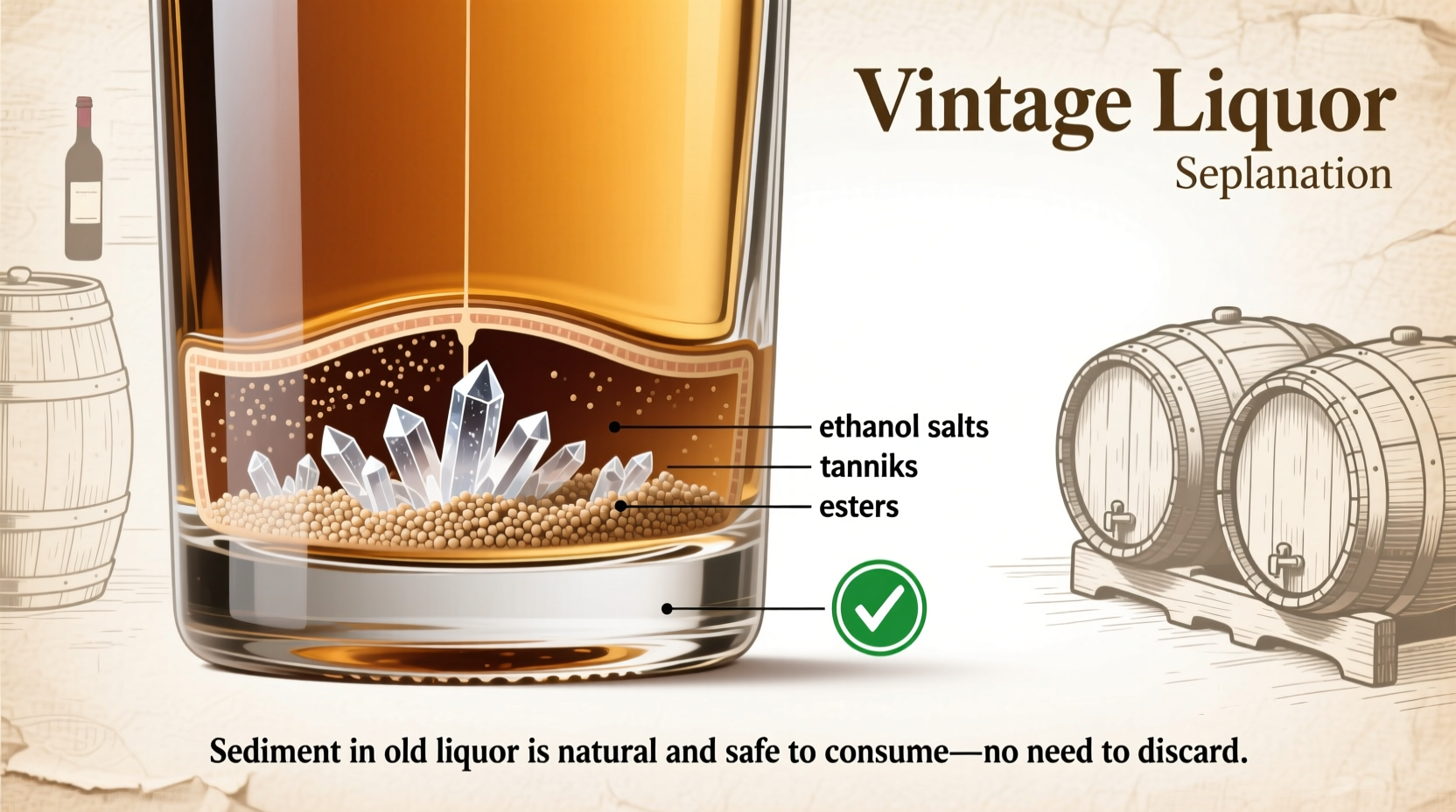
Sediment in distilled spirits arises from physical and chemical changes that occur over months or years—not microbial growth (as in spoiled beer or cider), but rather solubility shifts in naturally occurring compounds. When high-proof alcohol is diluted, cooled, or exposed to oxygen over time, certain molecules lose stability and precipitate out of solution. The primary culprits fall into three categories:
- Fatty acid esters: Formed during aging in wood casks, these aromatic compounds (like ethyl palmitate and ethyl oleate) contribute to mouthfeel and fruitiness. They’re highly soluble in high-proof spirit but become less stable as alcohol evaporates or water content increases—especially after bottling, if the spirit is stored upright for long periods or subjected to temperature fluctuations.
- Wood-derived tannins and lignin fragments: Extracted from oak barrels during maturation, these polyphenols can polymerize slowly over decades. In very old whiskies or cognacs, they may aggregate into fine, brownish particulates visible under light.
- Mineral salts and trace metals: Especially relevant in unfiltered, cask-strength releases or spirits bottled without chill filtration. Calcium, magnesium, and copper ions—originally leached from stills, pipes, or barrel hardware—can combine with fatty acids or organic acids to form insoluble soaps or crystalline deposits.
Crucially, none of these processes involve bacteria, mold, or yeast. Distilled spirits above 40% ABV are microbiologically inhospitable; no pathogen can reproduce or survive long-term in that environment. Sediment is therefore almost never a sign of “spoilage” in the food-safety sense—but it is a signpost pointing to history, handling, and chemistry.
Is It Safe to Drink? A Risk-Based Assessment Framework
Safety isn’t binary—it’s contextual. Below is a decision framework distilled from distillery quality control protocols, regulatory guidelines (TTB, EU Spirits Regulation 110/2008), and decades of master blender experience.
| Observation | Likely Cause | Safety Verdict | Action Recommended |
|---|---|---|---|
| Clear liquid with fine, white or pale yellow crystals at bottle base (especially in chilled or cold-stored bottles) | Fatty acid ester precipitation—common in unchill-filtered Scotch, bourbon, or rum | ✅ Safe | Pour carefully, leaving sediment behind; decant if desired |
| Hazy, milky cloudiness that appears *after* opening and exposure to air or humidity | Oxidation + ester hydrolysis + possible moisture ingress (e.g., humid storage, faulty cork) | ⚠️ Generally safe, but flavor compromised | Taste first: if sharp, soapy, or rancid, discard. Otherwise, consume within 2–3 weeks |
| Dark brown, gritty, or flaky particles clinging to cork or bottle shoulder | Aged tannin polymers + oxidized wood compounds—typical in 30+ year cognac or single malt | ✅ Safe | Decant gently through cheesecloth or fine mesh filter before serving |
| Greenish, blue-green, or iridescent sheen on surface or sediment | Copper corrosion from contact with unlined brass/copper fittings or improper still maintenance (rare in commercial bottlings) | ❌ Not recommended | Do not consume. Contact producer for batch verification |
| Fuzzy, stringy, or web-like material floating or suspended | Extremely rare—but if present, suggests post-bottling contamination (e.g., compromised seal, non-sterile water addition) | ❌ Unsafe | Discard immediately. Report to manufacturer |
This table reflects real-world thresholds used by brands like Macallan, Rémy Martin, and Appleton Estate. As Master Blender Joy Spence of Appleton Estate notes: “Sediment tells you the spirit has lived. But its story must align with the bottle’s provenance—time, temperature, and integrity all shape what settles at the bottom.”
Real-World Example: The 1972 Glenfarclas Family Cask
In 2021, a private collector opened a sealed 49-year-old Glenfarclas Family Cask (cask #1256), bottled in 2002 at 43% ABV. The liquid was brilliant amber—but thick, crystalline flakes coated the inside of the neck and settled densely at the base. Initial concern gave way to methodical assessment: no off-odors, no vinegar tang, no metallic bite. A small taste revealed heightened dried-fruit intensity and a waxy, lanolin-like texture—characteristic of ester recombination in ultra-mature Speyside whiskies. The sediment was later confirmed via lab analysis as ethyl palmitate crystals, formed during slow evaporation and thermal cycling in a cool, dark Edinburgh cellar. The whisky was not only safe but considered by two independent reviewers as “one of the most texturally expressive drams of the decade.” This case underscores a vital principle: sediment doesn’t degrade quality—it often deepens complexity, provided the spirit’s journey remains intact.
Tip: If you spot sediment, don’t shake the bottle. Let it settle fully (24–48 hours upright), then pour slowly—stopping 1 cm above the sediment line. Use a clean funnel and fine-mesh strainer for decanting older bottles.Step-by-Step: How to Evaluate Sediment Before Pouring
Follow this five-step protocol before consuming any aged spirit showing visible particulate matter. It takes under 90 seconds and eliminates guesswork.
- Inspect lighting & angle: Hold the bottle at eye level against a bright, neutral background (white wall or sheet of paper). Tilt slowly. Observe particle size, color, mobility, and adhesion.
- Check the seal & fill level: Is the cork intact, slightly recessed (not bulging), and free of seepage? Has the fill level dropped more than 1 cm in the past 5 years? Significant evaporation increases ester instability.
- Sniff uncorked (but not poured): Remove cork and hover nose 2 inches above the neck. Breathe gently. Reject if you detect acetone, wet cardboard, sour milk, or green apple skin (signs of ethyl acetate overproduction or oxidation).
- Examine clarity & viscosity: Pour 15 mL into a clean, dry glass. Swirl. Does the liquid coat the sides evenly? Does light pass through cleanly—or scatter diffusely? Haze that clears upon warming to room temperature is likely harmless ester bloom.
- Taste micro-sample: Place one drop on the center of your tongue. Hold for 5 seconds. No burning, no bitterness beyond expected oak tannin, no soapiness? Proceed. Any harsh, chemical, or medicinal note? Stop—and consider professional lab analysis if the bottle is valuable.
Do’s and Don’ts of Long-Term Spirit Storage
Prevention matters more than reaction. Most sediment issues stem from avoidable storage missteps—not inherent flaws in the liquid. Here’s what industry professionals actually do:
- DO store upright: Unlike wine, spirits should never be laid on their side. Cork contact with high-proof alcohol degrades seal integrity and accelerates ester migration into the closure.
- DO maintain stable temperature (12–18°C / 54–64°F): Fluctuations >5°C daily cause repeated contraction/expansion, forcing dissolved compounds out of solution.
- DO use UV-protective cabinets or opaque boxes: Direct sunlight breaks down esters and promotes aldehyde formation—leading to stale, papery off-notes and increased haze.
- DON’T refrigerate long-term: Cold encourages ester crystallization—even in 50% ABV spirits. Reserve fridge storage for opened bottles consumed within 2 weeks.
- DON’T top up with water or other spirits: Introducing new solvents disrupts equilibrium and invites unpredictable precipitation or cloudiness.
- DON’T assume “unfiltered” means “unsafe”: Many premium expressions (e.g., Ardbeg Uigeadail, Rhum Clément XO) are deliberately unchill-filtered to preserve congeners—sediment is part of their character.
FAQ: Your Most Pressing Questions Answered
Does sediment mean the liquor is “past its prime”?
No—sediment doesn’t indicate expiration. Spirits don’t “expire” like perishables. What changes is sensory profile: older whiskies may develop richer waxiness; aged rum gains deeper molasses depth; vintage brandy acquires leather-and-tobacco nuance. Sediment often accompanies those evolutions. Flavor degradation comes from oxidation (noticeable as sherry-like flatness or cardboard notes), not particulates themselves.
Can I filter sediment out at home—and will it affect taste?
Yes—with caveats. A coffee filter removes large particles but strips subtle oils and esters that carry aroma. For best results, use a dedicated spirit filter (e.g., Pall Acrodisc with 0.45 µm PTFE membrane) or triple-layer cheesecloth strained slowly. Expect minimal flavor loss in robust, heavily sherried whiskies—but delicate floral or citrus-forward bottlings may taste thinner afterward. Never use paper towels or cloth napkins: they leach fibers and chemicals.
Why don’t all aged liquors form sediment—even at similar ages?
Three key variables explain the inconsistency: (1) Proof at bottling: Higher ABV (55%+) suppresses precipitation far longer than 40–43% bottlings; (2) Filtration method: Chill-filtered spirits have esters removed pre-bottling; unfiltered ones retain them—and the potential to settle; (3) Wood interaction: Spirits matured in first-fill sherry casks absorb more tannins and polysaccharides, increasing long-term particulate risk versus refill bourbon barrels.
Conclusion: Trust Your Senses, Respect the Science
Sediment in old liquor isn’t a flaw—it’s evidence of time’s quiet alchemy. It speaks to cask selection, climate, and craftsmanship. But discernment is essential: understanding *why* particles form empowers you to distinguish between the poetic (crystallized esters in a 1960s Armagnac) and the problematic (copper leaching from a damaged still). You don’t need a lab degree to make that call—just consistent observation, calibrated tasting, and respect for the spirit’s journey. Next time you lift a bottle with a dusting of gold at its base, pause not in doubt—but in appreciation. That sediment is history made visible. Pour mindfully. Taste deeply. And remember: the safest dram is the one you understand—not the one you assume.
💬 Have you encountered surprising sediment in an old bottle? Share your experience—including spirit type, age, storage conditions, and how it tasted—in the comments. Your real-world insight helps others navigate the beautiful complexity of aged liquor.