Seeing a once-vibrant Sauvignon Blanc or crisp Pinot Grigio take on a tawny, amber, or even rusty-brown hue can be unsettling—especially if the bottle was unopened or recently poured. That color shift isn’t just cosmetic: it signals chemical changes occurring within the wine. While many assume browning automatically means spoilage or danger, the reality is more nuanced. Browning in white wine is primarily driven by oxidation—a natural but controllable process—and its implications for safety, quality, and drinkability depend on context: how the wine was made, stored, served, and how far the change has progressed. This article cuts through common myths with science-backed insight, practical diagnostics, and clear thresholds for when to enjoy, decant, or discard.
The Science Behind the Color Shift
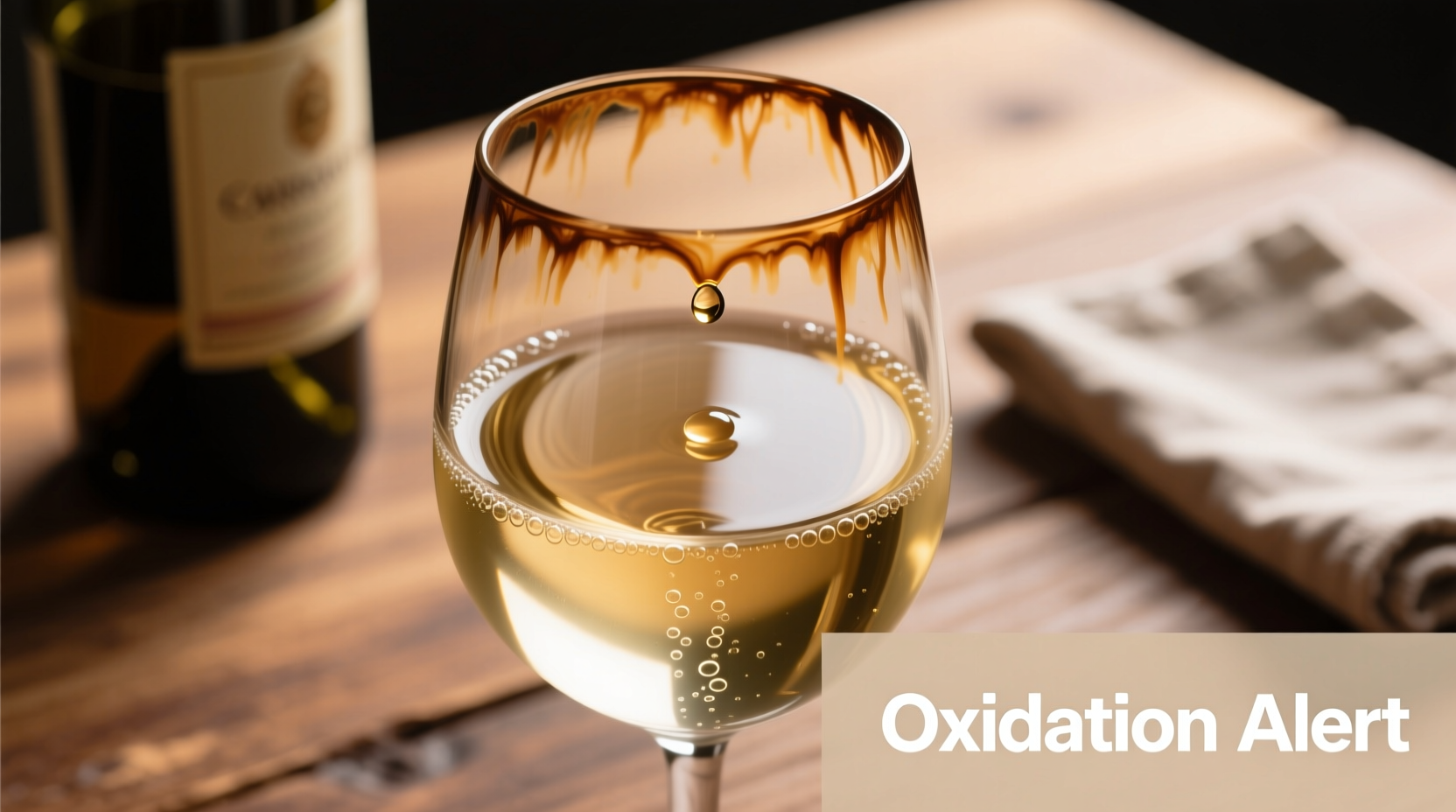
White wines derive their pale yellow-to-gold hues from trace phenolic compounds—flavonols like quercetin and non-flavonoid phenolics such as caftaric acid. Unlike red wines, which contain abundant anthocyanins (red pigments) and tannins that act as natural antioxidants, most white wines are pressed off skins early and have low tannin levels. That makes them far more vulnerable to oxidative reactions.
When oxygen interacts with these phenolics—especially in the presence of copper, iron, or enzymes like polyphenol oxidase—it triggers enzymatic and non-enzymatic browning. The result? Compounds called quinones form, then polymerize into larger, yellow-to-brown pigments known as xanthylium cations and melanoidins. These aren’t harmful; they’re simply different molecules with altered light-absorption properties.
Crucially, browning itself is not microbial spoilage. It doesn’t involve harmful bacteria like Clostridium or Salmonella, nor does it produce toxins. As Dr. Susan S. Ebeler, enology professor at UC Davis, explains:
“Oxidative browning is a chemical evolution—not contamination. It reflects exposure history, not pathogenic risk. A browned wine may taste flat or stale, but it won’t make you ill unless secondary spoilage (like volatile acidity or Brettanomyces) has also taken hold.” — Dr. Susan S. Ebeler, Director, Robert Mondavi Institute for Wine and Food Science
Common Causes: From Cellar to Glass
Browning rarely happens overnight. It accumulates over time—or accelerates under specific conditions. Here are the five most frequent contributors:
- Oxygen ingress during aging: Imperfect corks, faulty screwcap liners, or ullage (air space) in older bottles allow gradual O₂ diffusion. Even 0.5 mg/L of dissolved oxygen per year can visibly darken delicate whites like Riesling or Albariño.
- Heat exposure: Temperatures above 20°C (68°F) accelerate oxidation rates exponentially. A bottle left in a hot garage for two weeks may brown faster than one aged five years at 12°C (54°F).
- Lightstrike (photodegradation): UV and blue-spectrum light break down sulfur-containing amino acids (e.g., methionine), forming reactive compounds that bind with phenolics and deepen color—often accompanied by “wet cardboard” or “boiled cabbage” aromas.
- Poor post-opening handling: Once opened, white wine begins oxidizing within hours. Leaving a half-full bottle uncorked on the counter overnight can trigger measurable browning by day two.
- Intentional oxidative winemaking: Some styles—Sherry Fino (though protected by flor yeast), Vin Jaune from Jura, or certain Italian amber wines—are deliberately aged oxidatively. Their brown hues are stylistic hallmarks, not flaws.
Is Brown White Wine Safe to Drink? A Practical Safety Framework
Yes—in nearly all cases, browning alone does not compromise food safety. Ethanol (typically 11–13% ABV), low pH (3.0–3.4), and residual sulfites create an environment inhospitable to human pathogens. However, safety must be assessed alongside sensory integrity and potential co-occurring faults. Use this three-tier framework:
| Observation | Safety Status | Quality Assessment |
|---|---|---|
| Faint gold-to-amber tint in an aged Riesling or mature Chardonnay; clean aroma of nuts, honey, or dried apple | ✅ Safe | 🟢 Often desirable—indicates graceful aging |
| Medium brown with flat, sherry-like notes, slight acetic tang (<500 mg/L VA), no mold or fizz | ✅ Safe | 🟡 Drinkable but diminished; best for cooking or sauces |
| Deep brown or orange-brown + vinegar sharpness, nail polish remover (ethyl acetate), mousiness, or visible haze/sediment | ⚠️ Caution advised | 🔴 Likely compromised by microbial spoilage—discard |
Note: “Mousiness” (a lingering, unpleasant aftertaste reminiscent of rodent cages) is caused by Brettanomyces or lactic acid bacteria metabolites and is not toxic—but it renders wine undrinkable. It often accompanies advanced browning but is chemically distinct.
Real-World Example: The Case of the Forgotten Chenin Blanc
In spring 2023, a sommelier in Portland received a complaint from a customer who’d opened a 2018 Vouvray Demi-Sec—bought at release and stored upright in a closet near a radiator. The wine had turned deep amber, smelled faintly of bruised apple and caramel, and tasted noticeably flat with low acidity. Lab analysis showed dissolved oxygen at 4.2 mg/L (vs. ideal <0.5 mg/L) and volatile acidity at 0.72 g/L (just below the legal limit of 0.8 g/L for sweet wines). No pathogens were detected. The sommelier offered a replacement and explained: “This wine isn’t unsafe—but its freshness and varietal expression are gone. It’s now better suited for deglazing chicken than sipping solo.” The customer appreciated the transparency and began using a wine fridge set to 12°C with humidity control. Within six months, their next bottle of the same vintage showed only light gold coloring and vibrant quince notes.
Step-by-Step: How to Diagnose & Respond to Browning
Follow this sequence when you notice unexpected color change—whether in a newly opened bottle or a cellar sample:
- Assess storage history: Was the wine kept cool (<15°C / 59°F), dark, and still? If stored above 22°C (72°F) for >1 week, browning is highly probable.
- Inspect the seal: For cork-finished bottles, check for protrusion, dryness, or crumbly texture. For screwcaps, look for bulging or corrosion—signs of compromised integrity.
- Smell before tasting: Swirl gently. Clean nutty, honeyed, or toasted notes suggest intentional or benign oxidation. Vinegar, wet dog, rotten egg (H₂S), or sauerkraut indicate microbial issues.
- Taste critically: Focus on balance. Does acidity still lift the wine? Is there any bitterness or astringency beyond normal? A hollow, lifeless mid-palate with no finish points to advanced oxidation.
- Decide action: If safe but faded, use in vinaigrettes, poaching liquid for pears, or reduction sauces. If flawed beyond repair, compost the liquid (wine is biodegradable) and recycle the bottle.
Prevention Checklist: Preserve Freshness Before It Fades
Preventing browning starts long before the first pour. Use this actionable checklist—applicable to both casual drinkers and serious collectors:
- ✅ Store bottles at 10–13°C (50–55°F) with 60–70% humidity—never in kitchens, garages, or attics
- ✅ Keep bottles away from direct light—use UV-filtering glass doors or opaque cabinets
- ✅ For opened bottles: reseal tightly, refrigerate, and consume within 3–5 days (sparkling: 1–2 days; high-acid Riesling: up to 7 days)
- ✅ Use inert gas sprays (argon/nitrogen) to displace oxygen in partially consumed bottles
- ✅ Choose screwcap or technical closures for wines meant for early consumption (0–3 years)
- ✅ Avoid storing white wine in clear glass unless it’s UV-protected (most supermarket bottles are not)
FAQ: Your Top Questions Answered
Can I reverse browning in white wine?
No. Oxidation is an irreversible chemical reaction. Once quinones polymerize into brown pigments, no technique—including chilling, filtering, or adding sulfites—will restore original color or freshness. Prevention is the only effective strategy.
Does browning mean the wine is “corked”?
No. “Cork taint” refers specifically to contamination by 2,4,6-trichloroanisole (TCA), which causes musty, damp-cardboard aromas—but no color change. A browned wine can be TCA-free; a corked wine can remain pale yellow. They are unrelated faults.
Are organic or natural wines more prone to browning?
Often, yes—due to lower (or zero) added sulfites, minimal filtration, and avoidance of antioxidant additives like ascorbic acid. Without these stabilizers, phenolics oxidize more readily. That’s why many natural producers use amber-colored bottles, age under inert gas, or embrace oxidative styles intentionally.
Conclusion: Respect the Wine, Not Just the Color
A brown hue in white wine is less a warning label and more a quiet narrative—telling you about temperature fluctuations, light exposure, closure performance, or even the winemaker’s intent. It doesn’t signal danger, but it does demand attention. Understanding *why* browning occurs transforms anxiety into insight. You gain the confidence to distinguish between a gracefully aged Condrieu and a heat-damaged Pinot Gris. You learn when to savor a nutty, complex layer and when to reach for a fresher bottle instead. Most importantly, you stop equating visual change with hazard—and start reading wine as a living, breathing product shaped by chemistry, care, and context.
Your next bottle doesn’t need to stay perfectly pale to be worthy. But it does deserve thoughtful storage, mindful serving, and honest evaluation. Start tonight: check your wine rack’s location, verify your fridge’s temperature setting, and pour your next glass with curiosity—not concern. And if you’ve rescued a browned wine in an inventive way—say, transforming an over-oxidized Vermentino into a stunning seafood stew base—we’d love to hear how. Share your experience in the comments and help others turn “what went wrong” into “what worked beautifully.”
💬 Have you encountered browning in an unexpected place—like a chilled rosé or a sparkling wine? Tell us what happened, how you diagnosed it, and what you did next. Real stories shape better practices for all of us.