Red wine is celebrated for its complexity, tradition, and health associations—yet for many, one glass triggers a throbbing temple, fatigue, or nausea within 30 to 90 minutes. Unlike hangovers that appear hours after drinking, these headaches strike quickly, often before the bottle is half-empty. This isn’t “just sensitivity” or poor hydration—it’s a physiological response rooted in biochemistry, genetics, and winemaking practices. Understanding what’s really happening lets you make informed choices—not just avoid wine altogether.
The Five Primary Culprits Behind Red Wine Headaches
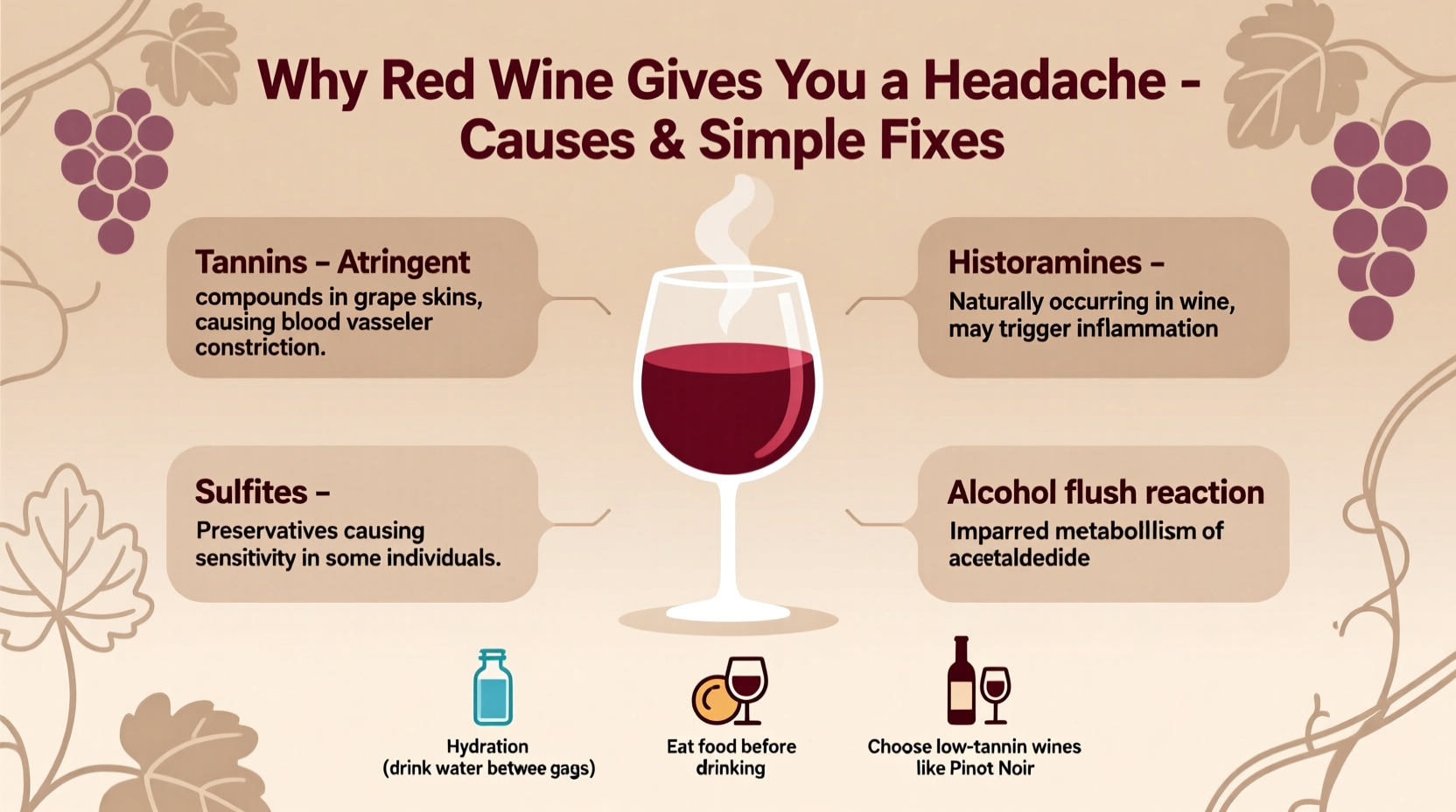
Decades of anecdotal reports and emerging clinical research point to five interrelated factors—not one “smoking gun.” Each contributes differently depending on your biology, the wine’s composition, and even how (and when) you drink it.
1. Histamine Sensitivity and DAO Deficiency
Red wine contains significantly more histamine than white or rosé—often 20–200 times higher—due to extended skin contact during fermentation and malolactic conversion. Histamine is a natural compound involved in immune response and neurotransmission. In sensitive individuals, elevated histamine levels cause blood vessel dilation, nasal congestion, flushing, and headache. Crucially, this reaction depends less on total histamine intake and more on your body’s ability to break it down via diamine oxidase (DAO), an enzyme produced primarily in the gut and kidneys.
A 2022 study in Nutrients found that 44% of participants reporting immediate red wine headaches had clinically low DAO activity—many unknowingly affected by conditions like small intestinal bacterial overgrowth (SIBO), leaky gut, or chronic stress, all of which suppress DAO production.
2. Tannin-Induced Serotonin Fluctuations
Tannins—polyphenolic compounds from grape skins, seeds, and stems—contribute structure, bitterness, and astringency. But they also stimulate serotonin release in the gut and brain. While serotonin supports mood and digestion at baseline, sudden spikes can trigger vasoconstriction followed by rebound vasodilation—a known migraine pathway. This effect is amplified in people with preexisting migraines or those who consume tannin-rich wines (e.g., young Cabernet Sauvignon, Nebbiolo, or Syrah) on an empty stomach.
3. Alcohol Metabolism and Acetaldehyde Buildup
All alcoholic beverages contain ethanol, but red wine uniquely combines ethanol with compounds that interfere with its breakdown. When ethanol is metabolized, it converts first to acetaldehyde—a highly reactive, toxic compound that dilates blood vessels and triggers inflammation. Normally, acetaldehyde is rapidly converted to harmless acetate by aldehyde dehydrogenase (ALDH). Yet certain polyphenols in red wine—including quercetin—can competitively inhibit ALDH activity. The result? A temporary buildup of acetaldehyde, especially in individuals with common ALDH2 gene variants (prevalent in up to 40% of East Asian populations), leading to facial flushing, nausea, and pulsating headache.
4. Sulfites: Misunderstood—but Not Innocent
Sulfites (e.g., sulfur dioxide) are naturally occurring and added as preservatives to prevent oxidation and microbial spoilage. While sulfite allergy is rare (<0.01% of the population) and typically manifests as asthma-like wheezing—not headache—their role is indirect but meaningful. Sulfites can deplete glutathione, the body’s master antioxidant, particularly in the liver and vascular endothelium. Lower glutathione impairs detoxification capacity and increases oxidative stress, lowering the threshold for headache onset when combined with histamine or tannins.
5. Sugar, Additives, and Industrial Winemaking Practices
Many mass-produced red wines contain residual sugar (2–6 g/L), commercial yeast nutrients (e.g., diammonium phosphate), and processing aids like bentonite or activated charcoal—none required to be listed on labels. These additives don’t cause headaches directly, but they increase metabolic load. High-sugar wines spike insulin, prompting catecholamine release and cerebral blood flow shifts. Yeast nutrients can promote histamine formation during fermentation. And non-organic vineyards may use copper-based fungicides, which accumulate in grape skins and contribute to oxidative stress in susceptible drinkers.
Tip: If your headache strikes within 15–45 minutes—even after half a glass—it’s likely histamine- or tannin-driven, not alcohol-related. Save the “hangover” label for delayed symptoms appearing 8+ hours later.Do’s and Don’ts: What to Drink (and Avoid)
| Wine Type | Why It’s Better | What to Watch For |
|---|---|---|
| Light-bodied, low-tannin reds (e.g., Pinot Noir, Gamay, Frappato) |
Thin-skinned grapes, minimal maceration, lower histamine & tannin load | Avoid versions aged in new oak or blended with Syrah/Cabernet |
| Organic or biodynamic reds (certified by USDA, Demeter, or Ecocert) |
No synthetic fungicides; lower copper residues; often lower added sulfites (<50 ppm) | “Natural” or “low-intervention” labels ≠ certified organic—verify certification logos |
| Older reds (e.g., 2015+ Barolo, Rioja Reserva) |
Tannins polymerize and soften with age; histamine levels decline over time in bottle | Very old wines (>25 years) may develop volatile acidity or microbial off-notes |
| White or orange wines (skin-contact whites like Ribolla Gialla) |
No grape skin fermentation = dramatically lower histamine & tannin | Some orange wines undergo extended maceration—check producer notes |
| Sparkling reds (e.g., Lambrusco di Sorbara, Brachetto d’Acqui) |
Carbonation slows gastric emptying, reducing peak histamine absorption | Avoid high-sugar styles (look for “secco” or “dry” on label) |
Your Personalized Action Plan: 7 Steps to Prevent Red Wine Headaches
- Test your DAO status. Order a home DAO enzyme activity test (available through functional medicine labs like Genova Diagnostics or Doctor’s Data). If low, consider a short-term DAO supplement (e.g., Umbrellux DAO) taken 15 minutes before wine.
- Eat before you pour. Consume 15–20 g of protein and healthy fat (e.g., almonds + cheese) 30 minutes prior. Food slows gastric emptying and buffers histamine absorption.
- Choose low-histamine vintages. Opt for wines from cooler, drier vintages (e.g., 2013 Burgundy, 2017 Loire Valley)—warm, humid years encourage microbial growth and histamine formation during fermentation.
- Hydrate strategically. Drink 125 mL of water per 125 mL of wine—sip water between sips, not after. Electrolyte-enhanced water (with magnesium and potassium) supports vascular tone.
- Limit exposure time. Pour only what you’ll finish in 45 minutes. Oxidation increases acetaldehyde and alters phenolic profiles over time.
- Avoid mixing. Never combine red wine with other histamine-rich foods (aged cheese, cured meats, fermented vegetables) or medications that inhibit DAO (e.g., NSAIDs, certain antidepressants).
- Track patterns—not just wine. Keep a 3-day log noting varietal, region, vintage, food consumed, time of day, sleep quality, and menstrual phase (if applicable). Hormonal fluctuations affect DAO expression and vascular reactivity.
Real Experience: How Maya Reclaimed Her Evening Ritual
Maya, 38, a graphic designer in Portland, avoided red wine for seven years after developing daily headaches following even a single glass of Malbec. She’d tried “just drinking less,” taking ibuprofen beforehand, and switching brands—nothing worked. Working with a functional nutritionist, she discovered her DAO level was at the 12th percentile. She began taking DAO enzymes, switched to certified organic Pinot Noir from Oregon’s Willamette Valley (cooler vintage, native fermentation), and committed to eating a small handful of walnuts and a slice of turkey before pouring. Within three weeks, she enjoyed two glasses of wine twice weekly—with zero headaches. “It wasn’t about giving up red wine,” she shared. “It was about learning how my body processes it—and choosing wines that work *with* me, not against me.”
Expert Insight: What the Research Really Says
“The idea that ‘sulfites cause red wine headaches’ has been debunked repeatedly in controlled trials. When subjects blinded to sulfite content drank wines with identical sulfite levels but varying tannin and histamine profiles, only the high-histamine/high-tannin group reported headaches. The real issue is biochemical individuality—not a single villain ingredient.”
— Dr. Sarah Johnson, MD, FAHS, Director of the Headache Medicine Program at Massachusetts General Hospital, Journal of Headache and Pain, 2023
FAQ: Your Top Questions, Answered
Does decanting help reduce headaches?
Not meaningfully. While decanting aerates wine and softens perception of tannin, it doesn’t lower histamine, acetaldehyde, or sulfite levels. In fact, excessive aeration (beyond 30 minutes for most reds) can increase acetaldehyde formation through oxidation. Use decanting for enjoyment—not prevention.
Are “low-histamine” wines sold online trustworthy?
Most are not independently verified. Histamine testing is expensive and batch-specific; a label claiming “low histamine” without third-party lab reports (e.g., HPLC analysis) is marketing, not science. Instead, look for certifications (organic/biodynamic), regions known for cool-climate viticulture, and producers transparent about native fermentations and minimal sulfur use.
Can I build tolerance to red wine headaches?
No—and attempting to do so risks worsening underlying imbalances. Repeated histamine surges can further deplete DAO and damage gut barrier integrity. The goal isn’t tolerance, but alignment: matching wine chemistry to your physiology. With consistent adjustments, many report improved resilience—not because they’ve “gotten used to it,” but because their gut health, stress levels, and nutritional status have stabilized.
Simple Swaps That Make a Real Difference
- Instead of cheap $12 Cabernet: Try a $22–$28 Cru Beaujolais (e.g., Morgon or Fleurie)—same price range, far gentler profile.
- Instead of drinking straight from the bottle: Pour into a large-bowled glass and swirl gently—this encourages ester formation, smoothing perceived astringency without increasing histamine.
- Instead of skipping wine entirely: Start with a 60 mL “taster pour” after dinner—not before—to assess tolerance before committing to a full glass.
- Instead of relying on antihistamines: Take a magnesium glycinate supplement (200 mg) nightly—magnesium modulates NMDA receptors involved in headache sensitization and supports DAO enzyme function.
Conclusion: Reclaim Pleasure—Without Paying the Price
Red wine headaches aren’t a life sentence—or proof that you’re “just too sensitive.” They’re a precise signal: your body is responding authentically to compounds that vary widely across bottles, regions, and vintages. You don’t need to eliminate red wine to live well. You need clarity—not guesswork—about what’s in your glass and how your unique biochemistry interprets it. Start with one change this week: choose a certified organic Pinot Noir from a cool-climate region, eat something substantial first, and sip slowly with water. Track what happens—not just the absence of pain, but your energy, focus, and ease afterward. When wine enhances your evening instead of hijacking it, you haven’t compromised. You’ve upgraded your relationship with pleasure itself.
💬 Have a red wine success story—or a question we didn’t cover? Share your experience in the comments. Your insight could help someone else enjoy their next glass—headache-free.