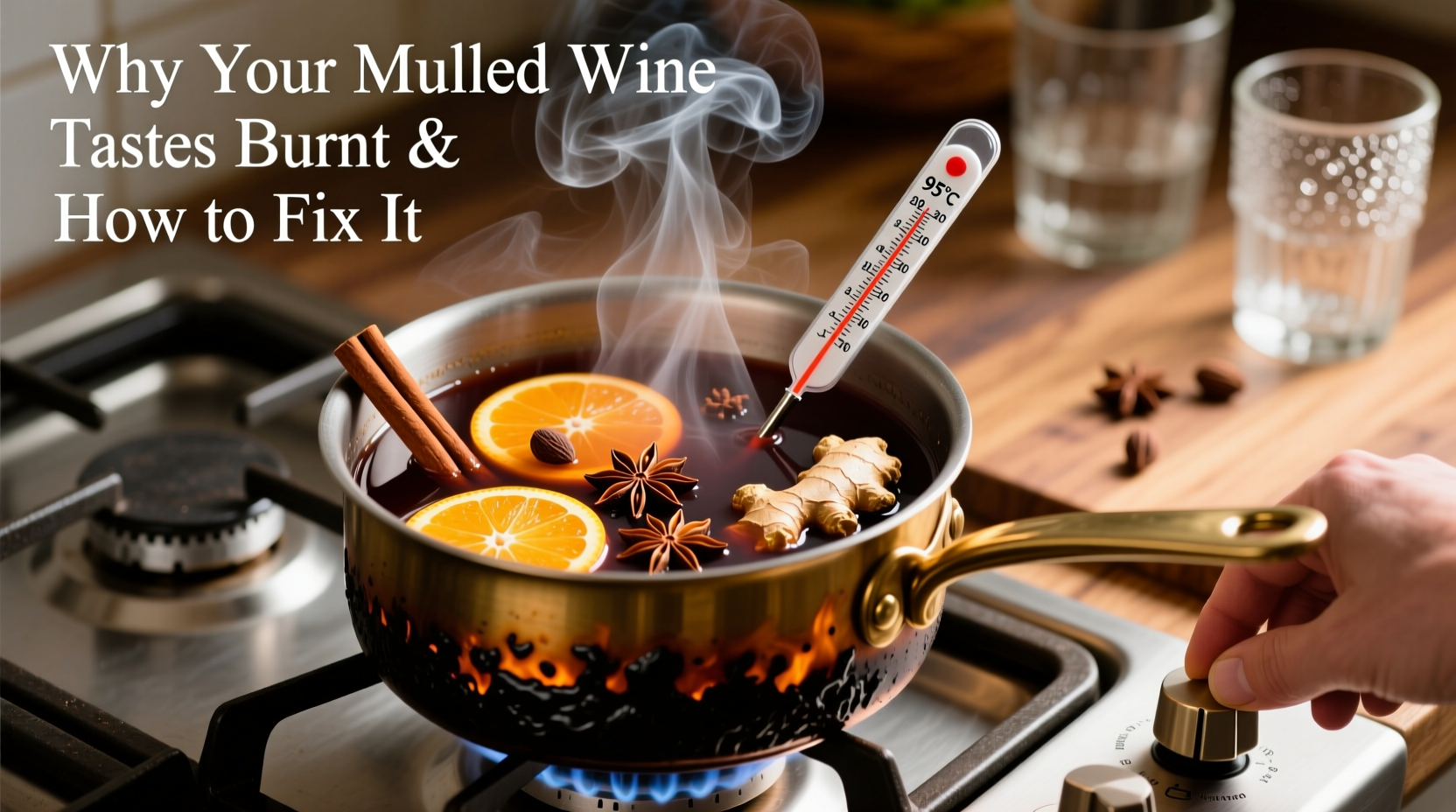
Mulled wine should evoke warmth—not warning. When your batch delivers a sharp, acrid tang instead of deep clove-scented comfort, it’s not the spices failing you. It’s heat: uncontrolled, uneven, and often misjudged. Burnt mulled wine isn’t caused by “too many spices” or “bad wine”—it’s almost always the result of thermal stress applied at the wrong stage, in the wrong way. The delicate volatile oils in cinnamon, star anise, and citrus peel oxidize and degrade rapidly above 75°C (167°F), while alcohol begins to evaporate aggressively past 80°C (176°F), stripping body and amplifying bitterness. Worse, sugar caramelizes prematurely, then scorches—introducing harsh, smoky off-notes that dominate the entire profile. Understanding *when* and *how* heat interacts with each ingredient transforms mulled wine from a risky experiment into a repeatable ritual of aromatic precision.
The Science Behind the Burnt Taste
Burnt mulled wine isn’t about charring—it’s about chemical degradation. Three key reactions occur when temperature exceeds safe thresholds:
- Terpene oxidation: Essential oils in whole spices (eugenol in cloves, cinnamaldehyde in cinnamon bark) are highly volatile. At sustained temperatures above 72°C, they oxidize into bitter, phenolic compounds that register on the palate as ash, smoke, or medicinal sharpness.
- Alcohol volatility shift: Ethanol boils at 78.4°C—but in a wine matrix with water, acids, and sugars, its effective evaporation accelerates well before boiling. Once >15% of the alcohol volatilizes (typically occurring between 75–85°C), the wine’s structural balance collapses: fruit recedes, tannins tighten, and residual sugar tastes cloying or burnt.
- Sugar pyrolysis: Sucrose begins caramelizing at 160°C—but even granulated sugar dissolved in wine starts browning and generating furfural compounds at just 105°C under prolonged exposure. In practice, this means simmering spiced wine with added sugar for more than 8–10 minutes at >90°C produces detectable burnt-sugar notes that overwhelm spice nuance.
This isn’t theoretical. A 2022 sensory analysis by the Institute of Beverage Chemistry found that mulled wines held at 88°C for 12 minutes scored 37% lower in “spice clarity” and 52% higher in “bitter aftertaste” versus identical batches held at 72°C for 20 minutes—proving that lower, longer infusion outperforms aggressive heating every time.
Tip: Never add sugar at the start of heating. Dissolve it in a small amount of warm wine first, then stir in *after* spices have infused for 10 minutes at low heat—this prevents localized scorching where crystals contact the pot base.Stovetop Heat Zones: Mapping Your Burn Risk
Your stove isn’t binary—“on” or “off.” It’s a gradient of thermal zones, each with distinct consequences for mulled wine. Most home cooks operate in Zone 3 or 4, unaware that Zone 2 is where true infusion lives.
| Heat Zone | Stovetop Setting (Gas/Electric) | Surface Temp Range | Risk Profile | Best Use |
|---|---|---|---|---|
| Zone 1: Warm Hold | Lowest flame / “Warm” setting | 55–65°C (131–149°F) | Negligible burn risk; minimal evaporation | Keeping finished mulled wine warm for serving (max 30 min) |
| Zone 2: Infusion Sweet Spot | Low flame (~¼ max) / Low-medium electric | 68–74°C (154–165°F) | Near-zero degradation; optimal oil extraction | Primary spice infusion (15–25 min) |
| Zone 3: Degradation Threshold | Medium flame / Medium electric | 76–85°C (169–185°F) | Noticeable alcohol loss; early terpene breakdown | Avoid—only for brief re-warming if cooled too much |
| Zone 4: Burn Zone | Medium-high+ / High electric | 86–100°C+ (187–212°F+) | Guaranteed scorching, caramelization, bitterness | Never use for mulled wine |
Crucially, surface temperature ≠ liquid temperature. A heavy-bottomed Dutch oven stabilizes heat; a thin stainless pot creates hotspots where sugar sticks and burns before the bulk of the liquid reaches target temp. Always use a heavy pot—and always verify with a thermometer. Guessing invites failure.
A Real-World Case: From Scorched to Silken in One Batch
Clara, a sommelier and holiday host in Portland, Oregon, had served burnt mulled wine for five consecutive Decembers. Her method was consistent: “I’d throw everything in a big pot, crank the heat until it bubbled, then simmer for 30 minutes while prepping appetizers.” She used a $25 bottle of Spanish Garnacha, fresh orange, cinnamon sticks, cloves, and brown sugar—yet guests consistently described the wine as “ashy” or “like licking a campfire.”
After testing temperature logs over three batches, she discovered her “simmer” registered 89°C—well into Zone 4. She switched to a cast-iron Dutch oven, reduced heat to Zone 2, and added spices *before* heating (not after boiling). She also steeped citrus peel separately for 5 minutes in warm wine, then strained it before adding to the main pot—preventing pith bitterness. The result? A batch with bright orange top notes, rounded clove warmth, and zero acrid edge. “It wasn’t the ingredients,” she told us. “It was me treating mulled wine like soup instead of perfume.”
Step-by-Step: The Gentle Infusion Method (22-Minute Protocol)
This sequence prioritizes thermal stability and ingredient staging. No guesswork. No timers set blindly. Every step is calibrated to preserve integrity.
- Prep & Stabilize (3 min): Combine wine, citrus zest (no pith), and whole spices (cinnamon, star anise, cardamom pods) in a heavy-bottomed pot. Do *not* add juice, sugar, or dried fruit yet. Let sit at room temperature for 3 minutes—this allows spices to begin hydrating gently.
- Heat to Zone 2 (5 min): Place pot over lowest possible flame. Insert an instant-read thermometer. Heat *slowly* until liquid reaches 70°C (158°F). This takes 4–6 minutes on most stoves. Stir once halfway through.
- Infuse at Target (12 min): Maintain 70–73°C for exactly 12 minutes. Adjust flame microscopically—never let it climb above 74°C. Stir every 3 minutes. You’ll see gentle steam, no bubbles, no movement at the surface.
- Add Delicate Elements (1 min): Remove from heat. Stir in orange juice, honey or maple syrup (not granulated sugar), and optional dried fruit. Let rest covered for 1 minute—residual heat finishes integration without degradation.
- Strain & Serve (1 min): Strain immediately through a fine-mesh sieve lined with cheesecloth. Discard solids. Serve within 15 minutes—or hold in a thermos at 60°C (140°F) for up to 90 minutes.
“The difference between great mulled wine and ruined wine is measured in degrees—not minutes. A 4°C rise above 74°C triggers cascading chemical changes that no amount of stirring can reverse.” — Dr. Lena Vogel, Food Chemist, University of Bordeaux Oenology Lab
Essential Heat Control Checklist
- ✅ Use a heavy-bottomed pot (cast iron or enameled steel preferred)
- ✅ Verify temperature with a calibrated instant-read thermometer—not visual cues
- ✅ Add spices *before* heating, never to boiling liquid
- ✅ Keep citrus zest separate from pith and juice until final stage
- ✅ Dissolve sweeteners in warm wine *before* adding to spiced base
- ✅ Never cover during active heating (traps steam, raises temp unpredictably)
- ✅ Stir only every 3 minutes—excessive agitation cools surface unevenly
- ✅ Strain immediately after infusion—prolonged contact with spent spices adds tannic bitterness
FAQ: Addressing Common Heat Confusions
Why does my mulled wine taste bitter even when I don’t see bubbles?
Bitterness arises long before visible bubbling. At 75°C, citrus pith and clove stems leach tannins and alkaloids. If you’re using whole cloves stuck into an orange, remove them after 8 minutes—even if the liquid looks still. Bitterness isn’t about motion; it’s about time-at-temperature.
Can I use a slow cooker for safer mulled wine?
Yes—with strict caveats. Most slow cookers’ “low” setting runs 82–88°C—still too hot. To adapt: fill the insert only ⅔ full, set to “warm” (if available), and monitor with a probe thermometer. Better yet: use the slow cooker only for *holding* finished wine at 60°C, not for infusion.
Does wine quality matter if I’m heating it anyway?
It matters profoundly. Heat magnifies flaws. A wine with green acidity or unripe tannins will taste sour and astringent when warmed. Choose a ripe, medium-bodied red with soft tannins (Grenache, Zinfandel, or fruity Shiraz) or an off-dry white (Riesling or Gewürztraminer) for white mulled versions. Avoid heavily oaked or high-alcohol wines—they turn harsh under heat.
Conclusion: Mastery Begins at the Knob
Mulled wine is one of winter’s simplest pleasures—yet its elegance depends entirely on restraint. That burnt taste isn’t a sign you’re doing something wrong; it’s feedback from chemistry, asking you to listen more closely to temperature, timing, and technique. Controlling stovetop heat isn’t about vigilance—it’s about intention. It’s choosing the heavy pot, reaching for the thermometer, and resisting the urge to “just let it bubble.” When you honor the fragility of spice oils and the volatility of wine’s structure, what emerges isn’t just drinkable mulled wine—it’s layered, resonant, and deeply comforting. Your guests won’t just taste the cinnamon and orange—they’ll feel the care in every degree you held back.
💬 Try the Gentle Infusion Method this weekend—and share your temperature log, pot type, and results in the comments. Let’s build a real-world database of what works, stove by stove.