There’s a quiet disappointment many craft beverage makers know well: that moment when you pour your vibrant, effervescent homemade ginger beer over ice, add a generous splash of rich dark rum—and watch the bubbles vanish within seconds. The sharp, spicy lift disappears. The mouthfeel turns slack. What should be a lively, complex highball collapses into a flat, syrupy afterthought. This isn’t just a sensory letdown—it’s a sign that something fundamental in your fermentation, formulation, or serving technique is misaligned. Unlike commercial ginger beers engineered for stability, homemade versions rely on delicate biological and physical equilibria. When dark rum enters the equation, it doesn’t merely add flavor; it disrupts the very forces holding CO₂ in solution. This article explains exactly why that happens—and more importantly, how to prevent it without sacrificing authenticity, complexity, or craft integrity.
The Science Behind the Fizz Collapse
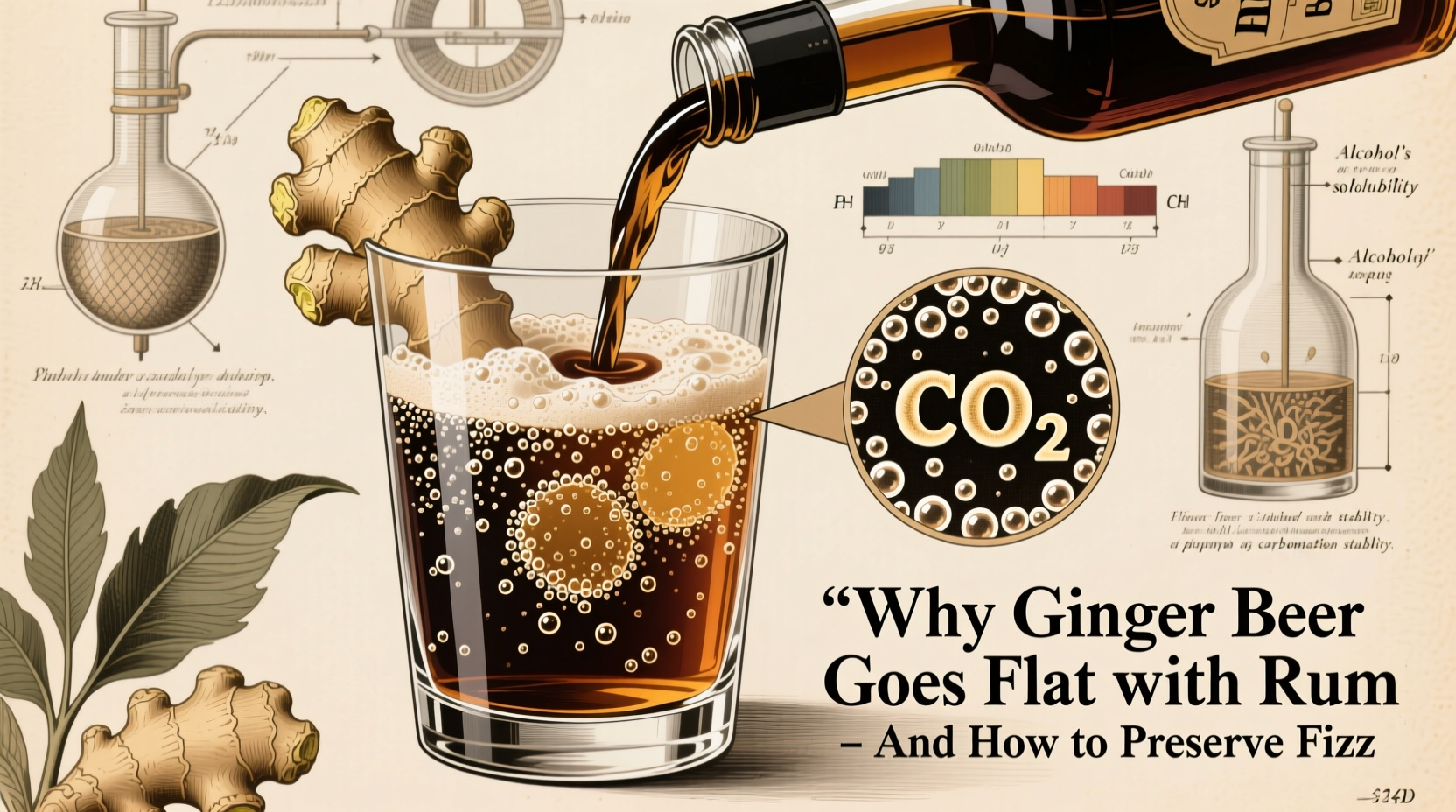
Homemade ginger beer’s carbonation comes almost exclusively from natural fermentation—typically driven by wild yeasts or a cultured ginger bug (a symbiotic culture of yeast and lactic acid bacteria). During bottle conditioning, yeast consumes residual sugars and produces CO₂, which dissolves into the liquid under pressure. But unlike forced carbonation (as used in soda siphons or keg systems), this CO₂ exists in a fragile equilibrium governed by Henry’s Law: the amount of gas dissolved in a liquid is directly proportional to the partial pressure of that gas above the liquid—and inversely related to temperature and solute concentration.
Dark rum introduces three destabilizing variables simultaneously:
- Alcohol content (typically 35–40% ABV): Ethanol reduces water’s surface tension and lowers CO₂ solubility. At 5–10% final alcohol-by-volume (the typical range when mixing 1:3 rum-to-ginger-beer), CO₂ solubility drops by 15–25% compared to non-alcoholic ginger beer at the same temperature and pressure.
- Temperature shock: Most dark rums are stored at room temperature (20–22°C), while properly carbonated ginger beer is ideally chilled (4–7°C). Warming even a small volume of the base liquid reduces CO₂ retention capacity before the first sip is taken.
- Surfactant disruption: Rum contains congeners—higher alcohols, esters, and fatty acids—that act as surfactants. These molecules migrate to gas-liquid interfaces, weakening bubble film integrity and accelerating nucleation. In practice, this means bubbles form faster, rise quicker, and burst sooner—robbing the drink of persistent effervescence.
This triad explains why “flatness” isn’t random—it’s predictable physics meeting imperfect timing. It also reveals why simply “using more yeast” or “fermenting longer” often backfires: over-carbonated ginger beer becomes dangerously pressurized in bottles and releases CO₂ even more violently upon dilution with rum.
Tip: Never add rum directly to a warm or room-temperature ginger beer. Always chill both components separately to 4–6°C before combining—and serve immediately in a pre-chilled glass.Five Critical Variables You Control (and How to Optimize Them)
Your ability to preserve fizz hinges not on one fix, but on harmonizing five interdependent factors. Adjust any one in isolation, and gains are marginal. Tune them together, and your rum-and-ginger highballs will retain bright, tingling effervescence for 4–6 minutes—long enough for full aromatic expression and balanced sipping.
| Variable | Optimal Range for Rum Compatibility | Why It Matters |
|---|---|---|
| Fermentation Sugar Profile | Use 60–70% fermentable sugar (e.g., white cane sugar) + 30–40% unfermentable sweetener (e.g., ginger juice, honey, or stevia) | Leaves residual body and viscosity to slow CO₂ escape; avoids over-dryness that accelerates bubble coalescence |
| Bottle Pressure Target | 2.8–3.2 volumes CO₂ (measured via pressure gauge or calibrated bottle test) | Higher pressures increase risk of gushing; lower pressures yield insufficient reserve for rum dilution |
| Chill Time Pre-Service | Minimum 24 hours at ≤5°C after carbonation stabilizes | CO₂ solubility increases exponentially below 7°C; cold saturation locks gas in more effectively |
| Rum Temperature & Proof | Chilled (4–6°C); prefer 35–38% ABV over 40%+ “navy strength” rums | Lower ABV = less ethanol-driven CO₂ desorption; cold rum prevents thermal shock |
| Glassware & Pour Technique | Tall, narrow highball glass; pour ginger beer first, then gently layer rum down the side of the glass | Minimizes agitation and nucleation sites; preserves laminar flow and bubble longevity |
A Real-World Case Study: The Barbados Bar Test
In early 2023, a small cocktail bar in Bridgetown began offering a signature “Plantation Highball” using house-fermented ginger beer and locally aged pot-still rum. Within two weeks, servers reported consistent complaints: “It starts fizzy, then goes dead in 90 seconds.” Owner Maya Singh didn’t blame the rum or the ginger beer alone—she suspected interaction. She ran a controlled four-day test:
- Day 1: Standard batch (3.5 volumes CO₂, fermented 5 days, served at 12°C) + room-temp rum → fizz lasted 78 seconds.
- Day 2: Same ginger beer, but both components chilled to 5°C → fizz lasted 142 seconds.
- Day 3: Adjusted sugar profile (65% cane sugar, 35% raw ginger juice) + 3.0 volumes CO₂ + chilled service → fizz held for 220 seconds, with fine, persistent bead.
- Day 4: Added a 1-second “rest” after pouring ginger beer (before adding rum) + gentle layering → fizz remained perceptible for 3 minutes 10 seconds, with no off-gassing or foam collapse.
The takeaway wasn’t about “more bubbles”—it was about designing for resilience. As Singh told Distiller’s Quarterly: “We stopped treating ginger beer as a standalone product and started treating it as a *system*—one that includes the spirit, the glass, the temperature gradient, and the human hand that pours it.”
Step-by-Step: Building a Rum-Resilient Ginger Beer (From Brew to Bottle)
- Day 0 – Prepare the Ginger Base: Grate 250g organic ginger (skin-on), steep in 1L boiling water for 20 minutes. Strain, then add 120g white cane sugar + 30g raw local honey. Cool to 28°C.
- Day 1 – Inoculate: Add 60g active ginger bug (or 1 tsp champagne yeast + 1 tsp grated ginger). Stir twice daily for 48 hours at 24°C.
- Day 3 – Stabilize Fermentation: Refrigerate at 4°C for 12 hours to halt yeast activity while preserving live cultures. Strain through a 100-micron nylon bag—no squeezing.
- Day 4 – Bottle Conditioning: Warm to 20°C. Add priming sugar: 5.2g dextrose per liter (calculated for 3.1 volumes CO₂ at 20°C). Fill sanitized 500mL swing-top bottles to 2cm headspace. Cap firmly.
- Days 5–7 – Carbonate: Store upright at 22°C. Check pressure daily with a bottle pressure tester. Stop when reading 2.9–3.1 volumes (≈32–35 psi at 22°C).
- Day 8 – Cold Crash: Move bottles to refrigerator (≤5°C) for 48 hours. This saturates liquid with CO₂ and encourages yeast flocculation.
- Day 10 – Serve: Chill rum separately. Use a narrow highball glass, pre-chilled. Pour 150mL ginger beer first. Wait 1 second. Gently layer 45mL rum down the side. Garnish with expressed lime oil—not juice—to avoid acidity-triggered degassing.
Expert Insight: Fermentation Meets Mixology
“The biggest misconception is that ‘more fermentation = more fizz.’ In reality, over-fermented ginger beer has low viscosity, high ethanol, and exhausted nutrients—all conditions that make CO₂ escape faster when diluted. Stability isn’t about maximum pressure—it’s about intelligent saturation, thoughtful formulation, and respecting the physics of gas dissolution. A well-designed ginger beer should behave like a spring: compressible, resilient, and ready to rebound—not like a balloon waiting to pop.” — Dr. Lena Torres, Food Microbiologist & Fermentation Consultant, author of Carbonation Dynamics in Craft Beverages
FAQ: Addressing Common Pitfalls
Can I use a different sweetener—like maple syrup or agave—to improve fizz retention?
Yes—but with caveats. Maple syrup adds dextrins that enhance mouthfeel and slow bubble rupture, but its invert sugars ferment more completely than sucrose, risking over-carbonation. Agave nectar (high in fructose) ferments rapidly and yields thinner mouthfeel, worsening fizz loss. Best practice: substitute no more than 25% of total sugar with maple syrup, and reduce priming sugar by 10% to compensate.
Does filtering my ginger beer before bottling help or hurt fizz?
Hurts—unless done correctly. Coarse filtration (e.g., coffee filter or nut milk bag) removes pulp and large particles, which is beneficial. But fine filtration (0.45-micron or lower) strips out suspended yeast and colloids that act as nucleation buffers—tiny surfaces where CO₂ can safely gather without bursting. Unfiltered or lightly filtered ginger beer retains better bubble structure post-rum addition.
Why does my ginger beer stay fizzy with vodka or light rum but not dark rum?
Three reasons: First, dark rums contain significantly higher congener concentrations (especially esters like ethyl acetate and fatty acids like lauric acid), which disrupt bubble films. Second, many dark rums are aged in charred oak, leaching tannins that bind with CO₂-hydrating ions (like calcium and magnesium), reducing solubility. Third, light rums are typically distilled to higher purity and lower congener levels—making them far less disruptive to the carbonation matrix.
Conclusion: Fizz Is a Feature—Not an Afterthought
Preserving the effervescence of homemade ginger beer alongside dark rum isn’t about chasing novelty or gimmickry—it’s about honoring the craftsmanship embedded in every stage: the careful grating of fresh ginger, the patient observation of fermentation, the precise calibration of pressure and temperature, and the mindful ritual of service. When fizz holds, it carries aroma upward, lifts spice onto the palate, and creates the textural contrast that defines a great highball. When it collapses, all that work recedes into background noise. You now understand the exact mechanisms behind the flatness—and hold actionable, field-tested strategies to prevent it. No special equipment is required. No industrial additives needed. Just attention to detail, respect for physical laws, and the willingness to treat your ginger beer not as a static ingredient, but as a living, responsive partner in the glass.
💬 Have you cracked the rum-and-ginger fizz code? Share your breakthrough technique, ratio, or favorite dark rum pairing in the comments—we’ll feature top insights in next month’s community roundup.