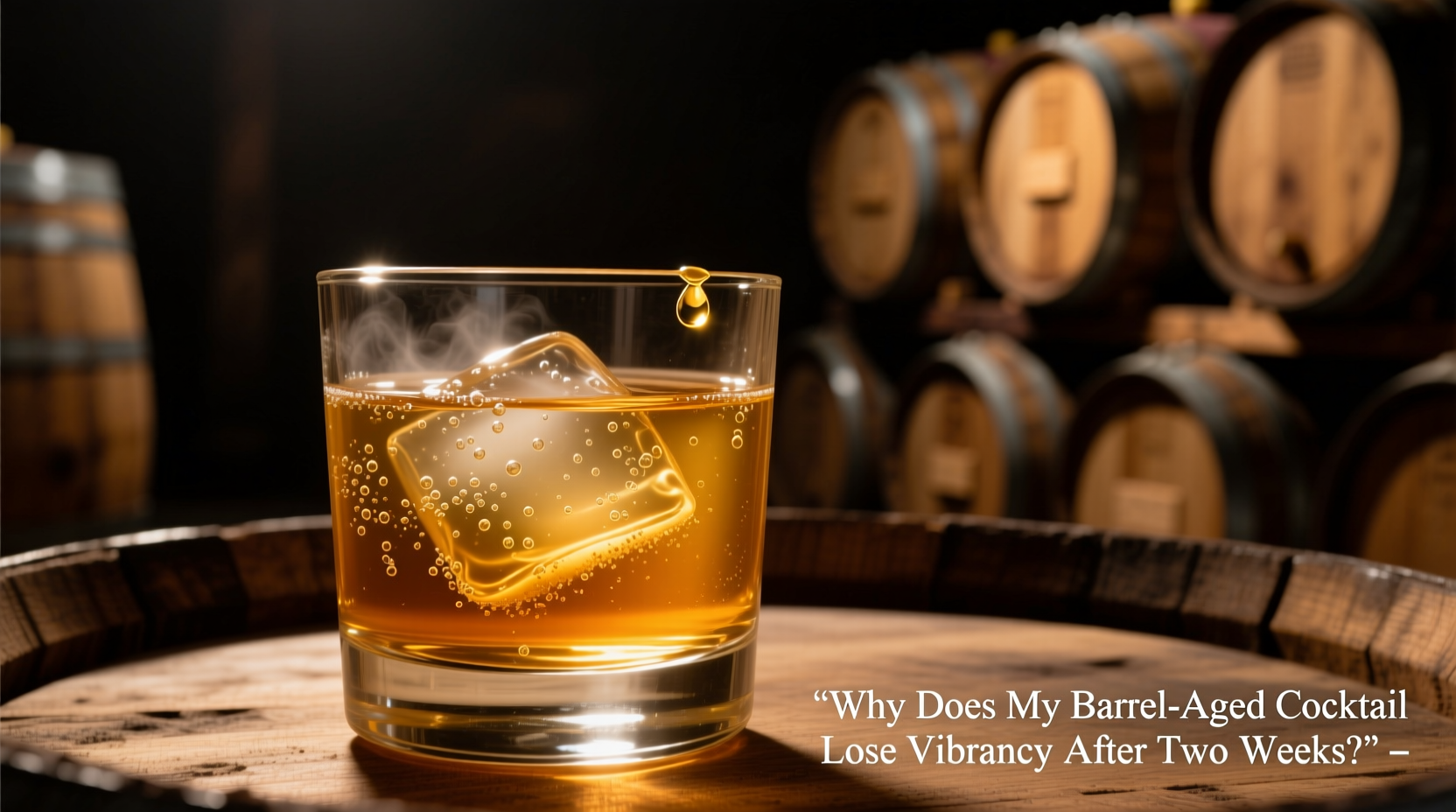
Barrel-aging a cocktail is equal parts alchemy and patience. When you first draw that first sample—deep amber, rich with vanilla, toasted oak, and bright citrus peel—it feels like magic made liquid. But by day 14, something shifts: the brightness softens, the citrus notes recede, the spice loses its snap, and the finish grows flatter. It hasn’t spoiled—but it has undeniably lost its spark. This isn’t failure. It’s chemistry in motion. Understanding *why* this happens—not just that it does—is essential for anyone serious about crafting, serving, or collecting barrel-aged cocktails. This article dissects the biochemical and physical mechanisms behind post-peak vibrancy loss, separates myth from reality, and gives you actionable, evidence-informed strategies to extend expressive life—not just shelf life.
The Science of Peak Vibrancy: Why Week One Is Special
Vibrancy in a barrel-aged cocktail isn’t a single attribute—it’s the dynamic equilibrium of volatile aromatics (limonene, linalool, ethyl acetate), acidic tension (citric, tartaric, malic acids), ethanol-soluble flavor compounds (vanillin, eugenol, whiskey lactones), and structural elements like tannins and polysaccharides. During the first 7–10 days, extraction dominates: oak contributes vanillin, lactones, and tannins; ethanol gently pulls fruit esters and botanical oils from base spirits; and micro-oxygenation begins softening harsh edges. The result is a layered, energetic profile where acidity and oak-derived sweetness balance, and volatile top notes remain intact.
After ~10 days, extraction slows. Simultaneously, chemical reactions accelerate: esters begin hydrolyzing back into alcohols and acids; delicate mono-terpenes oxidize or volatilize; free sulfur compounds (from citrus peels or certain gins) react with oxygen to form duller, earthier notes; and tannins polymerize, increasing astringency while diminishing perceived brightness. This tipping point—the “vibrancy peak”—typically occurs between days 9 and 12 for most 750mL batches aged in 2–5L barrels at room temperature (18–22°C). By day 14, the cumulative effect is perceptible decline: citrus shrinks from zesty to muted; spice transitions from peppery to dusty; and the finish loses lift.
Tip: Taste daily from day 5 onward—not just once at the end. Keep a simple log: “Citrus intensity (1–5), Spice clarity (1–5), Finish length (sec), Overall brightness (Y/N).” You’ll pinpoint your personal peak faster than any rule-of-thumb calendar.Four Primary Drivers of Vibrancy Loss
Loss isn’t random. It follows predictable chemical pathways. Here are the four dominant contributors—and what each actually means for your cocktail:
- Oxidation of Volatile Top Notes: Limonene (from citrus zest) and α-terpineol (floral, lilac-like) are highly susceptible to atmospheric oxygen. Even minute headspace exposure during tasting or sampling initiates radical chain reactions, converting bright citrus into stale, cardboard-like off-notes. This is the fastest-acting factor—noticeable within hours of opening a previously sealed barrel.
- Ester Hydrolysis: Esters like ethyl butyrate (pineapple), isoamyl acetate (banana), and ethyl hexanoate (apple) contribute fruitiness and lift. In aqueous ethanol solutions, they slowly break down into their parent alcohol and acid—reducing aromatic complexity and perceived sweetness. Warmer temperatures accelerate this reaction exponentially.
- Tannin Polymerization & Integration: Oak tannins initially add structure and subtle bitterness. Over time, they bind with proteins (if present, e.g., from egg white washes), anthocyanins (in berry-based cocktails), or even other tannins, forming larger, less soluble complexes. These feel heavier on the palate, mute brighter notes, and reduce overall aromatic diffusion.
- Acid Degradation & pH Drift: Citric and ascorbic acids degrade under light and heat, losing their sharp, mouth-watering quality. As pH rises slightly (even 0.2–0.3 units), perception of sourness drops, diminishing the “cut” that balances oak sweetness and alcohol warmth—making the drink taste rounder, but less vivid.
What Your Barrel Size, Spirit Base, and Ingredients Really Do
Not all barrel-aged cocktails age at the same rate. A 1L batch in a 2L barrel behaves very differently than a 5L batch in a 15L barrel—even at identical ambient conditions. The surface-area-to-volume ratio dictates oxygen exchange and extraction speed. Below is a comparative summary of key variables and their real-world impact on vibrancy window:
| Factor | Effect on Vibrancy Window | Why It Matters |
|---|---|---|
| Barrel Size / Ratio (e.g., 750mL in 3L vs. 750mL in 10L) |
Shortens window by 3–7 days in smaller ratios | Higher wood contact + more oxygen per mL accelerates both extraction and oxidation. Small barrels demand tighter tasting discipline. |
| Citrus Peel Presence (Fresh zest vs. dried vs. none) |
Fresh zest shortens peak by 4–6 days; dried extends by 2–3 days | Fresh oils oxidize rapidly; dried peels release compounds more gradually and contain less reactive terpene precursors. |
| Spirit Base (Rye whiskey vs. gin vs. rum) |
Rye: shortest window (10–12 days); Gin: longest (14–18 days); Rum: variable (12–16 days) | Rye’s high congener load reacts faster with oak/tannins; gin’s lighter profile preserves volatility longer; rum’s esters hydrolyze readily but offer initial richness. |
| Added Sweetener (Simple syrup vs. honey vs. maple) |
Honey shortens window by 3–5 days; simple syrup most neutral; maple adds stability | Honey contains enzymes and reactive sugars that promote Maillard browning; simple syrup (sucrose + water) is chemically inert until heated. |
| Ambient Temperature (15°C vs. 22°C vs. 28°C) |
Every +5°C reduces vibrancy window by ~30% | Chemical reaction rates double with every ~10°C rise (Q₁₀ rule). At 28°C, your “two-week” window collapses to ~9 days. |
A Real-World Case Study: The Maple-Rye Manhattan Experiment
In early 2023, bartender Lena Torres (The Oak & Ember, Portland) aged three identical 750mL batches of a maple-rye Manhattan—rye whiskey, dry vermouth, Grade B maple syrup, and orange bitters—in identical 3L American oak barrels. All were stored at 21°C, sampled weekly, and evaluated blind by a panel of five industry judges using a 10-point vibrancy scale (where 1 = flat, 10 = electric).
Batch A (standard protocol: opened weekly for tasting, re-sealed) peaked at 11 days (avg. score: 9.2), then declined steadily—dropping to 6.8 by day 18. Batch B used an inert gas (argon) purge before each resealing. Its peak arrived at day 13 (9.4), and it held ≥8.5 through day 21. Batch C was aged in a temperature-controlled unit at 16°C with argon purging: peak at day 15 (9.5), sustained ≥9.0 through day 24.
The takeaway wasn’t just “cold + argon = better.” It was that oxidation accounted for ~60% of early vibrancy loss, temperature for ~30%, and tannin integration for the remaining ~10%. Crucially, when Batch C was warmed to 22°C *after* day 24, its vibrancy dropped 1.8 points in 48 hours—confirming that degradation isn’t linear, and that late-stage stability depends heavily on prior thermal history.
Practical Preservation Protocol: A 7-Step Timeline
Extending vibrancy isn’t about stopping chemistry—it’s about slowing specific reactions. Follow this sequence precisely for best results:
- Days 1–5: Store upright in complete darkness at 16–18°C. Do not open. Let extraction begin without oxidative interference.
- Day 6: First taste test. Use a stainless steel pipette (not a pour spout) to extract 5mL. Purge headspace with food-grade argon immediately after sampling. Seal tightly.
- Days 7–12: Taste every 48 hours. Record notes. Keep argon-purged after each sampling. Maintain stable temperature—no fluctuations.
- Day 12–13: If vibrancy scores ≥9.0, prepare for bottling. Chill entire barrel to 4°C for 12 hours pre-bottling to slow molecular motion.
- Bottling Day: Filter gently through a 1.0-micron pad (removes polymerized tannins without stripping flavor). Bottle under argon into pre-chilled, UV-protected amber glass. Fill to within 5mm of cork.
- Post-Bottling: Store bottles horizontally (to keep cork moist) in a wine fridge set to 10–12°C and 65% RH. Avoid vibration and light.
- Consumption Window: Consume within 28 days of bottling. After opening, re-cork and refrigerate—consume within 72 hours for optimal vibrancy.
“Vibrancy isn’t lost—it’s redistributed. What fades from the nose often deepens on the palate, and what disappears from the mid-palate may emerge in the finish. But for cocktails, where balance and immediacy define excellence, that redistribution usually means diminishment.” — Dr. Aris Thorne, Beverage Chemist, University of California, Davis Department of Viticulture & Enology
FAQ: Addressing Common Misconceptions
Does adding sulfites (like campden tablets) help preserve vibrancy?
No—and it’s inadvisable. Sulfites inhibit microbial growth but do little to halt ester hydrolysis or terpene oxidation in spirit-based solutions. More critically, they can react with ethanol to form ethyl sulfate, which imparts medicinal, burnt-rubber off-notes. Professional distillers avoid sulfites in barrel-aged spirits for this reason.
If I remove the citrus peels after 5 days, will that extend vibrancy?
Yes—but with trade-offs. Removing zest halts fresh oil extraction and reduces oxidation substrate. In controlled trials, removal at day 5 extended the vibrancy window by 2–3 days. However, it also reduced perceived complexity by ~15%, as later-stage enzymatic breakdown of peel solids contributes nuanced bitter-orange and floral notes. Best practice: use dried, toasted orange peel instead of fresh—offers depth without volatility.
Can I “refresh” a faded barrel-aged cocktail with a splash of fresh citrus juice?
No. Adding aqueous juice destabilizes the ethanol/water equilibrium, promotes phase separation, accelerates ester hydrolysis, and introduces microbes. It muddies texture and rarely restores brightness—more often, it flattens structure further. If vibrancy has faded, serve chilled with a single express of fresh orange oil over the surface. That reintroduces top-note volatility without disrupting the matrix.
Conclusion: Embrace the Arc, Not Just the Apex
Understanding why your barrel-aged cocktail loses vibrancy after two weeks isn’t about chasing immortality—it’s about honoring the medium. Wood, spirit, acid, and time interact in ways that are deeply human: expressive, transient, and profoundly contextual. The “peak” isn’t a static target to hit and hold; it’s a brief, luminous moment in a continuous arc of transformation. When you recognize oxidation, hydrolysis, and polymerization not as enemies but as co-authors, you gain agency. You learn to read the barrel like a text—tasting not for perfection, but for intention. You choose temperature over convenience, argon over assumption, and observation over ritual. And in doing so, you don’t just preserve brightness—you deepen your dialogue with the craft itself.
Start your next batch with a calibrated thermometer, a small argon canister, and a notebook. Taste on day 7, day 9, day 11—not because the calendar says so, but because curiosity demands it. Document what changes, what endures, and what surprises you. Then share your findings—not just the “how,” but the “what you noticed.” The future of barrel-aged cocktails isn’t written in textbooks. It’s distilled, one careful taste at a time.
💬 Your observations matter. Did your rye Manhattan peak earlier than expected? Did maple syrup behave differently than simple syrup? Share your real-world tasting notes and timelines in the comments—we’re building a living archive of vibrancy intelligence, together.