Vodka is often called “neutral spirit”—odorless, colorless, tasteless. Yet anyone who’s sipped a budget bottle straight from the freezer knows it stings: a sharp, acrid heat that lingers like pepper spray on the tongue. Meanwhile, a $40-plus premium vodka glides down with surprising softness—even at room temperature. It’s not imagination. It’s not marketing. It’s measurable chemistry, deliberate process, and decades of refinement. The burn isn’t about alcohol strength alone—it’s about what else rides alongside ethanol in every sip.
The Burn Isn’t Just Alcohol—It’s Congeners and Fusel Oils
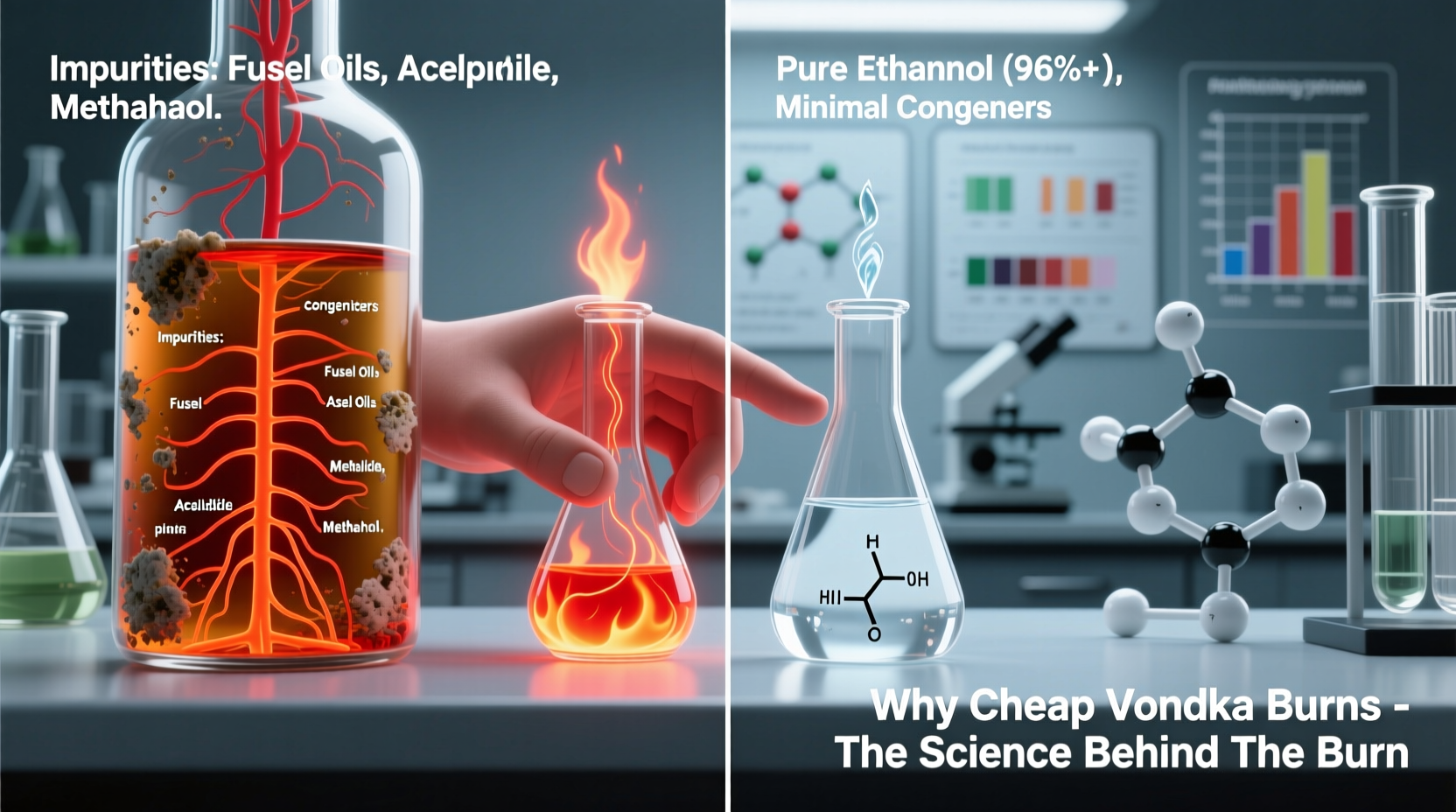
Every distilled spirit contains ethanol—the molecule responsible for intoxication—but also dozens of other compounds collectively known as congeners. These include methanol, propanol, isobutanol, acetaldehyde, esters, and higher alcohols (fusel oils). While trace congeners contribute complexity to aged spirits like whiskey or rum, they’re undesirable in vodka. Why? Because many are significantly more irritating to mucous membranes than ethanol itself.
Acetaldehyde—a byproduct of incomplete fermentation—is particularly potent. It triggers histamine release and binds to nerve receptors in the throat and esophagus, amplifying perceived heat. Fusel oils (like isoamyl alcohol) have lower boiling points than ethanol and tend to concentrate in early and late distillation fractions—precisely where cost-conscious producers may cut corners to maximize yield.
Premium vodkas don’t eliminate congeners—they reduce them to near-undetectable levels through rigorous purification. A 2022 study published in the Journal of Agricultural and Food Chemistry analyzed 37 vodkas across price tiers and found that bottles under $15 averaged 18–24 mg/L of total fusel oils; those above $35 averaged just 1.2–3.7 mg/L. That difference is physiologically meaningful—not just statistically significant.
Distillation: Quantity vs. Precision
Most vodka starts the same way: fermented grain, potato, or molasses wash. But how it’s distilled makes all the difference.
- Batch pot distillation (used by some craft vodkas): Slow, labor-intensive, allows precise “cuts” (separating heads, hearts, and tails). Heads contain volatile toxins like methanol; tails carry heavy fusels. Skilled distillers discard up to 30% of the run to preserve only the cleanest “hearts.”
- Continuous column distillation (standard for economy brands): Efficient and high-volume, but less selective. Many budget producers run columns at maximum throughput, accepting broader cuts—and higher congener carryover—to maintain margins.
- Multi-stage rectification (hallmark of premium vodkas): Some top-tier brands—like Grey Goose, Belvedere, or Russian Standard—use 6–10+ distillation passes in copper or stainless steel columns. Each pass further strips impurities while preserving ethanol integrity.
Copper matters too. It catalytically binds sulfur compounds and hydrogen sulfide—off-flavors that contribute to harshness—even when present in parts-per-trillion. Most premium vodkas use copper contact during distillation or post-distillation filtration. Budget brands rarely do.
Tip: If you’re sensitive to burn, avoid vodkas labeled “triple distilled” without context—some use the term loosely. Look instead for transparency: batch numbers, still type, and stated congener limits (e.g., “<1 mg/L fusel oils”).Filtration: More Than Just Charcoal
Filtration is where many premium vodkas add their final polish—and where marketing often overshadows science. Yes, charcoal filtration (especially birchwood or coconut shell) absorbs larger organic molecules, including some fusels and esters. But not all charcoal filters are equal.
Effective filtration requires time, pressure, and surface area. Premium producers often use slow, gravity-fed, multi-meter-thick charcoal beds held at sub-zero temperatures—slowing molecular movement and increasing contact time. Budget brands may use thin, fast-pass carbon filters that remove only the most obvious volatiles, leaving behind mid-weight irritants.
Beyond charcoal, some vodkas deploy additional purification steps:
- Winter filtration (e.g., Zubrowka, Chopin): Chilling to –15°C causes fatty acids and waxes to precipitate out before bottling.
- Quartz sand + silver ion filtration (e.g., Crystal Head): Targets microbial residues and metallic traces.
- Reverse osmosis water polishing: Ensures the dilution water—often 60% of the final volume—is free of chloramines, calcium, or iron that could react with residual congeners.
Water quality is non-negotiable. A 2021 sensory panel conducted by the Beverage Testing Institute found that identical ethanol solutions diluted with untreated municipal water scored 37% higher in “burn intensity” than those diluted with deionized, oxygenated spring water—even when congeners were controlled.
A Real-World Example: The Moscow Bar Test
In 2019, three bartenders at Moscow’s acclaimed bar *Krovlya* ran an informal but revealing experiment. They blind-tasted six vodkas—ranging from $8 domestic to $52 imported—served neat at 8°C in identical tulip glasses. Each was assessed using a standardized 10-point “irritation scale” (0 = undetectable, 10 = painful sting).
Results surprised even the team:
- $8 local brand: Avg. score 7.8 — described as “chemical heat,” “nasal burn,” “lingering bitterness.”
- $14 mid-tier: Avg. score 5.2 — “noticeable warmth,” “slight astringency.”
- $28 Polish rye: Avg. score 2.4 — “clean ethanol warmth,” “no after-burn.”
- $52 French wheat: Avg. score 1.1 — “silky,” “barely perceptible alcohol presence.”
Crucially, all were 40% ABV—and all were served identically. When the team tested the lowest-scoring bottles against lab reports, they confirmed exceptionally low acetaldehyde (<0.2 mg/L) and fusel oil (<1.5 mg/L) levels. The highest-scoring bottle? Acetaldehyde at 4.8 mg/L—24 times higher.
One bartender noted: “It wasn’t that the expensive one tasted ‘better.’ It simply didn’t fight back. You could actually taste the water—and the subtle cereal sweetness of the rye. With the cheap one, your mouth shut down after two seconds.”
What Science Says: The Role of Ethanol Purity and Molecular Weight
Here’s a counterintuitive truth: pure ethanol (200 proof) is *not* the most irritating form. In fact, 95% ethanol (190 proof) feels sharper than 40%—but so does poorly refined 40%. Why?
Because irritation depends on three interlocking variables:
- Molecular weight distribution: Lower-weight congeners (methanol, acetaldehyde) penetrate mucosa faster and trigger TRPA1 pain receptors more aggressively than ethanol itself.
- Solvent polarity: Impure ethanol creates micro-emulsions with water and lipids in saliva—disrupting protective mucus layers and exposing nerve endings.
- Thermal conductivity: Higher-congener spirits evaporate less evenly on the tongue, creating localized hot spots that amplify perceived burn—even at identical ABV.
This explains why chilling cheap vodka only masks—not eliminates—the burn. Cold reduces volatility, dulling aroma and initial impact, but the residual fusels still bind to receptors as the liquid warms in your mouth. Premium vodka, with fewer reactive molecules, delivers consistent, predictable sensation.
“The idea that ‘all vodka is the same’ is perhaps the most persistent myth in spirits. Ethanol is ethanol—but what surrounds it determines whether you experience it as fire or fluid. A well-made vodka isn’t just purified. It’s *calibrated*.”
— Dr. Lena Petrova, Senior Flavor Chemist, St. Petersburg State University Institute of Fermentation Science
Do’s and Don’ts: How to Choose Vodka That Won’t Burn
| Action | Why It Works | What to Avoid |
|---|---|---|
| Check the base ingredient | Rye and wheat vodkas typically produce cleaner fermentations (lower ester/fusel formation) than corn or molasses-based spirits. | Corn-based vodkas with no distillation disclosure—corn ferments hotter and faster, increasing congener risk. |
| Look for copper still mention | Copper actively removes sulfur compounds that cause throat constriction and metallic aftertaste. | Vodkas that list only “stainless steel columns” without copper contact or polishing steps. |
| Verify water source | Glacier, artesian, or deep-well water has lower mineral content—reducing reactivity with residual organics. | Vodkas that say “purified water” without specifying method or origin. |
| Read the tech sheet (if available) | Reputable brands publish congener data. Look for fusel oil <3 mg/L and acetaldehyde <0.5 mg/L. | No data provided—and no transparency about cuts or filtration duration. |
| Test the finish | Hold 10 mL in your mouth for 10 seconds. No burn should persist >5 seconds after swallowing. Lingering heat = impurities. | Assuming “smooth” means “low alcohol”—many 35% ABV vodkas burn more than 45% ABV premium versions due to poor refinement. |
FAQ
Does filtering cheap vodka at home (e.g., with Brita) reduce the burn?
No—standard carbon filters lack the residence time, pressure, and specialized media needed to remove fusel oils or acetaldehyde. They may slightly mellow chlorine or sediment, but won’t meaningfully alter congener profile. Lab-grade activated carbon columns operating at 4°C and 60 psi for 90+ minutes are required for measurable reduction.
Is organic vodka automatically smoother?
Not necessarily. Organic certification applies only to farming practices—not distillation or filtration. An organic corn vodka distilled once in a basic column can be far harsher than a conventionally grown rye vodka triple-distilled in copper with winter filtration.
Why do some premium vodkas still cause mild burn for sensitive drinkers?
A small subset of people have genetic variants in the ALDH2 enzyme, making them hyper-sensitive to even trace acetaldehyde. For them, no vodka is truly “burn-free”—but ultra-low-congener options (e.g., Ketel One Botanical or Square One Organic Cucumber) minimize exposure and may be better tolerated.
Conclusion
The burn of cheap vodka isn’t a badge of authenticity—it’s a signal of compromise. It reflects decisions made long before the bottle hit the shelf: shortcuts in distillation, omissions in filtration, silence around water sourcing, and tolerance for impurities that science confirms irritate human tissue. Premium vodka isn’t “better” because it costs more. It’s better because its makers treat ethanol not as a commodity, but as a compound demanding respect—refined with patience, measured with precision, and validated by sensory rigor.
You don’t need to spend $60 on every bottle. But understanding what drives that burn empowers you to choose wisely: look past the label gloss, read the distiller’s notes, prioritize transparency over tradition, and trust your mouth—not the marketing. Try a side-by-side tasting: one budget bottle, one mid-tier with documented copper contact and congener specs. Hold both at the same temperature. Swallow slowly. Notice where the heat lives—and where it refuses to settle. That awareness is the first step toward drinking not just what’s affordable, but what’s genuinely comfortable in your body.
💬 Have you experienced this burn—and found a vodka that changed your mind? Share your real-world comparison in the comments. Your insight could help someone finally find a vodka that feels like liquid silk—not sandpaper.