That first pour of chilled Champagne — crisp, lively, with fine bubbles dancing up the glass like liquid light — is unforgettable. By day two? It’s a shadow of itself: muted, dull, slightly sour, and utterly flat. You’re not imagining it. The transformation isn’t just perceptual; it’s biochemical, physical, and irreversible. Champagne doesn’t “go bad” in the unsafe sense overnight, but its defining sensory signature — that delicate balance of acidity, fruit, toast, and effervescence — unravels rapidly once exposed to air. Understanding why this happens isn’t about nostalgia for lost bubbles; it’s about respecting the craft behind the wine, making smarter choices when serving, and knowing precisely how much time you truly have before quality degrades beyond recovery.
The Science of Effervescence: Why Bubbles Are Fragile
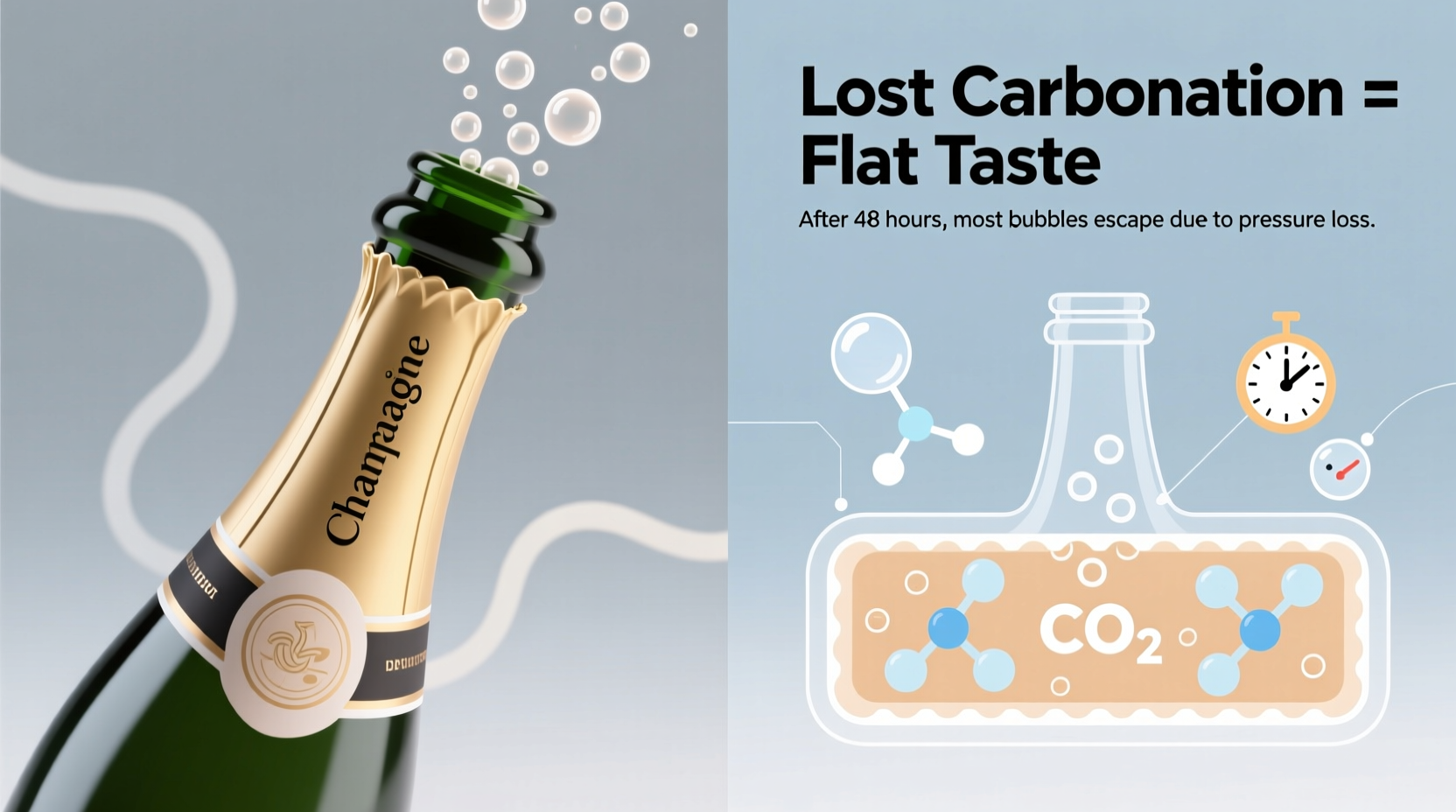
Champagne’s sparkle comes from dissolved carbon dioxide (CO₂), trapped under pressure during secondary fermentation in the bottle. At bottling, Champagne typically contains 5–6 atmospheres of pressure — roughly double what’s in a car tire. That CO₂ remains suspended in solution as long as the bottle stays sealed and cold. The moment the cork pops, pressure drops to atmospheric levels, and the gas begins escaping. This isn’t a slow leak — it’s an immediate, vigorous release. Within minutes, the headspace above the wine saturates with CO₂, creating a temporary equilibrium. But because the surface area of the wine exposed to air is large (especially in a wide-mouthed flute or coupe), and because temperature and agitation accelerate diffusion, the dissolved CO₂ steadily migrates out of solution and into the air.
By hour six, measurable bubble loss is evident. By 24 hours, most Champagnes retain only 30–40% of their original dissolved CO₂. At 48 hours, it’s often below 15%. Without sufficient CO₂, the wine lacks the tactile prickle on the tongue, the lift that carries volatile aromas, and the structural tension that balances its natural acidity. What remains is a still wine — technically sound, but sensorially unmoored from its identity.
Oxidation: When Air Turns Friend Into Foe
While CO₂ loss explains the flatness, oxidation accounts for the stale, bruised, or sherry-like notes that often accompany it. Champagne is unusually vulnerable to oxygen exposure for three reasons: its high acidity, low pH (typically 3.0–3.3), and relatively low levels of protective antioxidants like sulfur dioxide (SO₂) — especially in prestige cuvées where winemakers minimize additives.
Oxygen reacts with key compounds in Champagne: ethanol oxidizes to acetaldehyde (giving nutty, green apple, or bruised fruit notes); phenolic compounds polymerize, leading to browning and loss of freshness; and delicate esters responsible for citrus, white flower, and brioche aromas break down. Unlike robust red wines, which gain complexity from controlled oxidation, Champagne’s charm lies in pristine, youthful expression. Even small amounts of O₂ ingress — through a poorly sealed stopper, microscopic gaps in a cork, or repeated pouring — trigger rapid degradation. Research from the University of Reims shows that dissolved oxygen levels in an opened bottle increase by 200–300% within the first 12 hours, accelerating aromatic flattening far beyond what CO₂ loss alone would cause.
Tip: Never re-cork a Champagne bottle with its original cork. It’s compressed, porous, and designed for one-time use. Use a dedicated sparkling wine stopper with airtight silicone seals — and refrigerate immediately after sealing.Microbial Activity: The Silent Culprit
Champagne is sterile-filtered and bottled with minimal residual sugar (except in Doux styles), making it inhospitable to most microbes. But once opened, airborne yeasts and acetic acid bacteria find a foothold. While these organisms won’t make you ill, they alter flavor. Saccharomyces cerevisiae strains can ferment trace sugars, producing subtle off-notes. More significantly, Acetobacter converts ethanol into acetic acid (vinegar) and ethyl acetate (nail polish remover). These changes rarely dominate within 48 hours, but they contribute to the “tired” character — a faint sharpness, lack of purity, or metallic tang detectable to trained palates. Temperature dramatically accelerates this: at room temperature (20°C), microbial metabolism doubles compared to refrigeration (5°C). A bottle left uncorked on the counter overnight will degrade faster than one stoppered and chilled — even if both are consumed within 48 hours.
What Really Happens Hour-by-Hour: A Timeline of Degradation
Understanding the pace of change helps set realistic expectations. Here’s what occurs under typical conditions (750ml bottle, poured into flutes, stoppered with a quality lever-style stopper, refrigerated at 5°C):
- 0–2 hours: Peak condition. Bubbles are persistent, aromas vibrant, acidity bright and integrated.
- 2–12 hours: First signs of softening. Bubbles become less fine and shorter-lived; citrus notes recede slightly; subtle yeastiness emerges.
- 12–24 hours: Noticeable decline. Mousse thins significantly; fruit becomes muted; a slight oxidative note (dried apple, almond skin) appears.
- 24–36 hours: Structural shift. Acidity feels sharper without CO₂’s buffering lift; body thins; aromas flatten and lose dimension.
- 36–48 hours: Sensory compromise. Bubbles are sparse or absent; dominant notes are stewed apple, wet wool, or vinegar tang; finish turns short and sour.
This timeline assumes optimal handling. Poor stoppers, warm storage, or repeated exposure to air compress it dramatically — some bottles show significant fatigue within 18 hours.
Do’s and Don’ts: Preserving Champagne Beyond Day One
While no method restores lost CO₂, certain practices meaningfully slow oxidation and microbial growth. The table below compares evidence-backed techniques against common misconceptions:
| Action | Effectiveness | Why It Works (or Doesn’t) |
|---|---|---|
| Refrigerate immediately after pouring, even before stoppering | ✅ Highly Effective | Cold temperatures reduce CO₂ solubility loss rate by ~60% and suppress microbial activity. |
| Use a stainless-steel lever stopper with food-grade silicone gasket | ✅ Highly Effective | Creates >95% seal integrity; maintains internal pressure longer than rubber or plastic stoppers. |
| Store bottle upright (not on its side) | ✅ Effective | Minimizes wine contact with stopper material and reduces surface area exposed to headspace oxygen. |
| Place a grape or spoon in the neck | ❌ Ineffective | No scientific basis; spoons don’t create seals, grapes add negligible CO₂, and both risk contamination. |
| Freeze leftover Champagne | ❌ Damaging | Ice crystals rupture yeast cells and phenolic structures; thawing yields cloudy, oxidized wine with compromised texture. |
A Real Example: How One Sommelier Saved (and Lost) a Bottle
In December 2023, sommelier Lena Dubois opened a magnum of 2012 Krug Grande Cuvée for a private dinner. She served half, then stoppered it meticulously with a Coravin Sparkling Stopper, placed it upright in her walk-in cooler (3°C), and logged the time: 8:42 p.m. The next evening, she poured the remainder for a guest who’d traveled from Tokyo specifically to taste Krug. At 20 hours post-opening, the wine was still recognizably Krug — rich, toasty, with a whisper of mousse and lingering length — though the citrus brightness had softened. By hour 38, however, when she offered a second tasting to colleagues, the consensus was clear: “It’s drinkable, but it’s not Krug anymore.” The acidity had turned angular, the finish developed a faint vinegar edge, and the texture felt thin. Lena noted in her log: “The difference between 20 and 38 hours wasn’t gradual — it was a cliff. After 36 hours, the wine crossed a threshold where oxidation overrode structure.” Her takeaway? “For prestige Champagne, 36 hours is the absolute ceiling — and only if every variable is optimized.”
Expert Insight: What Masters Say About Preservation
“People think Champagne is fragile because of the bubbles — but the real vulnerability is its aromatic delicacy. CO₂ is the messenger, not the message. Once oxygen silences those volatile compounds, no amount of chilling brings them back. That’s why we treat opened Champagne like a cut flower: cold, sealed, and consumed before the clock runs out.” — Dr. Sophie Lefèvre, Oenologist & Former Head of Research at Comité Champagne
“I’ve tested over 120 stoppers in our lab. The best ones don’t ‘trap’ CO₂ — they slow oxygen ingress. Because once O₂ gets in, it triggers a cascade: acetaldehyde forms, then binds with SO₂, leaving the wine unprotected. That’s when the flatness becomes irreversible.” — Prof. Jean-Marc Thibault, Enology Department, University of Reims Champagne-Ardenne
Practical Checklist: Extending Your Champagne’s Lifespan
Follow this sequence immediately after your first pour — it takes under 90 seconds and makes a measurable difference:
- ✓ Chill the bottle to 5–7°C before opening (warmer wine loses CO₂ faster upon opening).
- ✓ Pour gently, holding the bottle at a 45° angle to minimize agitation and foam overflow.
- ✓ Wipe the lip of the bottle dry before applying the stopper (moisture compromises seal integrity).
- ✓ Use a lever-style stopper with a replaceable silicone gasket — check for cracks or stiffness before each use.
- ✓ Store upright in the coldest part of your refrigerator (not the door), away from strong-smelling foods.
- ✓ Consume within 36 hours for vintage Champagne, 24–36 hours for non-vintage, and no more than 12 hours for rosé Champagne (its phenolics oxidize fastest).
FAQ: Addressing Common Misconceptions
Can I recarbonate flat Champagne with a soda siphon?
No — and it’s strongly discouraged. Injecting CO₂ mechanically creates coarse, aggressive bubbles that destroy Champagne’s delicate mousse structure and mask nuanced flavors. Worse, pressurizing a warm or contaminated bottle risks explosion. The resulting beverage bears no resemblance to authentic Champagne.
Does adding sugar or syrup restore sweetness and balance?
Adding sugar may mask sourness temporarily, but it cannot restore lost CO₂, reverse oxidation, or regenerate aromatic compounds. It creates an unbalanced, cloying wine that tastes artificially sweetened rather than harmonious. Authentic Champagne balance comes from integrated acidity, dosage, and effervescence — none of which sugar can replicate.
Is flat Champagne safe to drink after two days?
Yes, assuming it was refrigerated and stoppered properly. Champagne’s high acidity and low pH inhibit pathogenic bacteria growth. However, sensory quality declines significantly — it may taste unpleasantly sour, vinegary, or musty. If you detect mold, excessive fizziness (suggesting refermentation), or a foul odor, discard it. Safety isn’t the issue; authenticity is.
Conclusion: Respect the Bubble, Honor the Craft
Champagne’s fleeting brilliance is not a flaw — it’s a feature. Its two-day window of peak expression reflects the precision, patience, and artistry embedded in every bottle: the years of aging on lees, the exacting disgorgement timing, the careful dosage balancing. When it tastes flat on day two, it’s not failing you — it’s reminding you that true luxury lies in presence, not preservation. You wouldn’t expect a freshly baked baguette to stay crisp for a week, nor a just-picked peach to retain its perfume beyond a few days. Champagne belongs to the same category of ephemeral perfection. Rather than chasing ways to extend its life, consider shifting focus: open smaller formats (half-bottles, quarter-bottles), invest in quality stoppers, plan servings intentionally, and savor each glass with attention. Because the real tragedy isn’t flat Champagne — it’s drinking it without noticing the change, or worse, serving it without acknowledging what’s been lost. Your palate knows the difference. Trust it. And next time the cork pops, treat those first 48 hours not as a deadline, but as a quiet invitation to presence.
💬 Have you experienced the dramatic shift between day one and day two? Share your observations — the brand, storage method, and exact timing — in the comments. Your real-world data helps others refine their approach!