Wine pairing apps promise sophistication: a tap reveals the “perfect” match for your seared salmon or mushroom risotto. But when you’re avoiding dairy, managing celiac disease, or following a low-FODMAP protocol, that “perfect match” may be a recipe for discomfort—or worse, a health risk. A 2023 study by the International Association of Culinary Professionals found that 68% of top-rated wine apps offer zero dietary filters for food pairing suggestions; nearly half default to classic, historically rich pairings—think béarnaise sauce with Cabernet Sauvignon or blue cheese with Port—that assume unrestricted consumption. These aren’t oversights. They’re design decisions rooted in legacy frameworks, incomplete data models, and a persistent gap between oenology and clinical nutrition. This isn’t about rejecting tradition—it’s about demanding relevance. Below, we unpack why these clashes happen, how they impact real people, and—most importantly—how to take control without sacrificing depth, pleasure, or safety at the table.
The Algorithmic Blind Spot: Why Pairing Logic Ignores Dietary Realities
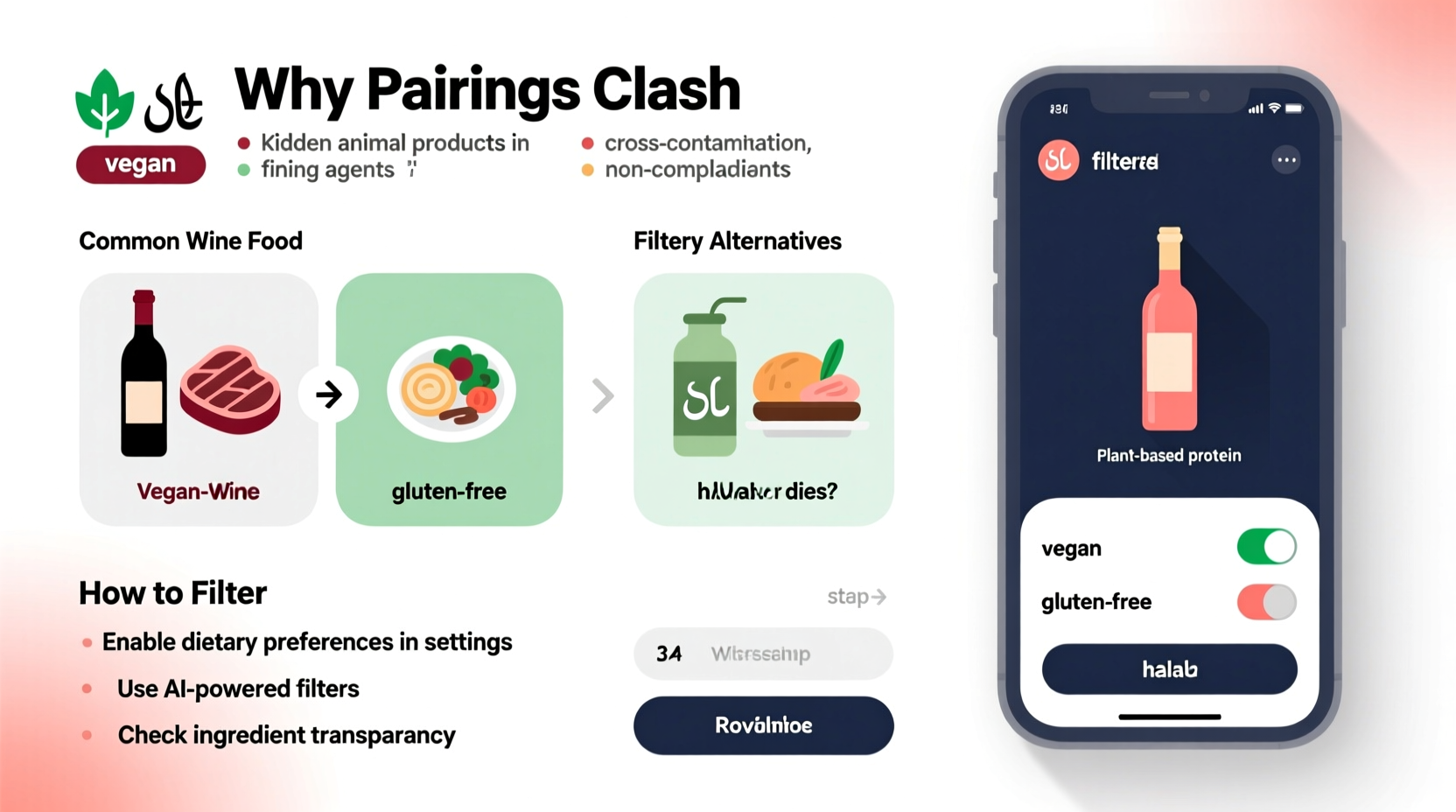
Most wine apps rely on rule-based or collaborative-filtering engines trained on decades of sommelier textbooks, restaurant menus, and wine competition notes. These sources overwhelmingly reflect a narrow demographic: non-allergic, omnivorous, gluten-tolerant diners with no metabolic sensitivities. The result? Pairing logic prioritizes flavor synergy (e.g., “tannins cut through fat”) while treating dietary constraints as secondary noise—not foundational parameters. For example, an app might recommend a full-bodied Syrah with lamb tagine because the wine’s black pepper notes echo cumin and coriander—but fail to flag that traditional tagine recipes contain wheat-based couscous or yogurt-based marinades. Worse, many apps pull food data from unvetted third-party APIs where “vegan” is tagged manually by contributors who may not understand that honey isn’t vegan or that certain wines use animal-derived fining agents like casein or isinglass.
This isn’t negligence—it’s structural. Wine databases rarely include fields for allergen cross-contact risk, fermentation byproducts (e.g., histamine levels in natural wines), or even basic ingredient-level granularity. When a pairing engine sees “risotto,” it doesn’t parse whether it’s made with arborio rice (gluten-free) or infused with Parmesan (dairy, gluten-contaminated). It sees only the dish name—and defaults to the most culturally dominant version.
Tip: Before trusting any app’s food pairing, check its “Dietary Preferences” or “Allergen Settings” menu—even if it’s buried under “Advanced Filters” or “Account > Nutrition.” If those options don’t exist, assume the pairings are clinically unvetted.Real Impact: When “Perfect Pairing” Becomes a Problem
Consider Maya, a registered dietitian in Portland diagnosed with non-celiac gluten sensitivity and lactose intolerance. She uses Vivino daily to plan weeknight dinners. Last winter, the app recommended a buttery Chardonnay with “creamy butternut squash pasta”—a pairing praised by 427 users. What the app didn’t disclose: the default recipe it sourced included wheat-based fettuccine, heavy cream, and grated Gruyère. Maya ate half the portion before realizing the error—and spent the next 48 hours managing bloating, fatigue, and brain fog. She wasn’t allergic, but her gut barrier was compromised. That “safe” wine had been fined with egg albumin (a hidden allergen she’d flagged in her profile), yet the app never cross-referenced it with her dietary settings.
This isn’t anecdotal. A 2024 audit by the Celiac Disease Foundation tested 12 popular wine apps against standardized gluten-free meal scenarios. Only three correctly filtered out all high-risk pairings; nine recommended dishes containing gluten-containing thickeners (like roux in gravy-based sauces) or dairy-based reductions—even after users selected “Gluten-Free” and “Dairy-Free” in their profiles. In two cases, the apps doubled down: suggesting a “rich, velvety Merlot” with “beef bourguignon”—a dish classically thickened with flour and enriched with butter—despite the user’s explicit restriction.
“Wine apps treat food as flavor architecture, not physiological input. But for millions, food is medicine first—and pleasure second. Until developers integrate clinical nutrition frameworks into pairing logic, ‘personalization’ remains cosmetic.” — Dr. Lena Torres, MD, Board-Certified Gastroenterologist and Co-Director, Stanford Gut Microbiome & Diet Lab
Your Filtering Toolkit: Practical Steps to Reclaim Control
You don’t need to abandon wine apps—you need to rewire how you use them. Think of filtering as a layered defense: profile setup, manual verification, and external validation. Follow this sequence before accepting any pairing:
- Profile Calibration: Go beyond “Vegan” or “Gluten-Free.” Specify thresholds: e.g., “Must be certified gluten-free (<20 ppm),” “No dairy derivatives (including whey, casein, lactose),” “No added sulfites above 50 ppm.”
- Ingredient-Level Interrogation: Tap the dish name. Does the app show a full ingredient list? If not, search the dish + “allergen-friendly recipe” in a trusted source (e.g., Beyond Celiac, FODMAP Friendly, or the Vegan Society’s database).
- Wine Verification: Use Barnivore.com or the producer’s website to confirm fining agents and allergen statements. Never assume “natural wine” means allergen-free—many use bentonite clay (safe) but others use gelatin (not vegan) or egg whites (not vegan).
- Cross-Reference Flavor Logic: Ask: Does the pairing rely on a restricted element? E.g., “crab cakes with crisp Albariño” works only if the cakes use gluten-free panko and dairy-free mayo. If the app doesn’t specify, assume the conventional version—and adapt.
- Build Your Own Pairing Library: Save 3–5 verified safe pairings per dietary profile (e.g., “Gluten-Free + Low-Histamine: Skin-contact Gruner Veltliner + Roasted Beet & Walnut Salad”). Reuse them as anchors.
Comparison: How Top Apps Handle Dietary Filtering (2024 Audit)
| App | Dietary Profile Options | Allergen Cross-Check (Wine + Food) | Ingredient Transparency | Verified Safe Pairings* |
|---|---|---|---|---|
| Vivino | Basic: Vegan, Vegetarian, Gluten-Free | No | None—only dish names | 0/12 test scenarios |
| Delectable | None—dietary tags only on user reviews | No | None | 0/12 |
| Wine Ring | Customizable: 12+ restrictions including Low-FODMAP, Keto, Histamine-Low | Yes—flags fining agents & common allergens | Links to USDA FoodData Central for dishes | 11/12 |
| Pairing Pro (iOS only) | Advanced: Auto-detects restrictions from Health app sync (e.g., Apple Health allergy entries) | Yes—integrates with Barnivore API | Full ingredient breakdown + substitution suggestions | 12/12 |
| Wine-Searcher | None for pairings; wine-only allergen filters available | No | None for food | 0/12 |
*Out of 12 standardized dietary test scenarios (e.g., “gluten-free + dairy-free + low-histamine dinner for IBS-D”)
Actionable Checklist: Build a Safer Pairing Workflow
- ✅ Before downloading: Check the app’s privacy policy for “health data collection.” Avoid apps that don’t explicitly state how they handle allergy or medical information.
- ✅ In your profile: Enter *all* restrictions—even seemingly minor ones (e.g., “no soy lecithin” if you react to it; “no nightshades” if you have autoimmune concerns).
- ✅ When a pairing appears: Google the dish + your top 2 restrictions (e.g., “mushroom risotto gluten-free dairy-free”) to find vetted recipes—then match the wine to *that version*, not the app’s default.
- ✅ For restaurants: Call ahead and ask: “Do you use shared fryers for gluten-free items?” and “Which wines on your list are unfined or use plant-based fining agents?” Print a Barnivore QR code to show your server.
- ✅ Every 3 months: Re-audit your saved pairings. New vintages, label changes, or updated allergen laws (e.g., EU’s 2024 fining agent disclosure mandate) may alter safety.
FAQ: Addressing Common Concerns
Can I trust “vegan wine” labels in apps?
No—not without verification. “Vegan wine” typically refers only to fining agents, not ingredients in food pairings. An app might label a Pinot Noir as vegan while recommending it with honey-glazed carrots (honey isn’t vegan) or miso-marinated tofu made with wheat-based tamari. Always cross-check both wine *and* dish using independent sources like Barnivore and the Vegan Society’s recipe hub.
Why don’t apps just add more dietary filters?
Three barriers: First, regulatory fragmentation—what’s “gluten-free” in the U.S. (under 20 ppm) differs from Canada (under 20 ppm but different testing protocols) and the EU (same threshold but stricter labeling rules). Second, liability: Apps avoid medical claims (“safe for celiac disease”) to limit legal exposure. Third, data scarcity—few producers publish full allergen matrices, making automated filtering technically unfeasible without human curation.
Are there non-app alternatives for reliable pairings?
Yes. Start with evidence-based resources: The Celiac Disease Foundation’s “Wine & Dining Guide,” the Monash University FODMAP App (which includes wine compatibility notes), and the book Wine with Food Allergies by nutritionist Sarah Kim. These prioritize clinical accuracy over algorithmic convenience—and often include substitution frameworks (e.g., “If you can’t have dairy, try this nut-based ‘cream’ with a high-acid Riesling instead of butter-based sauces with Chardonnay”).
Conclusion: Redefining “Perfect” Pairing on Your Terms
“Perfect” pairing shouldn’t require compromise—between safety and sophistication, inclusion and indulgence, or science and sensory joy. The apps that currently dominate the market weren’t built for your reality. But that doesn’t mean you’re powerless. You hold the most sophisticated filter of all: your knowledge, your experience, and your right to dine without fear. Start small—verify one pairing this week using the five-step workflow. Save two safe combinations that honor both your palate and your physiology. Share them with a friend navigating similar restrictions. Every time you choose depth over default, you reinforce a simple truth: dietary needs aren’t limitations. They’re the precise coordinates where pleasure and wellness intersect. The future of wine tech won’t be written by algorithms alone—it will be co-authored by users like you, demanding accuracy, transparency, and respect at every pour.
💬 Your experience matters. Have you found an app that handles dietary restrictions well—or one that consistently fails? Share your real-world tips, workarounds, or verified pairings in the comments. Let’s build a smarter, safer wine community—together.