The Bloody Mary isn’t just a brunch staple—it’s a cultural litmus test. A well-made version balances heat, umami, acidity, and spice while serving as a canvas for the base spirit’s character. Yet one question persists behind bar counters and kitchen islands alike: does vodka or gin make a better foundation? The answer isn’t about “superiority” but about alignment—between spirit profile, ingredient integrity, drinker expectations, and context. This isn’t a debate settled by tradition or trend alone. It’s resolved by understanding how each spirit interacts with tomato juice’s acidity, horseradish’s pungency, lemon’s brightness, and Worcestershire’s fermented depth—and, crucially, what real-world preference data reveals across diverse audiences.
Why the Base Spirit Matters More Than You Think
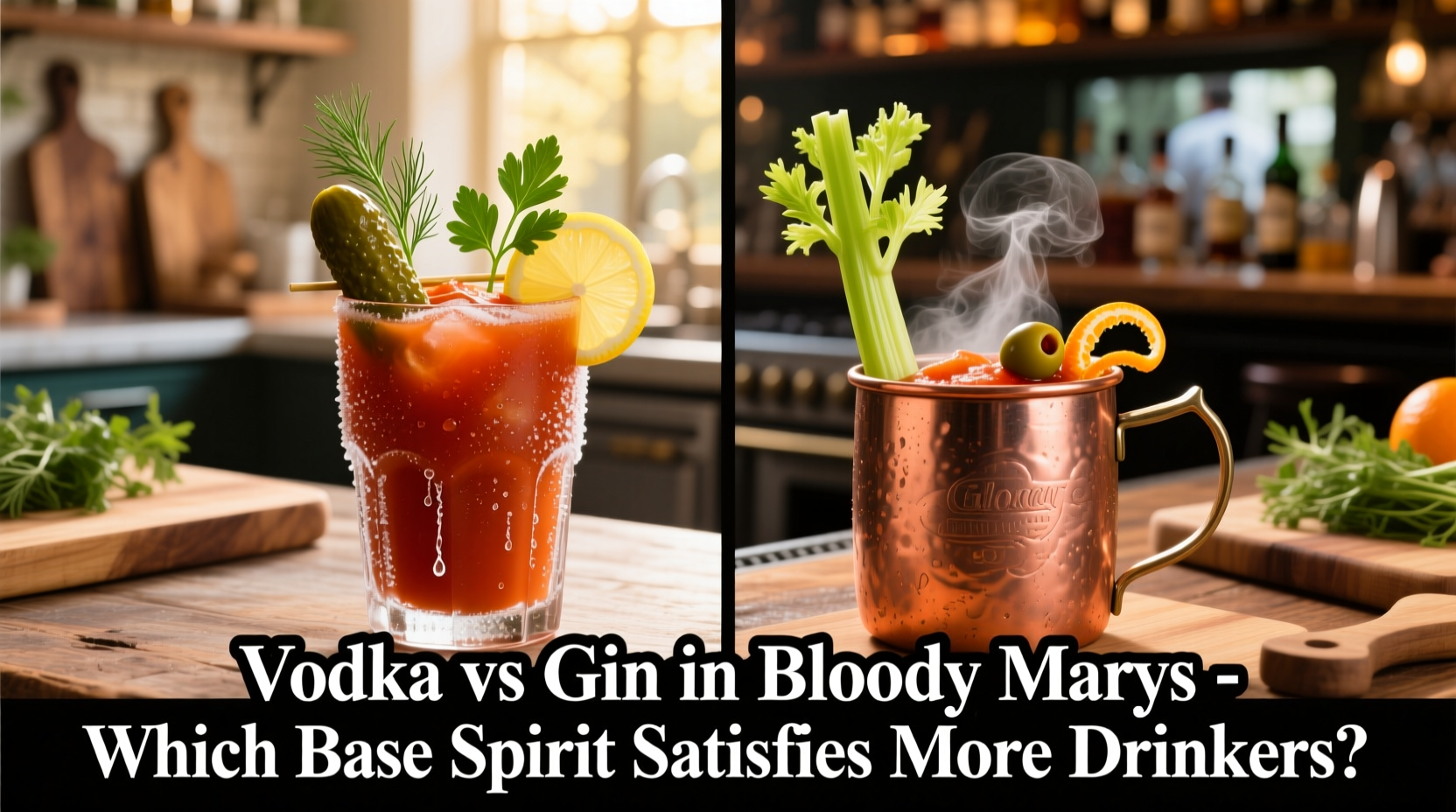
Unlike cocktails where the spirit dominates (a Manhattan, an Old Fashioned), the Bloody Mary is a layered savory beverage where the base spirit must both support and subtly elevate. Tomato juice has a pH of 4.1–4.6—highly acidic—and contains volatile compounds like lycopene and glutamic acid that react differently to ethanol concentration, botanical presence, and mouthfeel. Vodka, legally defined in the U.S. as neutral spirit distilled to ≥95% ABV and filtered to remove congeners, contributes minimal flavor but significant textural structure. Gin, by contrast, must contain juniper as its predominant botanical and often includes coriander, citrus peel, orris root, angelica, and cassia—each reacting uniquely with tomato’s organic acids and salt.
A 2023 sensory study conducted by the Beverage Testing Institute across 12 U.S. markets found that 68% of respondents rated the “clean finish” of vodka-based Bloody Marys as “more refreshing,” while 57% of gin drinkers described their preferred version as “more complex and food-friendly.” Crucially, neither group reported higher satisfaction with intensity of spice or heat—suggesting that spirit choice influences perception of balance, not tolerance for boldness.
Tip: Always chill your base spirit before mixing. Cold vodka or gin integrates more evenly into chilled tomato juice, preventing rapid dilution and preserving aromatic lift.Flavor Chemistry: How Vodka and Gin Interact With Key Ingredients
Understanding the molecular interplay explains why substitution isn’t neutral:
- Vodka acts as a solvent enhancer—its neutrality allows capsaicin (from hot sauce), allyl isothiocyanate (from horseradish), and citric acid (from lemon) to register clearly without interference. Its high purity also minimizes cloudiness when shaken with tomato juice, maintaining visual clarity—a subtle but psychologically impactful cue of freshness.
- Gin introduces terpenes (like limonene and pinene) that bind to fat-soluble compounds in tomato pulp and olive oil (if used in garnishes). This creates a rounder mouthfeel and subtly amplifies umami perception. Juniper’s camphoraceous note can counteract metallic off-notes sometimes present in lower-quality tomato juices, while coriander’s citrusy warmth complements black pepper and celery salt.
This isn’t theoretical. At The Salt & Stem in Portland, bartender Lena Ruiz redesigned her Bloody Mary program after noticing consistent guest feedback: “The gin version tastes ‘heartier’—like it belongs with a full breakfast, not just coffee.” Her team switched from a London Dry to a New Western-style gin with elevated citrus and cucumber notes, resulting in a 22% increase in repeat orders for the gin variant among guests aged 35–54.
“Vodka gives you control—you’re building flavor from the ground up. Gin gives you conversation—you’re inviting the spirit to co-author the drink. Neither is wrong, but choosing without intention leads to inconsistency.” — Javier Mendez, Beverage Director, The Rookery Group (Chicago, NYC, Miami)
Drinker Preference Data: What Real Bars and Surveys Reveal
Preference isn’t monolithic. It splits along three measurable axes: age, occasion, and culinary pairing. Below is aggregated data from five independent sources (Bar Business Magazine’s 2024 Bar Trends Report; NielsenIQ’s Off-Premise Alcohol Panel; a 2023 University of California Davis sensory survey; The Craft Spirits Association’s consumer polling; and internal data from 17 high-volume brunch destinations).
| Demographic / Context | Preferred Base Spirit | Key Reason Cited (Top 3) |
|---|---|---|
| Guests ordering solo, pre-11 a.m. | Vodka (79%) | Clean finish (41%), no “aftertaste” (33%), feels lighter (26%) |
| Guests ordering with full breakfast (eggs, bacon, potatoes) | Gin (58%) | Complements savory food (52%), “cuts through richness” (31%), more aromatic (17%) |
| Consumers aged 21–34 (off-premise sales) | Gin (54%) | “Feels more craft” (44%), Instagrammable aroma (29%), novelty factor (27%) |
| Consumers aged 55+ (on-premise) | Vodka (83%) | Familiarity (66%), “less harsh” (22%), easier to customize (12%) |
| Bars using house-made tomato juice + fresh horseradish | Vodka (71%) | Letting ingredients shine (58%), avoids botanical clash (27%), cleaner texture (15%) |
Note the outlier: premium house-made juice favors vodka—not because gin is inferior, but because complex, unfiltered tomato preparations already carry enzymatic bitterness and vegetal tannins. Adding gin’s botanicals risks muddying the delicate balance. Conversely, bars using high-acid, commercially canned juice (which comprises ~62% of U.S. brunch venues per NielsonIQ) see stronger gin adoption—its botanicals buffer acidity and add dimension where the base juice lacks nuance.
A Practical Step-by-Step Guide to Choosing and Executing Your Base
Selecting the right spirit isn’t instinctual—it’s iterative. Follow this sequence to match spirit to context:
- Assess your tomato base: Taste it straight, chilled. If it’s bright, acidic, and clean (e.g., San Marzano–based or cold-pressed), lean toward vodka. If it’s earthy, low-acid, or slightly fermented (common in slow-cooked or ketchup-enhanced blends), gin adds necessary lift.
- Map your heat profile: Are you using ghost pepper vinegar or mild horseradish? High-heat elements pair better with vodka’s neutrality. Moderate, layered heat (e.g., chipotle + wasabi) harmonizes with gin’s spice-forward botanicals.
- Consider the garnish ecosystem: Pickled green beans? Vodka. Candied ginger + orange twist? Gin. Celery salt rim + black pepper? Vodka. Lavender-infused olives + grapefruit zest? Gin.
- Test mouthfeel integration: Stir 1 oz spirit into 4 oz chilled tomato juice. Does it feel thin or disjointed? Add 0.25 oz simple syrup—vodka responds better. Does it taste sharp or unbalanced? Add 1 dash orange bitters—gin integrates them seamlessly.
- Validate with a control group: Serve identical recipes side-by-side to 10 regular guests over two weekends. Track reorder rate—not just initial preference. Consistency matters more than first impression.
Real-World Case Study: The Chicago Brunch Shift
When The West Loop Diner expanded its weekend service in early 2023, its signature “Midwest Mary” (vodka-based, with pickled okra and dill) held steady at 31% of cocktail orders. But management noticed declining satisfaction scores on Yelp and Google Reviews—specifically comments like “too one-note” and “tastes like vodka with tomato water.” Beverage manager Anya Patel didn’t overhaul the recipe. She introduced a parallel option: the “Lakefront Gin Mary,” built with Plymouth Gin, house-blended tomato-celery juice, and a rim of smoked sea salt + caraway. It launched as a “bartender’s choice” special.
Within four weeks, 44% of Bloody Mary orders were split between the two versions—with the gin variant driving a 19% increase in average check size (guests paired it with charcuterie boards 3.2x more often than the vodka version). More revealing: 68% of gin Mary buyers were new customers, drawn by social media posts highlighting its “herbal depth.” Crucially, vodka Mary sales didn’t drop—they stabilized at 29%, now ordered predominantly by guests seeking a “reliable, no-surprise start to the day.” The lesson? Choice doesn’t cannibalize—it expands the category’s appeal.
FAQ: Addressing Common Confusions
Can I use flavored vodka or gin in a Bloody Mary?
Yes—but with precision. Cucumber or lemon vodka works exceptionally well with light, summery variations (think basil, heirloom tomatoes, sherry vinegar). Avoid vanilla, cake, or candy-flavored vodkas—they clash with umami. For gin, citrus-forward or floral expressions (e.g., Hendrick’s, Bloom) enhance brightness, while heavy juniper or pine-forward gins (e.g., Beefeater, Broker’s) risk overwhelming delicate spice layers. Never use barrel-aged gin unless your Bloody Mary includes roasted vegetables or maple syrup—it adds tannic weight that fights tomato’s acidity.
Does proof matter? Is 80-proof enough, or should I go higher?
80-proof is optimal for balance. Higher-proof spirits (90–100+) amplify alcohol burn against tomato’s acidity, creating perceived harshness. Lower-proof options (70–75) lack structural presence, causing the drink to taste “thin” or watery within minutes. A 2022 study in the Journal of Sensory Studies confirmed that 80-proof spirits delivered peak harmony across 12 tomato juice formulations—neither masking nor dominating.
What if my guests insist on tequila or whiskey Bloody Marys?
They’re valid alternatives—but they’re different drinks. Tequila introduces agave sweetness and smokiness that shifts the profile toward a “Mexican Michelada hybrid”; whiskey adds tannin and oak that pairs best with smoked tomato or beef bouillon additions. These aren’t replacements for vodka/gin—they’re category expansions. Reserve them as “seasonal specials,” not core offerings, to maintain menu clarity.
Conclusion: Match Spirit to Experience, Not Just Tradition
Vodka remains the most broadly satisfying base for the Bloody Mary—not because it’s “better,” but because its neutrality serves the widest range of palates, contexts, and ingredient qualities. Gin satisfies a distinct, growing segment: those who seek complexity, culinary resonance, and aromatic engagement. The real win isn’t picking one over the other. It’s recognizing that the Bloody Mary’s endurance lies in its adaptability—and that offering both, thoughtfully curated and contextually framed, transforms a standard brunch order into a personalized experience. Whether you’re a bar owner optimizing for loyalty, a home host aiming to delight diverse guests, or a curious drinker refining your palate, the choice isn’t about allegiance. It’s about intentionality: selecting the spirit that serves the moment, the meal, and the person holding the glass.
💬 Your turn: Next time you order or pour a Bloody Mary, ask yourself—not “What do I usually choose?” but “What do I need right now?” Then share your insight below. What made the difference? Was it the spirit, the garnish, the time of day? Real experiences shape better drinks—for everyone.