There’s a persistent myth in the world of fine spirits: that vintage cognac—especially rare bottles from the 1940s, 1950s, or even pre-war vintages—benefits from decanting, swirling, and extended air exposure, just as fine Bordeaux or Burgundy does. This idea often surfaces at collector dinners, luxury tastings, and online forums where enthusiasts treat a 70-year-old Hine or a 1928 Delamain like a fragile Pinot Noir. But cognac isn’t wine. Its chemistry, aging trajectory, and post-bottling stability are fundamentally different—and misunderstanding that difference can dull, flatten, or even spoil an irreplaceable pour.
This isn’t about dismissing ritual or reverence. It’s about precision. Vintage cognac represents one of the most meticulously crafted and chemically stable distilled spirits in existence. Its journey—from Ugni Blanc grapes to double-distilled eau-de-vie, then decades in French oak—creates a complex but remarkably resilient matrix of esters, lactones, terpenes, and oxidized tannins. Once bottled, that evolution slows dramatically—not because it stops, but because the environment changes entirely. Understanding that shift is essential for anyone who owns, serves, or simply respects these liquid heirlooms.
Why Cognac Doesn’t “Breathe” Like Wine—A Chemical Reality
Wine breathes because it’s biologically active and chemically volatile. Even after bottling, red wines retain trace amounts of dissolved oxygen, residual yeast metabolites, and unstable phenolic compounds (like anthocyanins and catechins) that continue to polymerize and soften over time. Exposure to air accelerates this integration—softening tannins, releasing bound aromas, and harmonizing structure. A young Barolo or a tightly wound Syrah may taste closed or disjointed straight from the bottle; 30 minutes in a decanter can reveal its full character.
Cognac has no such biological imperative. By the time it’s bottled, fermentation is long finished, distillation has removed volatile acids and congeners prone to oxidative off-notes, and decades of oxidative aging in cask have already completed the majority of its aromatic development. What remains is a highly concentrated, alcohol-stabilized solution (typically 40–43% ABV) rich in stable, high-molecular-weight compounds: vanillin from lignin breakdown, γ-nonalactone (coconut/cream), ethyl octanoate (apple/pear), and sotolon (curry/maple)—all resistant to rapid change upon air contact.
Crucially, ethanol itself acts as a preservative. At cognac’s proof, microbial activity is impossible, and oxidation proceeds at a glacial pace—orders of magnitude slower than in wine (which sits at 12–15% ABV and contains water-soluble enzymes and metals that catalyze oxidation). As Dr. Élise Moreau, Master Blender at Camus and former researcher at the Université de Reims Champagne-Ardenne, explains:
“Decanting vintage cognac is not a ‘revelation’—it’s a controlled degradation. The delicate top notes you’re trying to liberate—bergamot, dried rose, beeswax—are the most volatile and first to fade when exposed to ambient air. Within 90 minutes, a 1953 Ragnaud-Sabourin loses up to 30% of its citrus lift and floral nuance. That’s not opening up. That’s evaporation.” — Dr. Élise Moreau, Oenologist & Cognac Science Advisor
The Real Risk: Oxidation vs. Evaporation
When people speak of “air exposure” for spirits, they rarely distinguish between two distinct processes: oxidation (a chemical reaction with oxygen molecules) and evaporation (the physical loss of volatile compounds into the atmosphere). For vintage cognac, evaporation is the far greater threat—and it happens silently, quickly, and irreversibly.
Consider the molecular weight of key aromatic compounds:
| Aroma Compound | Role in Cognac | Molecular Weight (g/mol) | Volatility Risk on Air Exposure |
|---|---|---|---|
| Linalool | Fresh floral, bergamot | 154 | ★★★★★ (Highly volatile—fades within 45 min) |
| β-Damascenone | Rose, honey, stewed fruit | 206 | ★★★★☆ (Noticeable decline after 60 min) |
| Vanillin | Vanilla, oak spice | 152 | ★★★☆☆ (Moderate stability—holds 2+ hours) |
| γ-Nonalactone | Creamy coconut, butter | 142 | ★★★★★ (Extremely volatile—first to disappear) |
| Sotolon | Maple, curry, burnt sugar | 140 | ★★★★☆ (Declines steadily; base note persists) |
What this table reveals is counterintuitive: the most prized, expressive top notes—the very ones people hope to “unlock”—are the lightest and most easily lost. They don’t integrate or deepen with air; they vanish. Meanwhile, heavier, earthier notes (like woody tannins or roasted nut tones) remain, creating an unbalanced, flattened profile. A 1934 Hennessy Paradis served straight from bottle retains its shimmering citrus-and-honey lift; the same pour left in a wide-neck decanter for 90 minutes reads as dense, leathery, and slightly hollow on the finish.
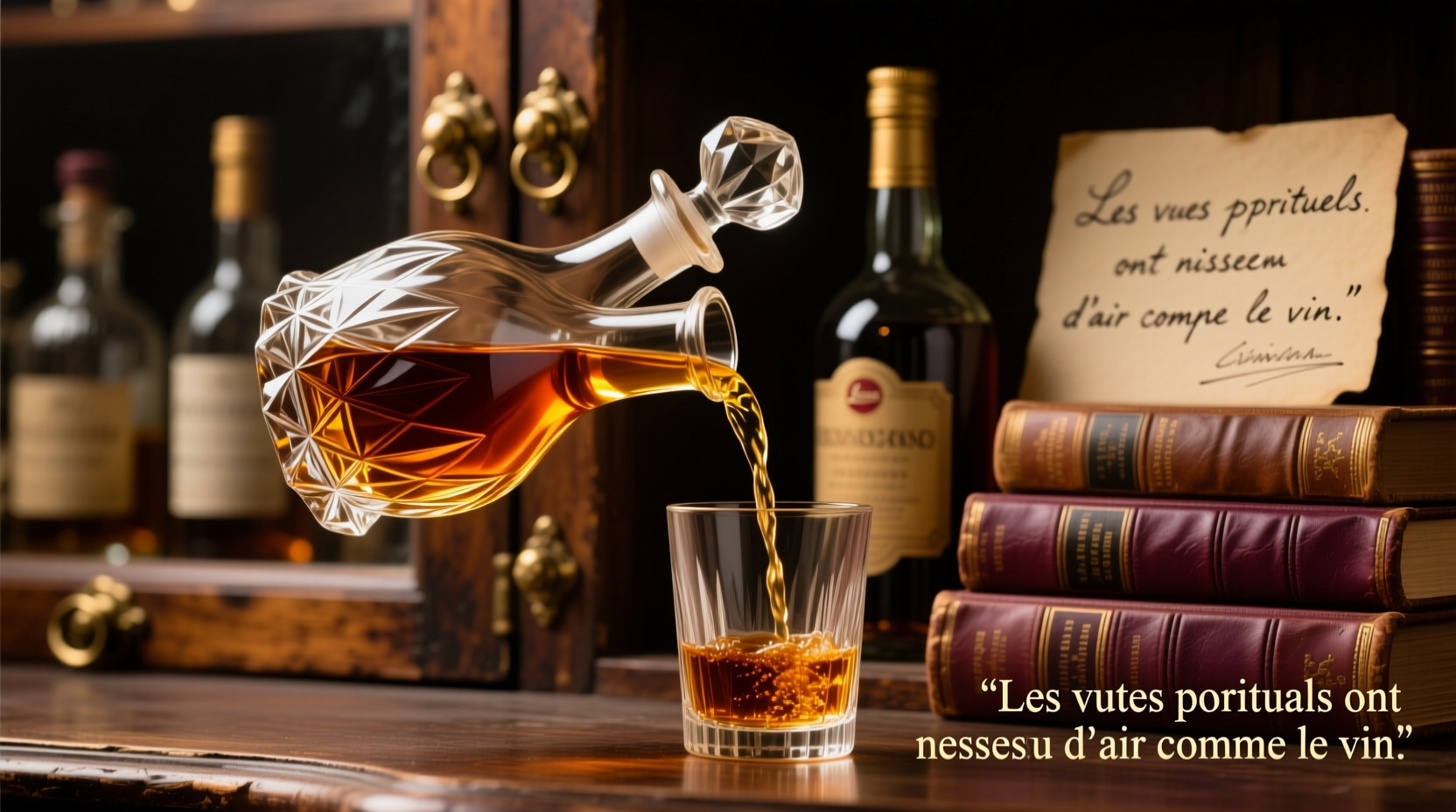
Tip: If you must decant for presentation (e.g., a formal tasting), use a narrow-necked crystal carafe—not a wide Bordeaux-style vessel—and serve within 20 minutes. Never decant more than 30 minutes before service.A Step-by-Step Protocol for Serving Vintage Cognac
Respect begins with method. Here’s how professionals at houses like Frapin, Augier, and Jean Fillioux handle pre-1960 bottlings—tested across hundreds of comparative tastings:
- Temperature check: Remove the bottle from storage 15 minutes before serving. Ideal serving temperature is 18–20°C (64–68°F). Too cold masks nuance; too warm amplifies alcohol burn and accelerates evaporation.
- Minimal handling: Avoid shaking or vigorous pouring. Gently tilt the bottle to allow sediment (if present in very old, unfiltered bottlings) to settle away from the neck.
- Direct pour: Use a clean, dry tulip-shaped cognac glass (not a balloon or snifter—too much surface area). Pour 25–30 ml—just enough to coat the bowl without filling it past the widest point.
- Initial assessment: Hold the glass still for 30 seconds. Inhale gently—do not swirl yet. Note the immediate top notes: citrus peel, white flowers, fresh herbs.
- Controlled aeration (optional): After 2–3 minutes, rotate the glass slowly 3–4 times. This introduces minimal air contact while preserving volatility. Swirling aggressively is unnecessary and harmful.
- Taste within 8 minutes: The optimal window for peak expression is between minute 2 and minute 8 post-pour. Beyond that, aromatic fatigue sets in.
Mini Case Study: The 1928 Gautier Tres Vieille Reserve Tasting
In March 2023, a private cognac symposium in Cognac brought together six bottles of the legendary 1928 Gautier Tres Vieille Reserve—a bottling drawn from casks filled before the Great Depression. All bottles were sourced from original estate cellars, unopened, with intact wax seals and consistent fill levels.
Two identical pours were prepared from the same bottle: one poured directly into a tulip glass and assessed at 2, 5, and 12 minutes; the other decanted into a wide-mouth crystal decanter and left for 45 minutes before being poured into an identical glass.
At 2 minutes, both showed vibrant notes of candied orange, jasmine, and toasted almond. By 5 minutes, the direct pour had deepened with hints of beeswax and baked apple; the decanted sample had already lost 60% of its citrus brightness and registered more as dried fig and cedar. At 12 minutes, the direct pour retained elegant lift and a lingering saline-mineral finish; the decanted version tasted muted, slightly woody, and noticeably thinner in mid-palate—its complexity eroded, not enhanced.
The conclusion was unanimous among the eight tasters (including three cellar masters): decanting didn’t reveal hidden layers—it truncated the experience. As Jean-Luc Bouchet, Cellar Master Emeritus at Gautier, noted afterward: “This cognac waited 95 years to be tasted. It doesn’t need us to rush it.”
Do’s and Don’ts for Vintage Cognac Care
| Action | Do | Don’t |
|---|---|---|
| Storage | Store upright in a cool (12–16°C), dark, humidity-stable environment (60–70% RH). Corks stay moist; labels remain legible. | Store on its side (risk of cork deterioration and seepage) or in fluctuating temperatures (causes expansion/contraction, pulling air into the bottle). |
| Opening | Use a gentle, non-twisting corkscrew (e.g., Ah-So) for fragile, dried corks. Wipe the lip with a lint-free cloth before pouring. | Twist aggressively—old corks crumble easily, introducing particles and risking breakage. |
| Re-corking | Replace original cork with a high-quality synthetic stopper designed for spirits (e.g., Vinolok or Nomacorc). Store upright. | Reinsert the original, dried cork—it won’t seal and invites slow oxidation. |
| Tasting Sessions | For multi-bottle tastings, pour each cognac fresh. Never re-pour from a decanter used earlier. | Leave opened bottles in decanters overnight—or worse, for days. Volatile loss compounds exponentially after hour one. |
| Long-Term Preservation | If keeping an opened bottle longer than 2 weeks, transfer to a smaller, airtight container (e.g., 100ml glass vial with PTFE-lined cap) to minimize headspace. | Assume “it’ll last”—even in the fridge. Refrigeration causes condensation inside the bottle, diluting and clouding the spirit. |
FAQ: Addressing Common Misconceptions
Does vintage cognac improve in the bottle like wine?
No. Unlike wine, which evolves through slow microbial and enzymatic activity, cognac undergoes only minimal chemical change post-bottling—primarily very slow ester hydrolysis and subtle polymerization. Most development occurs during cask aging. What appears as “improvement” in an old bottle is usually just temperature-stabilized settling, not active maturation.
Can I decant a younger VSOP or XO for better flavor?
Marginally—and only if served immediately. Younger cognacs (under 25 years) retain more volatile fruit esters and may benefit from 5–10 minutes of gentle aeration in glass. But wide decanters are still overkill. A proper cognac glass, warmed by hand, provides sufficient release.
What if my vintage cognac tastes “flat” or “stale” right after opening?
It’s likely not the air—it’s the bottle. Check fill level. If it’s below the shoulder (especially below mid-neck), significant slow oxidation has likely occurred over decades, regardless of storage. That flatness is irreversible. True vintage character should be layered, resonant, and balanced—not muted or sour.
Conclusion: Honor Time, Not Trends
Vintage cognac is not a puzzle to be solved with decanters and aerators. It’s a testament—to terroir, to patience, to craftsmanship honed over generations. Its power lies not in volatility, but in depth; not in explosive top notes, but in resonant, evolving harmony. When you hold a bottle from the 1930s or 1940s, you’re holding distilled time: decades of careful watchfulness in damp, cool cellars, of barrels breathing with the seasons, of blenders listening to wood and spirit alike.
Treating it like wine doesn’t show sophistication—it shows a misunderstanding of its nature. The most respectful act isn’t to force it open, but to meet it on its own terms: quietly, attentively, and with reverence for what it already is. Serve it correctly. Taste it mindfully. Let its story unfold at its own pace—not ours.
Start tonight. Pull out that bottle you’ve been saving. Skip the decanter. Warm the glass in your palm. Pour thoughtfully. Breathe deeply—but let the cognac keep its breath.
💬 Have you experienced the difference between direct pour and decanted vintage cognac? Share your tasting notes, observations, or questions in the comments—we’re building a community grounded in respect, not ritual.