Walk into any high-end bar in New York, London, or Tokyo today, and you’ll likely see a bartender measuring vermouth with a glass pipette, stirring a drink for 32 seconds over hand-carved ice, or garnishing with a dehydrated citrus wheel — not because it’s trendy, but because it’s correct. The cocktail renaissance of the past two decades has matured: we’ve moved beyond rediscovery into reverence. In 2024, it’s no longer enough to merely serve a Negroni — patrons expect its 1920s Turin origin story, its precise 1:1:1 ratio, and its use of Carpano Antica Formula vermouth. This isn’t nostalgia for nostalgia’s sake. It’s a cultural recalibration toward intentionality, craftsmanship, and flavor integrity. Bartenders and home enthusiasts alike are turning away from syrup-laden “craft” fusions and returning to the foundational elegance of pre-Prohibition and mid-century classics — drinks built on balance, clarity, and respect for each ingredient’s voice.
The Resurgence Is Rooted in Real Shifts
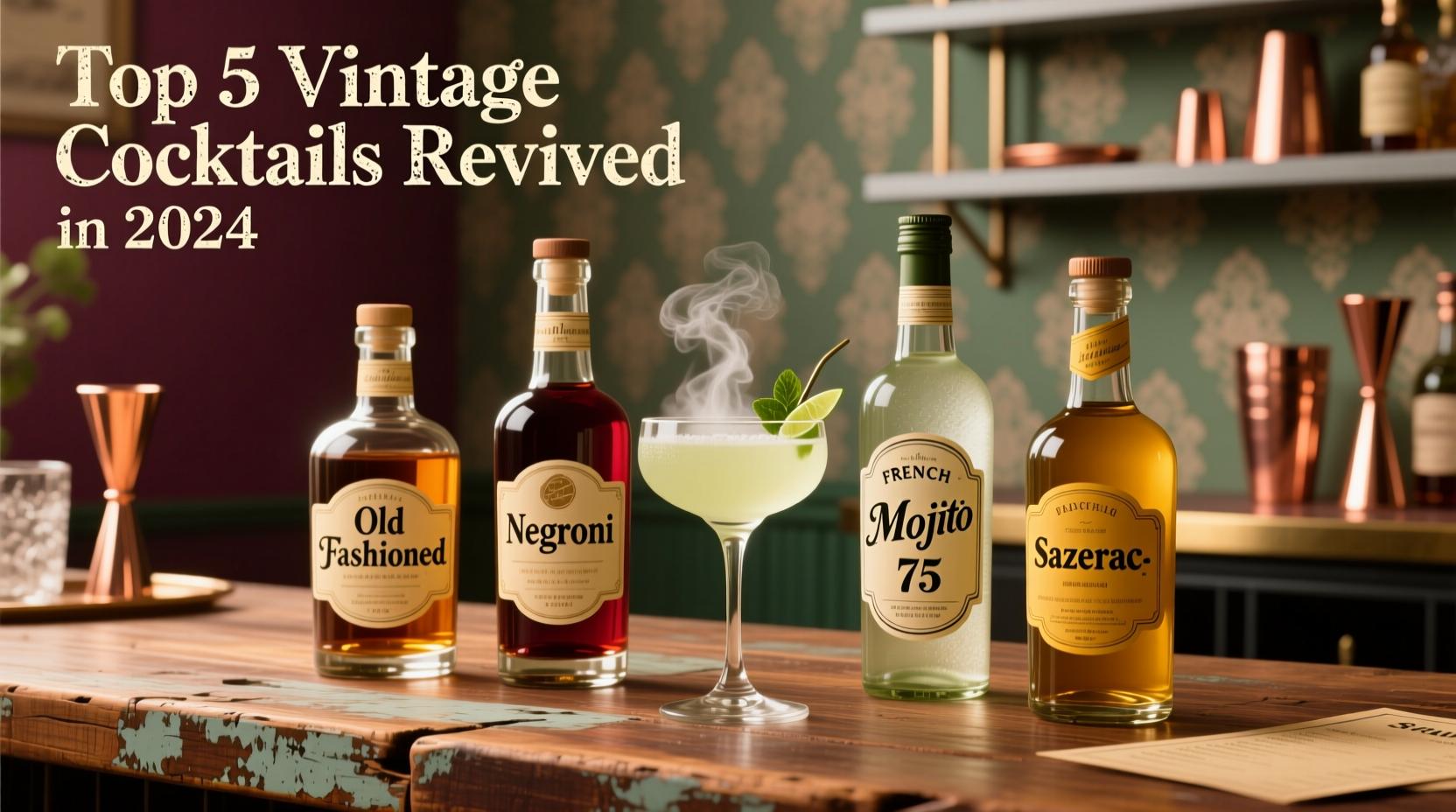
This revival isn’t driven by social media virality alone. Three converging forces have cemented vintage cocktails’ 2024 resurgence. First, consumer palate sophistication has deepened: after years of bold, sweet, and boozy modern creations, drinkers now crave structure, acidity, and subtlety — qualities baked into pre-1950 formulas. Second, the global rise of small-batch, historically accurate spirits — like Ransom Old Tom Gin, Bitter Truth Orange Bitters No. 6, and Cocchi Americano — has made authenticity practically achievable at home. Third, bartending education has shifted focus from flair to fundamentals; programs like the BarSmarts curriculum now emphasize period-correct techniques, including proper dilution through extended stirring and the critical role of temperature-stable glassware. As beverage historian David Wondrich observes: “We’re finally past the ‘look what I can do’ phase of mixology and entering the ‘this is how it was meant to be’ era. That requires humility, research, and restraint — all virtues embodied in vintage recipes.”
1. The Martinez: The Negroni’s Predecessor (c. 1884)
Long mischaracterized as a “proto-Martini,” the Martinez is, in fact, the direct ancestor of both the Martini and the Negroni — and arguably the first true stirred gin cocktail built for aromatic complexity. Originating at the Occidental Hotel in San Francisco, its original formulation called for Old Tom gin (a slightly sweeter, maltier style than London Dry), sweet vermouth, maraschino liqueur, and bitters. Its 2024 revival reflects a broader appreciation for layered sweetness and botanical nuance over aggressive dryness.
| Ingredient | Traditional Measure | Modern Equivalent (2024 Standard) | Why It Matters |
|---|---|---|---|
| Old Tom Gin | 2 oz | Ransom Old Tom or Hayman’s Old Tom | Provides malt-forward body that balances vermouth without cloying |
| Sweet Vermouth | 1/2 oz | Carpano Antica Formula or Punt e Mes | Rich, vanilla-tinged depth; avoids medicinal bitterness of cheaper brands |
| Maraschino Liqueur | 1/4 oz | Luxardo Maraschino or Leopold Bros. Maraschino | Adds subtle almond and cherry notes — not cherry syrup |
| Aromatic Bitters | 2 dashes | Angostura or The Bitter Truth Aromatic | Anchors the drink with spice and tannin |
2. The Last Word: A Prohibition-Era Puzzle (c. 1922)
Once nearly extinct outside of Detroit’s historic Clover Club, this equal-parts sour exploded onto global bar menus in the early 2010s — but its 2024 iteration is more precise, more balanced, and far less cloying. Made with gin, green Chartreuse, maraschino liqueur, and fresh lime juice, its revival speaks to our renewed appetite for challenging, herbaceous complexity. What separates today’s version from earlier attempts is the insistence on fresh-squeezed lime (never bottled), house-made maraschino (to avoid artificial red dye), and properly clarified Chartreuse — which softens its otherwise aggressive vegetal intensity.
“The Last Word isn’t a ‘fun’ drink — it’s a conversation starter, a palate reset, and a masterclass in harmony. When every component is sharp and true, the finish lingers like a memory of alpine herbs and citrus rind.” — Ivy Chen, Head Bartender, The Violet Hour, Chicago
3. The Bamboo: Sherry’s Sophisticated Statement (c. 1890s)
While sherry has enjoyed steady interest among wine lovers, the Bamboo — a simple, elegant blend of fino or amontillado sherry, dry vermouth, orange bitters, and a whisper of absinthe rinse — has surged in 2024 as the ultimate aperitif for discerning drinkers. Its appeal lies in its paradox: deeply savory yet refreshingly light, umami-rich yet bright with citrus lift. Bars like Sotheran’s in London and Bar Goto in NYC now list three Bamboo variations (Fino, Amontillado, and Oloroso) alongside tasting notes — treating it with the seriousness of a fine white wine flight.
Step-by-Step: Perfecting the Bamboo at Home
- Chill your coupe glass in the freezer for 10 minutes — sherry oxidizes rapidly when warm.
- Rinse the glass with 1/8 tsp of real absinthe (not substitutes); swirl and discard excess.
- Combine 1.5 oz amontillado sherry (Tio Diego or La Guita Amontillado), 1 oz dry vermouth (Dolin Dry), and 2 dashes Regans’ Orange Bitters in a mixing glass.
- Stir with ice for 30 seconds — not shaken. Agitation clouds sherry’s delicate texture.
- Strain into the rinsed coupe and garnish with a single, thin lemon twist expressed over the surface.
4. The Derby: Mint’s Understated Elegance (c. 1910)
Often overshadowed by the Mojito or Julep, the Derby is bourbon’s quiet answer to mint-based refreshment — and it’s having a moment. With only bourbon, dry vermouth, and peach bitters, it relies entirely on the quality of its mint: not muddled aggressively, but gently slapped and laid across the top as a fragrant garnish. Its 2024 resurgence signals a move away from sugary mint overload toward aromatic subtlety and spirit-forward clarity. Modern interpretations skip simple syrup entirely, trusting the bourbon’s natural caramel notes and the vermouth’s grapey sweetness to provide balance.
Tip: Never muddle mint for a Derby. Slap 3–4 sprigs firmly between your palms to release oils, then rest them atop the drink. Muddling releases bitter chlorophyll — exactly what you want to avoid.5. The Tuxedo No. 2: A Jazz Age Refinement (c. 1930)
Conceived at New York’s legendary Tuxedo Club, the Tuxedo No. 2 is the rare cocktail that improves with age — literally. Its formula (gin, dry vermouth, maraschino, orange bitters, and a rinse of absinthe) was designed to evolve over time, gaining complexity as the botanicals integrate. In 2024, it’s being revived not just as a drink, but as a *process*: forward-thinking bars like Attaboy in NYC offer “cellared Tuxedo” aged in glass carafes for 7–14 days before service. Home enthusiasts are adopting the practice too — storing pre-batched Tuxedo No. 2 in airtight bottles in the refrigerator for up to 10 days yields a smoother, rounder, more integrated profile than the freshly stirred version.
Real-World Revival: How One Bar Rebuilt Its Identity Around Vintage Cocktails
In early 2023, The Copper Still in Portland, Oregon, faced declining foot traffic and menu fatigue. Owner Marcus Bell and head bartender Lena Ruiz audited their top-selling drinks: seven were variations of the Espresso Martini or Aperol Spritz — high-volume, low-margin, and increasingly indistinguishable from competitors. They pivoted decisively. Over six weeks, they researched original recipes from Harry Craddock’s The Savoy Cocktail Book, David Embury’s The Fine Art of Mixing Drinks, and archival menus from the 1920s–40s. They replaced all commercial syrups with house-made orgeat and gum syrup, sourced Old Tom gin and vintage-style absinthe, and trained staff on period-appropriate stirring times and glassware temperatures. By March 2024, 68% of their cocktail sales came from vintage-focused offerings — with the Bamboo and Martinez leading volume. More significantly, average check size increased by 22%, and customer dwell time rose from 47 to 73 minutes. “People aren’t just ordering a drink,” Ruiz explains. “They’re buying into a ritual — the weight of the coupe, the scent of the expressed twist, the silence while it’s stirred. That’s irreplaceable.”
Your Vintage Cocktail Starter Checklist
- ✅ Acquire one bottle each of Old Tom gin, dry vermouth (Dolin), sweet vermouth (Carpano Antica), green Chartreuse, and maraschino liqueur (Luxardo)
- ✅ Invest in a quality jigger (preferably Japanese-style, dual-sided) and a bar spoon with a long, twisted shaft
- ✅ Stock two types of bitters: Angostura aromatic and Regans’ Orange
- ✅ Buy fresh citrus daily — never substitute bottled juice, especially for lime or lemon
- ✅ Chill coupes and martini glasses in the freezer for 10 minutes before serving
- ✅ Keep a small notebook to log ratios, stir times, and observations — vintage mixing rewards consistency and reflection
FAQ
Do I need expensive, hard-to-find spirits to make these authentically?
No — but substitution matters. For the Martinez, if you can’t find Old Tom gin, use a London Dry gin with ¼ tsp of simple syrup to approximate its rounded sweetness. For the Bamboo, a good-quality fino sherry (like Lustau Pastrana) works beautifully and costs under $20. Authenticity starts with technique and proportion, not price tags.
Why does stirring time matter so much for vintage cocktails?
Pre-1950 bartenders understood dilution as a *flavor tool*, not a side effect. Stirring longer (35–45 seconds) cools the drink thoroughly while integrating ingredients without aerating or clouding — essential for spirit-forward drinks like the Martinez or Bamboo. Shaking introduces air and ice shards, which disrupts clarity and mouthfeel in these formulas.
Can I batch these for parties?
Absolutely — and it’s encouraged. The Tuxedo No. 2, Martinez, and Bamboo all batch exceptionally well. Combine all ingredients except garnish in a sealed bottle and refrigerate for up to 10 days. Stir each serving individually over fresh ice, then strain. Batching ensures consistency and frees you to engage with guests — a very vintage virtue.
Conclusion
The return of vintage cocktails in 2024 is not about wearing suspenders or playing jazz on loop. It’s about choosing precision over convenience, patience over speed, and respect over reinvention. These five drinks — the Martinez, Last Word, Bamboo, Derby, and Tuxedo No. 2 — are more than recipes. They’re vessels for history, chemistry lessons in liquid form, and invitations to slow down. You don’t need a speakeasy or a $300 shaker set to begin. Start with one drink, one bottle of vermouth, and ten minutes of focused stirring. Taste the difference that intention makes. Then share it — not just the drink, but the story behind the ratio, the reason for the stir, the reverence for the rinse. Because the most enduring cocktails weren’t invented to go viral. They were built to last.
💬 Which vintage cocktail will you make first? Share your experience, substitutions, or favorite historical detail in the comments — let’s keep the revival alive, one properly stirred sip at a time.