For decades, passengers aboard Pan Am, TWA, British Airways, and Air France encountered the quiet ritual of the “mini-bar” service: a small, foil-wrapped bottle of whiskey, gin, or cognac placed beside their meal tray. Today, those tiny vessels—often no taller than 4 inches, stamped with airline logos and era-specific branding—are quietly amassing in attics, display cabinets, and online auction listings. But beneath the sepia-toned charm lies a pressing question: Are these miniature artifacts genuinely valuable, or do they exist solely as sentimental souvenirs? The answer isn’t binary. It hinges on provenance, rarity, condition, and shifting cultural appetite—not just for aviation history, but for the tactile poetry of mid-century travel.
What Makes a Mini Bottle Collectible—Beyond Nostalgia?
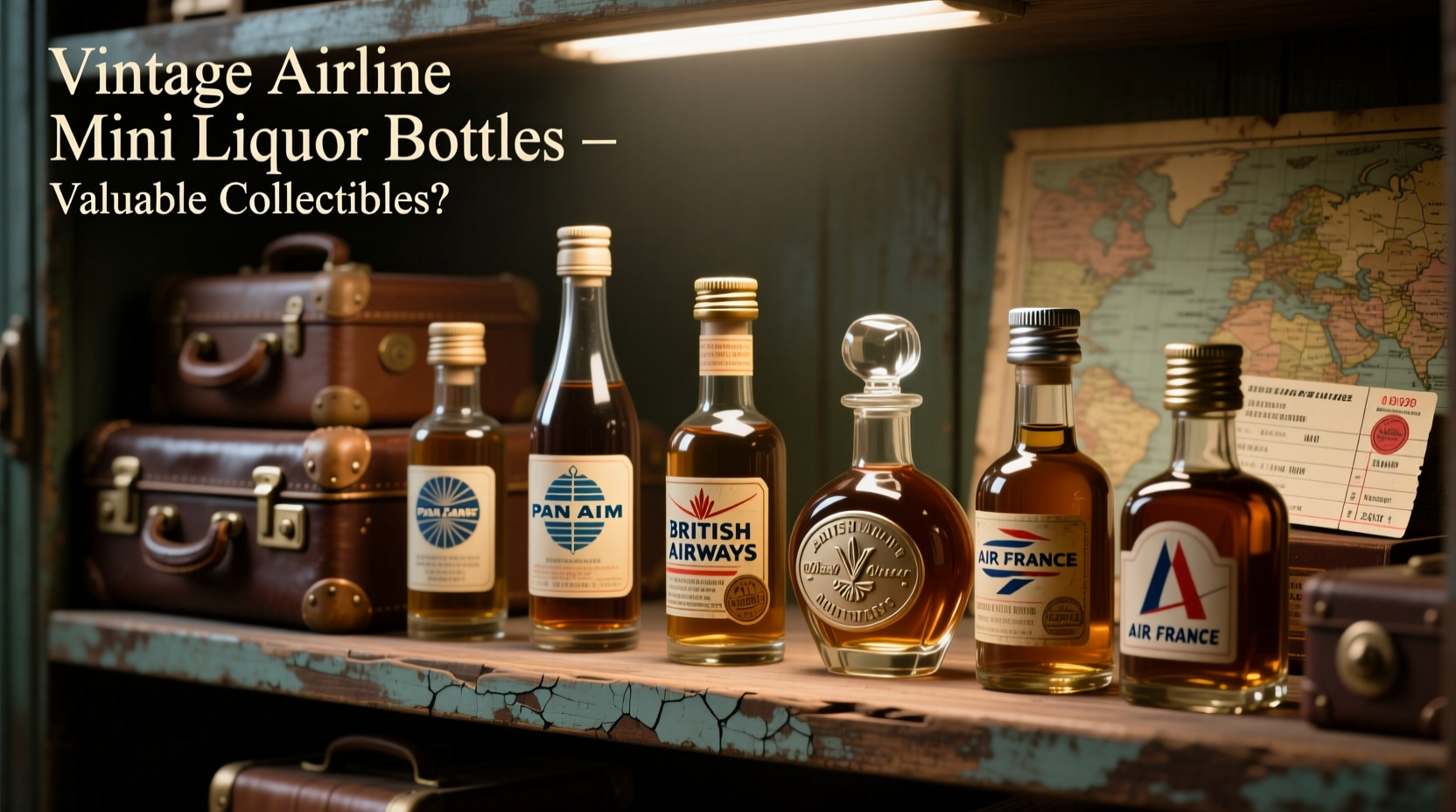
Not all airline minis are created equal. A 1990s Delta-branded Smirnoff bottle holds little traction among serious collectors, while a 1967 Braniff International “Flying Colors” bottle in original packaging may command hundreds. Value emerges from four interlocking criteria:
- Provenance and Era: Pre-deregulation U.S. carriers (pre-1978) and iconic international lines (e.g., Swissair’s 1950s–60s “Alpine Blue” series, BOAC’s early jet-age releases) carry stronger historical weight. Bottles from defunct airlines—like Northeast Airlines, Eastern Air Lines (pre-1991), or the short-lived Laker Airways—add scarcity by default.
- Brand and Spirit Type: Prestige labels matter. A 1973 Air France Rémy Martin VSOP mini is inherently more desirable than a generic house-label bourbon. Limited editions—such as the 1984 Olympic-themed United Airlines Chivas Regal—signal intentional collectibility at the time of release.
- Condition and Completeness: Sealed foil caps, intact labels without creases or fading, and original cardboard trays or flight attendant presentation boxes dramatically elevate value. Even minor label discoloration from UV exposure can reduce worth by 30–50%.
- Airline-Specific Design Elements: Unique typography, embossed glass, custom-shaped bottles (e.g., JAL’s 1972 “rising sun” silhouette), or bilingual labeling (Lufthansa’s German/English dual text) serve as authenticity markers and aesthetic differentiators.
Crucially, value is contextual—not intrinsic. A bottle’s worth reflects what informed buyers are willing to pay *right now*, not its production cost or sentimental weight alone. As aviation historian Dr. Helen Cho observes:
“Mini bottles are micro-archives. They’re not just alcohol containers—they’re physical records of route networks, branding strategies, and passenger class distinctions. A first-class Heublein gin from a 1965 JFK–London Concorde flight tells a richer story than a dozen economy-class vodkas from the same year.” — Dr. Helen Cho, Curator of Transport History, Smithsonian National Air and Space Museum
The Market Reality: What Sells—and What Doesn’t
Online auction data from Heritage Auctions, eBay (filtered for completed sales), and specialized platforms like BottleNet reveals clear patterns. Between January 2022 and June 2024, over 12,400 vintage airline minis sold publicly. The median sale price was $14.50. Yet the top 5% averaged $187—and the highest recorded sale remains a sealed 1961 Pan Am “Clipper Club” Johnnie Walker Black Label, which fetched $1,220 in 2023.
| Category | Typical Range (USD) | Key Drivers |
|---|---|---|
| Common 1980s–90s U.S. carriers (USAir, Northwest, American) | $3–$12 | High supply; minimal design distinction; often found in bulk lots |
| Iconic pre-1975 international carriers (BOAC, Sabena, Alitalia) | $25–$95 | Rarity of surviving stock; strong collector base in Europe; bilingual packaging |
| Defunct U.S. airlines (Eastern, TWA pre-1985, Ozark) | $40–$160 | Nostalgic demand from former employees/families; limited production runs |
| Limited editions & special events (Olympics, World Expos, airline anniversaries) | $85–$420+ | Documented scarcity; often issued with certificates; high visual appeal |
| Museum-grade rarities (Pan Am Clipper Club, early Concorde service, Braniff “Flying Colors”) | $300–$1,220+ | Provenance verification; pristine condition; association with aviation milestones |
This tiered structure underscores a vital truth: nostalgia is universal, but value is selective. A bottle must resonate with a specific collector demographic—aviation historians, graphic design archivists, or spirits connoisseurs—to transcend sentimentality.
How to Assess Your Own Collection: A Practical Step-by-Step Guide
Before listing a bottle or assuming it’s “just junk,” follow this actionable evaluation process:
- Identify the airline and year: Cross-reference bottle shape, logo style, and font with resources like the Airline Bottle Archive (airlinebottlearchive.org) or the book Flight Spirits: A History of Airline Miniatures. Note that many airlines changed branding multiple times—even within a single decade.
- Check for original sealing: Gently inspect the foil cap. If pierced, peeled, or resealed (even with tape), assume collector value drops 60–90%. Unopened is non-negotiable for premium tiers.
- Assess label integrity: Hold under natural light. Look for fading (especially reds and blues), adhesive residue, or water damage. Labels printed on thin paper degrade faster than laminated or embossed ones.
- Verify spirit brand and age: Research whether the brand still exists and whether the vintage aligns with known bottling practices. For example, a “1968 KLM Bols Genever” is plausible; a “1968 Singapore Airlines Macallan 25 Year Old” is anachronistic—and likely counterfeit.
- Consult recent sales—not asking prices: Search eBay’s “sold items” filter or Heritage Auctions’ archives using precise terms: “TWA 1972 Chivas Regal mini.” Compare your bottle’s condition to actual sold examples, not wishful listings.
A Real-World Case Study: From Attic Dust to Auction Spotlight
In 2022, Margaret R., a retired flight attendant from Chicago, cleared her late husband’s study. Among old logbooks and uniform pins, she found a shoebox labeled “TWA – 1964–1967.” Inside were 47 unopened mini bottles—mostly Chivas Regal and Canadian Club—but also three outliers: two sealed 1965 TWA “Ambassador Class” Courvoisier VSOP bottles and one 1966 “First Class Only” Haig & Haig Pinch Bottle, each housed in individual blue velvet sleeves with gold-embossed TWA wings.
Margaret initially assumed they were “just mementos.” She contacted a local antique dealer, who offered $120 for the entire lot. Instead, she emailed the Smithsonian’s Air and Space Museum library, which connected her with a specialist at BottleNet. After verifying dates, packaging, and comparing photos to museum archives, the specialist confirmed the Courvoisier minis were part of TWA’s inaugural transatlantic first-class upgrade—a limited run of under 500 units. The Haig & Haig was rarer still: produced exclusively for TWA’s 1966 New York–Tokyo route launch.
She consigned them to Heritage Auctions. The two Courvoisiers sold for $312 and $298 respectively; the Haig & Haig reached $475. Total return: $1,085. More importantly, the buyer—a curator building an exhibit on 1960s luxury air travel—documented their provenance and donated high-res scans to the museum’s digital archive. Margaret kept one unopened Chivas Regal “1964 JFK–Paris” as a personal anchor—not for value, but for voice.
What Collectors Actually Want: A Checklist for Sellers and Enthusiasts
If you’re curating, selling, or simply seeking authenticity, use this field-tested checklist before acquiring or offering a bottle:
- ✅ Foil cap is fully intact, with no punctures, tears, or signs of resealing
- ✅ Label shows zero fading, especially on critical elements (airline name, spirit name, vintage year)
- ✅ Bottle glass is free of chips, scratches, or clouding (a sign of poor storage or chemical leaching)
- ✅ Airline branding matches documented era-specific guidelines (e.g., Pan Am’s “blue ball” logo wasn’t used post-1971)
- ✅ Accompanying materials are present and verified: original tray, flight attendant sleeve, or promotional brochure (adds 20–40% value if genuine)
- ❌ Avoid bottles with handwritten dates or added stickers—these almost always indicate later tampering
- ❌ Do not trust “vintage” claims without corroborating evidence—many 2000s-era reproductions mimic 1950s designs
Frequently Asked Questions
Are empty vintage mini bottles worth anything?
Rarely—unless they’re exceptionally rare shapes (e.g., a 1959 Air India “peacock” bottle) or part of a documented museum collection. Most collectors prioritize sealed contents for provenance and preservation. Empty bottles typically sell for $2–$8 unless accompanied by original packaging and verifiable history.
Can I drink the liquor inside?
Technically yes—but strongly discouraged. Ethanol degrades over decades, especially in small volumes exposed to temperature fluctuations and trace oxygen ingress through imperfect seals. Flavors oxidize, aromas flatten, and volatile compounds break down. More critically, older plastic or cork closures may leach compounds into the spirit. These bottles belong in collections—not cocktails.
How should I store my collection long-term?
Store upright in a cool (60–68°F), dark, humidity-stable environment—never in attics, basements, or near windows. Use acid-free tissue between bottles to prevent label abrasion. Avoid plastic sleeves (they off-gas); opt for archival-quality cardboard trays or inert acrylic stands. Rotate display pieces every 6 months to minimize light exposure asymmetry.
Conclusion: Value Is Where History Meets Intention
Vintage airline mini liquor bottles sit at a compelling intersection: they are simultaneously mundane objects and potent cultural artifacts. Their worth isn’t dictated solely by auction results or rarity charts—it’s affirmed when a historian uses one to reconstruct 1960s service standards, when a designer studies its typography for a retro branding project, or when a child holds their grandfather’s TWA bottle and feels the tangible echo of a world where crossing oceans felt like ceremony.
So are they valuable? Yes—if you define value as resonance, rigor, and relevance. Are they *only* nostalgic? No—if nostalgia is paired with research, respect for material integrity, and connection to broader narratives of technology, globalization, and human aspiration. The most meaningful collections aren’t built on speculation, but on stories patiently uncovered: the airline that launched it, the route it flew, the hands that served it, and the quiet dignity of a small bottle carrying big dreams across the sky.
💬 Have a bottle with a story? Share its airline, year, and how you acquired it in the comments—we’ll help verify its era and context. Let’s build the next chapter of this quiet, spirited history—together.