Choosing the right tablecloth isn’t just about color or fabric—it starts with precise measurements. A poorly fitted tablecloth can look sloppy, slip off during meals, or fail to protect your furniture. Whether you're hosting a holiday dinner, setting up for a wedding, or refreshing your dining room, getting the dimensions right ensures elegance, function, and durability. This comprehensive guide walks you through every step of measuring your table accurately and selecting the ideal drop length, shape, and size for any occasion.
Why Accurate Table Measurements Matter
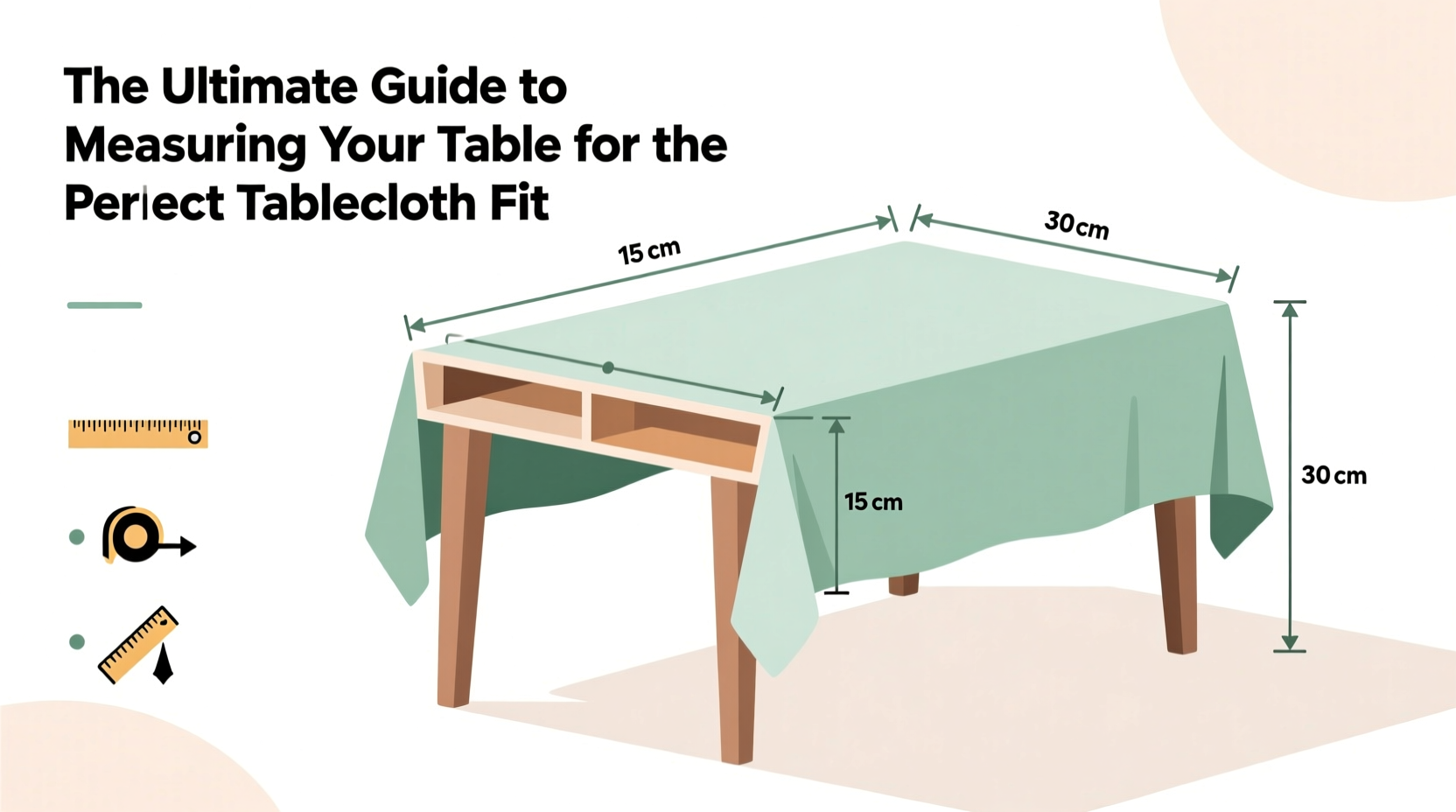
A well-fitted tablecloth enhances the aesthetic of your space while protecting the surface from spills, scratches, and heat. Too short, and it looks undersized; too long, and it becomes a tripping hazard or collects dust. The key lies in understanding three critical factors: table shape, exact dimensions, and desired drop length (the amount of fabric that hangs down from the edge).
Most people assume all rectangular tables are standard, but variations exist—even within common sizes like 6-foot banquet tables or 42-inch round dining tables. Measuring your specific table eliminates guesswork and ensures compatibility with ready-made or custom linens.
Tip: Always measure your actual table—even if it’s labeled “standard size.” Manufacturing variances can lead to differences of several inches.Step-by-Step Guide to Measuring Your Table
Follow this systematic approach to get accurate measurements for any table shape:
- Gather your tools: Use a metal tape measure (not fabric), a notepad, and a level surface. Have someone assist if possible.
- Clear the table: Remove all items so you can access edges and corners without obstruction.
- Determine the shape: Identify whether your table is rectangular, square, round, oval, or specialty-shaped (e.g., boat-shaped or hexagonal).
- Measure the length and width: For rectangular or square tables, measure from one end to the opposite end along the longest and widest points.
- For round tables: Measure straight across the center to get the diameter.
- For oval tables: Measure both the longest length (end to end) and the widest width (side to side at the center).
- Record the height: From the floor to the top surface. This helps determine total cloth length when combined with drop preferences.
Write down all numbers clearly. Double-check each measurement to avoid costly errors, especially when ordering online.
Accounting for Drop Length
The drop—the vertical portion of the tablecloth hanging below the tabletop—is essential for both appearance and practicality. Common drop lengths include:
- 1 inch (trimmed fit): Sits just at the edge; ideal for casual settings or layered looks.
- 6–8 inches (half drop): Reaches mid-way down chair backs; popular for everyday dining.
- 12–15 inches (full drop): Touches the seat or knees; elegant for formal events.
- Floor-length (30+ inches): Drapes to the ground; dramatic for weddings or banquets.
To calculate total tablecloth size, add twice the desired drop to both length and width. For example, a 72\" x 30\" table with a 10-inch drop requires a cloth sized 92\" x 50\" (72 + 10 + 10 = 92; 30 + 10 + 10 = 50).
“Many clients order the wrong size because they forget to account for drop length. It’s not just about covering the table—it’s about how it flows.” — Lydia Chen, Event Stylist & Linen Consultant
Shape-Specific Measurement Tips
Different table shapes require unique considerations:
Rectangular Tables
Most common in homes and event halls. Ensure you measure both length and width precisely. Corners should be sharp and even. If using a fitted tablecloth, confirm corner radius if applicable.
Round Tables
Always measure through the center point. Even a 2-inch discrepancy can result in an unbalanced drape. Use a chalk mark or small object to identify the center before measuring.
Oval Tables
These often have subtle curves. Measure maximum length and width, and consider whether the ends are semi-circular or elongated. Custom-cut cloths may be necessary for best fit.
Folding or Extension Tables
If your table expands, decide which configuration you’ll use most frequently. You may need multiple cloths—one for each setup—or opt for a slightly larger universal size with careful hemming.
Tip: For extendable tables, choose a cloth based on the fully expanded size. Smaller inserts can be used when collapsed.Tablecloth Sizing Reference Chart
| Table Type | Common Table Size | Recommended Cloth Size (with 12\" drop) | Total Cloth Dimensions |
|---|---|---|---|
| Round Dining | 42\" diameter | 66\" round | 42\" + (12\" x 2) = 66\" |
| Rectangular Dining | 72\" x 36\" | 96\" x 60\" | 72\"+24\", 36\"+24\" |
| Banquet (6ft) | 72\" x 30\" | 90\" x 48\" – 90\" x 60\" | Depends on 9\"–15\" drop |
| Cocktail (5ft) | 60\" x 30\" | 78\" x 48\" (9\" drop) | 60\"+18\", 30\"+18\" |
| Square Table | 36\" x 36\" | 60\" square | 36\" + (12\" x 2) = 60\" |
This chart serves as a starting point. Adjust based on your preferred drop and table specifics.
Real-World Example: Wedding Reception Setup
Sarah was planning her outdoor wedding reception with 10-foot-long farm tables. She assumed standard banquet cloths (90\" x 132\") would suffice. After delivery, she noticed gaps between tables and awkward pooling on the ground. Upon re-measuring, she discovered her tables were actually 120\" long—not 96\"—and sat higher than average.
She recalculated using a 15-inch drop (to reach chair seats without touching grass) and ordered 150\" x 132\" cloths. The new fit was clean, proportional, and wrinkle-free. Her mistake? Relying on assumed dimensions instead of measuring each table individually.
This case highlights the importance of verifying real-world specs, especially when renting or using non-standard furniture.
Checklist: Ensuring a Perfect Tablecloth Fit
- ✅ Clear the table completely before measuring
- ✅ Use a rigid metal tape measure
- ✅ Record length, width, and height for all tables
- ✅ Confirm table shape and any irregularities (e.g., rounded corners)
- ✅ Decide on desired drop length (knee, seat, floor)
- ✅ Add double the drop to both dimensions for final cloth size
- ✅ Verify care instructions match your usage frequency
- ✅ Order swatches if choosing fabric type (linen, polyester, cotton blend)
- ✅ Label cloths by table number if managing multiple setups
Frequently Asked Questions
What if my table has rounded corners?
Standard rectangular cloths usually work unless the radius is large (over 2\"). In such cases, look for \"rounded corner\" or \"fitted\" tablecloths designed for that specification. Measure the radius by placing a ruler diagonally from the corner edge inward to the curve’s start.
Can I use a larger tablecloth and fold it?
Not recommended. Folding creates bulk, uneven draping, and safety hazards. It also strains seams and accelerates wear. Always aim for a tailored fit.
How much overhang is too much?
Overhangs beyond 30 inches (floor-length) can collect dirt and pose tripping risks, especially in high-traffic areas. For indoor dining, 12–15 inches is typically ideal. Outdoor or ceremonial events may allow longer drops for visual impact, provided pathways remain clear.
Final Thoughts: Precision Leads to Perfection
Measuring your table correctly transforms a simple accessory into a polished centerpiece. Whether you're outfitting a home dining set or coordinating linens for a grand celebration, attention to detail makes all the difference. Take the time to measure thoughtfully, calculate drop accurately, and select fabrics that suit your lifestyle.
💬 Ready to refresh your table styling? Grab your tape measure today and create a look that’s both functional and flawless. Share your tablecloth success story in the comments!