In today’s competitive hospitality landscape, every ounce of spirit matters—not just for flavor integrity, but for profitability, compliance, and brand reputation. Smart pourers—electronic, sensor-driven dispensing systems mounted directly on liquor bottles—have moved beyond novelty to become essential tools for modern bar operations. Unlike traditional measured pour spouts or free-pour techniques, these devices integrate real-time flow monitoring, digital logging, and cloud-based analytics to deliver unprecedented control over alcohol dispensing. This isn’t about restricting bartenders; it’s about empowering them with data, reducing waste, and ensuring every guest receives a consistent, correctly portioned drink—every time.
Why Precision Pouring Is a Business Imperative
Free-pouring remains widespread—but at a steep hidden cost. Industry studies consistently show that unmeasured pours average 20–35% more than standard 1.5-ounce (44 mL) servings. A single high-volume bar serving 300 cocktails nightly can over-pour nearly 10 liters of spirits per week—translating to $1,200–$2,800 in lost margin monthly, depending on spirit tier. Worse, inconsistency erodes guest trust: a patron who receives a light pour one night and a heavy one the next perceives unfairness, even if unintentional. Regulatory scrutiny is also intensifying; health departments and liquor control boards increasingly audit pour practices during inspections, particularly where over-serving or inventory discrepancies are flagged.
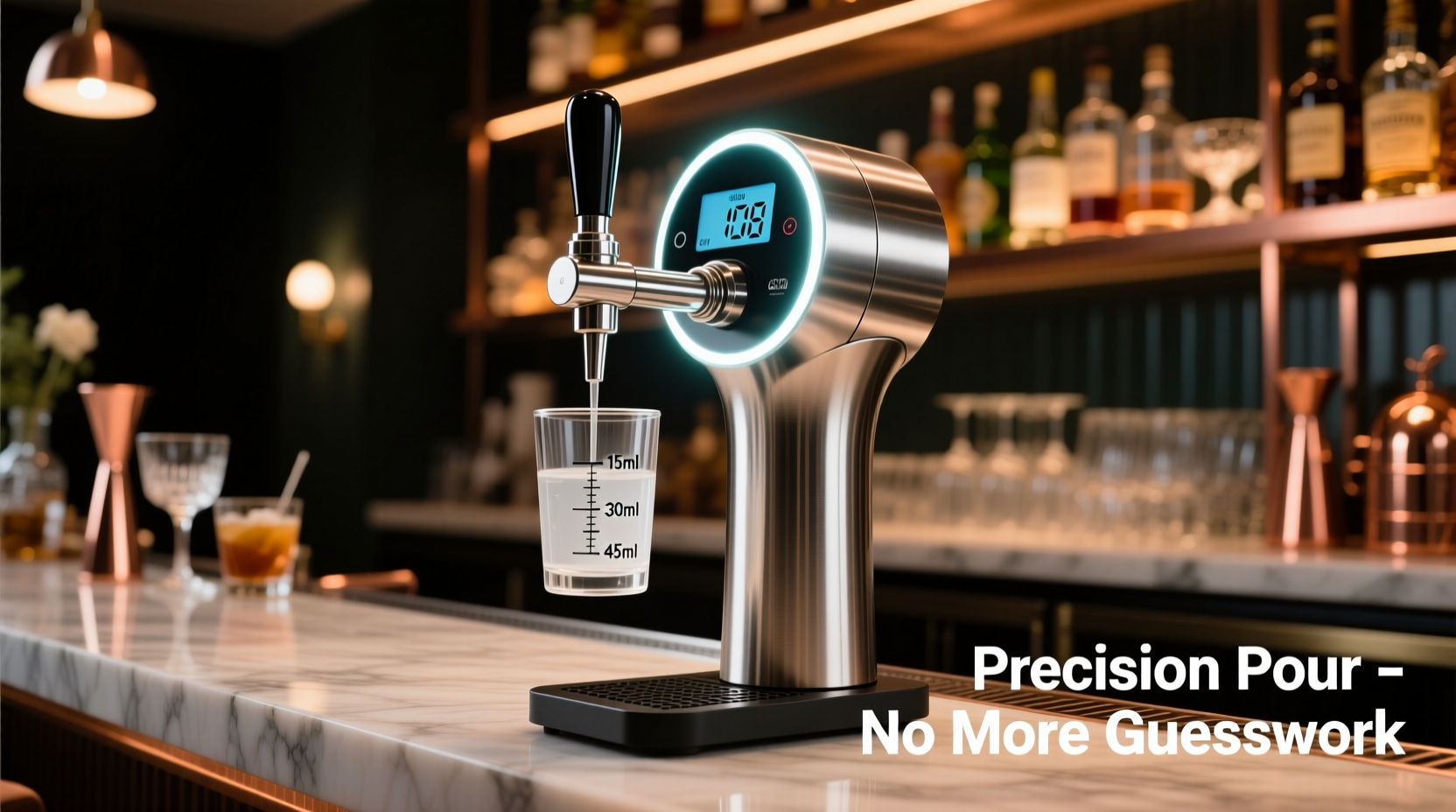
Smart pourers address this at the source. By measuring flow rate, duration, and total volume dispensed per pour—and validating each against pre-set thresholds—they eliminate guesswork. More importantly, they convert physical action into actionable intelligence: Which bartender has the tightest pour accuracy? Which well spirit shows the highest variance? When does over-pouring spike—during rush hours or shift changes? These insights don’t just protect margins—they inform training, scheduling, and menu engineering.
How Smart Pourers Deliver Accurate Measurement
At their core, smart pourers use one of two validated sensing technologies: ultrasonic time-of-flight or precision turbine flow meters. Ultrasonic models emit high-frequency sound waves across the liquid stream; the time differential between upstream and downstream pulses calculates velocity and volume with ±0.3 mL accuracy. Turbine-based units deploy miniature, food-grade stainless steel rotors that spin proportionally to flow rate—calibrated to ±0.25 mL. Both types feature built-in microprocessors that sample data 200+ times per second, filtering out splashes, air pockets, or tilt-induced anomalies.
Crucially, accuracy isn’t static—it’s adaptive. Advanced systems allow operators to set *dynamic thresholds*: for example, a “standard” pour of 44 mL for vodka, but 60 mL for a premium tequila used in a signature cocktail. Some models even integrate with POS systems to auto-adjust pour limits based on drink selection—ensuring a “Double Old Fashioned” triggers a 90 mL pour while a “Single Whiskey Sour” defaults to 44 mL. Calibration is user-initiated via smartphone app or base station, requiring under 90 seconds and no technical expertise.
Tip: Re-calibrate pourers weekly during low-traffic periods—and always after replacing a bottle or cleaning the spout—to maintain sub-0.5 mL measurement fidelity.Five Tangible Benefits Beyond Accuracy
While precise measurement is the headline feature, smart pourers generate cascading advantages across operations. Here’s how they move beyond the bottle to impact your entire business:
- Real-Time Inventory Tracking: Each pour updates cloud-based inventory counts instantly. No more weekend stocktakes or “mystery shrinkage.” You’ll see exactly how much Grey Goose was used Tuesday at 8:47 p.m.—and whether it aligned with POS sales.
- Waste & Spill Reduction: Built-in drip catch reservoirs and auto-shutoff (triggered after 3 seconds of inactivity) reduce spillage by up to 68%, according to a 2023 National Restaurant Association field study.
- Staff Accountability Without Surveillance: Anonymous pour logs identify outliers—not individuals. If Pour ID #A72 shows 12% higher variance than team average, you coach technique—not discipline. This fosters psychological safety while improving consistency.
- Regulatory Audit Readiness: Generate compliant, timestamped pour reports with one click—covering volume, time, date, and bottle ID. Essential for ABC board reviews or insurance claims related to service incidents.
- Menu Engineering Intelligence: Correlate pour data with sales trends. Did the new $18 Mezcal Paloma sell 30% more when poured at 48 mL instead of 44 mL? Data reveals what guests truly value—and what they’ll pay for.
Smart Pourer Comparison: Key Features at a Glance
| Feature | Basic Mechanical Pourer | Entry-Level Smart Pourer | Premium Smart Pourer |
|---|---|---|---|
| Measurement Accuracy | ±3–5 mL (gravity-dependent) | ±0.5 mL | ±0.25 mL with auto-drift correction |
| Real-Time Data Sync | No | Bluetooth to tablet/app (5–10 sec delay) | Wi-Fi + cellular failover (sub-1 sec sync) |
| POS Integration | None | API for major platforms (Toast, Square, Micros) | Two-way sync: POS triggers pour limits; pour data updates sales tax reporting |
| Battery Life | N/A (no battery) | 6–9 months (replaceable CR123) | 18–24 months (rechargeable lithium) |
| Audit Trail | None | Timestamped pours, basic export | Full forensic log: pour ID, device ID, calibration history, firmware version |
Mini Case Study: The Harborview Lounge Turnaround
Harborview Lounge, a 75-seat craft cocktail bar in Portland, faced declining margins despite rising cover charges. Their controller noticed a 22% gap between liquor purchases and POS-reported sales—a red flag. After installing six premium smart pourers across top-selling spirits (gin, bourbon, mezcal, rum, tequila, vodka), patterns emerged within 72 hours. One bartender consistently poured 52 mL of gin in Martinis—18% over the 44 mL standard. Another had erratic flow rates during peak service, correlating with 30% more spills on busy Friday nights.
Instead of reprimands, management ran a 90-minute “Precision & Flow” workshop using anonymized pour heatmaps. They adjusted the gin pour limit to 48 mL for Martinis (improving guest perception of value) and introduced timed pour drills during prep shifts. Within four weeks, liquor cost dropped from 28.4% to 23.1%. More significantly, online reviews mentioning “consistent drinks” rose by 41%. As General Manager Lena Ruiz observed: “We didn’t get stricter—we got smarter. The data told us where to invest attention, not where to assign blame.”
Expert Insight: What Industry Leaders Say
“Smart pourers aren’t about policing staff—they’re about professionalizing the craft. When a bartender knows their pour is measured and visible, they take ownership of consistency. That elevates the guest experience and protects the operator’s bottom line simultaneously.” — Chef & Bar Consultant Marcus Bell, author of The Profitable Pour, 2023
“The ROI isn’t just in saved liquor. It’s in reduced staff turnover. Bartenders report higher job satisfaction when they’re trusted with technology that supports their skill—not replaces it. We’ve seen 35% lower churn in venues using smart pourers with coaching-focused dashboards.” — Dr. Anya Sharma, Hospitality Operations Researcher, Cornell School of Hotel Administration
Actionable Implementation Checklist
Adopting smart pourers successfully requires more than hardware installation. Follow this proven sequence:
- ✅ Audit Your Top 10 Spirits: Identify which bottles drive 70% of pour volume and revenue. Prioritize these for initial deployment.
- ✅ Standardize Pour Definitions: Document exact volumes for every cocktail (e.g., “Old Fashioned = 60 mL bourbon, 15 mL simple syrup”) and align with your POS modifiers.
- ✅ Train on Technique, Not Tech: Spend 20 minutes showing staff how to hold bottles vertically, initiate flow smoothly, and avoid “tapping off” the pour. Technology amplifies good habits—it doesn’t create them.
- ✅ Set Up Weekly Review Rituals: Block 15 minutes every Monday to review the prior week’s variance report. Celebrate improvements; diagnose outliers collaboratively.
- ✅ Integrate with Your Broader System: Connect pour data to inventory software and accounting platforms. Ensure your bookkeeper receives automated weekly variance summaries.
Frequently Asked Questions
Do smart pourers slow down service during rushes?
No—when properly installed and calibrated, they match or exceed free-pour speed. Premium models activate flow within 0.18 seconds of bottle tilt and auto-shut off precisely at the programmed volume. In fact, elimination of “re-pours” due to inconsistent first attempts often saves net time during peak service.
Can I use smart pourers with half-bottles or airline-sized spirits?
Yes, but verify compatibility. Most systems support standard 750 mL bottles and common 1L formats. For smaller containers, look for models with adjustable mounting collars and low-flow calibration modes (e.g., those designed for fortified wines or amaros). Avoid universal-fit adapters—they compromise seal integrity and measurement accuracy.
How do I handle maintenance and cleaning?
Clean pourers weekly with food-safe citric acid solution (not bleach or vinegar) to prevent mineral buildup in flow paths. Disassemble only as directed—most require no internal cleaning. Wipe exteriors with isopropyl alcohol. Replace O-rings every 6 months or per manufacturer schedule. Never immerse electronics in liquid.
Conclusion: Precision Is the New Standard of Professionalism
Smart pourers represent more than a tool—they signal a commitment to operational excellence, staff development, and guest respect. In an era where consumers demand transparency, consistency, and value, pouring by instinct alone is no longer sustainable. The numbers don’t lie: accurate measurement recaptures lost margin, reduces regulatory risk, and builds trust at every interaction. But the deeper value lies in culture—when bartenders engage with data, refine technique, and see the direct link between their craft and the bar’s success, pride and professionalism flourish. Start small: equip your top three spirits. Track variance for 14 days. Then decide—not based on assumptions, but on evidence. Your bottom line, your team, and your guests will all register the difference.
💬 Ready to measure what matters? Share your biggest pour control challenge in the comments—and let’s troubleshoot it together with real-world solutions.