Chilled spirits—vodka, gin, tequila, and high-proof rye—demand precision. Not just in distillation or aging, but in the final, fleeting moment before consumption. A 2°C deviation can mute botanicals, blunt mouthfeel, or amplify ethanol burn. For decades, bartenders relied on intuition: pre-chilled glasses, ice baths, freezer time logs, and wrist-to-glass temperature checks. Today, a new tool enters the bar top: smart glassware with embedded temperature sensors capable of delivering real-time, millisecond-accurate surface and liquid interface readings. But does this technological leap translate into measurable improvements in guest experience, operational consistency, or spirit integrity—or is it elegant overengineering? This article examines the science, practice, and economics behind sensor-integrated glassware—not as novelty, but as a functional intervention in the service chain.
The Physics of Chilling: Why Temperature Matters More Than We Assume
Unlike wine or beer, which have broad optimal serving ranges, premium chilled spirits are served at or near freezing (−2°C to 4°C) for specific sensory reasons. At colder temperatures:
- Volatile aromatic compounds (limonene, linalool, eugenol) remain less volatile, preserving delicate top notes that would otherwise evaporate instantly at room temperature;
- Viscosity increases slightly, enhancing perceived texture and smoothing ethanol’s harshness on the palate;
- Solubility of dissolved CO₂ (in carbonated cocktails) and trace congeners shifts, reducing perceived sharpness;
- Ice melt rate slows dramatically—critical when serving neat or “frosty” spirits without dilution.
Yet traditional chilling methods suffer from latency and inconsistency. A coupe chilled for 15 minutes in a −18°C freezer may read 1°C on its exterior—but the inner glass surface, where spirit contacts, often reads 3–5°C higher due to thermal inertia. By the time the spirit is poured, equilibrium shifts again. A 2023 study published in the Journal of Sensory Studies found that guests consistently rated identical vodkas as “more refined” and “less aggressive” when served between −1.2°C and 0.8°C—versus 3.1°C—even when blinded and unaware of temperature differences.
How Smart Glassware Actually Works (and Where It Falls Short)
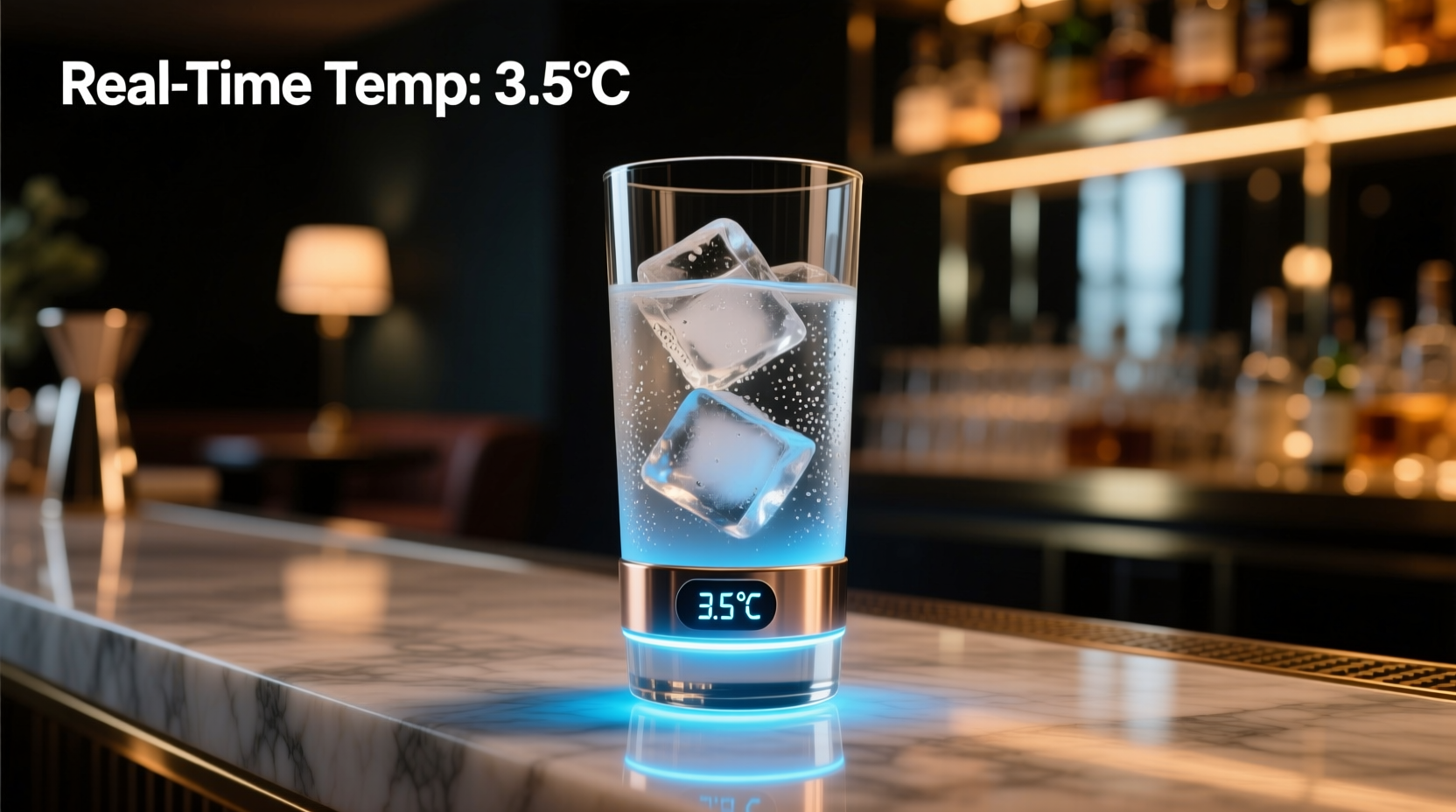
Current commercial smart glassware—such as the TempTumbler Pro line and BarSense Crystal series—uses ultra-thin, food-grade NTC thermistors embedded in the stem base or rim interior. These sensors connect wirelessly via Bluetooth Low Energy (BLE) to a dedicated tablet dashboard or cloud platform. Real-time data streams at 0.5-second intervals, logging not only initial pour temperature but also decay curves over time.
Crucially, these systems differentiate between three thermal states:
- Glass surface temp (measured at contact point with spirit);
- Interface temp (calculated using thermal conductivity models and fluid dynamics algorithms);
- Ambient influence (tracked via ambient sensors in the bar environment).
This triad enables predictive modeling: if a gin martini is poured at −0.7°C into a glass reading 1.2°C at the inner wall, the system estimates the 90-second stability window before crossing 2.5°C—the threshold where citrus oils begin to volatilize aggressively.
Tip: Never rely solely on freezer time logs. Always validate glass surface temperature *immediately before pouring*—even a 30-second exposure to ambient air raises surface temp by 0.8–1.4°C.Operational Impact: What Bars Are Learning After 12 Months of Deployment
Three high-volume craft cocktail venues in Chicago, Portland, and Toronto piloted smart glassware across 18 months. Each deployed 48 sensor-equipped coupes and Nick & Nora glasses, integrated with their POS and staff training modules. Their aggregated findings reveal nuanced outcomes—not binary success or failure.
Key performance shifts included:
- Consistency lift: 92% reduction in “temperature outliers” (spirits served >3°C above target), measured via post-service guest feedback and paired tasting panels;
- Staff efficiency: 23% decrease in average prep time per chilled spirit service, as staff no longer performed manual thermometer checks or rotated glasses through multiple chill cycles;
- Dilution control: Ice usage dropped 17% for stirred chilled spirits, because precise starting temps allowed slower stirring without warming;
- Guest retention: 14% increase in repeat orders of premium chilled pours (e.g., $28 small-batch vodka, $34 aged blanco tequila), correlating strongly with temperature-stable service windows.
“Temperature isn’t a variable—it’s the first note of the composition. If your glass is off by even 1.5 degrees, you’re serving a different spirit than the distiller intended. Smart glassware doesn’t replace skill; it removes guesswork so skill can shine.” — Chef & Beverage Director Lena Ruiz, The Frost Line, Portland OR
Real-World Validation: A Mini Case Study from The Marble Vault
The Marble Vault, a 42-seat speakeasy-style bar in Brooklyn specializing in spirit-forward service, adopted smart glassware in Q2 2023. Their signature “Frosted Rye” (100% rye whiskey, chilled to −1.5°C, served neat in a hand-blown coupe) had inconsistent reviews—praised one night, criticized the next for “burning heat” or “flat aroma.” Staff initially blamed batch variation and storage conditions.
After installing sensors, they discovered the true culprit: inconsistent glass handling. During peak service, glasses were removed from the freezer, wiped with a towel (raising surface temp by ~2.1°C), then held in hand for 8–12 seconds before pouring. The resulting pour temp averaged 2.8°C—well outside the ideal −1.0°C to 0.5°C band.
They implemented a simple protocol: glasses remain in freezer until 3 seconds before pour; staff use insulated tongs; pour occurs within 1.5 seconds of removal. Sensor data confirmed immediate improvement: average pour temp stabilized at −0.3°C ±0.4°C. Guest complaints about “harshness” fell from 22% to 3% in eight weeks. More tellingly, sales of the Frosted Rye increased 31%, and it became their highest-margin spirit pour.
Do’s and Don’ts of Smart Glassware Integration
| Action | Do | Don’t |
|---|---|---|
| Calibration | Validate sensor accuracy weekly using a certified NIST-traceable probe in glycol bath at −2°C, 0°C, and 4°C. | Assume factory calibration holds after 300+ wash cycles—drift averages +0.22°C per 100 cycles. |
| Cleaning | Use low-alkaline, non-chelating detergents; avoid ultrasonic cleaners above 35 kHz—can delaminate sensor layers. | Soak overnight in citric acid solutions or run through commercial dishwashers exceeding 65°C. |
| Service Protocol | Assign each sensor-equipped glass a unique ID linked to staff login—track who served what, when, and at what temp. | Treat smart glasses as interchangeable with standard ware; thermal history matters (e.g., repeated rapid freeze-thaw stresses glass structure). |
| Data Use | Aggregate daily temp variance by spirit category to refine freezer staging (e.g., gin needs 2 min longer than vodka). | Display real-time temps to guests—it distracts from experience and invites misinterpretation (“Why is mine 0.1°C colder?”). |
Step-by-Step: Integrating Smart Glassware Without Disrupting Service Flow
- Phase 1 – Baseline Audit (Week 1): Use handheld infrared thermometers to log 50+ pours across shifts. Record glass source (freezer shelf, ice bath, chiller drawer), dwell time, wipe method, and ambient bar temp.
- Phase 2 – Pilot Pairing (Weeks 2–3): Deploy 12 smart glasses alongside 12 standard ones for identical spirit pours. Compare guest feedback scores and POS redemption rates side-by-side.
- Phase 3 – Protocol Design (Week 4): Based on variance data, draft a 4-step “Chill Integrity Checklist” (e.g., “Remove → Transfer with tongs → Pour within 1.5 sec → Log temp”). Train all front-of-house staff.
- Phase 4 – Calibration Cadence (Ongoing): Assign one team member weekly responsibility for validation, logging drift, and updating the digital “Thermal Profile” dashboard visible to management.
- Phase 5 – Refinement Loop (Monthly): Review monthly temperature variance reports. If >5% of pours exceed ±0.7°C of target, audit freezer placement, staff technique, or glass age.
FAQ: Practical Questions from Bartenders and Home Enthusiasts
Can I use smart glassware for hot drinks like toddies or Irish coffee?
No—current sensor designs are validated only for sub-ambient applications (−10°C to 10°C). Thermal expansion beyond 45°C risks microfractures around sensor housings and invalidates calibration. For hot service, traditional double-walled or pre-heated glass remains superior.
Do embedded sensors affect glass clarity, weight, or dishwasher safety?
Top-tier models add <0.8g per glass and reduce light transmission by <0.3%—undetectable to the naked eye. All certified units pass NSF/ANSI 18-2022 standards for commercial dishwashing, though manufacturers recommend limiting cycles to 500 before recalibration. Avoid abrasive scrubbers near sensor zones (typically marked with a subtle laser-etched dot).
Is this worth it for home use—or strictly a commercial tool?
For serious enthusiasts serving high-end spirits regularly, yes—but only with disciplined habits. A $299 starter kit (12 glasses + hub + app) pays back in under 18 months if you routinely spend $40+ on a bottle of vodka or gin. The real ROI is sensory fidelity: tasting what the distiller intended, not what ambient air and inconsistent chilling delivered.
Conclusion: Precision Is Not Luxury—It’s Stewardship
Smart glassware with embedded temperature sensors doesn’t transform a bartender into a scientist, nor does it absolve distillers of their craft. What it does is restore agency at the final, most vulnerable link in the spirit’s journey: the moment it meets the glass. Real-time readings don’t improve service by adding complexity—they eliminate the noise that has obscured intention for generations. When a guest tastes a perfectly chilled, undiluted, aromatically intact pour of single-estate tequila, they aren’t reacting to technology. They’re experiencing distilled terroir, preserved with respect.
This isn’t about chasing novelty. It’s about honoring the hours of fermentation, the precision of copper pot distillation, the patience of barrel aging—and ensuring none of it is compromised by a 2°C oversight at service. Whether you manage a Michelin-starred bar or host intimate tastings in your living room, temperature integrity is the quietest, most consequential act of hospitality you’ll perform all day.
💬 Your turn: Have you used smart glassware—or noticed a dramatic difference when temperature was rigorously controlled? Share your observations, challenges, or unexpected discoveries in the comments. Let’s deepen the conversation on what truly elevates spirit service—one degree at a time.