Terroir—the complex interplay of soil, climate, altitude, and human stewardship—is a concept long revered in wine, coffee, and fine chocolate. But in the world of gin, where juniper berries are often sourced from Macedonia, coriander from Bulgaria, and citrus peels from Sicily, does “place” truly register on the palate? Or is gin, by its very nature, a product of deliberate artifice—blended, calibrated, and engineered for harmony rather than origin? The rise of single-origin gins—bottles that spotlight juniper harvested from one mountain range, or lavender grown on a single Dorset farm—has reignited this question with urgency. Yet behind every headline-grabbing terroir-driven release lies a deeper tension: between authenticity and intentionality, between expression and reliability. This isn’t merely about marketing labels or botanical provenance. It’s about how distillers translate geography into aroma, how consistency negotiates with seasonality, and whether the soul of gin resides in its roots—or in its resolution.
What “Single-Origin Gin” Really Means (and What It Doesn’t)
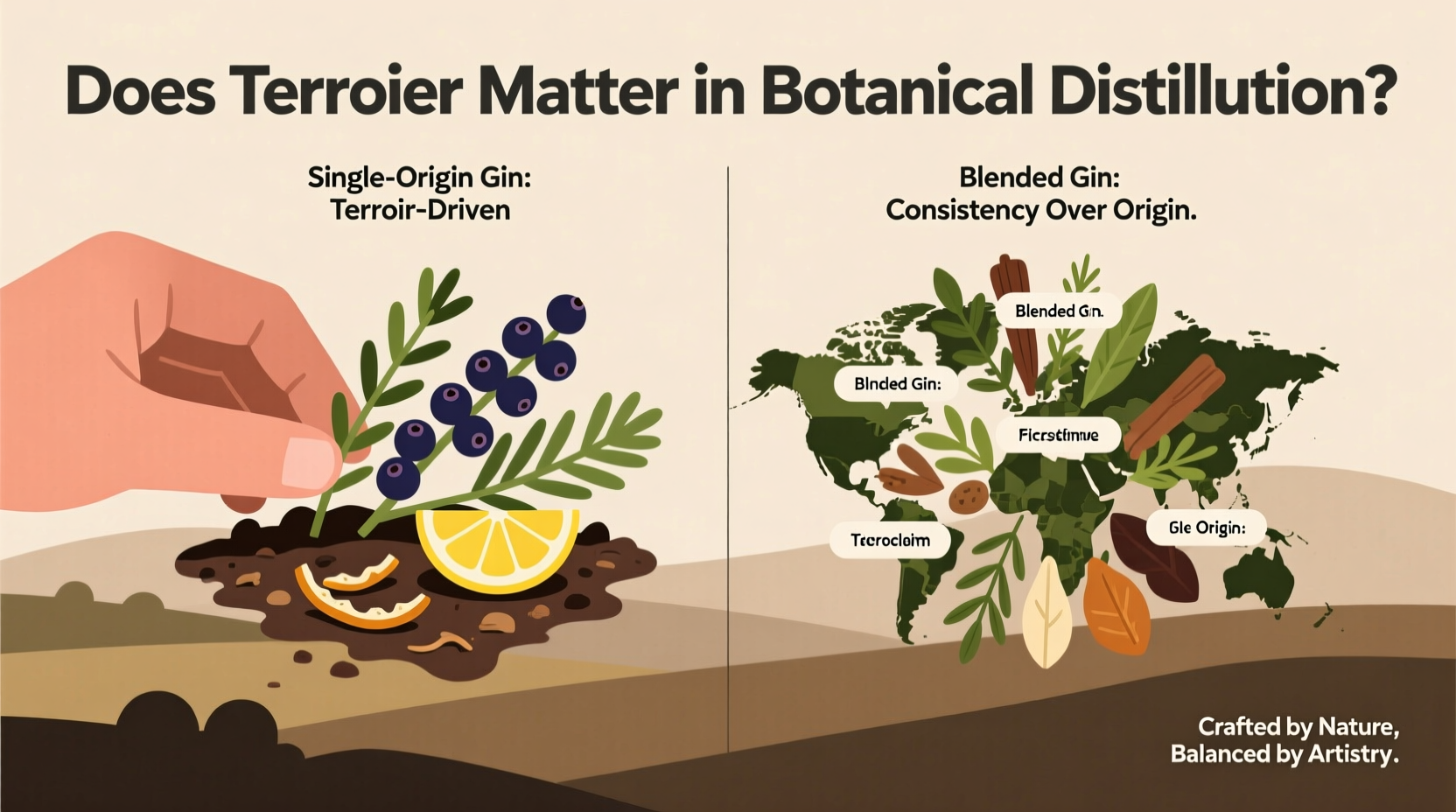
The term “single-origin gin” lacks legal definition or industry standardisation. Unlike Scotch whisky or Champagne, no regulatory body governs its use. In practice, it most commonly refers to gin where one or more key botanicals—not necessarily all—are sourced from a geographically defined, traceable location, and where that origin demonstrably influences the final spirit’s character. Crucially, it does not mean the entire botanical bill comes from one farm, nor does it imply the base spirit is made from locally grown grain (though some producers do pursue that too). More often, it signals intentionality: a distiller choosing Macedonian juniper over Italian not for cost or availability, but because its resinous, pine-forward profile—shaped by high-altitude limestone soils and diurnal temperature swings—adds a specific structural backbone.
This distinction matters. A “single-origin” label may highlight juniper from the Balkan Mountains while using organic lemon peel from California and orris root from Morocco. The emphasis is on botanical terroir, not geographic exclusivity. And yet, even that focus carries weight. Juniper berries, for instance, vary significantly across regions: Greek berries tend floral and soft; Spanish specimens lean peppery and green; Macedonian fruit delivers intense camphor and dried herb notes. These differences aren’t subtle background noise—they’re compositional levers. When distilled with minimal intervention, they become the dominant voice in the spirit’s narrative.
Tip: When evaluating a “single-origin” gin, look beyond the label—check the distiller’s website for harvest dates, elevation data, soil type, and whether botanicals were wild-foraged or cultivated. Authentic terroir expression requires transparency.The Terroir Effect: How Geography Shapes Botanical Chemistry
Botanical chemistry is profoundly responsive to environment. Juniperus communis doesn’t express itself identically in the chalky downs of southern England as it does in the volcanic slopes of Mount Etna. Sun exposure alters terpene ratios: higher UV intensity increases α-pinene (resinous, pine) and limonene (citrus), while cooler nights preserve delicate esters responsible for floral lift. Soil pH affects mineral uptake—calcium-rich soils yield berries with firmer tannic structure; acidic, peaty substrates encourage softer, earthier phenolics. Even rainfall timing matters: drought-stressed plants produce more defensive compounds, intensifying aromatic complexity but reducing yield.
A 2022 study published in the Journal of Agricultural and Food Chemistry analysed 37 wild-harvested juniper samples across Europe. It found statistically significant variance in monoterpene profiles correlating directly with altitude and mean summer temperature—differences detectable not just in gas chromatography, but in sensory panels trained to identify “green needle,” “wet stone,” and “crushed pine” descriptors. Similarly, lavender grown at 800m in Provence expresses higher linalool (floral, sweet) and lower camphor (medicinal, sharp) than lowland varieties—making it ideal for gins seeking elegance over austerity.
But terroir isn’t destiny—it’s potential. How that potential is realised depends entirely on distillation philosophy. A vapour-infusion still preserves volatile top-notes but sacrifices depth; a maceration-and-boil method extracts heavier, spicier compounds. So while place writes the first draft of flavour, the still is the editor.
Why Blending Remains Indispensable—Even for Terroir-Driven Brands
Blended gin isn’t the antithesis of terroir—it’s its necessary counterbalance. Consider this: a single batch of Macedonian juniper may deliver extraordinary depth one year, but drought or early frost can render the next harvest thin or overly tannic. Relying solely on one origin introduces unacceptable volatility—not just for commercial supply chains, but for sensory integrity. A master distiller’s role is less curator of purity and more conductor of coherence. They blend not to obscure origin, but to frame it.
Take Sipsmith’s “V.J.O.” (Very Junipery Overproof), which uses juniper from three distinct sources: wild Macedonian (for backbone), hand-picked Italian (for brightness), and English-grown (for herbal nuance). Each contributes a different dimension—like bass, midrange, and treble in audio engineering. The result isn’t homogenised; it’s layered. Similarly, Edinburgh Gin’s “Prestonfield” release featured juniper from a single Perthshire estate—but was blended with coriander from Rajasthan and cardamom from Guatemala to ensure the local juniper’s austere, alpine character didn’t dominate at the expense of balance.
“Terroir gives you character. Blending gives you consistency—and consistency is what allows terroir to be understood over time. Without repeatability, you have novelty, not expression.” — Dr. Katie Jones, Senior Distiller at Cotswolds Distillery and co-author of *Botanical Distillation: Science & Sensibility*
Comparative Framework: Single-Origin vs. Blended Gin in Practice
Understanding the functional differences helps move past ideology into practical appreciation. Below is a comparative overview grounded in production reality, sensory impact, and market positioning—not hierarchy.
| Dimension | Single-Origin Gin | Blended Gin |
|---|---|---|
| Primary Goal | Express a specific botanical’s regional identity | Achieve harmonious, repeatable flavour architecture |
| Juniper Sourcing | One defined geographic source (e.g., “Dinaric Alps, Serbia”) | Multiple origins, selected for complementary traits |
| Batch Variability | High—seasonal shifts alter profile year-on-year | Low—rigorous botanical profiling ensures batch-to-batch fidelity |
| Typical Use Case | Neat sipping; paired with simple tonics to avoid masking | Cocktails, G&Ts, mixing—designed for versatility |
| Price Positioning | Premium (driven by scarcity, labour-intensive foraging) | Broad spectrum—from accessible to ultra-premium |
Note that overlap exists: many premium blended gins use single-origin botanicals within their matrix. The distinction lies in intent—not ingredients. A single-origin gin invites contemplation; a blended gin invites engagement.
Mini Case Study: The Isle of Harris Gin and the Limits of Locality
Launched in 2015, Isle of Harris Gin became an instant benchmark for terroir-driven spirits. Its signature ingredient—rock samphire—was foraged exclusively from tidal zones around the Outer Hebrides. The plant, rich in saline minerality and iodine, gave the gin an unmistakable coastal character: briny, bright, and fiercely local. Early batches were revelatory—critics praised its “taste of Atlantic wind.”
But within two years, challenges emerged. Rock samphire is slow-growing and ecologically sensitive. Over-foraging threatened local populations, prompting strict harvesting quotas from Scottish Natural Heritage. Simultaneously, climate variability led to inconsistent samphire yields—some seasons delivered lush, succulent stems; others yielded sparse, fibrous growth with muted flavour. To maintain supply without ecological harm, Harris Distillery made a pivotal decision: they retained rock samphire as the heart of the gin, but began supplementing it with samphire grown in controlled coastal nurseries on the island—using native seed stock and replicating tidal conditions. They also introduced small quantities of hand-harvested bladder campion (another Hebridean native) to add floral lift and structural balance.
The result? A gin that remained authentically “of Harris”—but one that evolved from strict single-origin to thoughtfully augmented terroir. As Master Distiller Mark Tayburn explained in a 2021 interview: “We didn’t abandon place—we deepened our relationship with it. True terroir isn’t static. It’s dialogue.” Today, Harris Gin is labelled “Hebridean Origin,” not “single-origin”—a subtle but meaningful shift reflecting maturity over dogma.
Your Practical Guide: How to Taste Terroir in Gin (Step-by-Step)
Discerning botanical terroir requires focused attention—not just tasting, but listening to the spirit. Follow this sequence to build your sensory literacy:
- Smell Neat, First Pass: Hold the glass still. Note immediate impressions—avoid swirling. Is there a dominant green note (forest floor, crushed pine)? Citrus zest? Salinity? Earthiness? These top-notes often reflect volatile terpenes most sensitive to climate.
- Swirl & Wait 30 Seconds: Introduce oxygen. Now smell again. Does a deeper layer emerge—spice, wood, dried herb, smoke? These suggest heavier compounds influenced by soil minerals and ripening conditions.
- Taste at Room Temperature: No ice. Let 1 ml coat your tongue. Focus on the mid-palate: is the juniper sharp or rounded? Bitter or sweet? Does it feel “lean” (high altitude, cool climate) or “lush” (lowland, warmer summers)?
- Add One Measure of Chilled, High-Quality Tonic: Observe how botanicals integrate. Does the origin character hold firm—or get subsumed? Single-origin gins often shine brightest here: their distinctiveness becomes a conversation partner, not background noise.
- Compare Side-by-Side: Try two gins using juniper from different regions (e.g., Macedonian vs. Greek). Note texture differences—Macedonian often feels drier and more tannic; Greek tends smoother, with brighter florals. That contrast is terroir speaking.
Frequently Asked Questions
Does “single-origin gin” mean it’s made with only one botanical?
No. “Single-origin” refers to the geographic source of one or more botanicals—not the number of ingredients. All gin must contain juniper, but most include 8–15 botanicals. A single-origin gin might use Macedonian juniper, French lavender, and Sri Lankan cinnamon—it’s the juniper’s origin that’s highlighted.
Can I taste terroir in mass-market gin?
Rarely, and not intentionally. Large-scale producers prioritise consistency above all, sourcing botanicals globally and standardising profiles through fractional distillation and post-distillation blending. Any regional nuance is deliberately smoothed out. That doesn’t make them inferior—it makes them engineered for reliability, not revelation.
Is single-origin gin always better or more sustainable?
Not inherently. Sustainability depends on foraging ethics, transport emissions, and agricultural practices—not origin alone. A “single-origin” gin shipping juniper 5,000 miles has a larger carbon footprint than a thoughtfully blended gin using regionally sourced botanicals. Likewise, “better” is subjective: terroir-driven gins reward contemplative drinking; blended gins excel in versatility and accessibility. Choose based on intention—not labels.
Conclusion: Terroir Isn’t a Destination—It’s a Dialogue
Terroir matters in gin—not as a rigid doctrine, but as a living variable in the distiller’s palette. It offers texture, memory, and distinction. Yet to elevate it above all else is to mistake the brushstroke for the painting. The most compelling gins today don’t choose between origin and blend; they orchestrate both. They let Macedonian juniper anchor the structure, then weave in Bulgarian coriander for spice, Tuscan lemon for lift, and locally foraged heather for whispering complexity—each origin contributing its unique voice to a coherent whole. This is where craftsmanship meets conscience: respecting place without fetishising it, honouring seasonality without surrendering to its whims.
So the next time you pour a gin—whether labelled “single-origin” or proudly “blended”—pause before the tonic. Smell deeply. Taste slowly. Ask not “Where is this from?” but “What story does this tell—and who helped write it?” Because terroir isn’t just in the soil. It’s in the hands that harvest, the still that transforms, and the mind that decides when to let a place speak—and when to help it sing in harmony.
💬 Your palate is part of gin’s evolving story. Try a single-origin and a blended gin side-by-side this week—and share what you discover in the comments. What surprised you? Where did place shine through—and where did balance win? Let’s deepen the conversation, one thoughtful sip at a time.