Whiskey newcomers often feel overwhelmed when facing a wall of amber bottles labeled “Scotch” and “Bourbon.” The terms sound interchangeable—but they represent distinct traditions, legal frameworks, and sensory experiences. Understanding the flavor differences isn’t about memorizing jargon; it’s about recognizing what your palate responds to—and why. This isn’t a contest between two spirits. It’s a map for your taste journey. Scotch and bourbon share DNA—both are aged grain spirits distilled from fermented mash—but their geographic roots, grain bills, cask practices, and climate-driven maturation create unmistakably different personalities on the tongue.
What Legally Defines Each Spirit?
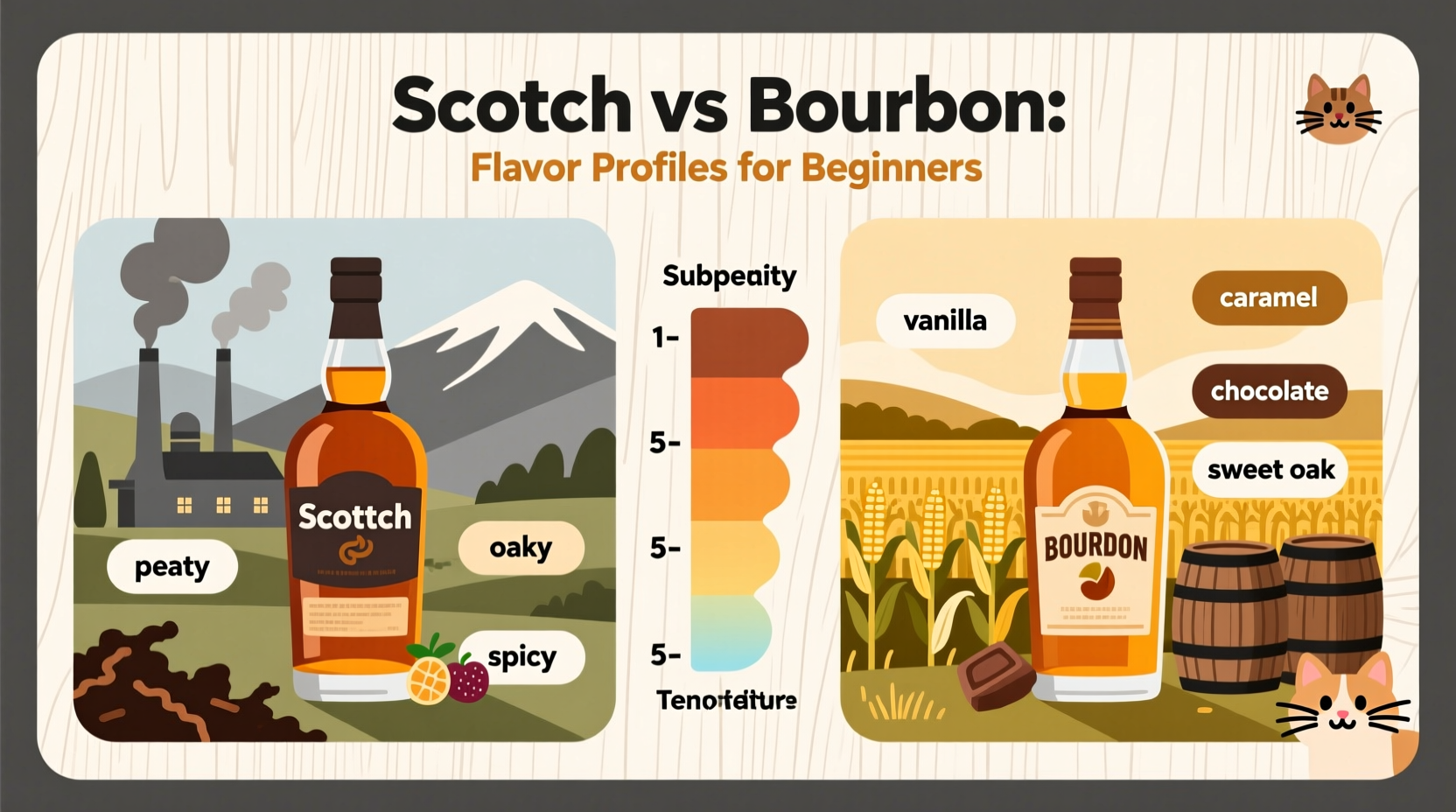
Before tasting, know the rules—because they shape flavor at the source. Both Scotch and bourbon are governed by strict, codified regulations that dictate everything from ingredients to aging conditions.
Scotch whisky must be made in Scotland, distilled to no more than 94.8% ABV, matured in oak casks for a minimum of three years, and bottled at no less than 40% ABV. It must be made exclusively from water and malted barley (for single malt) or water, malted barley, and other whole grains (for blended or grain Scotch). No additives—except water and plain caramel coloring (E150a)—are permitted.
Bourbon, by U.S. federal law, must be produced in the United States (not just Kentucky), made from a grain mixture that is at least 51% corn, distilled to no more than 80% ABV, entered into new, charred oak barrels at no more than 62.5% ABV, and aged without added coloring or flavoring. There is no minimum aging requirement for “bourbon”—but to be labeled “straight bourbon,” it must age for at least two years and contain no added flavors or coloring.
Tip: If a label says “blended whiskey” or “whiskey liqueur,” it doesn’t meet the legal definitions for either Scotch or straight bourbon—and likely contains additives or neutral spirits that dilute the core flavor profile.Core Flavor Drivers: Grain, Process & Place
The divergence begins before fermentation even starts. Corn dominates bourbon’s grain bill—typically 60–75%—delivering inherent sweetness: think vanilla, caramel, baked apple, and toasted marshmallow. Malted barley provides enzymatic power for conversion, while rye (in high-rye bourbons) adds spice and structure, and wheat (in wheated bourbons) softens edges with honeyed, biscuity notes.
Scotch’s foundation is almost always malted barley—especially in single malts—but the magic lies in how it’s treated. Peat smoke is applied during kilning for many expressions, embedding phenolic compounds that translate to medicinal, smoky, or maritime notes. Even unpeated Scotch develops deeper complexity from slower distillation in copper pot stills, longer fermentation times (often 50–120 hours vs. bourbon’s typical 2–5 days), and maturation in used casks—most commonly ex-bourbon barrels (which impart coconut, oak, and vanilla), but also sherry, port, rum, or wine casks that layer dried fruit, chocolate, or tannic depth.
Climate matters profoundly. Scotland’s cool, damp, maritime climate slows maturation, encouraging subtle oxidation and gentle wood integration over decades. Kentucky’s hot, humid summers accelerate extraction from the charred oak—intensifying vanilla, spice, and tannin in half the time. A 12-year-old bourbon often tastes bolder and more extracted than a 12-year-old Highland single malt.
A Side-by-Side Flavor Profile Comparison
| Characteristic | Bourbon | Scotch (Single Malt) |
|---|---|---|
| Primary Sweetness | Caramel, brown sugar, maple syrup, ripe banana, butterscotch | Honey, dried apricot, stewed pear, barley sugar, baked apple (unpeated); treacle, blackstrap molasses (peated) |
| Spice & Heat | Cinnamon stick, clove, black pepper, nutmeg, white pepper heat | White pepper, ginger snap, anise seed, cardamom (especially Speyside); medicinal iodine, brine, seaweed (Islay) |
| Smoke/Earth | Rare—only in experimental or smoked-grain bourbons (toasted oak, campfire ash) | Peat smoke: medicinal, wet wool, bonfire, charcoal, smoked fish (Islay); earthy mushroom, forest floor, damp stone (Highland) |
| Wood Influence | Strong vanilla, coconut, sawn oak, char, toasted almond, baking spice | Subtler oak: cedar, sandalwood, old library book; sherry cask: fig, raisin, walnut, dark chocolate |
| Mouthfeel | Rich, viscous, oily-sweet, often with a warming, rounded finish | Varies widely: light and crisp (Lowland), waxy and full (Speyside), chewy and saline (Islay), austere and drying (Island) |
This table reflects tendencies—not absolutes. A heavily sherried Glenfarclas tastes dramatically different from a lightly peated Auchentoshan. And a high-rye bourbon like Bulleit delivers sharper spice than a wheated Maker’s Mark. But the patterns hold: bourbon leans into corn-derived sweetness and aggressive oak; Scotch explores wider terrain—smoke, salinity, fruit intensity, and textural nuance—guided by terroir and cask choice.
Your First Tasting Roadmap: A Step-by-Step Guide
Taste isn’t passive—it’s an active, repeatable skill. Follow this sequence to build confidence distinguishing Scotch and bourbon characteristics:
- Observe: Hold the glass at eye level against a white background. Note color—amber for young bourbon, deep mahogany for older sherry-matured Scotch. Swirl gently and watch the “legs”: thicker, slower legs suggest higher viscosity (common in well-aged bourbon or sherry casks).
- Nose Without Water: Bring the glass to your nose—don’t inhale deeply yet. Hover 1 inch away and breathe normally. Identify broad families: sweet? smoky? fruity? floral? Then gently draw air in through your nose while the glass is ½ inch away. Note specific impressions: “cinnamon roll,” “wet gravel,” “orange marmalade.”
- Add One Drop of Water: Especially for cask-strength or high-ABV pours (anything above 50%), one drop unlocks hidden aromas by releasing esters. Re-nose. Does smoke recede? Does fruit brighten?
- Sip & Hold: Take a small sip (½ tsp), let it coat your tongue for 5 seconds. Don’t swallow yet. Breathe gently through your mouth—this volatilizes aromas from the back of your throat (“retronasal olfaction”). Notice where flavor hits: front (sweet), sides (acid/spice), back (bitter/tannin), and finish (lingering warmth or smoke).
- Compare Side-by-Side: Taste a bourbon and a Scotch back-to-back. Rinse with water between. Ask: Which feels richer? Which lingers smokier? Which has brighter fruit? This contrast builds neural pathways faster than solo tasting.
Real-World Example: How a Beginner Navigated the Divide
Maya, a 28-year-old graphic designer in Portland, bought her first whiskey—a bottle of Macallan 12 Year Old Sherry Oak—after seeing it in a film. She found it “overwhelmingly dry and bitter,” with “raisins and something medicinal.” Discouraged, she tried a friend’s Elijah Craig Small Batch bourbon. “It tasted like dessert,” she said. “Caramel, cinnamon, warm pie crust—I could actually enjoy it.” That experience led her to explore *why*: she learned Macallan’s sherry casks contributed tannins and dried fruit, while Elijah Craig’s new charred oak delivered vanilla and sweetness. Her next step wasn’t abandoning Scotch—it was choosing a lighter, unpeated expression: Glenmorangie Original, aged in ex-bourbon casks. “It tasted like lemon curd and white peach,” she shared. “Finally, I got it. It wasn’t that I didn’t like Scotch—I just started too heavy.”
Maya’s story underscores a critical truth: flavor preference isn’t fixed. It’s shaped by exposure, context, and education. Starting with approachable benchmarks builds confidence to venture further.
Expert Insight: What Masters Say About Palate Development
“Taste memory is built in layers—not leaps. Beginners fixate on ‘Do I like this?’ instead of ‘What do I notice?’ A single note—vanilla, smoke, citrus—recognized consciously today becomes the foundation for identifying complex layers tomorrow.” — Dr. Rachel Chen, Master Blender, Compass Box Whisky
“The biggest mistake new drinkers make is assuming ‘smooth’ means ‘better.’ A sharp, peppery rye bourbon or a medicinal Islay Scotch isn’t flawed—it’s communicating terroir and tradition. Respect the intention behind the spirit, not just your immediate comfort.” — James R. McEwan, former Distillery Manager, Bruichladdich
Beginner-Friendly Bottle Checklist
- ✅ For Bourbon: Start with a wheated or low-rye expression—Maker’s Mark, W.L. Weller Special Reserve, or Four Roses Yellow Label. These emphasize corn sweetness and soft oak, minimizing aggressive spice.
- ✅ For Unpeated Scotch: Choose a Speyside or Lowland single malt matured in ex-bourbon casks—Glenfiddich 12, Glenmorangie Original, or Auchentoshan Classic. Clean, fruity, and accessible.
- ✅ For Peated Scotch (if curious): Begin with a mild introduction—Caol Ila 12 or Benromach Traditional—to gauge your tolerance for smoke before tackling Ardbeg or Laphroaig.
- ✅ Always serve at room temperature in a tulip-shaped glass (like a Glencairn) to concentrate aromas.
- ✅ Never judge a spirit neat at cask strength—dilute gradually with drops of water until the alcohol burn recedes and flavors emerge.
Frequently Asked Questions
Does “Scotch” always mean smoky?
No—less than 10% of Scotch production is heavily peated. Most Speyside, Highland, and Lowland single malts use unpeated barley and emphasize orchard fruit, honey, floral notes, and gentle oak. Smoke is a regional signature—not a category requirement.
Why does bourbon taste sweeter than most Scotch?
Three reasons: corn’s natural sugars dominate the grain bill; new charred oak imparts intense vanilla and caramel compounds; and shorter, hotter aging extracts those sweet notes rapidly. Scotch’s reliance on used casks and cooler climate yields subtler, drier wood influence and more emphasis on grain and fermentation character.
Can I mix Scotch and bourbon in cocktails?
Absolutely—but purposefully. Bourbon’s boldness shines in classics like the Old Fashioned or Manhattan. Scotch adds intrigue: a splash of Islay in a Rob Roy creates briny depth; a floral Highland malt elevates a Penicillin. Avoid blending them *in the same drink* unless you’re experimenting intentionally—the flavor clash can overwhelm rather than harmonize.
Conclusion: Your Palate Is the Only Authority That Matters
Scotch and bourbon aren’t rivals. They’re complementary chapters in whiskey’s global story—one rooted in Scottish geology and centuries of coastal adaptation, the other born from American ingenuity and the abundance of new oak and corn. Their flavor profiles reflect those origins with remarkable fidelity. You don’t need to “choose a side.” You need only pay attention—to the warmth of bourbon’s vanilla kiss, the whisper of peat in a Highland dram, the way water transforms a sharp edge into layered nuance. Every sip is data. Every bottle, a teacher.
Start simple. Taste one bourbon and one unpeated Scotch this week—no notes required, just presence. Then try adding a drop of water. Then compare. Let curiosity override expectation. In time, you’ll recognize not just “what it is,” but “why it tastes that way”—and that understanding transforms drinking into discovery.
💬 Your turn. What was the first bourbon or Scotch that made you pause and say, “I get it now”? Share your breakthrough moment in the comments—we’ll all learn from your taste journey.