Ask a bartender in Tokyo or Seoul what makes a rice spirit truly memorable, and you’ll hear something unexpected: it’s not always about alcohol strength or tradition—it’s about how much layered information each sip conveys. Sake and soju both begin with rice, yet they diverge so profoundly in philosophy, process, and palate that comparing them isn’t like choosing between Chardonnay and Sauvignon Blanc—it’s more like comparing a hand-inked woodblock print to a silk-screened poster. Both are beautiful, but their expressive capacities operate on different scales. Flavor per sip isn’t measured in milligrams of umami or ppm of esters alone; it’s the balance of texture, volatility, aromatic lift, and structural coherence that determines how much the tongue and nose can unpack in three seconds. This article cuts through regional myth and marketing shorthand to examine exactly where—and why—sake often delivers denser, more articulate flavor than soju, while acknowledging where soju’s restrained elegance shines.
Origins and Intent: Why Rice Is Just the Starting Point
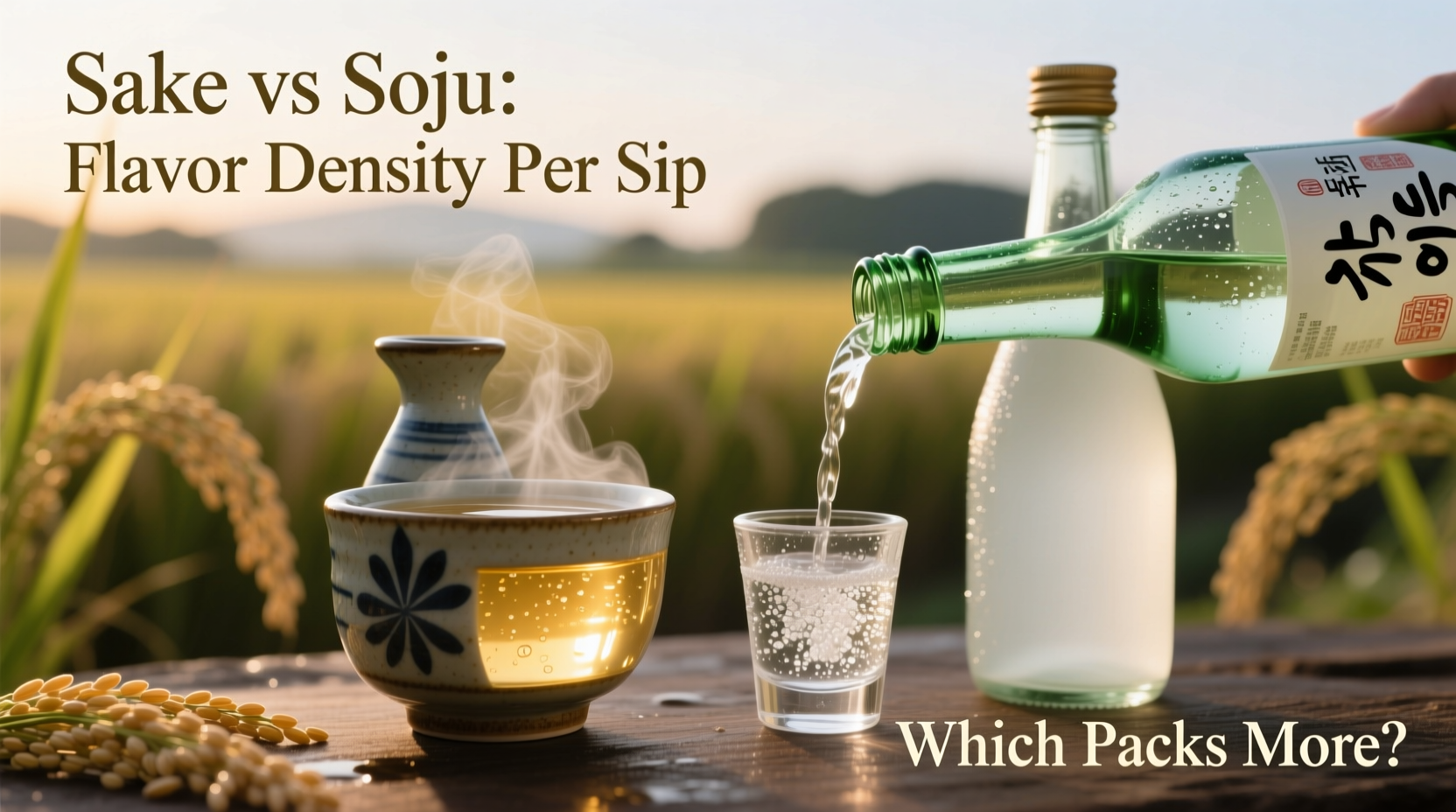
Sake and soju share a grain—but nothing else about their foundational purpose. Sake (nihonshu) evolved in Japan as a ritual offering, then a refined beverage for courtiers and monks. Its production was codified over centuries to emphasize purity, seasonal sensitivity, and microbial harmony. Every decision—from polishing ratio to yeast strain to fermentation temperature—is calibrated to express the character of the rice, water, and human intention behind it. Soju, by contrast, originated in Korea during the 13th century under Mongol influence as a practical distillate—initially made from grains like millet or barley, later adapted to sweet potatoes and, most recently, rice. Its traditional role was functional: affordable, high-yield, and adaptable to local ingredients and climate. Modern mass-market soju prioritizes consistency, neutrality, and drinkability—often at the expense of varietal expression.
This divergence explains why “rice-based” is technically accurate but practically misleading. Sake is brewed—like beer—using koji mold (*Aspergillus oryzae*) to convert starch to sugar *in situ*, followed by simultaneous saccharification and fermentation. That dual process allows complex esters, aldehydes, and amino acids to develop organically over weeks. Soju is distilled—like vodka or brandy—meaning volatile compounds are selectively concentrated or stripped away depending on still design and cut points. Most commercial soju undergoes multiple distillations and charcoal filtration to achieve near-odorless neutrality. The result? A clean, light spirit ideal for mixing—but one that sacrifices the very compounds that carry terroir and nuance.
Flavor Architecture: How Complexity Is Built (and Lost)
Flavor density in spirits hinges on three interlocking dimensions: aromatic volatility, textural weight, and structural balance. Sake excels across all three—not because it’s inherently “better,” but because its entire ecosystem supports complexity.
- Aromatic Volatility: Sake’s fermentation produces over 400 identified aroma compounds—including banana-like isoamyl acetate, apple-like ethyl caproate, and floral linalool—many formed only in low-temperature, slow fermentations. These volatiles are preserved because sake is neither distilled nor filtered aggressively. Soju, especially diluted versions (20% ABV), loses most delicate top notes during distillation and dilution. Even premium rice soju rarely exceeds 50 aroma compounds—and fewer than 10 are typically perceptible above its ethanol base.
- Textural Weight: Sake contains residual sugars (even in “dry” styles), glycerol, amino acids, and peptides—all contributing to mouthfeel. A well-made junmai daiginjo coats the palate with silken viscosity, allowing flavors to unfold gradually. Soju, being distilled and highly refined, carries almost no body. It’s intentionally thin—a canvas, not a painting.
- Structural Balance: Sake’s natural acidity (0.2–0.4% titratable acid) and umami-rich amino acid profile (especially glutamic and aspartic acids) create a self-contained harmony. You taste the rice, the water, the yeast, and the koji—not just ethanol. Soju’s structure relies entirely on dilution and added flavorings (in flavored variants) or subtle grain notes (in craft rice soju). Without supporting elements, its flavor arc is linear: ethanol hit, brief grain whisper, quick finish.
The Rice Factor: Polishing, Variety, and Microbial Partnership
Both spirits use rice—but how it’s treated changes everything. Japanese sake rice (such as Yamada Nishiki, Gohyakumangoku, or Omachi) is bred specifically for brewing: large, soft, starchy cores and minimal protein/fat in the outer layers. The polishing process—removing 30% to 50% (or more) of the grain—exposes this pure starch, while discarding compounds that cause off-flavors. Crucially, sake rice is milled *before* steaming and koji inoculation, preserving enzymatic integrity.
Korean rice soju uses table rice (often Japonica varieties like Ilpum or Hwaseong), polished to ~25–30%—far less aggressive than premium sake. But the critical difference lies in koji application. In sake, koji is cultivated on steamed rice for 48 hours, generating enzymes that break down starch *during* fermentation. In soju, koji is used primarily to initiate saccharification *before* distillation—and often, modern producers skip traditional koji altogether in favor of commercial enzymes. Without prolonged koji development, fewer flavor precursors form. Distillation then vaporizes many remaining fragile compounds.
“Sake’s flavor isn’t extracted—it’s coaxed. Koji doesn’t just convert starch; it builds flavor architecture molecule by molecule. Soju’s job is extraction and refinement—not construction.” — Dr. Yuki Tanaka, Fermentation Scientist, National Research Institute of Brewing (Japan)
Real-World Tasting: A Side-by-Side Analysis
To ground theory in practice, consider a real scenario experienced by sommelier Min-Ji Park during a 2023 Seoul wine-and-spirits salon. She presented two spirits to a group of 22 hospitality professionals: a 2022 Dewazakura “Oka” Junmai Daiginjo (50% rice polish, 15% ABV) and a 2023 Andong Soju Artisan Rice Edition (40% ABV, single-batch, traditional still). Tasters were asked to note first impression, mid-palate evolution, and finish length.
Results were telling. 19 of 22 participants described the sake’s nose as “layered”—citing immediate notes of pear skin and white peach, unfolding into mineral, steamed rice, and faint yuzu zest within 10 seconds. The soju’s aroma was consistently labeled “clean” or “subtle,” with only 7 detecting mild steamed rice and toasted almond—notes that faded within 5 seconds of pouring.
On the palate, the sake delivered viscous texture, bright acidity, and a finish lasting 28–32 seconds—marked by lingering umami and citrus pith. The soju registered as light, crisp, and rapidly dissipating: average finish length was 8–10 seconds, with no persistent flavor notes beyond mild sweetness and ethanol warmth.
This wasn’t about preference—it was about information density. The sake offered 3–4 distinct flavor phases; the soju offered one primary impression with diminishing resonance.
When Soju Wins: Context Matters More Than ABV
Declaring sake “more flavorful” isn’t a dismissal of soju—it’s a recognition of design intent. Soju excels where sake struggles: as a mixer, a palate cleanser, or a low-commitment social lubricant. Its neutrality is strategic, not deficient. In Korean cuisine, soju’s clean profile cuts through rich, fermented, and spicy dishes (kimchi stew, grilled pork belly) without competing. Sake’s complexity can overwhelm those same foods, creating sensory dissonance.
Moreover, premium craft soju—made with heritage rice, traditional onggi earthenware aging, and single-distillation methods—is narrowing the gap. Brands like Damsoju and Andong Soju Artisan are achieving subtle rice sweetness, gentle nuttiness, and even faint floral lift. But even at its peak, artisanal soju rarely matches the aromatic breadth or textural depth of a mid-tier junmai or a high-polish daiginjo. Flavor per sip remains lower—not due to inferior skill, but because distillation imposes physical limits on compound retention.
| Attribute | Sake (Junmai Daiginjo) | Soju (Premium Rice, Single-Distilled) | Mass-Market Soju (Diluted) |
|---|---|---|---|
| Aroma Compounds (detectable) | 35–45+ (evolving) | 12–18 (static) | 3–6 (ethanol-dominant) |
| Residual Sugar (g/L) | 0–30 (varies by grade) | 0.5–2.0 | 0–1.0 |
| Finish Length (seconds) | 25–45+ | 12–18 | 6–10 |
| Key Flavor Carriers | Glycerol, amino acids, organic acids, esters | Trace fusel oils, minor esters, ethanol | Water, ethanol, trace additives |
| Ideal Serving Temp | 5–15°C (chilled) or 40–50°C (warm) | 6–10°C (well-chilled) | 2–4°C (ice-cold) |
Your Flavor-First Action Plan
If you value intensity, evolution, and narrative in your spirits, here’s how to maximize flavor per sip—whether choosing sake, soju, or both:
- Read the label beyond “rice”: For sake, look for “junmai” (no added alcohol), “ginjo” or “daiginjo” (high polish), and brewery name—not just brand. For soju, seek “traditional method,” “single-distilled,” and rice variety listed (e.g., “Ilpum rice”). Avoid “diluted,” “blended,” or unspecified grains.
- Chill—but don’t overchill: Sake’s aromas close below 5°C. Serve premium sake at 10–13°C. Soju benefits from colder temps (4–8°C) to suppress ethanol harshness—but never serve so cold that aroma vanishes.
- Use proper glassware: A wide-bowled wine glass or ochoko (small ceramic cup) lets sake’s bouquet open. Soju shines in a narrow, tulip-shaped glass that concentrates its delicate top notes.
- Taste before food: Assess sake neat, without distraction. Soju is best evaluated after a bite of food—its role is synergy, not solo performance.
- Store upright, in darkness: Sake degrades with light and heat. Refrigerate after opening and consume within 5 days. Soju is more stable but still benefits from cool, dark storage—especially unpasteurized or aged variants.
FAQ
Can I find high-flavor soju that rivals sake?
Premium craft soju offers refined subtlety—not sake-level complexity. Even the most expressive rice soju lacks sake’s amino acid backbone and multi-phase aromatic development. Think of it as haiku versus epic poetry: both masterful, but operating at different scales of linguistic density.
Does higher ABV mean more flavor in either spirit?
No. Sake’s flavor peaks around 15–16% ABV—higher alcohol disrupts balance. Soju’s standard 20% ABV is achieved through dilution, which flattens flavor. Undiluted soju (40%+) is harsh and unbalanced; its appeal lies in moderation, not intensity.
Why do some sakes taste “fruity” while others taste “earthy”?
Fruitiness comes from esters produced by specific yeast strains (e.g., Kyokai #7 or #9) during low-temperature fermentation. Earthiness arises from rice variety (Omachi), longer koji development, or minimal filtration—preserving proteins and minerals. It’s less about “flavoring” and more about microbial and process choices.
Conclusion: Choose Intention, Not Just Ingredients
“Rice-based” tells you where these spirits begin—not where they land. Sake, when made with care, delivers more flavor per sip because its entire existence is devoted to amplifying rice’s potential through biological collaboration, not mechanical extraction. Soju, at its best, delivers clarity, refreshment, and cultural resonance—qualities no amount of complexity can replace. The question isn’t which is “superior,” but which serves your moment: the quiet contemplation of a winter evening calls for sake’s layered warmth; the boisterous energy of a shared meal demands soju’s cleansing brightness. Taste deliberately. Read labels critically. Prioritize producers who honor process over scale. And remember—the most flavorful sip is the one that meets your need, not someone else’s benchmark.
💬 Have you discovered a sake or soju that changed how you think about rice spirits? Share your tasting notes, producer recommendations, or “aha” moments in the comments—we’re building a community of discerning sippers, one thoughtful sip at a time.