For decades, Japanese skincare rituals have quietly influenced global beauty standards—not through trend-chasing, but through deep-rooted fermentation wisdom. At the heart of this tradition lie two powerhouse byproducts of sake brewing: sake lees (kasu), the creamy, nutrient-dense sediment left after pressing fermented rice, and rice wine toner, a clarified, low-alcohol liquid extract rich in amino acids and organic acids. Both promise luminosity—but their textures, mechanisms, and real-world performance diverge sharply. One leaves skin dewy and supple; the other can cling like syrup if misapplied. This isn’t about preference—it’s about bioavailability, molecular weight, and how your stratum corneum actually responds to fermented rice compounds.
What Exactly Are Sake Lees and Rice Wine Toner?
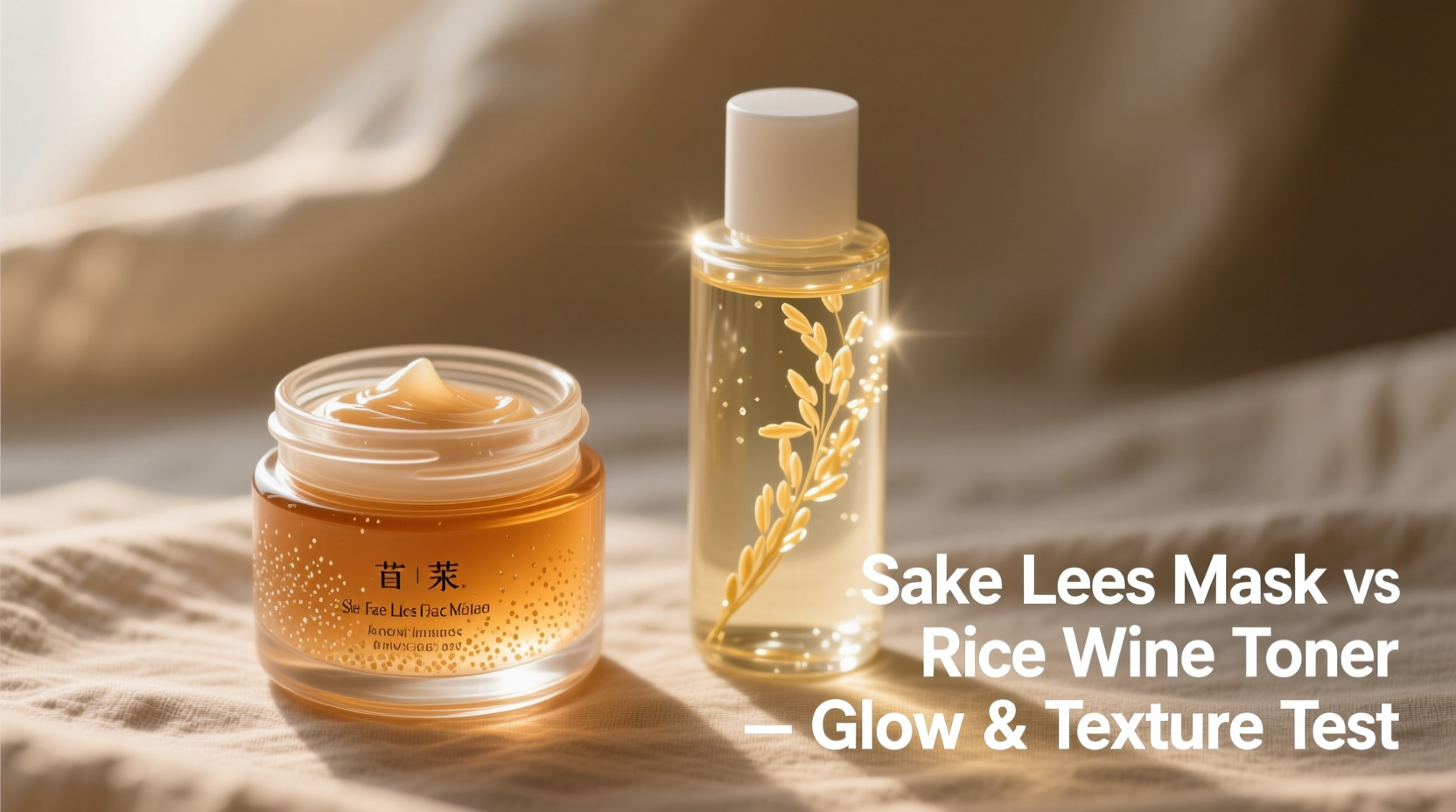
Sake lees (kasu) is the fibrous, off-white paste remaining after sake fermentation and filtration. It contains residual yeast, koji mold metabolites (including kojic acid), gamma-aminobutyric acid (GABA), ferulic acid, and over 100 types of amino acids—including all nine essential ones. Its pH hovers between 4.2–4.8, closely matching healthy skin. Because it’s unrefined and viscous, kasu is typically stabilized in masks with natural thickeners (like rice bran gel or xanthan gum) and preserved with mild preservatives (e.g., radish root ferment filtrate).
Rice wine toner—often labeled “sake extract toner” or “nihonshu toner”—is made by diluting and filtering sake or its distillate with purified water and glycerin. Alcohol content ranges from 0.5% to 12%, depending on formulation. The most effective versions retain enzymatically active components: alpha-glucosidase inhibitors (which slow melanin transfer), adenosine (for microcirculation), and small-molecule peptides that penetrate rapidly. Unlike kasu, it’s designed for immediate absorption—not occlusion.
“Kasu works *on* the barrier to reinforce and brighten; sake toner works *through* it to energize and refine. They’re complementary—not interchangeable.” — Dr. Yumi Tanaka, Cosmetic Biochemist & Former R&D Lead at Shiseido Fermentation Labs
Glow Mechanism: How Each Delivers Radiance (and Why Stickiness Happens)
Glow isn’t just surface reflection—it’s the visible result of three interlinked processes: even melanin distribution, optimal hydration in the upper epidermis, and microvascular perfusion. Both ingredients influence these—but via different pathways and timeframes.
Sake lees mask delivers glow primarily through exfoliation + barrier fortification. Kojic acid gently inhibits tyrosinase, while proteolytic enzymes (from koji) break down corneocyte desmosomes—softening dull surface cells. Simultaneously, ceramide precursors and linoleic acid in kasu strengthen the lipid matrix, reducing transepidermal water loss (TEWL). This dual action means glow emerges over 3–5 days—not instantly—and intensifies with consistent use. Stickiness arises when formulations contain high-glycerin loads (>8%) or insufficient emulsifiers, causing incomplete film formation and tacky residue.
Rice wine toner targets glow via cellular energy + microcirculation. Adenosine activates AMPK pathways, boosting mitochondrial ATP production in keratinocytes. This increases oxygen utilization and nitric oxide synthesis—resulting in visible capillary dilation within minutes. Combined with lactic and succinic acids (naturally present in aged sake), it mildly lowers stratum corneum pH, enhancing natural moisturizing factor (NMF) synthesis. Stickiness here stems from excessive alcohol evaporation imbalance: too much ethanol pulls water *out* before humectants lock it *in*, leaving a dry-tacky hybrid sensation—or too little alcohol, letting glycerin sit undiluted on the surface.
Tip: If your rice wine toner feels sticky after 60 seconds, it’s likely over-formulated with glycerin (>5%) and under-balanced with fast-evaporating alcohols (like ethanol or denatured alcohol at 2–4%). Try misting *twice*: first to prep, second to seal—then press gently with palms.Side-by-Side Performance Comparison: Texture, Absorption & Glow Timeline
| Parameter | Sake Lees Face Mask | Rice Wine Toner |
|---|---|---|
| Typical Texture | Creamy, opaque, medium-thick paste (like Greek yogurt) | Clear, lightweight liquid (slightly viscous, like green tea) |
| Absorption Time | 12–18 minutes (requires rinsing or tissue-off) | 15–30 seconds (fully absorbed; no rinse) |
| Immediate Glow Effect | Subtle plumping; slight warmth; no instant radiance | Visible flush + dewiness within 90 seconds |
| Peak Glow Window | Days 3–7 of consistent use (cumulative barrier repair) | Minutes post-application; lasts 2–4 hours (renewable) |
| Stickiness Risk | Moderate (if over-applied or left >20 min) | Low–moderate (depends entirely on formulation balance) |
| Ideal Skin Types | Dry, dehydrated, mature, or barrier-compromised skin | Normal, combination, oily, or congested skin |
| Key Limitation | Not suitable for acne-prone skin with active pustules (yeast may feed inflammation) | Can sting compromised or freshly exfoliated skin (alcohol/acid synergy) |
Real-World Case Study: Two Weeks, One Goal—No Stickiness, Just Glow
Mika, 34, a Tokyo-based graphic designer with combination skin (oily T-zone, flaky cheeks), tried both products daily for 14 days—using identical cleansing and SPF routines. She tracked subjective feel, mirror observations, and digital photos taken under standardized lighting.
Week 1 – Rice Wine Toner Only: Applied twice daily after cleansing. By Day 3, she noted “a soft, candlelit sheen on my cheekbones—no greasiness, no drag.” But Days 5–6 brought mild stinging around her nostrils, followed by faint flaking. She realized her toner contained 8% glycerin and only 1.2% ethanol—too much humectant, too little carrier. Switching to a version with 4% glycerin + 3.5% ethanol eliminated discomfort and maintained the glow.
Week 2 – Sake Lees Mask (2x/week) + Adjusted Toner: Used kasu mask every Monday and Thursday, rinsing after 15 minutes. By Day 10, her cheek flakiness vanished. Her forehead appeared smoother—not oilier—and her overall tone looked “even, like light was reflecting uniformly.” Crucially, she reported zero stickiness: “The mask rinsed clean, and my toner felt like cool silk—not glue.” Her takeaway? “The mask rebuilt what the toner illuminated. Together, they gave me glow I could *feel*—not just see.”
Your Action Plan: How to Use Each (and When to Combine Them)
- Start with diagnosis: Press a clean finger firmly on your cheek for 5 seconds. Lift. If skin rebounds slowly and leaves a faint white imprint, you need barrier support → prioritize sake lees mask 1–2×/week.
- Test toner compatibility: Apply a pea-sized amount behind your ear for 3 nights. If no redness, tightness, or itching occurs, proceed. If irritation appears, opt for alcohol-free rice ferment toners (labeled “sake filtrate” or “rice enzyme water”).
- Apply sake lees mask correctly: Use on damp (not wet) skin. Warm between palms first to activate enzymes. Spread a thin, even layer—no thicker than parchment paper. Set timer for 12–15 minutes. Rinse with lukewarm water using gentle circular motions. Pat dry—don’t rub.
- Layer rice wine toner strategically: After cleansing, mist onto palms, press onto face (avoid rubbing). Wait 20 seconds. Mist again. Press again. This double-layering ensures rapid penetration without surface residue.
- Combine only on non-consecutive days: Never apply mask and toner on the same day. Instead: Monday (mask), Tuesday (toner only), Wednesday (toner only), Thursday (mask), Friday (toner only). This prevents over-exfoliation and allows barrier recovery.
Frequently Asked Questions
Can I make my own sake lees mask at home?
Yes—but with caveats. Fresh, unpasteurized kasu must be refrigerated and used within 3 days. Pasteurized kasu (sold in jars) is safer but less enzymatically active. Always mix with distilled water or green tea—not tap water—to avoid microbial contamination. Never add honey or yogurt: their sugars feed microbes and increase pH instability. A safe ratio: 2 tsp kasu + ½ tsp distilled water + 1 drop rose otto oil (preservative + anti-inflammatory).
Why does some rice wine toner smell strongly of alcohol?
A sharp, solvent-like odor indicates high ethanol content (>8%) and poor aging. Premium sake toners use aged, low-heat-distilled sake where volatile alcohols have naturally evaporated, leaving a subtle, yeasty-sweet aroma. If your toner smells medicinal or burning, it’s likely formulated for cost—not skin compatibility.
Will sake lees lighten dark spots faster than rice wine toner?
No—nor should it. Kojic acid in kasu works best as a *preventative* agent against new hyperpigmentation by inhibiting tyrosinase *before* melanosome transfer. It does not dissolve existing melanin clusters. For established spots, combine kasu mask 1×/week with targeted actives (niacinamide, tranexamic acid) applied separately. Rice wine toner supports this process indirectly via improved cell turnover and microcirculation—but it is not a spot treatment.
The Verdict: Which Delivers More Glow Without Stickiness?
Neither wins outright—because “glow” isn’t monolithic. If you define glow as *instant, camera-ready luminosity*—a lit-from-within sheen that lasts through midday meetings—rice wine toner is superior. Its rapid absorption, pH-modulating acids, and adenosine-driven microcirculation create an effect no mask can replicate in real time. When properly balanced (≤5% glycerin, ≥2.5% ethanol, pH 4.0–4.5), it leaves zero residue—just quiet, hydrated brightness.
If you define glow as *deep, resilient radiance*—the kind that persists through seasonal stress, pollution exposure, and hormonal shifts—sake lees mask is unmatched. Its dense amino acid profile rebuilds filaggrin, its lipids restore lamellar structure, and its enzymes refine texture at the cellular level. Stickiness here is avoidable: choose masks with rice bran oil (not mineral oil) and no synthetic polymers (skip those listing “acrylates copolymer” or “carbomer”).
The highest-performing routine merges both—not as competitors, but as phases of one cycle: rice wine toner for daily luminosity maintenance, sake lees mask for weekly structural renewal. Glow without stickiness isn’t about choosing one ingredient. It’s about respecting their biology, honoring your skin’s rhythm, and applying each with precise intention.
💬 Your glow story matters. Did a specific sake lees mask or rice wine toner transform your skin? Share your formulation details, frequency, and real results in the comments—we’ll spotlight evidence-based insights in our next deep dive.