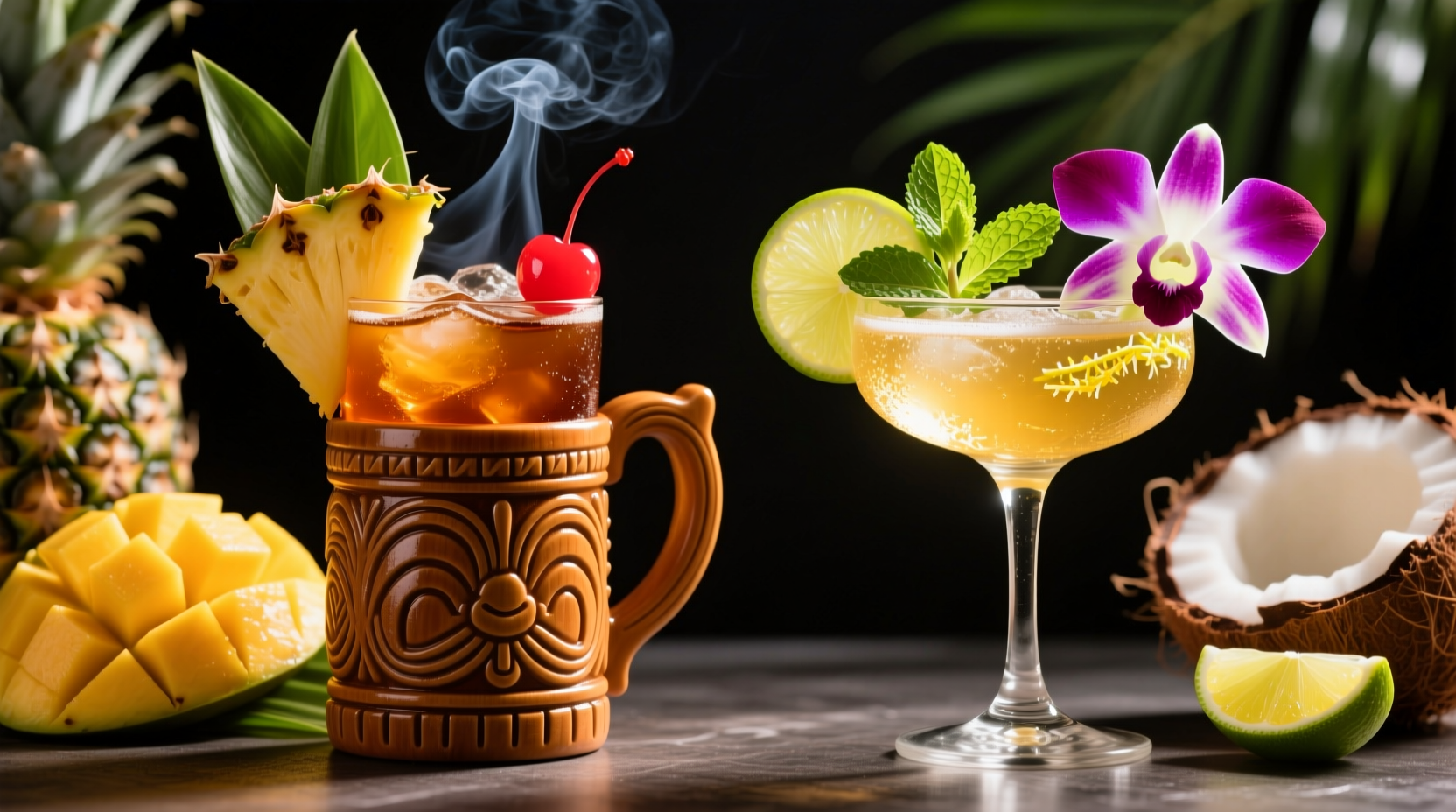
Tropical drinks live or die by their base spirit—not just its alcohol content, but how deeply it contributes to the drink’s aromatic architecture, textural resonance, and lingering finish. When a bartender reaches for rum or tequila to anchor a Mai Tai, a Paloma-inspired tiki riff, or a complex clarified piña colada, they’re making a decision that shapes everything from the first citrus lift to the final spice-tinged exhale. Flavor depth here isn’t about loudness or sweetness; it’s about layered volatility—how many distinct aromatic compounds survive dilution, how well those compounds harmonize with coconut, lime, pineapple, or allspice, and how much structural integrity the spirit retains when chilled, shaken, and strained over crushed ice. Neither rum nor tequila is inherently “better.” But their botanical origins, production philosophies, and chemical signatures produce profoundly different kinds of depth—and understanding those differences transforms cocktail construction from recipe-following into intentional composition.
The Terroir Factor: Where Flavor Depth Begins
Flavor depth in spirits starts long before distillation—in the soil, climate, and varietal choices that define raw material expression. Rum begins with sugarcane: either fresh-pressed juice (as in rhum agricole), molasses (the dominant feedstock globally), or syrup. Each carries distinct microbial and enzymatic footprints. Sugarcane grown in Martinique’s volcanic slopes yields grassy, vegetal, almost green-peppercorn notes in agricole; Jamaican molasses fermented for up to 14 days generates ester bombs—ethyl acetate, isoamyl acetate—that read as overripe banana, pineapple skin, and fermented mango. Tequila, by contrast, begins exclusively with blue Weber agave, matured for 7–10 years in mineral-rich highland or volcanic lowland soils. Highland agave tends toward floral, citrusy, and herbal complexity—think lemongrass, white pepper, and chamomile—while lowland agave delivers earthier, smokier, and more mineral-driven profiles, often with cooked artichoke or wet stone undertones. Crucially, agave’s fructans break down during roasting into dozens of unique fermentable sugars—not just glucose and fructose, but kestose and neokestose—each yielding different congeners during fermentation. This biochemical diversity gives tequila a built-in advantage in aromatic nuance, especially when rested in wood: the same barrel that adds vanilla to rum may pull out roasted agave, dried hibiscus, and saline brine in reposado tequila.
Tip: For maximum depth in stirred tropical drinks (like an Agave Old Fashioned), choose a reposado tequila aged 8–12 months in neutral oak—long enough to integrate agave character with subtle wood tannin, short enough to avoid overpowering vanilla or caramel notes.Distillation & Congener Profile: The Chemistry of Complexity
Congeners—the non-ethanol compounds created during fermentation and concentrated in distillation—are the true architects of flavor depth. Rum’s congener range is staggering: Jamaican pot-still rums can exceed 1,500 g/hL of esters (the highest legally permitted), while Cuban column-still rums may sit below 200 g/hL. That difference isn’t just strength—it’s dimension. High-ester rums deliver top-note brightness (pineapple, pear drops) *and* deep bass notes (wet hay, damp cellar, blackstrap molasses)—a full-spectrum profile ideal for drinks needing both lift and gravity. Tequila’s congener profile is narrower but intensely focused: higher concentrations of terpenes (limonene, pinene) from agave, plus sulfur compounds like dimethyl sulfide that evoke sea breeze and roasted corn. A well-made añejo tequila doesn’t rely on ester fireworks; instead, it layers roasted agave sweetness with toasted oak vanillin, clove-like eugenol, and oxidative nuttiness from slow oxidation in barrel. In tropical applications, this means rum excels in bright, frothy, multi-layered drinks where complexity unfolds across temperature shifts (e.g., a swizzled Corn ‘n’ Oil), while tequila shines in cleaner, more linear expressions where each note remains distinct—like a clarified margarita with grilled pineapple and smoked salt rim, where agave’s vegetal core stays perceptible beneath citrus acidity.
Barrel Aging: How Wood Interacts With Spirit Identity
Aging doesn’t add depth uniformly—it reveals or obscures it, depending on how the spirit’s native chemistry engages with wood. Rum’s high ester content reacts vigorously with oak lactones, generating coconut and peach notes, while its residual sugars caramelize into butterscotch and dark fruit. But over-aging risks muddying high-ester rums, burying their vibrant top notes under oak tannin. Tequila’s lower sugar content and higher lignin-derived compounds mean it integrates with oak more slowly and deliberately. A 24-month añejo tequila develops profound depth not through added sweetness, but through polymerization of agave phenolics—creating textures that feel viscous yet dry, with finishes that linger on dried chiles, mesquite smoke, and black tea tannin. In practice, this makes aged tequila uniquely suited to tropical drinks built on contrast: think a Mezcal-Tequila split-base Paloma where the smoky mezcal provides top-end intrigue and the reposado tequila anchors with deep, resonant warmth. Rum, meanwhile, achieves depth through cumulative layering—especially in blends. A master blender might combine a funky Jamaican pot still (for funk), a rich Demerara column still (for molasses weight), and a light Puerto Rican column still (for crisp structure) to build depth no single distillate could achieve alone.
| Spirit Type | Typical Congener Range (g/hL) | Key Depth-Contributing Compounds | Ideal Tropical Application |
|---|---|---|---|
| Jamaican Pot Still Rum | 1,200–1,500 | Ethyl acetate, isoamyl acetate, ethyl hexanoate, sotolon | Frothy tiki drinks (Zombie, Navy Grog) where ester brightness cuts through richness |
| Barbadian Column + Pot Blend | 400–600 | Vanillin, furfural, diacetyl, gamma-decalactone | Stirred, spirit-forward tropicals (Rum Manhattan, Spiced Rum Negroni) |
| Reposado Tequila (Highland) | 180–250 | Limonene, eugenol, vanillin, guaiacol, agavins | Citrus-forward, herbaceous drinks (Agave Paloma, Cilantro-Ginger Margarita) |
| Añejo Tequila (Lowland) | 200–300 | Smoke phenols, oak lactones, oxidized agave ketones | Smoky, savory-tropical hybrids (Mezcal-Tequila Jungle Bird, Charred Pineapple Sour) |
A Real-World Mixology Test: The “Depth Challenge” at Tiki Tonka
In early 2023, bar director Lena Ruiz ran a controlled experiment at her Miami Beach tiki bar, Tiki Tonka, testing how perceived flavor depth shifted across identical drink templates using different base spirits. She built three versions of a “Tropical Sour” (2 oz base, 0.75 oz fresh lime, 0.5 oz coconut cream, 0.25 oz orgeat, dry shake, hard shake with ice, double-strain): one with Wray & Nephew Overproof (high-ester Jamaican rum), one with Fortaleza Reposado (highland agave-forward tequila), and one with El Dorado 12 Year (Demerara rum, medium ester, rich oak). Fifty trained tasters rated each on a 10-point scale for “perceived flavor depth”—defined as the number of distinct, identifiable flavor notes experienced across the sip-to-finish arc.
The results were revealing: Wray & Nephew scored highest on initial impact (9.2/10) but dropped sharply on finish clarity (6.1/10), with many noting “funk overload” and “muddled aftertaste.” El Dorado 12 scored consistently high across all phases (8.4/10), praised for “molasses weight and oak spice that lingers cleanly.” Fortaleza Reposado scored lowest on initial brightness (7.3/10) but highest on finish resonance (9.6/10), with tasters repeatedly citing “a long, drying, peppery tail that brings the lime back into focus.” As Ruiz observed in her tasting notes: “Rum gives you depth *immediately*—like walking into a spice market. Tequila gives you depth *retrospectively*—like the memory of a meal you can’t stop thinking about. They’re different neurological events.” The takeaway wasn’t superiority—it was intentionality. For drinks meant to be consumed quickly, rum’s explosive depth won. For sipping tropicals designed to evolve over 15 minutes, tequila’s resonant depth prevailed.
Expert Insight: The Bartender’s Perspective on Structural Integrity
“People confuse intensity with depth. A high-proof rum punch slaps your palate—that’s intensity. True depth is when the third sip tastes *different* than the first because your brain has decoded new layers: the clove in the rum’s barrel char, the saline whisper in the tequila’s agave, the way both interact with the citric acid in lime to release hidden esters. That only happens when the spirit has structural integrity—enough congeners to survive dilution, enough texture to carry flavor, and enough balance so no single note dominates. Rum builds depth vertically; tequila builds it horizontally.” — Carlos Mendez, James Beard Award–nominated beverage director, La Palma & The Sun, Oaxaca City
Practical Decision Framework: Choosing Based on Drink Architecture
Selecting between rum and tequila for tropical drinks isn’t about preference—it’s about matching spirit architecture to drink architecture. Use this step-by-step guide to decide:
- Analyze the drink’s primary acid source: Lime-heavy drinks (Margarita, Daiquiri) benefit from tequila’s citrus-adjacent terpenes (limonene, pinene) which amplify brightness without competing. Pineapple- or passionfruit-dominant drinks (Piña Colada, Purple Haze) pair better with rum’s ester profile, which mirrors tropical fruit volatiles.
- Assess the texture goal: Creamy, emulsified drinks (coconut cream, orgeat, egg white) need a spirit with sufficient body to prevent flabbiness. Aged rums (8+ years) or añejo tequilas provide viscosity; unaged blanco tequila will thin out a Piña Colada, while overproof rum may fracture the emulsion.
- Map the intended flavor journey: If the drink should evolve—bright → herbal → earthy → smoky—tequila’s linear, terroir-driven progression excels. If it should explode then settle—fruity → funky → spiced—rum’s congener cascade delivers.
- Consider dilution tolerance: Shaken, crushed-ice drinks lose 25–35% ABV to melt. High-ester rums retain aromatic clarity at lower proofs; tequila’s deeper phenolics hold up better in stirred, less-diluted formats like a tropical Old Fashioned.
- Verify ingredient synergy: Does your drink include cilantro, jalapeño, or grilled fruit? Tequila’s vegetal DNA harmonizes. Does it feature allspice dram, falernum, or burnt sugar? Rum’s molasses-and-spice affinity wins.
FAQ
Can I blend rum and tequila in the same tropical drink?
Absolutely—and it’s increasingly common among top-tier bars. The key is complementary roles: use tequila for backbone and agave-driven earthiness, rum for top-note brightness and ester lift. Start with a 60:40 ratio (tequila:rhum) in a sour template, then adjust. Avoid pairing high-ester Jamaican rum with delicate highland tequila—they’ll clash. Instead, match bold lowland añejo with Demerara rum, or agricole with blanco tequila for shared vegetal clarity.
Does aging always increase flavor depth?
No—aging adds complexity, but not always depth. Over-oaked rum loses ester vibrancy; over-aged tequila drowns agave in vanilla. Depth requires balance: enough time for congeners to mature and integrate, but not so much that primary character fades. For tropical drinks, 6–18 months in oak often delivers optimal depth-to-clarity ratio in both categories.
What’s the biggest mistake home mixologists make with these spirits?
Using “light” or “silver” rum interchangeably with aged or pot-still rums—or assuming “blanco tequila” means “neutral.” Light rums are filtered to remove color *and* congeners, sacrificing depth for mixability. Blanco tequila isn’t neutral—it’s pure agave expression, often intensely vegetal and peppery. Substituting either flattens the drink’s dimensional potential. Always match the spirit’s inherent depth level to the drink’s structural needs.
Conclusion
Rum and tequila don’t compete for the title of “best” in tropical drinks—they occupy adjacent dimensions of flavor depth, each offering irreplaceable tools for the thoughtful mixer. Rum’s depth is architectural: built from the ground up with molasses weight, ester brilliance, and oak integration, delivering immediate, multi-tiered impact. Tequila’s depth is geological: formed over years in volcanic soil and revealed through slow roasting, fermentation, and patient aging, offering resonant, evolving finishes that deepen with attention. The most compelling tropical drinks of the next decade won’t choose one over the other—they’ll leverage rum’s vertical complexity and tequila’s horizontal persistence in deliberate, informed combinations. Your next Mai Tai might feature a Jamaican pot still for funk and a reposado tequila for grounding warmth. Your next Paloma could gain depth from a 12-year Demerara rum’s oak spice alongside blanco tequila’s agave snap. Depth isn’t found in a bottle—it’s uncovered in the dialogue between spirits, ingredients, and intention.
💬 Your turn: Try one substitution this week—swap rum for tequila in a classic Daiquiri, or tequila for rum in a simple Dark ’n’ Stormy. Taste closely. Note what changes in the first sip, the mid-palate, and the finish. Then share your observations in the comments—we’ll feature the most insightful tasting notes in next month’s deep-dive on agave-rum hybrids.