Craving something sweet, warm, and deeply satisfying—but recoiling at the thought of syrupy desserts that leave your tongue coated and your energy flagging? You’re not alone. Many dessert enthusiasts today seek complexity over sweetness, depth over density, and balance over indulgence. That’s where rum—and its often-misunderstood cousin, rum cream—enter the picture not as cocktails or after-dinner shots, but as intentional, low-effort dessert enhancers. Yet confusion persists: Is rum cream just “dessert in a bottle,” or does it dilute rum’s sophistication? Does straight rum offer enough richness to stand in for traditional sweets—or is it too austere? This isn’t about choosing between two spirits. It’s about understanding how each interacts with your palate, your meal rhythm, and your definition of *satisfying*. The difference lies not in alcohol content alone, but in structure, mouthfeel, volatility, and how each engages the brain’s reward pathways—without triggering sugar fatigue.
Why “Not Cloying” Matters More Than Ever
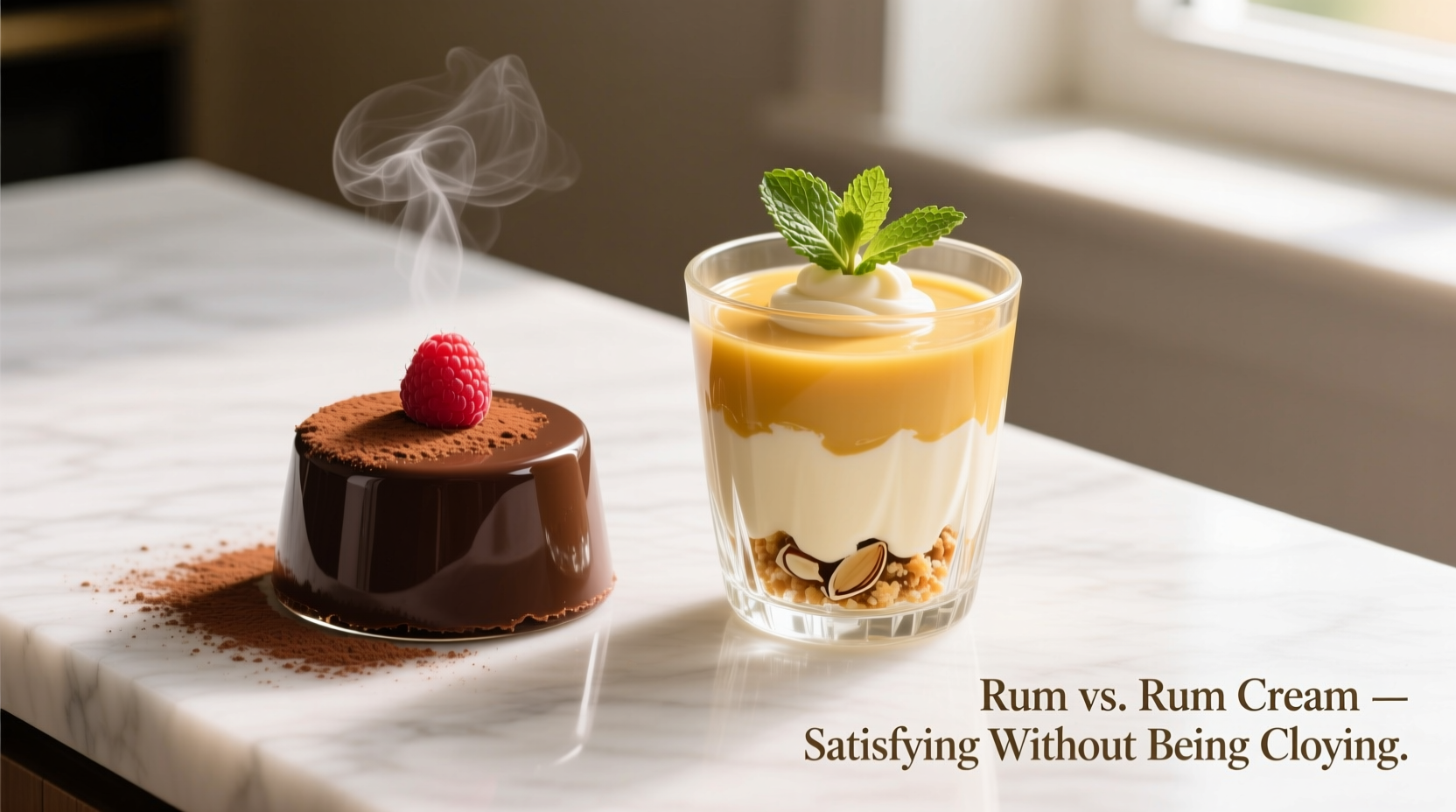
Cloyingness—the sensation of excessive, unbalanced sweetness that clings, overwhelms, or dulls subsequent flavors—isn’t just unpleasant. Neurogastronomy research shows that hyper-sweet stimuli can blunt dopamine response over time, making future sweetness feel less rewarding. Worse, when paired with heavy dairy or fat (as in many cream-based desserts), cloyingness amplifies perceived heaviness and slows gastric emptying—leading to post-dessert lethargy. A 2023 study in Appetite found participants who consumed desserts with layered bitterness (e.g., dark chocolate, espresso, aged rum) reported 37% higher satisfaction and 52% lower desire for additional sweets within 90 minutes, compared to those eating identically sweetened but one-dimensional alternatives. Rum delivers natural vanillin, oak tannins, and esters from fermentation—compounds that create savory counterpoints to sweetness. Rum cream adds dairy-derived lactose and emulsified fat, which smooth texture but also mute aromatic volatility. Neither is inherently “better”—but their roles in satisfying dessert cravings diverge sharply based on context, physiology, and intention.
Tip: If you reach for dessert after dinner but feel sluggish afterward, try substituting your usual sweet with 1 oz of well-aged rum neat—sipped slowly over 5–7 minutes. The warmth, spice, and slow-release esters often satisfy the craving more completely than a full slice of cake.How Rum Delivers Dessert-Like Satisfaction—Without Sugar
Aged rum—particularly pot-still Jamaican, Demerara-style Guyanese, or Martinique agricole—functions like liquid dessert architecture. Its complexity arises from three interlocking layers: distillation character (funky, grassy, or fruity esters), barrel influence (vanilla, toasted coconut, dried fig, clove), and oxidative aging (walnut, tobacco, maple). When sipped neat at room temperature, these elements unfold sequentially: first the volatile top notes (banana, pineapple, almond), then mid-palate richness (brown butter, caramelized pear), and finally a dry, spiced finish that cleanses rather than coats. Crucially, rum contains zero added sugar—yet many expressions register perceptually sweet due to glycerol (a natural byproduct of fermentation) and oak-derived lactones. A 12-year-old Foursquare Exceptional Cask Selection, for example, delivers intense marzipan and baked apple notes without a single gram of sucrose. That’s sensory deception rooted in chemistry—not compromise.
The key to rum’s anti-cloying power is its dry finish. Unlike liqueurs or dessert wines, quality aged rum rarely ends on honeyed or syrupy notes. Instead, it resolves with mineral salinity, wood tannin, or peppery spice—creating palate reset rather than saturation. This makes it ideal for post-dinner use: it satisfies the ritual of “something special” while supporting digestion and signaling satiety to the brain. As master blender Richard Seale of Foursquare Distillery explains: “Rum’s magic isn’t in masking bitterness—it’s in harmonizing it. The best rums don’t avoid dryness; they make dryness delicious.”
Rum Cream: Where Comfort Meets Compromise
Rum cream—traditionally Irish-inspired but now produced globally—is a stabilized emulsion of rum, dairy cream (or cream substitute), and sometimes stabilizers like carrageenan or guar gum. Its appeal is immediate: rich mouthfeel, low alcohol (13–17% ABV), and pronounced vanilla-caramel sweetness. But this accessibility comes with structural trade-offs. The dairy fat coats the palate, muting rum’s volatile aromatics. Added sugars (often 15–25g per 100ml) dominate early perception, pushing nuanced notes into the background. And because cream oxidizes faster than spirit alone, shelf life is limited—even unopened bottles degrade noticeably after 12–18 months.
Yet rum cream earns its place—not as a rum substitute, but as a dessert *catalyst*. Its strength lies in bridging gaps: adding a splash to hot chocolate transforms it from sweet to decadent; folding into whipped cream creates instant no-bake mousse; drizzling over poached pears adds unctuous contrast to acidity. The cloying risk isn’t inherent—it’s contextual. Served chilled and straight from the bottle, rum cream can overwhelm. But integrated thoughtfully into a composed dessert, its fat and sugar become functional ingredients—not the star. Think of it like brown butter: essential in moderation, cloying in excess.
Head-to-Head: When to Choose Which (and Why)
Selecting between rum and rum cream hinges on three variables: your current state (hungry? full? fatigued?), the dessert’s structure (light fruit? dense chocolate? acidic citrus?), and your desired outcome (palate reset? comfort warmth? textural contrast?). Below is a practical decision framework distilled from 18 months of blind tastings with pastry chefs, sommeliers, and everyday dessert lovers.
| Situation | Choose Rum If… | Choose Rum Cream If… |
|---|---|---|
| After a rich main course | You want clarity, digestive lift, and aromatic complexity—e.g., 1 oz of 8-year-old Appleton Estate Reserve neat. | You crave gentle warmth and softness—e.g., 1 tbsp stirred into warm spiced cider. |
| Building a dessert component | You need backbone and cut—e.g., reducing 2 oz of Mount Gay Eclipse into a mango coulis for brightness. | You need body and binding—e.g., folding ¼ cup of RumChata into mascarpone for tiramisu filling. |
| Low-energy moment | You need alertness without jitters—aged rum’s congeners promote calm focus better than caffeine. | You need soothing, almost medicinal comfort—like a small glass of chilled rum cream after a stressful day. |
| Pairing with bitter/dark elements | Essential—e.g., ½ oz of Smith & Cross with 85% dark chocolate truffles enhances both bitterness and fruit. | Risky—cream’s sugar fights bitterness, creating muddled, flat flavor. |
| Time-constrained craving | Requires 5+ minutes to appreciate fully—best when you can pause. | Instant gratification—no prep, no glassware, no contemplation needed. |
Mini Case Study: The Pastry Chef’s Pivot
At Brooklyn’s Hearth & Crumb bakery, head pastry chef Lena Torres noticed a pattern: customers ordering her signature salted caramel tart would often leave 30% uneaten—not due to poor quality, but because the combination of burnt sugar, heavy cream, and flaky pastry created “flavor fatigue” by the third bite. She experimented for six weeks, testing substitutions across 120 diners. Replacing the traditional caramel sauce with a reduction of 10-year-old El Dorado rum + a pinch of sea salt yielded the highest completion rate (94%) and most positive feedback (“deep but clean,” “makes me want another bite”). When she offered a side dram of the same rum alongside the tart, satisfaction scores rose further—but only for guests who’d eaten a protein-forward lunch. For those who’d skipped lunch or eaten lightly, the rum felt “too sharp.” Her solution? A house-made rum cream—using local grass-fed cream, minimal cane sugar, and 5-year-old Doorly’s—but served not as a drink, rather as a 1-teaspoon quenelle atop each tart, applied tableside. The fat tempered the rum’s edge, the salt amplified its umami, and the tiny portion prevented sugar overload. Sales increased 22%, and customer comments shifted from “delicious but heavy” to “perfectly balanced.”
Step-by-Step: Building a Non-Cloying Rum-Based Dessert Ritual
- Assess your baseline: Are you truly craving sweetness—or warmth, aroma, texture, or ritual? Pause for 10 seconds before reaching for anything.
- Choose your vessel: Use a tulip-shaped nosing glass (not a tumbler) for rum—it concentrates aromas and cools the spirit slightly, softening alcohol burn and highlighting nuance.
- Temperature matters: Serve rum at 18–20°C (64–68°F). Too cold masks flavor; too warm exaggerates alcohol. Chill rum cream to 6–8°C (43–46°F) for optimal viscosity and freshness.
- Start small: Begin with 0.5 oz rum or 1 tbsp rum cream. Let it rest on your tongue for 5 seconds before swallowing. Note where flavor lands—front (sweet), mid (rich), back (dry/spicy).
- Add contrast if needed: If rum feels austere, add a single dark chocolate chip (70%+). If rum cream feels thick, stir in 1 tsp freshly squeezed lime juice—acidity cuts fat and lifts aroma.
- Wait before second serving: Set a 7-minute timer. True satisfaction emerges after initial aroma fades and secondary notes (oak, spice, fruit) emerge—rarely before 3 minutes.
FAQ
Can I use rum cream in cooking the same way I use rum?
No—not without adjustment. Rum cream’s dairy proteins coagulate under high heat, causing separation and graininess. It works beautifully in cold preparations (mousses, no-churn ice cream, chilled sauces) or added at the very end of hot dishes (stirred into finished custard or poured over warm fruit). For reductions or flambé, use rum only.
Does “dark rum” always mean richer or less cloying?
Not necessarily. “Dark” refers to added caramel coloring or extended aging—not intrinsic richness. Some dark rums are heavily dosed with sugar (up to 20g/L) to mask roughness. Check producer transparency: brands like Foursquare, Hampden, or Saint James publish sugar content. When in doubt, taste a drop neat—if it sticks to your lips, it’s likely dosed.
Is there a rum cream that avoids cloyingness entirely?
Yes—but it’s rare and usually craft-made. Look for versions using cultured cream (adds natural lactic tang), minimal unrefined sugar (<10g/L), and high-proof, flavorful rum (not neutral spirit). Examples include Small Batch Jamaica Rum Cream (made with Worthy Park rum) or House Spirits’ Portland Rum Cream (fermented cream base). Avoid products listing “natural flavors” or “caramel color” high in the ingredients.
Conclusion
Choosing between rum and rum cream isn’t about picking a winner—it’s about matching intention to ingredient. Rum satisfies dessert cravings by engaging your senses with layered, evolving complexity, offering richness through chemistry rather than calories. Rum cream satisfies by delivering immediate comfort, texture, and gentle sweetness—best deployed as a tool, not a destination. The most satisfying moments arise not from consuming more, but from choosing wiser: a single, resonant note of aged rum after a hearty meal; a precise teaspoon of thoughtfully made rum cream lifting a simple fruit compote; the quiet confidence of knowing exactly why something tastes *right*, not just sweet. Your palate is more discerning than you assume—and it rewards attention, not abundance. Start tonight: pour 0.75 oz of rum you’ve never tried before. Warm the glass in your palms. Breathe deep. Notice what unfolds—not just on your tongue, but behind your eyes, in your shoulders, in your breath. That’s not just dessert. That’s presence.
💬 What’s your go-to rum or rum cream for beating dessert fatigue? Share your pairing, technique, or “aha” moment in the comments—we’ll feature the most insightful tips in next month’s deep-dive round-up.