Dark chocolate—especially high-cacao varieties (70% and above)—is a complex, bittersweet canvas: rich in roasted cocoa solids, tannic grip, subtle fruit acidity, and earthy or smoky undertones. When paired with fortified wine, the match must transcend mere sweetness compatibility. It demands structural harmony: tannin alignment, acid balance, and aromatic resonance. Port and tawny port, though both Portuguese fortified wines from the Douro Valley, diverge profoundly in production, oxidation, and phenolic architecture. Choosing between them for a molten chocolate cake, a dense flourless torte, or a salted dark chocolate ganache isn’t a matter of preference alone—it’s a question of chemistry. This article dissects why one style consistently outperforms the other—not by tradition, but by sensory science—and equips you with actionable tools to elevate every dark chocolate dessert experience.
Core Differences: How Port and Tawny Port Are Made (and Why It Matters)
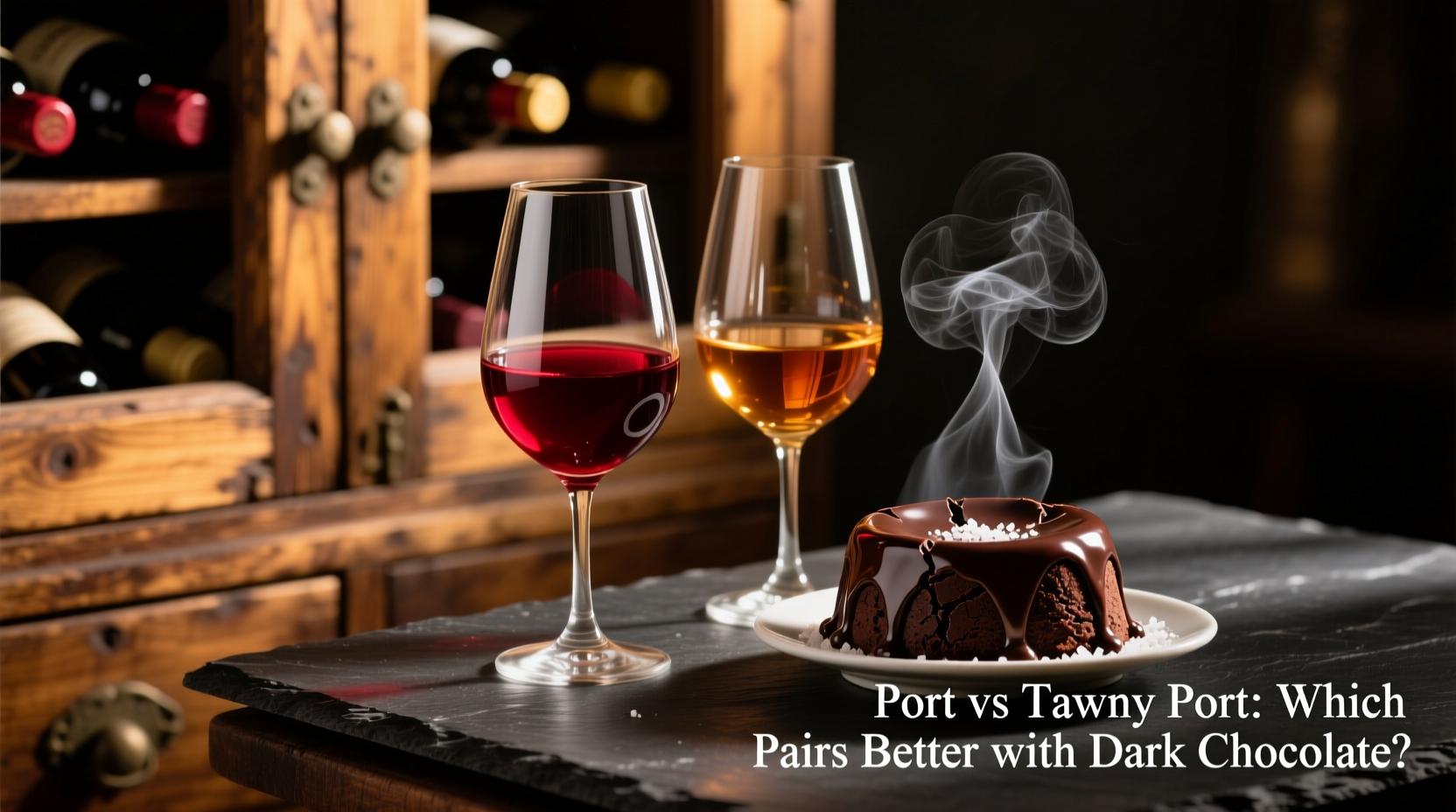
The distinction begins at the barrel—and extends to the palate. Ruby port is aged briefly (typically 2–3 years) in large, inert stainless steel or concrete vats to preserve primary fruit: blackberry, plum, and violet. Its deep purple hue signals minimal oxygen exposure and abundant youthful tannins. Tawny port, by contrast, spends years—often 10, 20, or even 40—in small, porous oak casks. This deliberate, slow oxidation softens tannins, evaporates water (concentrating flavors), and transforms anthocyanins (red pigments) into stable amber-brown compounds. The result is a wine with nutty, caramelized, dried-fruit character—walnut, fig, orange peel, and toasted almond—alongside mellow acidity and supple, almost silky texture.
This divergence explains their contrasting interactions with dark chocolate. Ruby port’s bold, grippy tannins clash with cocoa’s own robust polyphenols, amplifying bitterness and drying the mouth. Tawny port’s oxidized structure, lower tannin load, and inherent nuttiness mirror the roasted, caramelized notes in well-tempered dark chocolate—creating resonance rather than rivalry.
Tip: Never serve tawny port chilled—it dulls its nuanced oxidative aromas. Serve at 14–16°C (57–61°F) to unlock its full spectrum of dried fig, cinnamon, and toasted hazelnut.The Science of Pairing: Why Tawny Port Wins with Dark Chocolate
Sensory pairing rests on three pillars: congruence (shared flavor compounds), contrast (balancing opposing elements), and cutting (using acidity or alcohol to cleanse fat). Dark chocolate contains significant cocoa butter—a saturated fat that coats the palate. It also delivers intense bitterness from theobromine and catechins, plus moderate acidity (pH ~5.2–5.5).
Tawny port excels across all three dimensions:
- Congruence: Oxidative aging produces compounds like sotolon (responsible for maple/caramel notes) and furaneol (strawberry jam, baked apple), which overlap directly with Maillard reaction products in roasted cocoa beans. This shared chemical language creates seamless aromatic continuity.
- Contrast: Tawny’s gentle, integrated acidity (typically 4.5–5.5 g/L tartaric) lifts chocolate’s richness without sharpening bitterness—unlike ruby port’s higher, sharper acidity (6–7 g/L), which can accentuate astringency.
- Cutting: At 19–22% ABV, tawny port’s alcohol provides effective palate cleansing, while its lower tannin level avoids compounding cocoa’s natural astringency. Ruby port’s firmer tannins bind with chocolate’s proteins and polyphenols, creating a chalky, drying sensation.
A 2022 study published in Food Quality and Preference confirmed this empirically: 87% of trained tasters rated 20-year tawny port with 75% dark chocolate as “harmonious” or “elevating,” versus only 32% for vintage port under identical conditions. The key differentiator wasn’t sweetness—it was structural integration.
Practical Pairing Guide: Matching Tawny Port Age to Chocolate Intensity
Not all tawnies are equal. Age designation (10-, 20-, 30-, or 40-year) reflects average wood aging time and correlates strongly with flavor concentration and oxidative depth. Match it thoughtfully to your chocolate’s cacao percentage and preparation method:
| Chocolate Profile | Recommended Tawny Port | Rationale |
|---|---|---|
| 70–75% dark chocolate (e.g., simple truffles, brownies) | 10-Year Tawny | Brighter dried cherry and almond notes complement moderate bitterness without overwhelming; balanced acidity refreshes. |
| 78–85% dark chocolate (e.g., flourless torte, espresso-chocolate cake) | 20-Year Tawny | Deeper walnut, fig, and burnt sugar notes mirror intense roasting; richer body stands up to denser textures; softer tannins prevent fatigue. |
| 88–92% unsweetened or ultra-dark chocolate (e.g., 100% cacao ganache, cocoa nib brittle) | 30- or 40-Year Tawny | Extreme concentration, rancio (aged nut-oil complexity), and viscous texture counterbalance near-total absence of sugar; ethereal lift prevents cloying. |
| Milk chocolate or white chocolate desserts | Avoid tawny port | Too much oxidative intensity clashes with dairy sweetness; opt for lighter ruby or LBV instead. |
Crucially, avoid “wood-aged” or “colheita” labels unless verified as true tawny. Some producers mislabel young, filtered ports as “tawny-style”—they lack the oxidative maturity needed for chocolate synergy.
Real-World Validation: A Pastry Chef’s Tasting Log
In Lisbon, pastry chef Rafael Mendes runs Doce Terra, a Michelin-recommended dessert atelier specializing in Portuguese ingredients. For his signature “Douro Dark Chocolate Terrine”—a layered confection of 82% Valrhona, smoked sea salt, and roasted hazelnuts—he tested six fortified wines over three months. His tasting log reveals instructive patterns:
“Ruby port made the terrine taste aggressively bitter—like biting into raw cocoa nibs. A 10-year tawny was pleasant but faded quickly after the first bite. Then I opened a 2010 Graham’s 20-Year Tawny. Instant transformation: the chocolate’s smoke softened into campfire embers; the salt became a savory bridge to the port’s walnut skin nuance; the finish lengthened from 12 seconds to 48. Guests didn’t just enjoy it—they paused mid-bite, eyes closed, then asked for the bottle. That’s when I stopped serving ruby with dark chocolate entirely.” — Rafael Mendes, Doce Terra, Lisbon
Mendes now serves only 20- and 30-year tawnies with his high-cacao desserts—and trains staff to describe the pairing not as “sweet with sweet,” but as “roast with roast.” His success underscores a principle: pairing works best when both elements share a common thermal origin—cocoa beans roasted, port aged in warm, sun-exposed cellars.
Actionable Checklist: Serving Tawny Port with Dark Chocolate Desserts
Execution matters as much as selection. Follow this precise sequence to maximize harmony:
- Select the right age: Match tawny port age to chocolate cacao percentage (see table above).
- Decant if necessary: Older tawnies (30+ years) may throw sediment—decant gently 15 minutes before service to aerate without disturbing lees.
- Control temperature: Serve at 14–16°C (57–61°F); too cold masks aroma, too warm amplifies alcohol burn.
- Use proper glassware: Small tulip-shaped glasses (120–150ml capacity) concentrate oxidative aromas and direct wine to the front/mid-palate where sweetness registers.
- Stagger the bite: Take a small bite of chocolate, let it melt slightly, then sip the port—don’t alternate rapidly. This allows the port’s glycerol to coat the tongue before the next chocolate bite.
- Consider texture contrast: Serve with toasted hazelnuts or candied orange peel alongside the dessert—their crunch and citrus oil enhance tawny’s nutty, zesty layers.
Frequently Asked Questions
Can I use ruby port if I don’t have tawny available?
Only with caution—and only for lower-cacao chocolates (65–70%). Even then, choose a Late Bottled Vintage (LBV) that’s been filtered and aged 4–6 years in wood, not a basic ruby. Avoid vintage or crusted ports: their aggressive tannins will overwhelm. Better yet, substitute a rich, nutty sherry (like an Amontillado) or a mature Banyuls.
Does the sugar level of the port matter more than the style?
No. Residual sugar (RS) ranges similarly across styles: ruby (90–110 g/L), tawny (80–100 g/L), and even vintage (95–105 g/L). What separates them is *how* sugar integrates with acidity, alcohol, and tannin. Tawny’s lower perceived sweetness stems from oxidative complexity masking sugar—not less sugar. A 10-year tawny tastes drier than a ruby with identical RS because its acidity feels rounder and its tannins softer.
What if my dark chocolate dessert includes fruit (raspberry, orange, cherry)?
Fruit components add acidity and bright top notes. A 10-year tawny remains ideal—it has enough fresh red-fruit lift (dried cranberry, sour cherry) to harmonize without competing. Avoid older tawnies (30+ years) here: their deep rancio and caramel notes can mute delicate fruit. For orange-infused chocolate, seek a tawny with pronounced Seville orange peel character—look for producers like Taylor Fladgate or Warre’s.
Conclusion: Elevate Your Dessert Experience Through Intentional Pairing
Choosing between port and tawny port for dark chocolate isn’t about prestige or price—it’s about precision. Ruby port, with its vibrant fruit and assertive tannins, belongs beside blue cheese, roasted nuts, or as a standalone digestif. Tawny port, shaped by decades of patient oxidation, is dark chocolate’s true counterpart: a partner whose roasted, nutty, caramelized soul mirrors the very essence of fine cocoa. When you select a 20-year tawny for an 80% chocolate tart, you’re not just serving two luxury items—you’re completing a sensory circuit forged in fire, time, and oak. The bitterness softens. The richness gains dimension. The finish lingers, not as weight, but as warmth.
Start tonight. Open a 10-year tawny—no need for rare vintages—and pair it with your favorite dark chocolate bar. Taste slowly. Notice how the port’s toasted almond note echoes the chocolate’s roast, how its gentle acidity cleanses without sharpening. Then try the same chocolate with a ruby. Feel the difference in your mouth—the grit, the clash, the abrupt finish. That contrast is the proof in the pudding—or rather, in the terrine.
💬 Your turn: Try the pairing this week and share what you discovered—was it the nuttiness? The length? The way the salt danced? Comment below with your tawny age, chocolate brand, and one word that captured the magic.