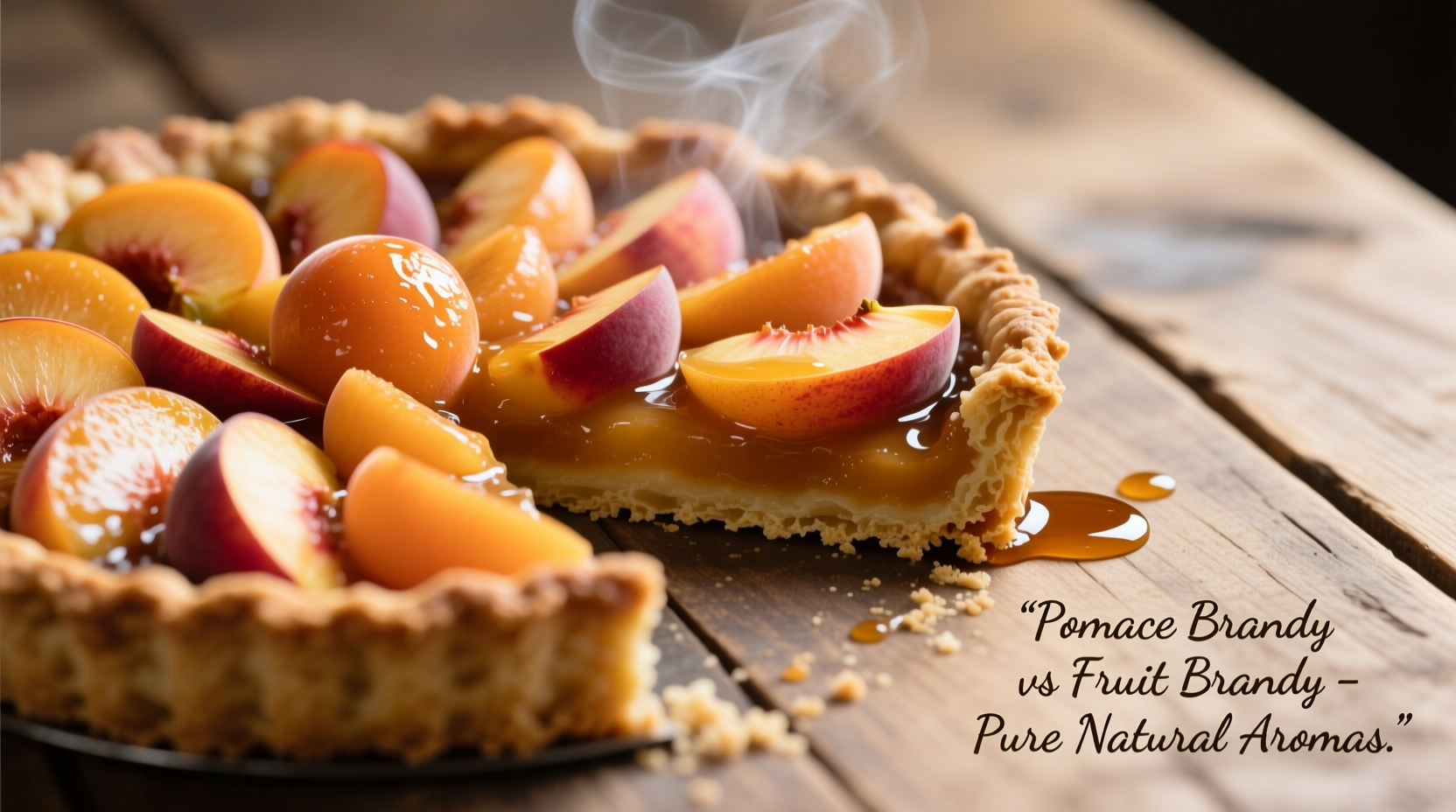
Stone fruit tarts—apricot, plum, nectarine, and sour cherry—rely on aromatic integrity. Not sweetness alone, not texture alone, but the unmistakable, sun-warmed scent of ripe fruit, lifted and deepened just enough to resonate on the palate without tipping into cloying or synthetic territory. Many bakers reach instinctively for brandy when building flavor depth in fruit fillings, glazes, or frangipane. But not all brandies behave the same way in pastry. Pomace brandy (eau-de-vie de marc) and fruit brandy (eau-de-vie de fruit) originate from distinct raw materials, distillation philosophies, and aromatic profiles—and their impact on stone fruit tarts is neither interchangeable nor subtle. This isn’t about preference; it’s about precision. A 5g addition of one can amplify the violet-honey top note of a Simca apricot, while the same dose of the other may mute its delicate aldehyde lift and introduce distracting fermented undertones. Understanding this distinction transforms brandy from a generic “boozy accent” into a deliberate aromatic catalyst.
Why Aroma Integrity Matters More Than Alcohol Content
Alcohol itself plays only a minor role in aroma enhancement. What matters far more is the volatile compound matrix carried by the spirit: esters, terpenes, lactones, and norisoprenoids—many of which are native to the original fruit or its skins, seeds, and stems. Stone fruits contain high concentrations of gamma-decalactone (peachy, creamy), beta-damascenone (honeyed, stewed plum), and linalool (floral, citrusy). These compounds are highly soluble in ethanol—but they’re also thermally fragile. During tart baking, volatile top notes evaporate first. A well-chosen brandy doesn’t just add its own bouquet; it acts as a molecular carrier and thermal stabilizer, helping retain and gently volatilize the fruit’s native aromatics during the critical 15–25 minute bake window.
This is where origin becomes decisive. Fruit brandy is distilled directly from fermented whole fruit pulp—think Mirabelle plums, Williams pears, or quinces. Its profile is fruit-forward, often lush and rounded, with pronounced ester character (ethyl hexanoate, ethyl octanoate) that harmonizes readily with stone fruit’s lactonic core. Pomace brandy, by contrast, is distilled from the solid remains of winemaking—the skins, seeds, and stems left after pressing grapes. It carries phenolic complexity, green tannins, and oxidative notes (vanillin, eugenol, cis-rose oxide) that interact differently with stone fruit chemistry—sometimes enhancing depth, sometimes competing.
Tip: Never add brandy to hot fruit compote straight from the stove. Cool filling to below 40°C before stirring in spirit—this preserves volatile top notes and prevents alcohol-driven evaporation of delicate esters.Chemical Behavior in Tart Applications: A Side-by-Side Analysis
The difference between pomace and fruit brandy reveals itself most clearly in three functional contexts: maceration, frangipane enrichment, and post-bake glaze infusion. Each demands different aromatic synergy.
| Application | Fruit Brandy (e.g., Poire William) | Pomace Brandy (e.g., Marc de Bourgogne) |
|---|---|---|
| Maceration (raw fruit + sugar + spirit, 2–4 hrs pre-bake) | Softens cell walls gently; releases juice without oxidation; enhances floral-lactonic lift. Apricots develop brighter osmanthus nuance; plums gain candied violet depth. | Extracts more polyphenols; can cause slight browning and tannic grip. Works well with tart cherries or underripe plums—but risks dulling honeyed top notes in ripe apricots. |
| Frangipane enrichment (almond cream base) | Blends seamlessly; adds roundness without masking marzipan. Nectarine tarts gain a subtle almond-blossom resonance. | Introduces peppery, woody notes that can clash with delicate frangipane. Best reserved for rustic, spiced versions (e.g., plum-tarragon-frangipane). |
| Post-bake glaze (brandy + apricot jam, brushed warm) | Preserves volatile fruit esters in the glaze; creates seamless aromatic continuity from crust to filling. | Can dominate glaze with earthy, leathery tones—best used sparingly (≤1% v/v) or paired with blackberry reduction to anchor its phenolics. |
A Real-World Baking Test: The Alberi Orchard Apricot Tart
In spring 2023, pastry chef Luca Moretti conducted a controlled test at his Turin-based atelier using identical batches of Alberi orchard apricots (known for high gamma-decalactone and low acidity). Three tarts were prepared side-by-side: one with 10g Poire William (fruit brandy), one with 10g Marc de Bourgogne (pomace), and one control with no spirit. All were baked identically in a convection oven at 180°C for 22 minutes, then glazed with warmed apricot jam.
Sensory evaluation by six professional tasters revealed stark differences. The fruit brandy tart scored highest for “aromatic coherence”: descriptors included “sun-warmed apricot skin,” “honeyed blossom,” and “clean stone-fruit finish.” The pomace version showed greater perceived “depth” but lower “freshness”—tasters noted “dried fig,” “cedar,” and “bitter almond” notes that, while pleasant, diverged from the fruit’s inherent profile. The control lacked lift entirely—described as “flat” and “slightly stewed.” Crucially, when tasters were blindfolded and asked to identify the dominant fruit note, 83% correctly named “apricot” for the fruit brandy version—but only 42% did so for the pomace version, with many citing “plum” or “quince” instead.
Moretti concluded: “Fruit brandy doesn’t mask—it mirrors and magnifies. Pomace brandy interprets. For tarts where authenticity is paramount, interpretation is a risk. But for layered, savory-sweet compositions, it’s a tool.” His current apricot tart uses Poire William in maceration and a whisper of aged marc (2g per tart) folded into the crumb topping—leveraging both spirits’ strengths without conflict.
Step-by-Step: Optimizing Brandy Integration for Maximum Aromatic Lift
- Select fruit at peak ripeness — Underripe stone fruit lacks sufficient esters; overripe fruit has degraded volatiles. Look for slight give at the stem end and intense varietal fragrance.
- Macinate 2–3 hours pre-bake — Combine sliced fruit, 5–7% weight sugar, and fruit brandy (0.8–1.2% of fruit weight). Refrigerate uncovered to allow slow enzymatic release.
- Drain—not squeeze—before filling — Excess liquid dilutes flavor and weakens crust. Reserve syrup for glaze.
- Enrich frangipane last — Fold brandy into cooled frangipane (not hot) to preserve volatile compounds. Use fruit brandy at 0.5% of frangipane weight.
- Glaze within 3 minutes of removal from oven — Warm surface allows immediate absorption. Mix reserved syrup with 1 tsp fruit brandy per 100g jam; brush evenly.
Expert Insight: The Science of Volatile Synergy
“Esters in fruit brandy—like ethyl butyrate and isoamyl acetate—share structural affinity with stone fruit lactones. They co-volatilize, lowering the effective boiling point of key aroma compounds and extending their perception window. Pomace brandy’s higher phenolic load disrupts this synergy, increasing binding to fruit proteins and reducing headspace volatility. That’s why it deepens but rarely brightens.”
— Dr. Anika Voss, Food Chemist & Sensory Lead, École Nationale Supérieure de Chimie de Paris
Do’s and Don’ts for Authentic Stone Fruit Expression
- Do source single-varietal fruit brandy made from the same species you’re baking (e.g., Mirabelle plum brandy for plum tarts).
- Do store brandy in cool, dark conditions—even unopened bottles degrade with UV exposure, losing top notes in 6–12 months.
- Don’t substitute grape-based pomace for fruit brandy in delicate tarts like white nectarine or early-season apricot.
- Don’t use brandy older than 5 years for aromatic lift—oxidation diminishes ester concentration and introduces stale, sherry-like notes.
- Do taste your brandy alongside raw fruit before committing. If the spirit’s aroma clashes (e.g., smoky marc against floral apricot), it will clash in the tart.
FAQ
Can I use Calvados (apple brandy) in a plum tart?
Yes—but with caution. Calvados contains high levels of ethyl decanoate and diacetyl, which add buttery, nutty notes that complement plum’s tannins but can overwhelm its floral top notes. Use at half the recommended dose (0.5% instead of 1%) and pair with a touch of star anise in the filling to bridge the profiles.
Is there a non-alcoholic alternative that mimics the aromatic lift?
Not truly. Alcohol’s solvent power for esters is unmatched. However, a 1:1 infusion of dried stone fruit kernels (apricot or peach) in neutral grape seed oil, gently warmed and strained, provides lactonic depth without alcohol. It won’t replicate volatility, but it adds authentic background richness.
Does aging the brandy in oak affect its suitability for tarts?
Unaged (blanche) fruit brandy is ideal for aromatic fidelity—oak adds vanillin and tannins that compete with stone fruit’s native compounds. Oak-aged pomace brandy gains structure but loses brightness; reserve it for dense, spiced applications like plum-cinnamon galettes—not delicate summer tarts.
Conclusion: Choose Your Catalyst With Intention
Brandy in stone fruit tarts is never merely “for flavor.” It is a precision instrument—one that either amplifies nature’s design or reinterprets it. Pomace brandy offers depth, structure, and rustic complexity. Fruit brandy offers fidelity, lift, and aromatic truth. Neither is superior; each serves a distinct expressive purpose. When your goal is to intensify natural aromas without artificial notes—to let the sun-ripened essence of the fruit resonate with clarity and grace—fruit brandy is the unequivocal choice. Its ester-rich, unadulterated profile works in concert with the fruit’s own volatile chemistry, not against it. Pomace brandy, meanwhile, finds its rightful place in compositions where contrast is desired: when you want the earthiness of plum skins to echo the woodsmoke of a hearth-baked tart, or when the bitter almond note of cherry pits should be echoed, not erased.
Baking is an act of listening—to the fruit, to the season, to the subtle language of aroma. The next time you reach for a bottle before filling your tart pan, pause. Smell it beside the fruit. Consider what you wish to emphasize: the fruit’s voice, or your own interpretation. Then choose—not habitually, but intentionally. Your tarts will speak with greater authenticity, and your guests will taste the difference in every nuanced, unforced note.
💬 Have you discovered a surprising brandy pairing in stone fruit tarts? Share your experience—including variety, brandy type, and observed effect—in the comments. Let’s build a living reference for aromatic precision in pastry.