Moonshine and vodka occupy overlapping space in popular imagination: clear, potent, unaged spirits that burn cleanly and mix easily. But equating them is like calling a hand-forged hunting knife the same as a mass-produced kitchen paring tool—superficially similar in function, yet worlds apart in intention, craftsmanship, legality, and consequence. Understanding the distinction isn’t just about terminology; it’s about safety, heritage, regulation, and respect for distillation as both craft and science. This article cuts through myth and marketing to clarify how moonshine and vodka diverge—not just historically or legally, but chemically, culturally, and practically.
Origins and Historical Context: Rebellion vs Refinement
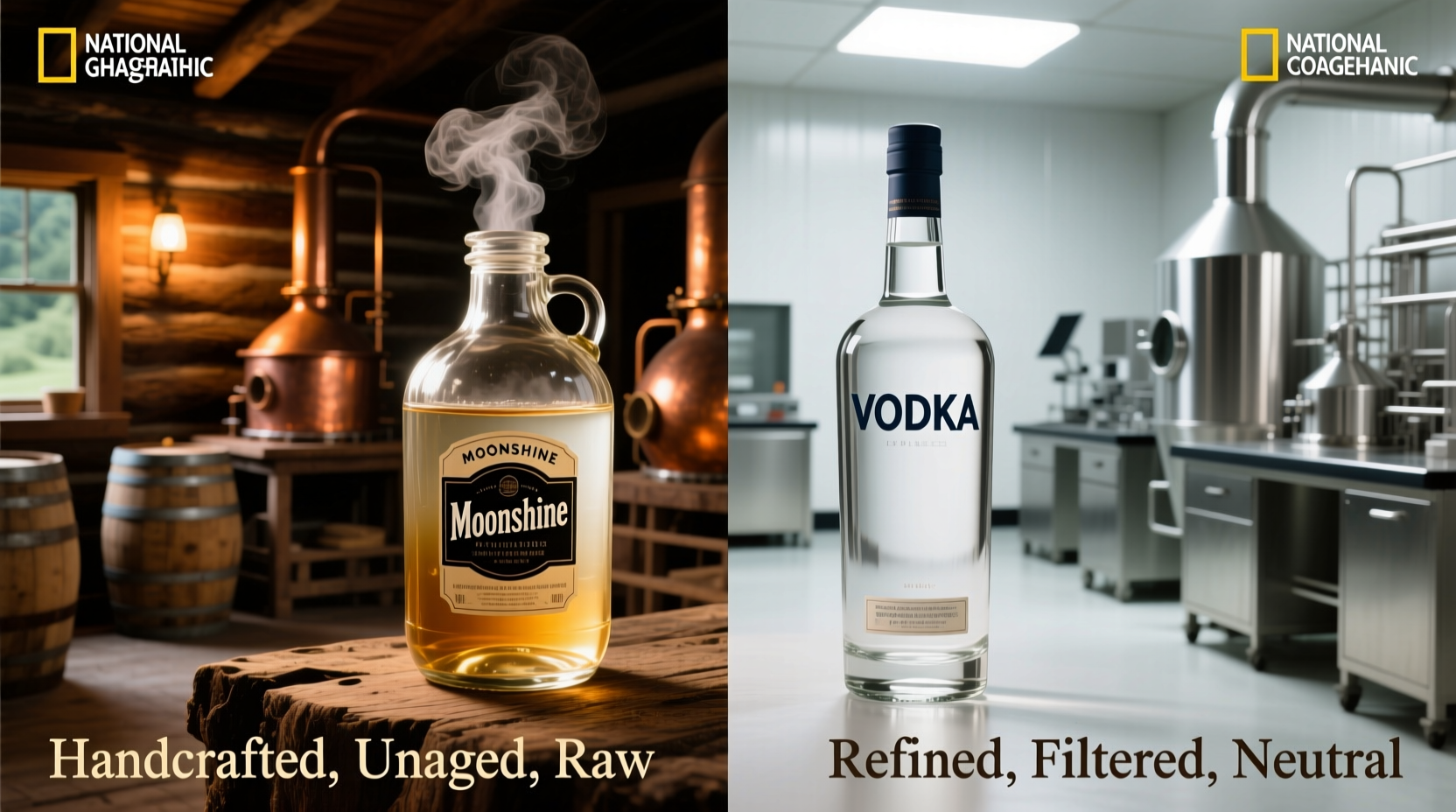
Vodka’s roots trace to medieval Eastern Europe—likely 9th-century Poland or 10th-century Russia—where early distillers refined fermented grain or potato mashes into increasingly pure, neutral spirits. By the 14th century, Polish apothecaries were producing “gorzałka” (burning water), and by the 18th century, Russian state-controlled distilleries standardized production, emphasizing filtration and dilution to achieve consistency. Vodka evolved not as contraband, but as a regulated national beverage—its name derived from the Slavic word *voda*, meaning “water,” underscoring its intended neutrality and purity.
Moonshine, by contrast, emerged from necessity and resistance. In 18th-century Britain, “moonshine” referred to anything done by the light of the moon—clandestine, secretive. In post-Revolutionary America, federal excise taxes on distilled spirits sparked the Whiskey Rebellion of 1791. Appalachian and Southern farmers, reliant on turning surplus corn into portable, high-value value-added goods, refused to pay tax—and began distilling at night, under cover of darkness, hence “moonshine.” Its identity was inseparable from evasion: no government oversight, no quality control, no labeling, no accountability.
This foundational divergence persists today: vodka is defined by institutional standardization; moonshine, even when legal, carries the DNA of autonomy—and sometimes, hazard.
Legal Definitions and Regulatory Frameworks
Under U.S. federal law (TTB regulations), vodka must be distilled to at least 190 proof (95% ABV), then diluted to bottling strength (typically 40–50% ABV). It must be “without distinctive character, aroma, taste, or color”—a definition enforced through mandatory lab testing, ingredient disclosure, and facility licensing. Every commercial vodka brand undergoes batch certification, heavy metal screening, and congeners analysis before release.
Moonshine, however, has no legal definition in U.S. statute. What’s sold as “moonshine” in liquor stores falls into two categories: (1) legal craft spirits labeled as “unaged corn whiskey” (per TTB standards), and (2) illicit product—distilled without permits, tax payment, or safety oversight. The former must meet all requirements for American whiskey: made from ≥80% corn, aged in new, uncharred or used oak barrels (though many skip aging entirely), and bottled at ≥40% ABV. Crucially, it cannot be labeled “moonshine” unless qualified—e.g., “Georgia Moon Corn Whiskey”—to avoid consumer confusion with unregulated product.
The regulatory chasm is stark: vodka’s purity is mandated and verified; moonshine’s authenticity is often marketed as *lack* of regulation—a selling point that carries real risk.
Tip: If a bottle labeled “moonshine” lists no distillery address, batch number, or government health warning, treat it as potentially unsafe—regardless of packaging aesthetics.Production Methods: Precision Filtration vs Raw Distillation
Vodka production prioritizes removal. After initial distillation (often column stills achieving 95%+ ABV), most vodkas undergo multiple rounds of charcoal or quartz filtration to strip fusel oils, esters, and sulfur compounds. Brands like Grey Goose use triple distillation and limestone-filtered spring water; Belvedere employs rye distilled in copper pot stills, then filtered through activated charcoal and Baltic birch wood ash. The goal isn’t flavor—it’s molecular uniformity.
Traditional moonshine uses simple pot stills—often copper or stainless steel—with minimal reflux. Corn mash ferments for 3–7 days, then distills once or twice. The “heads” (volatile, toxic methanol and acetone) and “tails” (oily, off-flavor fusels) are cut manually by the distiller based on smell, temperature, and experience—not lab data. Without precise temperature control or hydrometers, dangerous fractions can slip into the final product. Illicit operators may even use car radiators as condensers—leaching lead and antifreeze into the spirit.
A 2022 FDA report documented 37 cases of methanol poisoning linked to illicit “fruit moonshine” sold at flea markets and social media pop-ups—symptoms included blurred vision, permanent blindness, and respiratory failure. Legal vodka? Zero documented methanol-related incidents in the past 40 years.
Chemical Composition and Safety Profile
All ethanol-based spirits contain congeners—byproducts of fermentation and distillation—including acetaldehyde, propanol, isobutanol, and methanol. Methanol is especially dangerous: metabolized to formaldehyde and formic acid, it causes metabolic acidosis and optic nerve damage. While trace methanol occurs naturally in all fermented beverages (wine contains ~0.1–0.2 g/hL), unsafe distillation concentrates it in the heads fraction.
Vodka’s regulatory ceiling for methanol is 100 mg/L. Reputable producers test every batch below 20 mg/L. Moonshine—especially illicit—has no such limits. A 2019 University of Kentucky study tested 12 seized illicit samples: methanol ranged from 420 to 2,800 mg/L. One sample contained 1,100 mg/L of ethyl carbamate—a known carcinogen formed when urea reacts with ethanol during improper storage.
That’s not theoretical risk. In 2013, over 100 people in the Czech Republic were hospitalized after drinking bootleg “spirit” laced with industrial-grade methanol; 45 died. Similar outbreaks occurred in India (2022, 99 deaths), Mexico (2023, 27 deaths), and South Africa (2024, 31 deaths)—all tied to unregulated, untested distillates mislabeled or misrepresented as safe alcohol.
“Distillation isn’t just heating liquid—it’s applied chemistry. Removing methanol requires precise temperature control and fractional separation. Skipping that step isn’t ‘old-school’—it’s playing Russian roulette with biochemistry.” — Dr. Lena Petrova, Food Toxicologist & Former FDA Alcohol Safety Lead
Flavor, Use, and Cultural Perception
Vodka’s neutrality makes it a functional canvas: it carries the character of mixers without competing. Its clean finish supports complex cocktails like the Martini or Bloody Mary, where balance hinges on spirit restraint. Premium vodkas do exhibit subtle differences—Belvedere’s creamy rye warmth, Chopin’s potato silkiness, Ketel One’s citrus-lifted grain—but these are refinements within strict parameters.
Legal craft moonshine, meanwhile, embraces expressive corn character: toasted cereal, green apple, wet stone, and peppery heat. It shines in simple serves—over ice with a lemon wedge, or in a “Corn Whiskey Sour” with lemon and demerara. Its appeal lies in terroir and transparency: single-batch, locally sourced corn, open-ferment tanks, copper pot stills visible through tasting-room windows.
Illicit moonshine, however, offers no such reliability. Flavor varies wildly—sometimes sweet and fruity, sometimes solvent-like or rubbery—depending on mash pH, yeast strain, still cleanliness, and cut accuracy. That unpredictability is part of its folklore (“It’ll put hair on your chest!”), but it’s also why bartenders and serious home mixologists avoid it in recipes requiring consistency.
| Attribute | Vodka | Legal Craft Moonshine | Illicit Moonshine |
|---|---|---|---|
| Regulatory Oversight | Federal TTB licensing, batch testing, labeling compliance | TTB-compliant as “unaged corn whiskey”; taxed and inspected | No oversight; illegal to produce, sell, or distribute |
| Methanol Limit | ≤100 mg/L (typically <20 mg/L) | Same as vodka (required for sale) | Unmeasured—often 5–20× legal limit |
| Typical Base | Grain, potato, molasses, whey, or even grapes | ≥80% corn (U.S. standard) | Variable: sugar wash, fruit scraps, spoiled grain, or unknown sources |
| Proof Range | 80–100 proof (40–50% ABV) | 80–125 proof (40–62.5% ABV); often bottled higher | 60–190 proof (30–95% ABV); frequently uncut and dangerously potent |
| Cultural Role | Global cocktail staple; symbol of modernity and precision | Regional pride; artisanal revival; heritage celebration | Risk-taking trope; poverty marker; public health threat |
Mini Case Study: The Tennessee Distillery That Changed the Narrative
In 2010, Ole Smoky Distillery opened in Gatlinburg, Tennessee—the first legal distillery in the Smokies since Prohibition. Founders Joe Baker and Andy Riffel didn’t market “moonshine” as rebellion. Instead, they partnered with local corn farmers, installed FDA-certified stills, and implemented third-party methanol and heavy-metal testing on every barrel. Their flagship “Tennessee Shine” is labeled “Unaged Corn Whiskey,” carries full batch traceability, and retails at $25–$35—comparable to mid-tier vodkas.
Within five years, Ole Smoky became the top-selling American whiskey brand by volume—not because it mimicked vodka, but because it honored tradition while demanding accountability. Their success spurred over 200 legal craft “corn whiskey” distilleries across Appalachia and the Midwest. Crucially, Tennessee saw a 73% decline in reported methanol poisonings between 2010 and 2023—correlating directly with licensed production replacing illicit operations.
This wasn’t nostalgia winning. It was safety, transparency, and quality becoming commercially viable—and culturally desirable.
Practical Checklist: How to Choose Safely and Authentically
- ✅ Check the label: Look for “Distilled and Bottled by [Name], [City], [State]” and a TTB DSP (Distilled Spirits Plant) number.
- ✅ Verify the base: “Corn whiskey” means ≥80% corn; “grain vodka” or “potato vodka” tells you the source.
- ✅ Scan for warnings: All legal U.S. spirits carry the Surgeon General’s alcohol warning. Its absence signals illegality.
- ❌ Avoid “homemade” or “small-batch” claims without verifiable distillery info—especially on social media or cash-only sales.
- ❌ Never consume spirits served from unlabeled jugs, mason jars, or repurposed bottles, regardless of who made it.
FAQ
Can moonshine be aged like whiskey?
Yes—but only if legally produced as corn whiskey. Federal law requires aging in oak to be labeled “whiskey.” Unaged corn whiskey is legally “moonshine” only in colloquial or marketing terms. Aging transforms harshness into vanilla, caramel, and spice notes—but adds cost and time, which is why most legal craft versions remain unaged.
Is vodka ever made from corn?
Absolutely. Over 60% of U.S. vodkas use non-GMO yellow dent corn as their base—same grain as traditional moonshine. The difference isn’t the ingredient; it’s the distillation rigor, filtration intensity, and regulatory verification. Tito’s Handmade Vodka, for example, is corn-based but distilled six times and filtered through charcoal—rendering it sensorially distinct from even the finest legal corn whiskey.
Why do some legal brands call it “moonshine” if it’s regulated?
Marketing. The TTB permits “moonshine” as a brand name if accompanied by accurate class/type designation—e.g., “Clyde May’s Alabama Style Moonshine (Unaged Corn Whiskey).” It leverages cultural resonance while remaining compliant. Consumers benefit from clarity; producers gain storytelling power—without compromising safety.
Conclusion
Moonshine and vodka are not synonyms. They represent two poles of the distilled spirits universe: one rooted in defiance and improvisation, the other in global standardization and scientific refinement. When legal and responsibly made, craft corn whiskey honors Appalachian ingenuity with modern safeguards. Vodka embodies centuries of cross-cultural distillation mastery—optimized for purity, versatility, and consistency. Confusing them risks more than poor cocktail balance; it blurs critical lines between heritage and hazard, authenticity and exploitation, freedom and negligence.
Next time you reach for a clear spirit, read the label—not just the name. Support distillers who publish batch data, list their still type, and disclose their grain source. Ask bartenders where their “moonshine” comes from—and whether it’s been independently tested for methanol. And if someone offers you a jar of “real deal” shine at a roadside stand? Smile, thank them, and walk away. True tradition doesn’t demand sacrifice of safety. It evolves—thoughtfully, transparently, and with respect for those who drink it.
💬 Your palate—and your health—deserve clarity. Share this guide with a friend who’s ever wondered, “Is this stuff actually safe?” Let’s replace myth with knowledge, one informed pour at a time.