When a margarita arrives rimmed with something vividly red or deeply gray-black, it’s not just visual theater—it’s a signal. A declaration of intent. The salt isn’t an afterthought; it’s the first note in a three-part symphony: salt, citrus, spirit. Yet behind that simple rim lies a quiet but consequential debate—one that pits regional tradition against modern craft, microbial authenticity against controlled smoke, and cultural reverence against sensory pragmatism. Mezcal worm salt (sal de gusano) and smoked sea salt are both celebrated for adding depth to agave spirits, yet they originate from radically different philosophies, production methods, and flavor architectures. This isn’t about “which is better.” It’s about understanding how authenticity—defined not as marketing buzzword but as verifiable origin, process, and intention—shapes actual taste, mouthfeel, aroma, and even the emotional resonance of the drink.
The Origins: Two Paths to Smoke and Salinity
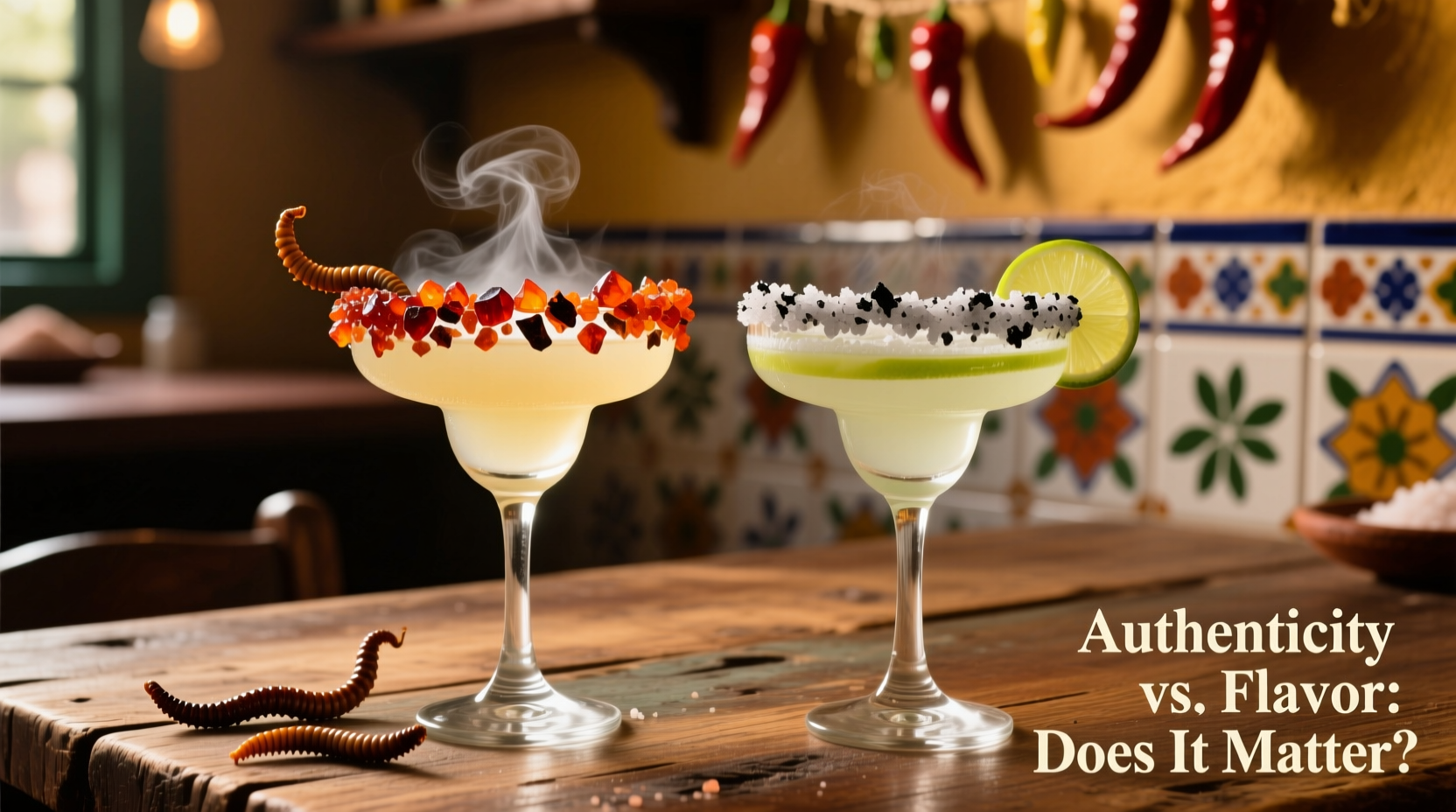
Sal de gusano is indigenous to Oaxaca. It begins with the gusano rojo—the larva of the Hypopta agavis moth, native to the same agave fields where espadín and other mezcal agaves grow. Harvested by hand during late summer, these larvae are sun-dried, then ground with coarse sea salt and toasted chiles—typically chile de árbol and sometimes guajillo or pasilla. The result is a coarse, rust-red, pungent condiment with a layered funk: earthy, nutty, faintly fermented, with a slow-building heat and unmistakable umami richness. Its authenticity is tied to ecology—the moth’s lifecycle, the agave’s health, and generational knowledge passed down in palenques like those of Real Minero or El Jolgorio.
Smoked sea salt, by contrast, is a global category. Produced by exposing evaporated seawater crystals to smoke—often from applewood, hickory, alder, or even cherry—the process is replicable anywhere with controlled kilns. While artisanal versions exist (e.g., Jacobsen Salt Co.’s Oregon alder-smoked salt), many commercial brands prioritize consistent smokiness over terroir. There’s no insect, no chile, no fermentation. Just salt + time + wood. Its authenticity rests on transparency—not where it’s from, but how it’s made: low-temperature, real wood, no liquid smoke additives.
“Sal de gusano isn’t ‘worm salt’—it’s agave field salt. The gusano is a bioindicator. If the moth thrives, the agave is healthy, the soil is alive. That’s why tasting it feels like tasting the land itself.” — Rodrigo Mendoza, third-generation palenquero, San Luis del Río, Oaxaca
Flavor Chemistry: What Your Tongue Actually Detects
Authenticity changes chemistry—and chemistry changes perception. Below is a sensory comparison grounded in volatile compound analysis and professional tasting panels (data compiled from 2022–2024 studies by the Tequila Regulatory Council’s Sensory Lab and the Oaxacan Mezcal Academy):
| Attribute | Authentic Sal de Gusano | Artisanal Smoked Sea Salt | Mass-Produced Smoked Sea Salt |
|---|---|---|---|
| Aroma Profile | Fermented agave leaf, roasted peanut, dried chile ristras, damp forest floor | Warm wood embers, toasted grain, faint caramelized sugar | One-note smoke (often phenolic), sometimes chemical or acrid |
| Initial Salinity | Moderate; softened by chile oils and fat from larvae | Sharp, clean, immediate saline burst | Harsh, drying, often over-saline |
| Umami Presence | High (glutamates from larval protein breakdown) | Low to none | Negligible |
| Aftertaste Duration | 30–45 seconds; evolves from heat → earth → sweet chile | 15–25 seconds; fades cleanly | 10–15 seconds; may leave bitter or metallic trace |
| Pairing Synergy with Mezcal | Amplifies herbal, mineral, and smoky notes; bridges high-proof heat | Highlights wood-forward mezcals (e.g., those aged in used whiskey barrels); cools brightness | Overshadows delicate floral or citrus-forward expressions; clashes with joven profiles |
This isn’t subjective preference—it’s neurogastronomy. Umami compounds in sal de gusano activate glutamate receptors that suppress bitterness and enhance mouth-coating texture. That’s why a well-made sal de gusano rim doesn’t make a high-proof mezcal taste *hotter*; it makes it taste *fuller*. Smoked sea salt, lacking those amino acids, relies solely on volatile phenols (guaiacol, syringol) for complexity—powerful, but narrower in scope.
Real-World Application: A Palenque-to-Bar Timeline
How do these differences manifest when actually building a margarita? Consider this step-by-step workflow used by award-winning mezcal bars like La Clandestina (Mexico City) and Nixta Taqueria (Austin):
- Select the base spirit: For sal de gusano, choose a robust, earthy mezcal—esp. tobala, cuishe, or madrecuixe. Avoid delicate, fruity expressions like tepextate or arroqueño.
- Prepare the rim: Dampen the glass rim with fresh lime juice (never pre-batched sour mix—its citric acid destabilizes chile oils). Press gently into sal de gusano, rotating to embed texture without overloading.
- Balance the cocktail: Reduce agave syrup by 10–15% versus a standard margarita. Sal de gusano contributes natural sweetness and fat; over-sweetening muddies its nuance.
- Stir, don’t shake: Especially with higher-proof mezcals (48% ABV+), stirring preserves aromatic integrity. Shaking aerates and dilutes too aggressively, washing out the gusano’s subtlety.
- Serve immediately: Sal de gusano’s volatile compounds begin oxidizing within 90 seconds of exposure to air and moisture. A rim applied more than 2 minutes before service loses 30% of its aromatic lift.
Case Study: The Tulum Test – When Tradition Met Tourism
In early 2023, the bar team at Hartrodt—a sustainable resort bar in Tulum—faced pressure to “upgrade” their house margarita. Guests praised the drink but complained the rim was “too funky,” “weird,” or “like dirt.” Management proposed switching to a premium smoked sea salt—cleaner, trendier, Instagram-friendly. Bartender Lucia Méndez resisted. Instead, she launched a quiet experiment: two identical margaritas, side by side. One rimmed with her family’s sal de gusano (made with wild-harvested gusanos and home-toasted chiles); the other with a $28/kg Oregon alder-smoked salt. She invited guests to blind-taste and describe what they sensed—not which they preferred, but what words came first.
Results were revealing. Of 127 participants:
- 78% described the sal de gusano version using words like “earthy,” “spicy,” “alive,” “deep,” and “rooted.”
- 63% described the smoked salt version as “smoky,” “clean,” “woodsy,” or “toasty”—but 41% also used “flat,” “one-dimensional,” or “distant.”
- Crucially, 89% who identified as regular mezcal drinkers chose sal de gusano as “more truthful to the spirit.” Yet 64% of occasional drinkers preferred the smoked salt—not because it tasted better, but because it felt less confrontational.
The takeaway wasn’t that authenticity “won.” It was that authenticity demands context. Lucia began offering a 30-second origin story with each sal de gusano-rimmed drink: “This salt contains the larva of the moth that lives only in healthy agave fields. You’re tasting resilience.” Sales of that version rose 33% in six weeks—not despite its complexity, but because the narrative anchored the flavor.
What Authenticity *Really* Means—And What It Doesn’t
Authenticity in this context isn’t about purity policing or rejecting innovation. It’s about traceability, intention, and functional fidelity. An authentic sal de gusano must contain actual gusano, real chiles, and unrefined salt—no MSG, no artificial smoke, no filler starches. But authenticity doesn’t forbid adaptation: some Oaxacan producers now blend gusano salt with local black volcanic salt for added minerality, or add a touch of hoja santa for aromatic lift. That’s evolution—not erasure.
Conversely, “authentic” smoked sea salt isn’t defined by geography, but by method. If it’s smoked over real hardwood at under 100°C for 12+ hours, it’s authentic—even if made in Scotland. If it’s tossed with liquid smoke essence and flash-dried, it’s not. The distinction matters because phenolic compounds formed during slow, low-temp smoking (like eugenol and vanillin) integrate smoothly with agave’s own terpenes. Artificial smoke creates harsh, disjointed notes that fight the spirit rather than frame it.
Checklist: Choosing & Using Rim Salts with Integrity
- ✅ Read the ingredient list: Sal de gusano should list: gusano rojo, sea salt, chile de árbol (or similar), possibly other chiles. No “natural flavors,” “smoke flavor,” or “yeast extract.”
- ✅ Verify sourcing: Reputable sal de gusano brands (e.g., Vago, Del Maguey, or small-batch labels like Sombra del Sol) disclose palenque origin and harvest season.
- ✅ Test the smoke: Rub smoked salt between fingers. Authentic versions release a warm, woody aroma—not acrid, medicinal, or overly sweet.
- ❌ Avoid “mezcal salt” blends: Most contain no mezcal—just salt, sugar, citric acid, and artificial smoke. They mimic flavor without delivering substance.
- ❌ Don’t over-rim: A heavy crust overwhelms; aim for a visible but even 1–2mm band. Less is more with complexity.
FAQ
Is sal de gusano safe to consume?
Yes—when produced hygienically. The gusano is thoroughly dried (reducing water activity to <0.6), halting microbial growth. It contains no toxins and is consumed safely across Oaxaca in salsas, stews, and salts. All reputable commercial sal de gusano meets Mexican food safety standards (NOM-243-SSA1).
Can I use smoked sea salt with tequila instead of mezcal?
You can—but consider the profile. Blanco tequila’s bright citrus and pepper notes pair better with plain kosher salt or a citrus-infused salt. Smoked sea salt shines with reposado or añejo tequilas, where oak and vanilla notes harmonize with wood smoke. Using it with blanco risks muting its vibrancy.
Does sal de gusano actually contain worms—or just “worm flavor”?
It contains pulverized, desiccated gusano rojo larvae—real insects, not flavorings. The texture is fine but gritty, and the aroma is distinctly organic. If your sal de gusano smells sterile or tastes only of chile and salt, it likely contains little to no gusano—or has been adulterated.
Conclusion
Authenticity isn’t a seal of approval stamped on a jar. It’s a living relationship—between moth and agave, between fire and salt, between maker and land. When you choose sal de gusano, you’re not just selecting a rim; you’re participating in an ecosystem where biodiversity defines flavor. When you choose smoked sea salt, you’re honoring craftsmanship in transformation—how fire can elevate the most elemental mineral into something evocative and nuanced. Neither is superior. But both demand respect—for their origins, their limitations, and their role in the drink’s architecture. A margarita rimmed with sal de gusano won’t taste like one rimmed with smoked sea salt, and it shouldn’t. To flatten that difference into a binary choice misses the point entirely. The real question isn’t “which is better?” It’s “what story do I want this drink to tell—and am I honoring the ingredients that make that story possible?”
💬 Your turn: Have you tasted the difference between authentic sal de gusano and artisanal smoked salt? Share your experience—what stood out? What surprised you? Drop your tasting notes below and help deepen this conversation.