Ask any bartender, sommelier, or seasoned agave enthusiast what separates mezcal from tequila—and you’ll hear more than “one’s smoky, the other’s crisp.” The real distinction lies in how each spirit behaves on the palate: how cleanly it burns, how gracefully it finishes, and whether its flavor unfolds with transparency or distraction. “Cleaner burn” isn’t about absence of heat—it’s about the *quality* of that warmth: smooth, integrated, and fleeting—or harsh, solvent-like, and lingering. Likewise, “cleaner taste” refers to aromatic clarity, structural balance, and the absence of off-notes from poor fermentation, rushed distillation, or industrial additives. This isn’t a question of preference, but of craft integrity. And the answer depends less on geography or agave species than on human decisions made at every stage—from field to still.
What “Cleaner Burn” Really Means (Beyond Alcohol Heat)
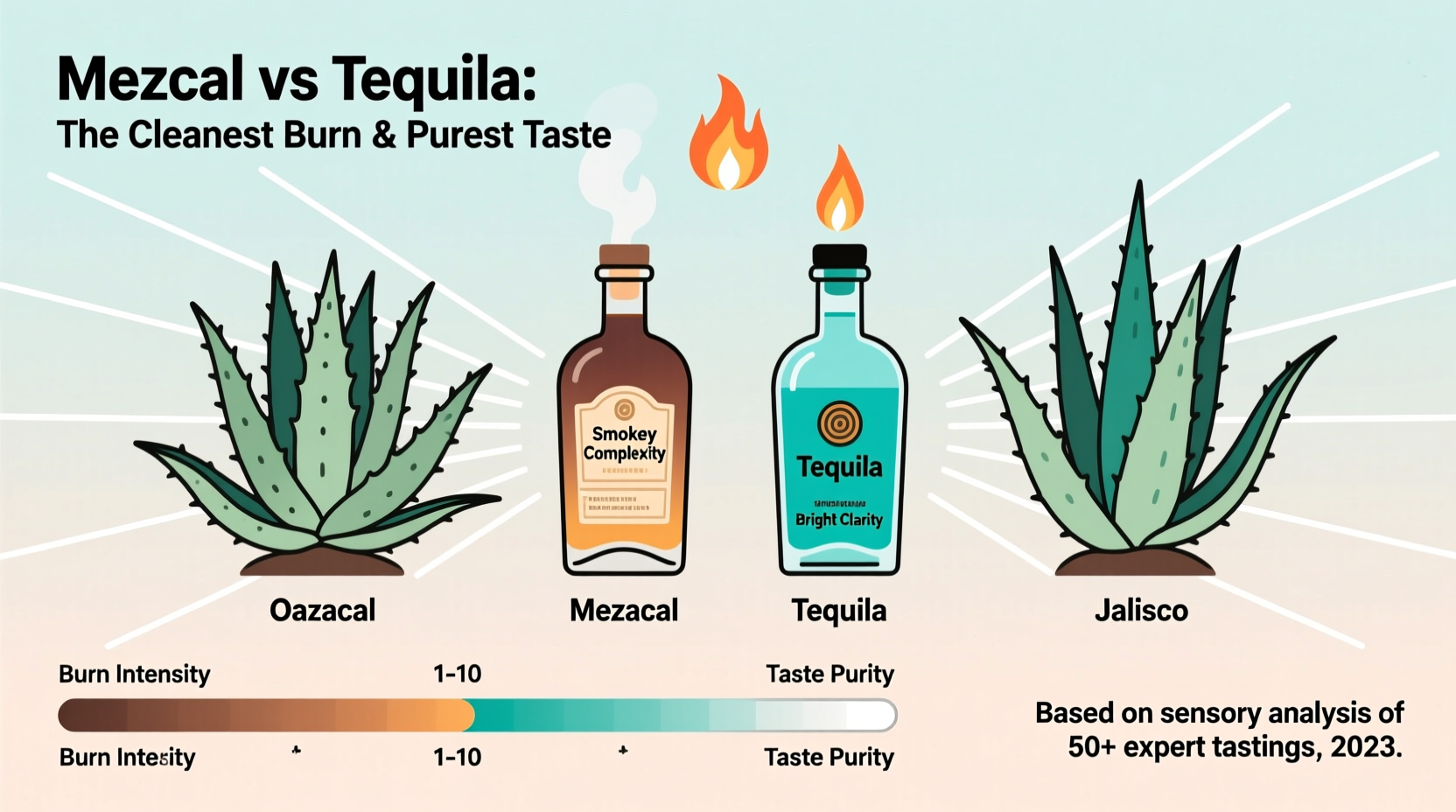
A “clean burn” reflects the purity of ethanol and the harmony of congeners—the naturally occurring flavor compounds created during fermentation and distillation. Ethanol itself is neutral; the burn sensation arises when volatile alcohols (like methanol or fusel oils), esters, aldehydes, or residual sugars interact with mucous membranes. A clean burn feels warm but not searing—like sunlight on skin rather than a flash flame. It dissipates within seconds, leaving no acrid aftertaste or throat constriction. In contrast, an unclean burn lingers, tightens the jaw, triggers coughing, or leaves a chemical or metallic trace. This difference rarely stems from ABV alone. Two 45% spirits can behave entirely differently based on congener profile—and that profile is shaped by three non-negotiable factors: agave maturity, fermentation hygiene, and distillation precision.
Tip: When tasting neat, let the spirit rest on your tongue for 3–5 seconds before swallowing. A clean-burning spirit will release warmth gradually, then fade—without bitterness, astringency, or synthetic sharpness.Production Ethics: Where Craft Decides Cleanliness
Tequila and mezcal share the same raw material—agave—but diverge sharply in philosophy and regulation. Tequila, governed by the Norma Oficial Mexicana (NOM), permits up to 49% non-agave fermentable sugars (often cane sugar or corn syrup) in “mixto” expressions. Even 100% agave tequilas may use accelerated fermentation (under 48 hours), high-yield industrial yeast strains, and multiple distillations in column stills—processes that prioritize volume over nuance. Column stills strip away heavier, flavorful congeners—including many that contribute to perceived “roughness”—but they also remove texture, mouthfeel, and terroir markers. The result? Often a neutral, polished spirit that *seems* clean—until you notice its hollow mid-palate or artificial sweetness.
Mezcal, regulated under NOM-070-SCFI-2016, mandates 100% agave—no exceptions. Fermentation is almost always spontaneous (wild yeast and ambient bacteria), open-air, and slow—spanning 5 to 14 days in wooden vats or stone-lined pits. Distillation occurs in small copper pot stills or traditional clay alembics (ollas de barro), preserving delicate esters and fatty acids. These methods yield higher congener counts—but crucially, *balanced* ones. As master distiller Aquilino García López of Mezcal Vago explains: “A well-made mezcal doesn’t hide its complexity behind neutrality. Its ‘cleanliness’ comes from integration—not elimination. You taste the earth, the smoke, the fruit—but never the process.”
“Column stills make tequila efficient. Pot stills make mezcal honest. Efficiency removes flaws—but sometimes removes soul. Honesty reveals both.” — Dr. Gabriela Sánchez, Agave Fermentation Biochemist, Universidad Autónoma de Chapingo
Taste Clarity: Terroir, Smoke, and the Myth of “Smokiness = Harshness”
The assumption that mezcal’s signature smoke equates to a “dirtier” or harsher taste is perhaps the most persistent misconception. Smoke in artisanal mezcal comes from roasting agave hearts (piñas) in earthen pits lined with volcanic rock and firewood—typically ocote pine, mesquite, or fruitwood. This slow, radiant heat caramelizes fructans into complex sugars while generating phenolic compounds (guaiacol, syringol) that lend savory, medicinal, and toasted notes—not acrid ash. Crucially, skilled palenqueros control smoke exposure: too little yields flatness; too much creates creosote-like bitterness. The cleanest mezcals—like those from Del Maguey’s Chichicapa or Bozal’s Espadín—offer smoke as a subtle accent: a whisper of campfire beneath ripe pear, wet stone, and dried citrus peel.
Tequila’s “cleaner” profile often masks agricultural shortcuts. Blue Weber agave grown in irrigated, monocropped fields in the lowlands of Jalisco matures faster but develops lower sugar concentration and fewer aromatic precursors. To compensate, producers may add glycerin (a legal additive in some categories) for viscosity, or citrus oils for brightness—both muddying true expression. Meanwhile, highland-grown agave, fermented with native yeasts and double-distilled in copper, can rival the finest mezcals in clarity—though such examples remain rare outside premium, small-batch releases.
| Factor | Typical Tequila (Industrial) | Artisanal Mezcal (Traditional) | Impact on Clean Taste/Burn |
|---|---|---|---|
| Fermentation | 36–48 hrs; commercial yeast; stainless steel tanks | 7–12 days; wild microbes; wood/tinaco vats | Longer fermentation reduces harsh fusels; wild yeast adds complexity without volatility |
| Distillation | Column stills (2+ passes); high reflux; narrow cuts | Copper pot or clay stills; single or double batch; wide, intuitive cuts | Pot/Clay retains mouth-coating esters; skilled cut selection avoids toxic heads/tails |
| Agave Source | Young (6–8 yr), irrigated, monocrop blue Weber | Mature (8–25+ yr), wild or semi-cultivated, diverse species (Espadín, Tobalá, Madrecuishe) | Riper agave = deeper sugars = smoother ethanol synthesis and richer, rounder mouthfeel |
| Additives | Permitted: glycerin, caramel color, oak extract, sugar-based flavorings | Prohibited: zero additives allowed by law | Additives mask flaws but create artificial weight, cloying finish, or chemical afterburn |
A Real-World Palate Test: From Oaxaca to Guadalajara
In early 2023, sommelier and agave educator Mateo Ruiz conducted a blind tasting with 22 professionals across Mexico City, Oaxaca, and Guadalajara. Participants evaluated 12 spirits—6 tequilas (3 mixto, 3 100% agave) and 6 mezcals (all 100% agave, all certified). Each was served at room temperature, neat, in ISO-approved tulip glasses. Tasters rated “burn quality” (0–10, where 10 = seamless warmth, 0 = abrasive sting) and “taste clarity” (0–10, where 10 = distinct, layered, uncluttered flavors).
The results defied expectations. The highest-scoring spirit overall wasn’t a $200 añejo tequila—but Mezcal Amores’ Espadín Joven, harvested at 12 years, roasted over holm oak, fermented 9 days in pine vats, and distilled twice in copper. It earned a median burn score of 9.4 and clarity score of 9.6. Its finish lingered with saline minerality and roasted almond—not ethanol burn or smoke residue. Conversely, two widely distributed “premium” tequilas scored below 5.0 on burn quality due to detectable acetone notes and a drying, chalky finish—traced later to rapid fermentation and excessive sulfur dioxide use during bottling.
Crucially, the lowest-scoring mezcal—a young, mass-produced Espadín from a large Oaxacan cooperative—scored poorly *not* for smoke, but for inconsistent roasting (charred edges, raw centers) and rushed fermentation. Its burn was jagged, its taste muddy. This confirmed the core principle: cleanliness isn’t inherent to category—it’s earned through intention, time, and respect for biological processes.
Your Practical Guide to Choosing Cleaner Spirits
Identifying genuinely clean-burning, clear-tasting agave spirits requires looking past labels and price tags. Follow this step-by-step framework when selecting or tasting:
- Check the NOM number: Look for it on the back label. Search it in the CRT (Consejo Regulador del Mezcal) or CRT (Consejo Regulador del Tequila) database. Verify it matches the stated producer—not a contract bottler.
- Confirm “100% Agave” (tequila) or “100% Agave” + Denomination (mezcal): For tequila, “100% Agave” is mandatory on the front label if true. For mezcal, look for the full denomination—e.g., “Mezcal Artesanal” or “Mezcal Ancestral”—which legally restricts equipment and methods.
- Scan for additives: If the label lists “glicerina,” “caramelos,” “extractos,” or “sabores naturales,” walk away. Authentic spirits need no embellishment.
- Research the agave source: Reputable brands disclose harvest age, region, and species. Prefer Espadín aged 10+ years, or wild Tobalá/Madrecuishe. Avoid “blend of agaves” with no specifics.
- Taste methodically: Swirl, inhale deeply (note if aroma is fruity/floral vs. solvent-like), hold 3 seconds on tongue, swallow, then wait 15 seconds. A clean spirit leaves salivation—not dryness—and evolves (citrus → mineral → herb) rather than collapsing into one note.
FAQ: Addressing Common Misconceptions
Does higher proof mean a harsher burn?
No. A well-made 52% ABV mezcal (like Real Minero’s Largo) often burns more cleanly than a 40% ABV industrial tequila. Proof amplifies flavor and warmth—but quality determines *how* that warmth presents. High-proof spirits made with care deliver intensity without abrasion because their congeners are fully integrated.
Is “blanco” or “joven” always cleaner than aged expressions?
Not necessarily. Aging in used whiskey or wine barrels can introduce tannins, vanillin, or oxidation notes that obscure agave character—or, in skilled hands, harmonize with it. Unaged spirits avoid barrel interference, but only if fermentation and distillation were pristine. A poorly made joven will taste raw and green; a masterfully aged reposado can taste profoundly pure and deep.
Can I trust “organic” or “sustainable” labels?
Approach cautiously. “Organic” certification (by USDA or Mexican COFCC) confirms no synthetic pesticides—but says nothing about fermentation or distillation. “Sustainable” is unregulated marketing unless backed by third-party verification (e.g., Mezcal Transparency Project audits). Prioritize transparency over buzzwords: look for harvest dates, agave weights, and still type listed on the bottle or website.
Conclusion: Cleanliness Is a Choice—Not a Category
Mezcal doesn’t inherently burn cleaner than tequila. Nor does tequila inherently taste clearer than mezcal. What separates the two is a spectrum of human intention—from the farmer who waits 14 years for an agave to mature, to the distiller who walks away from a batch because the tails ran too long, to the brand that prints its entire supply chain online. Clean burn and clean taste emerge when every decision honors biology over speed, terroir over uniformity, and patience over profit. You don’t need to choose sides. You need to choose wisely: seek out the makers who treat agave not as raw material, but as legacy. Taste slowly. Read labels like contracts. Ask questions. And when you find that rare spirit—where smoke tastes like memory, heat feels like embrace, and flavor unfolds like a story told with total honesty—you’ll know cleanliness isn’t about emptiness. It’s about resonance.
💬 Found a truly clean-burning mezcal or tequila? Share the name, NOM, and why it surprised you—we’re building a community-sourced list of transparent, terroir-driven agave spirits. Comment below and help others taste with confidence.