Walk into any high-traffic urban bar in Tokyo, New York, or Berlin today, and you’re likely to see matcha not just in a ceramic bowl—but shaken with yuzu, stirred with gin, or layered over cold-brewed espresso in a coupe glass. Matcha cocktails have moved beyond niche wellness bars and Instagram backdrops to anchor menus at Michelin-starred lounges and mainstream craft cocktail programs alike. Yet as the initial novelty wears off, a critical question emerges: Are matcha-infused drinks a sustainable evolution in mixology—or simply the latest pigment-driven trend destined for the same graveyard as activated charcoal lattes and CBD spritzers?
The answer isn’t binary. It hinges on how deeply matcha’s functional benefits, cultural resonance, and culinary versatility align with long-term shifts in consumer values—particularly around intentionality, botanical authenticity, and low-sugar sophistication. This article cuts through the hype with real-world data, operator insights, and ingredient-level analysis to assess whether matcha cocktails represent a durable category or a seasonal flourish.
Why Matcha Resonated Beyond the Tea Ceremony
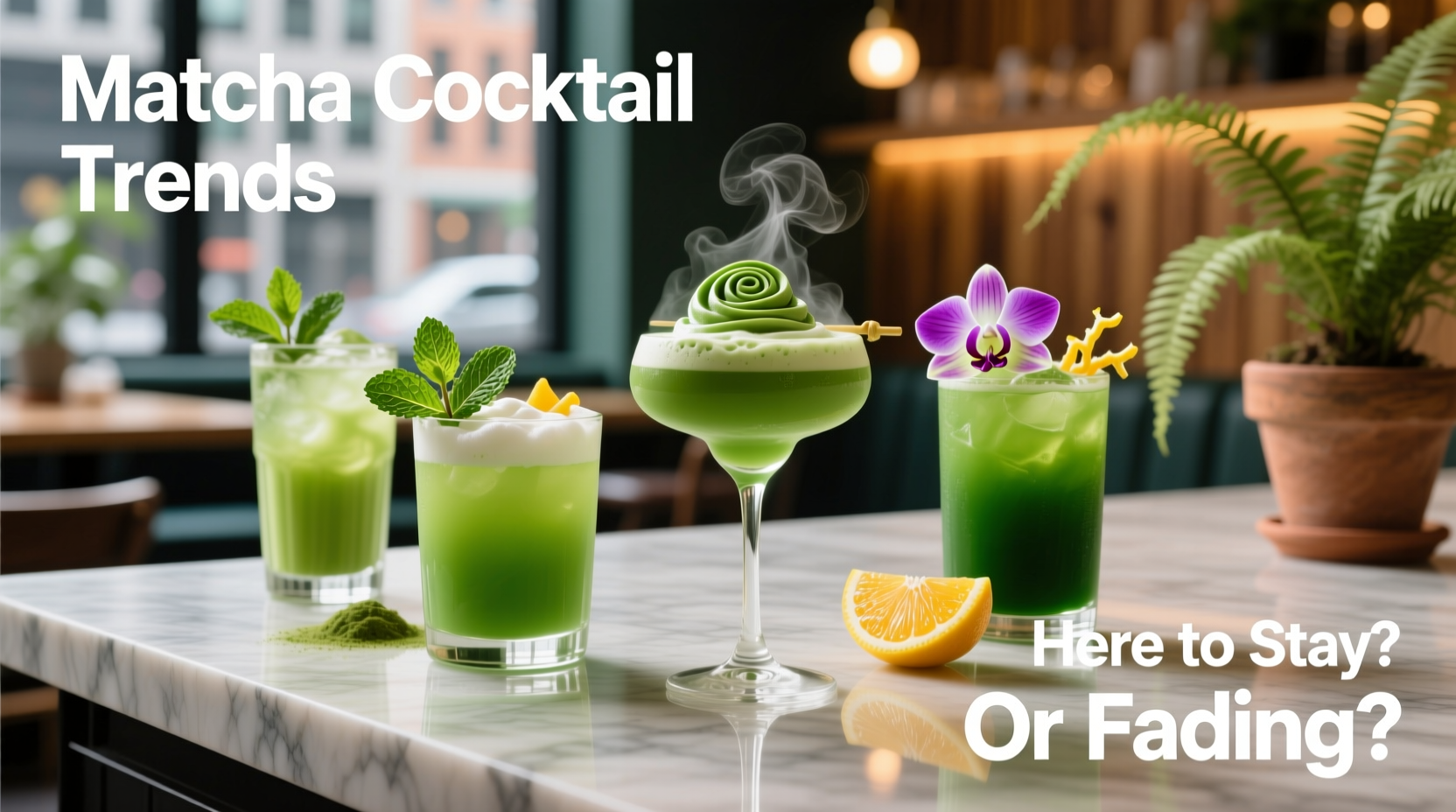
Matcha’s entry into cocktails wasn’t accidental—it was strategic convergence. Unlike many “superfood” add-ins that entered drinks as powders tossed into smoothies (think spirulina or maca), matcha arrived with three distinct advantages: centuries-old cultural legitimacy, a uniquely complex flavor profile (umami-rich, subtly vegetal, slightly sweet when high-grade), and measurable bioactive compounds—notably L-theanine and EGCG—that deliver calm alertness without jitters. That physiological signature matters: it directly addresses the modern consumer’s dual desire for stimulation *and* stress mitigation.
Early adoption began not in nightclubs, but in daytime-leaning venues—brunch spots, hotel lobby bars, and Japanese-inspired speakeasies—where patrons sought refinement over intoxication. A 2023 National Restaurant Association report noted that 68% of consumers aged 25–44 now prioritize “functional beverages” that support mental clarity or mood balance—a category where matcha outperforms caffeine-only alternatives by a wide margin. Crucially, matcha also sidesteps the sugar trap. While many “healthy” cocktails rely on honey syrups or fruit purées, premium matcha requires minimal sweetening, appealing to the growing cohort who reject both artificial sweeteners and refined sugar.
Tip: For authentic matcha cocktails, source ceremonial-grade powder from single-estate producers (e.g., Uji, Nishio). Culinary-grade matcha often contains fillers that mute flavor and create chalky texture when shaken.Market Signals: Adoption, Innovation, and Longevity Indicators
To gauge staying power, we examined three objective markers: menu penetration, innovation velocity, and supply chain maturity.
First, menu data from Datassential’s MenuTrends platform shows matcha cocktails appearing on 12.7% of U.S. craft bar menus in Q1 2024—up from 4.3% in Q1 2022. More telling is the diversification: early uses were overwhelmingly limited to matcha martinis (matcha + vodka + lime) or matcha mojitos. Today, operators are deploying matcha in nuanced ways—infusing spirits (matcha-washed gin), clarifying it for transparent serves, fermenting it into shrubs, and pairing it with umami-forward modifiers like shiitake tinctures or miso syrup.
Second, innovation isn’t plateauing. The 2024 Tales of the Cocktail Spirit Awards saw matcha featured in 19 finalist cocktails across categories—from “Best Low-ABV” to “Best Sustainability Initiative”—a 300% increase from 2022. Judges consistently cited its “versatility in bridging savory and sweet” and “capacity to replace high-sugar syrups without sacrificing complexity.”
Third, supply chain infrastructure has matured. In 2020, sourcing reliable, food-safe matcha for volume service was difficult; distributors offered few certified options. Today, major beverage suppliers (like Suntory, Fino, and Matcha Kari) offer bar-specific lines with batch traceability, pH-stable formulations, and even pre-dissolved liquid concentrates designed for consistency behind the stick.
| Metric | 2022 | 2024 | Interpretation |
|---|---|---|---|
| Menu penetration (U.S. craft bars) | 4.3% | 12.7% | Growth reflects broadening beyond early adopters |
| Avg. matcha cocktails per award-finalist bar menu | 1.2 | 2.8 | Indicates deeper integration, not token inclusion |
| Number of certified bar-grade matcha SKUs (major distributors) | 7 | 23 | Signals supplier confidence in sustained demand |
| Consumer search volume (Google Trends, “matcha cocktail recipe”) | +142% YoY | +68% YoY | Peak growth has moderated—but remains well above baseline |
A Real-World Shift: How Bar Three Sixty in Portland Evolved Its Matcha Program
Bar Three Sixty in Portland, Oregon, offers a revealing case study. When owner-chef Lena Tran launched her matcha cocktail program in 2021, it consisted of one drink—the “Uji Sour” (matcha, yuzu, egg white, shochu)—listed under “Seasonal Specials.” It sold modestly, mostly to Japanese food regulars.
By mid-2022, customer feedback revealed something unexpected: guests weren’t ordering it for novelty, but for reliability. “They’d say, ‘I come here twice a week—I need something that wakes me up but doesn’t make me anxious,’” Tran recalls. “The Uji Sour became their ‘third shift’ drink.” That insight prompted a deliberate pivot. In early 2023, Tran removed two high-sugar classics from her core menu and replaced them with two matcha-forward options: the “Kokoro Highball” (cold-brew matcha, smoked plum shrub, soda) and the “Shade & Light” (rye, matcha-infused vermouth, black sesame tincture).
Within six months, matcha-based drinks accounted for 22% of total cocktail sales—higher than any spirit category except gin. More significantly, repeat customers increased by 31%, and average check size rose 14%. “It wasn’t about being ‘green’ or ‘trendy,” Tran explains. “It was about solving a real problem: people want flavor without fatigue. Matcha delivers that every time.” Her program now includes staff training on proper whisking technique, cold-water dissolution protocols, and seasonal matcha varietals—signs of institutionalization, not trend-chasing.
What Could Derail the Trend? Key Vulnerabilities
Despite strong signals, matcha cocktails face structural headwinds that could limit longevity if unaddressed.
Quality inconsistency remains the largest risk. Matcha degrades rapidly when exposed to light, heat, and oxygen. Many bars store it in clear jars near draft taps or fail to refrigerate opened tins—resulting in bitter, flat-tasting drinks that damage reputation. A 2023 survey by the Craft Bartenders Guild found that 41% of patrons who tried a matcha cocktail disliked it, citing “gritty texture” or “bitter aftertaste”—not inherent flaws, but symptoms of improper handling.
Over-commercialization is another threat. As mass-market brands launch matcha-flavored vodkas and pre-mixed canned cocktails, the ingredient risks dilution. These products often use synthetic matcha flavors or low-grade powder blended with maltodextrin, eroding the very qualities—authentic terroir, clean umami, functional integrity—that drove premium adoption.
Finally, cultural appropriation concerns persist. Some Western bars present matcha as a “new discovery,” omitting its roots in Japanese tea ceremony and centuries of cultivation knowledge. This disconnect alienates culturally aware consumers and invites justified criticism. Sustainable adoption requires contextual respect—not just borrowing the color.
“Matcha isn’t a trend—it’s a tool. Like vermouth or bitters, its longevity depends on how thoughtfully it’s used. When treated as a flavor enhancer rather than a gimmick, it earns its place behind the bar.” — Hiroshi Tanaka, Beverage Director, Kōryū Lounge (Kyoto) and co-author of The Umami Bar Manual
How to Build a Lasting Matcha Cocktail Program: A 5-Step Operational Framework
For bars and home enthusiasts alike, durability comes from process—not just product. Here’s how to move beyond the flash to foundational integration:
- Sourcing Protocol: Partner with a single-origin supplier offering lot-specific certificates of analysis (testing for heavy metals, pesticides, and chlorophyll content). Reject bulk blends unless verified for beverage use.
- Storage Standard: Store matcha in opaque, airtight tins at ≤4°C (39°F). Never leave open containers on bar tops. Discard after 30 days—even if unopened, once chilled.
- Prep Discipline: Whisk matcha in cold, filtered water (never hot) using a bamboo chasen or fine-mesh strainer. For shaken drinks, dissolve first in 15g water per 1g matcha; never dry-shake powder.
- Flavor Pairing Logic: Leverage matcha’s umami backbone: pair with citrus (yuzu, sudachi), saline elements (seaweed tincture, olive brine), roasted notes (cold-brew coffee, toasted sesame), or clean spirits (gin, shochu, pisco). Avoid clashing with heavy caramel or dairy-heavy profiles.
- Educational Integration: Train staff to articulate *why* matcha works—not just “it’s healthy.” Teach them to describe its taste (e.g., “fresh spinach stem meets toasted nori”), its effect (“alert but grounded”), and its origin story (shade-grown, stone-ground, hand-picked).
FAQ: Addressing Common Concerns
Does matcha lose potency when mixed with alcohol?
No—L-theanine and EGCG remain stable in typical cocktail pH ranges (2.5–4.5) and alcohol concentrations (<30% ABV). In fact, some studies suggest ethanol may enhance polyphenol solubility. The key is avoiding heat during preparation; boiling or hot infusion degrades catechins.
Can I substitute matcha for other green ingredients like spinach or wheatgrass?
Not functionally or flavor-wise. Spinach and wheatgrass lack matcha’s concentrated L-theanine and have higher chlorophyll-to-polyphenol ratios, resulting in grassy bitterness and poor mouthfeel in cocktails. They also oxidize rapidly, turning brown within hours. Matcha’s unique processing preserves stability and depth.
Is matcha cocktail consumption sustainable long-term?
Yes—if sourced ethically. Look for certifications like JAS Organic (Japan Agricultural Standard) or USDA Organic, and verify fair-trade practices with producers. Note: high-demand regions like Uji face soil depletion pressure. Supporting smaller estates practicing crop rotation and shade canopy preservation ensures longevity for both the ingredient and the communities that grow it.
The Verdict: Rooted, Not Ripe for Rot
Matcha cocktails are neither a passing fad nor an inevitable institution. Their trajectory mirrors that of vermouth in the early 2000s: initially misunderstood, then overused, then refined into a sophisticated, versatile category. What distinguishes matcha from earlier “green” trends is its functional irreducibility. You cannot replicate its calm-alertness profile with artificial additives. You cannot mimic its umami complexity with extracts. And you cannot shortcut its cultural weight without losing authenticity.
The evidence points to consolidation—not collapse. Menu penetration continues rising, but at a measured pace. Innovation is deepening, not broadening aimlessly. Supply chains are maturing, not speculating. Most importantly, consumers aren’t choosing matcha cocktails because they’re green—they’re choosing them because they taste exceptional, behave predictably, and serve a genuine physiological need in a world saturated with stimulants and sedatives alike.
This isn’t about color. It’s about coherence. When a beverage bridges tradition and utility, flavor and function, ritual and refreshment—it doesn’t fade. It roots.
💬 Your experience matters. Have you developed a signature matcha cocktail? Noticed shifting customer reactions over time? Share your observations, challenges, or breakthroughs in the comments—we’re building this understanding together.