It’s no longer just about “dry January” or “sober curious” hashtags. Across wine bars in Lisbon, natural wine shops in Portland, and supermarket aisles from Tokyo to Toronto, bottles labeled 5.5%, 8.5%, or even “0.0% ABV—alcohol removed post-fermentation” are commanding shelf space once reserved for bold Barolos and buttery Chardonnays. This isn’t a passing fad—it’s the visible crest of a quiet revolution in how people relate to alcohol. Low-alcohol wines (typically defined as under 11% ABV, with many falling between 5.5% and 9.5%) are gaining traction not because consumers are abandoning wine, but because they’re redefining what wine *means* in their daily lives: pleasure without penalty, ritual without recklessness, indulgence aligned with intention.
This shift reflects deeper societal currents—rising health literacy, evolving workplace norms, heightened awareness of mental wellness, and a growing appetite for transparency in food and drink. It also signals a maturing palate: one that values nuance over intensity, balance over bravado, and craftsmanship over convention. What was once relegated to niche “wellness sections” now anchors tasting menus at Michelin-starred restaurants and fuels direct-to-consumer brands achieving seven-figure annual revenue. Moderation, it turns out, isn’t austerity—it’s sophistication in motion.
The Data Behind the Decline of ‘More Is More’
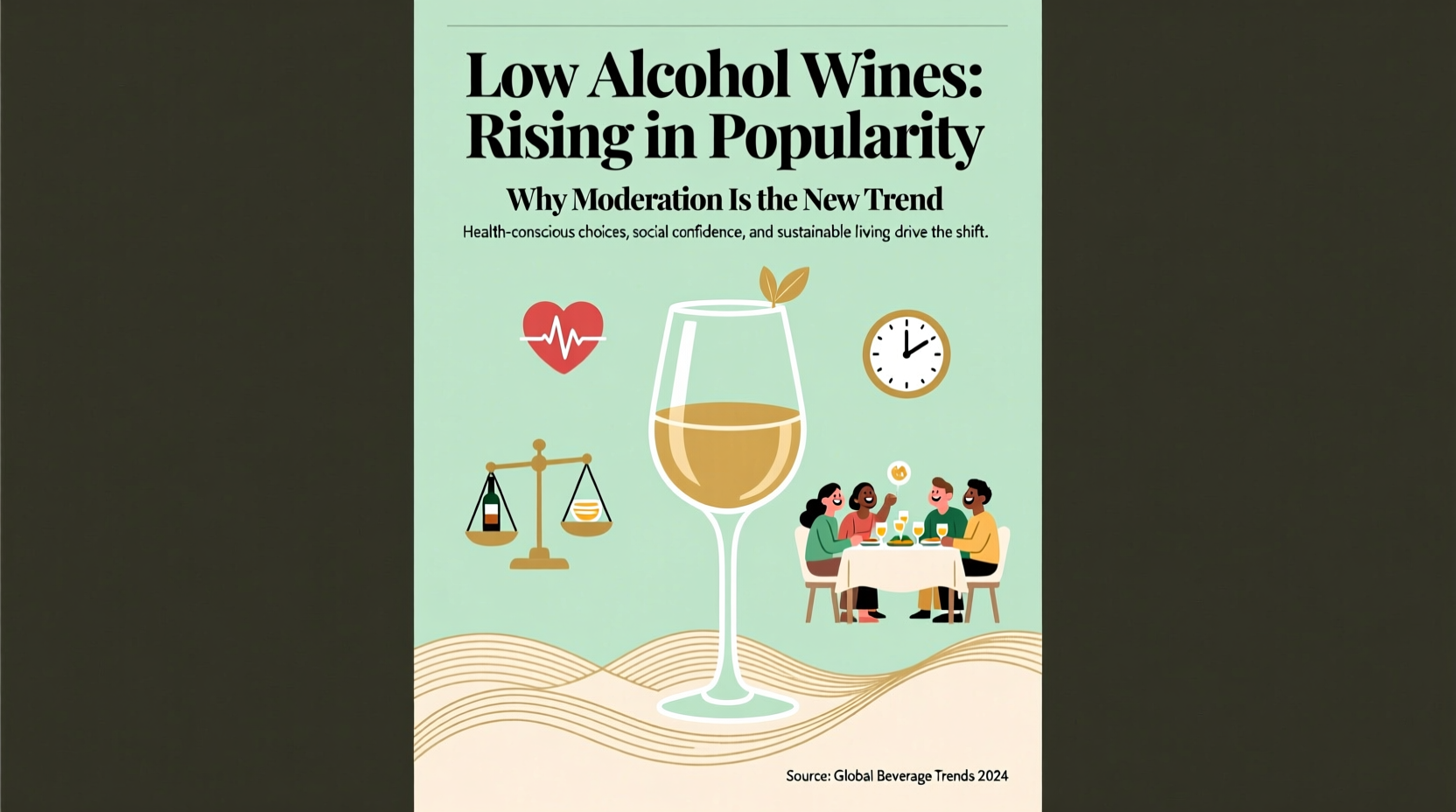
Market research confirms this isn’t anecdotal. According to IWSR Drinks Market Analysis (2023), global low- and no-alcohol wine sales grew 24% year-on-year—outpacing overall wine category growth by more than threefold. In the UK, Waitrose reported a 67% rise in low-alcohol wine sales over two years; in Australia, Dan Murphy’s noted that wines under 9% ABV now represent 12% of total wine volume—a figure that stood at just 3% in 2018. Crucially, buyers aren’t exclusively non-drinkers: 68% of low-alcohol wine purchasers still consume regular wine, often alternating based on context—choosing a 7.8% skin-contact Riesling for Tuesday night dinner but reserving a 13.5% Syrah for Saturday’s celebration.
This duality reveals a critical insight: moderation is not abstinence reframed. It’s strategic calibration—aligning beverage choice with energy needs, social setting, sleep goals, and even professional demands. A software engineer may opt for a spritzy, 8.2% pét-nat before an afternoon coding sprint; a new parent might reach for a zero-alcohol sparkling rosé during a school pickup chat; a fitness coach may select a low-ABV orange wine post-yoga class, knowing it delivers polyphenols without compromising recovery.
Tip: When exploring low-alcohol wines, prioritize those made via natural fermentation (not watered-down) and look for terms like “unfortified,” “no dealcoholization,” or “spontaneous fermentation”—these signal integrity of process and flavor.How Winemakers Are Reinventing Tradition—Not Diluting It
Early low-alcohol wines suffered from thinness, cloying sweetness, or artificial aftertastes—products of dilution or industrial dealcoholization. Today’s leaders reject that compromise. Instead, they deploy time-honored viticultural and winemaking strategies to achieve lower alcohol *naturally*, preserving structure, acidity, and aromatic complexity.
Key approaches include:
- Earlier harvest timing: Picking grapes at optimal phenolic ripeness—not sugar ripeness—means lower potential alcohol while retaining freshness and tannin maturity. In cooler regions like Germany’s Mosel or New Zealand’s Central Otago, this is standard practice for crisp Rieslings and Pinot Noirs.
- High-elevation or coastal vineyards: Cooler temperatures slow sugar accumulation. Wines from Argentina’s Uco Valley (1,200+ meters) or Portugal’s Vinho Verde region regularly land between 9–10.5% ABV without sacrificing concentration.
- Native yeast ferments and ambient temperature control: Allowing fermentation to proceed slowly and coolly prevents runaway alcohol production and preserves volatile aromatics.
- Blending with low-ABV varieties: Incorporating grapes like Schiava (Italy), Trousseau (Jura), or Assyrtiko (Santorini)—which naturally yield 9–10.5% wines—adds texture and salinity without boosting alcohol.
The result? Wines that taste complete—not compromised. A 2022 blind tasting organized by the Guild of Sommeliers found that 73% of professionals could not reliably distinguish a well-made 8.9% Gamay from its 12.8% counterpart when served at proper temperature and in context. Flavor, not force, had won.
Real-Life Shift: A Week in the Life of Maya, 34, Marketing Director & Wine Enthusiast
Maya used to open a bottle of Malbec most evenings—“It was my wind-down, my reward.” But by 2022, she noticed fatigue mid-afternoon, disrupted sleep, and a persistent brain fog she’d attributed to stress. After cutting alcohol for four weeks, her energy rebounded. She didn’t want to quit wine entirely—she loved its ritual, its connection to food, its cultural resonance. So she began experimenting.
Her new rhythm emerged organically:
- Monday–Wednesday: A glass of 8.5% skin-contact Vermentino from Sardinia with dinner—bright acidity, herbal lift, zero hangover.
- Thursday: “No-alcohol night”—but she pours a chilled, zero-ABV sparkling Shiraz (dealcoholized via vacuum distillation) into her favorite stemware, garnishes with black pepper and orange zest, and treats it like a ceremony.
- Friday: One glass of a 10.2% Loire Cabernet Franc—fuller body, but she stops there, pairing it with dark chocolate instead of dessert wine.
- Saturday: A shared bottle of traditional-method sparkling wine at 11.5%—still moderate, but celebratory and social.
“I didn’t trade joy for discipline,” Maya shared in a follow-up interview. “I traded autopilot for attention. Now I taste more. I savor longer. And I show up—fully—for my team, my partner, and myself.” Her experience mirrors findings from a 2023 University of Sussex study: participants who adopted intentional, low-alcohol patterns reported 31% higher self-rated wellbeing scores than those maintaining habitual higher-intake routines—even when total weekly units were similar.
What to Look For (and Avoid): A Practical Buying Guide
Navigating the expanding low-alcohol landscape requires discernment. Not all “light” labels reflect quality or authenticity. Use this checklist before purchasing:
Checklist: Choosing Authentic Low-Alcohol Wines✓ Check the ABV on the back label—not just marketing copy.
✓ Prefer wines fermented to dryness (<2 g/L residual sugar) unless you specifically want off-dry styles.
✓ Avoid terms like “diluted,” “watered down,” or “blended with water.”
✓ Look for region-specific cues: “Vinho Verde” (Portugal), “Kabinett” or “Feinherb” (Germany), “Patxaran”-style infusions (Spain).
✓ Prioritize producers who list vineyard sources and harvest dates—transparency signals accountability.
✓ If zero-ABV, verify the method: vacuum distillation or reverse osmosis generally preserves more flavor than spinning cone technology.
For clarity, here’s how common low-alcohol categories compare across key dimensions:
| Category | Typical ABV Range | Production Method | Flavor Profile Strengths | Best Paired With |
|---|---|---|---|---|
| Naturally Low-ABV Wines (e.g., Vinho Verde, Kabinett Riesling) | 8.5%–10.5% | Early harvest + cool-climate viticulture | High acidity, vibrant fruit, mineral edge | Seafood, salads, goat cheese, spicy Asian dishes |
| De-alcoholized Wines (0.0%–0.5% ABV) | 0.0%–0.5% | Vacuum distillation or reverse osmosis post-fermentation | Fruit-forward, clean, sometimes slightly flat; best when made from high-acid base wines | Grilled vegetables, light pasta, brunch dishes, mocktail bases |
| Pétillant Naturel (Pét-Nat) | 9.0%–11.0% | Bottle-fermented with native yeasts, disgorged early | Unfiltered, cloudy, effervescent, funky, textural | Charcuterie, fried foods, picnic fare, bold cheeses |
| Orange Wines (skin-contact whites) | 10.0%–11.5% | Extended white grape skin contact, often in clay or wood | Tannic, oxidative, nutty, savory—more “red-like” structure | Roasted poultry, mushroom risotto, aged gouda, Middle Eastern mezze |
Expert Insight: Beyond the Bottle
This movement transcends beverage preference—it’s part of a recalibration of personal agency in a hyper-stimulated world. Dr. Lena Torres, clinical psychologist and author of *The Intentional Pause*, observes a profound link between mindful drinking and broader self-trust:
“Choosing a lower-alcohol wine isn’t just about limiting intake—it’s a micro-decision that reinforces autonomy. Every time someone opts for presence over numbness, for clarity over cloudiness, they strengthen neural pathways associated with self-efficacy. That confidence doesn’t stay in the dining room. It shows up in boundary-setting at work, in calmer parenting responses, in the courage to pivot careers. Moderation, practiced intentionally, becomes training ground for resilience.” — Dr. Lena Torres, Clinical Psychologist & Mindful Living Researcher
Similarly, Master of Wine Jancis Robinson emphasizes the sensory evolution underway: “The old hierarchy—‘big’ equals ‘better’—is collapsing. We’re learning that restraint can be more demanding than power. Making a compelling 8.5% wine requires greater precision in the vineyard, more patience in the cellar, and deeper respect for the grape’s inherent voice. These wines don’t shout. They invite you to lean in.”
FAQ: Your Practical Questions, Answered
Do low-alcohol wines contain fewer antioxidants or polyphenols?
No—polyphenol content depends more on grape variety, skin contact time, and winemaking technique than alcohol level. In fact, many low-alcohol reds (like lighter Pinot Noirs or Gamays) retain high levels of resveratrol and anthocyanins because they’re harvested earlier, when phenolic compounds are concentrated. Skin-contact whites (orange wines) also deliver robust antioxidant profiles regardless of ABV.
Can I cook with low-alcohol wine the same way I use regular wine?
Absolutely—and often more effectively. Because they’re less likely to introduce harsh alcohol burn or excessive sweetness, low-alcohol wines integrate seamlessly into sauces, reductions, and marinades. Just avoid zero-ABV versions for long-simmered dishes, as heat can accentuate any residual processing notes. Stick with naturally low-ABV wines (9–10.5%) for cooking—they reduce cleanly and add depth without volatility.
Are low-alcohol wines more expensive? Why?
They can be—but not inherently. Premium low-alcohol wines often cost more due to lower yields (earlier harvests mean less juice per ton), labor-intensive vineyard practices, and smaller batch production. However, value exists: many European co-ops and family estates produce excellent 9–10% wines under $20. The price premium reflects craft—not gimmick.
Conclusion: Moderation as Meaning-Making
Low-alcohol wines are rising—not because people love wine less, but because they love life more. They reflect a generation refusing to accept false binaries: pleasure versus health, celebration versus clarity, tradition versus innovation. This trend is rooted in something deeply human: the desire to participate fully, without surrendering agency. It’s in the sommelier recommending a 9.2% Loire Chenin Blanc alongside a tasting menu. It’s in the couple sharing a bottle of pét-nat on their apartment balcony, laughing easily, sleeping soundly. It’s in the entrepreneur choosing a zero-ABV aperitif before a high-stakes investor call—not out of fear, but out of focus.
Moderation, when chosen deliberately, is never about lack. It’s about abundance—of energy, of presence, of possibility. It’s the quiet confidence of knowing your limits not as walls, but as contours that make the landscape richer. As you explore low-alcohol wines, do so with curiosity, not calculation. Taste the terroir in the acidity. Notice how the finish lingers without weighing you down. Let each pour become a small act of alignment—between what you drink, who you are, and who you aspire to be.
💬 Your turn: Have you discovered a low-alcohol wine that changed how you think about drinking? Share your favorite bottle, pairing, or “aha” moment in the comments—we’re building a living guide, together.