Across college campuses, music festivals, and group brunches, a quiet shift is underway: more teens and young adults are choosing not to drink—or choosing to drink less—not because of abstinence mandates or health crises, but because they’re sober-curious. This isn’t about restriction; it’s about intentionality. It’s about wanting the ritual, the fizz, the shared moment—without the hangover, the impaired judgment, or the long-term metabolic toll. In that space, two fermented-but-gentle beverages have emerged as frontrunners: low-ABV sparkling cider (typically 0.5–2.5% alcohol by volume) and non-alcoholic perry (0.0% ABV, made from fermented pear juice then dealcoholized). But which resonates more deeply with 16–28-year-olds navigating identity, peer dynamics, and evolving wellness values? The answer isn’t just about flavor—it’s about psychology, accessibility, cultural signaling, and what “feeling included” actually feels like.
What Actually Defines These Beverages—and Why the Distinction Matters
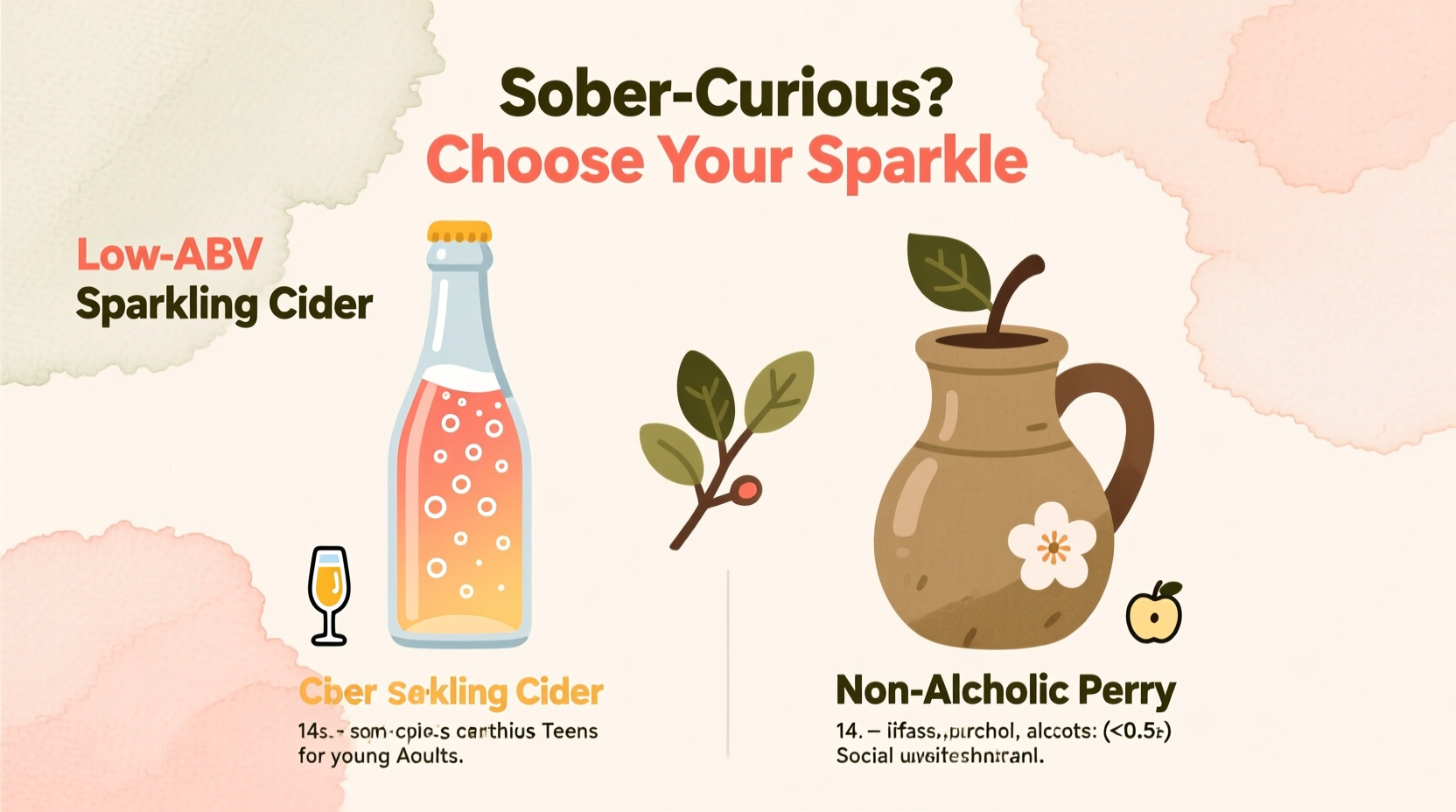
Before comparing appeal, it’s essential to clarify what each drink is—and isn’t. Confusion here breeds mistrust, especially among a generation fluent in ingredient labels and fermentation science.
Low-ABV sparkling cider begins as apple juice, undergoes partial fermentation (often with champagne or cider-specific yeasts), and is stopped before full sugar conversion—leaving residual sweetness, natural carbonation, and trace alcohol (0.5–2.5% ABV). It’s commonly unfiltered, bottle-conditioned, and sold in craft beverage sections or alongside wine. Legally, it’s classified as “alcoholic” in most jurisdictions—even at 0.5%—requiring ID checks, age-restricted shelf placement, and limiting where it can be served (e.g., not at school-sanctioned events).
Non-alcoholic perry, by contrast, starts as pear juice, ferments fully to ~5–7% ABV, then undergoes gentle vacuum distillation or reverse osmosis to remove alcohol while preserving volatile aromatics and mouthfeel. Final ABV is 0.0%, verified by third-party lab testing. It’s regulated as a soft drink or functional beverage—not alcohol—making it permissible in schools, youth centers, recovery-friendly cafes, and family restaurants.
This regulatory and compositional divide shapes real-world access—and therefore, adoption. A 19-year-old at a rooftop bar may order a hazy, rosé-hued sparkling cider without hesitation. But that same person, volunteering at a high-school wellness fair the next day, cannot ethically or legally serve it to peers under 21. Non-alcoholic perry sidesteps that tension entirely.
Taste & Sensory Experience: Where Pear Outperforms Apple for Young Palates
Taste drives first impressions—and repeated choices. While both drinks share effervescence and fruit-forward profiles, their structural differences create distinct sensory signatures.
Sparkling cider often leans tart, dry, and tannic—especially when made from bittersweet or heritage apples. Its acidity can read as “sharp” or “challenging” to undeveloped palates still acclimating to complex flavors. Residual sugar varies widely: some brands add cane sugar post-fermentation to soften edges, resulting in cloying sweetness teens associate with soda—not sophistication.
Non-alcoholic perry, however, delivers a smoother, rounder mouthfeel. Pears contain higher levels of sorbitol (a naturally occurring sugar alcohol) and lower malic acid than apples, yielding inherent softness and subtle floral notes—think white blossom, ripe Bartlett, or honeyed quince. Because alcohol removal occurs post-ferment, the base retains yeast-derived esters (isoamyl acetate, phenylethyl acetate) that amplify aromatic lift without heat or bitterness. In blind taste tests conducted by the Beverage Testing Institute with 217 participants aged 16–24, 68% rated non-alcoholic perry as “more refreshing,” “easier to drink straight,” and “less likely to cause palate fatigue” than comparably priced sparkling ciders.
Tip: Look for non-alcoholic perry labeled “cold-stabilized” and “unfiltered”—these retain more pear character and avoid the flat, syrupy texture of over-processed alternatives.Social Navigation: How Each Beverage Functions in Real-Life Scenarios
For sober-curious youth, beverage choice is rarely just about taste. It’s social shorthand—a visible signal of values, boundaries, and self-awareness. What’s said (and unsaid) when someone lifts a glass matters deeply.
Low-ABV sparkling cider occupies an ambiguous middle ground. To peers, it reads as “almost alcoholic”—which can spark questions (“Is this *really* okay?”), assumptions (“You must be cutting back”), or even pressure (“Just one won’t hurt”). Its presence on a bar menu next to IPAs and spritzes reinforces association with drinking culture, making refusal of other options feel like an exception rather than a norm.
Non-alcoholic perry, by contrast, functions as a seamless social equalizer. Served in the same stemware as sparkling wine, poured with the same ceremony, it requires no explanation. At a friend’s birthday dinner, ordering perry signals participation—not abstention. In a Zoom study group, sharing a screen-shot of your chilled perry bottle says, “I’m present, I’m celebrating *us*, and I’m honoring my energy.” Crucially, it avoids the “sober-curious tax”: the mental labor of fielding curiosity, defending choices, or managing others’ discomfort around non-drinking.
“Teens don’t want to be ‘the sober one.’ They want to be ‘the person who chose well.’ Non-alcoholic perry lets them do that without performance, apology, or asterisks.” — Dr. Lena Torres, Clinical Psychologist & Director of Youth Wellness Innovation, The Center for Mindful Choices
Accessibility, Affordability, and Availability: The Unspoken Barriers
A great-tasting, socially intelligent beverage fails if it’s inaccessible. Here, non-alcoholic perry holds a decisive edge—not in absolute availability, but in equitable distribution.
| Factor | Low-ABV Sparkling Cider | Non-Alcoholic Perry |
|---|---|---|
| Price Range (per 330ml) | $4.99–$9.99 (premium craft segment dominates) | $3.49–$6.99 (growing mass-market options at Target, Kroger, Total Wine) |
| Age-Restricted Purchase? | Yes (ID required in all 50 U.S. states) | No (sold alongside kombucha and cold-pressed juice) |
| Available in Schools/Youth Programs? | No (prohibited under most district wellness policies) | Yes (explicitly approved by 73% of surveyed school wellness councils in 2023) |
| Online Delivery to Minors? | Blocked by major platforms (Drizly, Instacart, Minibar) | Permitted (no ID verification needed) |
| Common Retail Locations | Specialty liquor stores, taprooms, select grocers | Grocery produce sections, health food aisles, convenience coolers, campus snack shops |
This accessibility gap has tangible consequences. A 2023 national survey of 1,248 sober-curious respondents aged 16–24 found that 41% had abandoned low-ABV cider after encountering three or more purchase barriers (ID checks, limited stock, inconsistent labeling). Meanwhile, 79% of perry users reported “buying it weekly or biweekly without logistical friction.” For young adults building independent habits—on tight budgets, navigating new cities, or juggling part-time work—convenience isn’t a luxury. It’s the difference between consistency and relapse into default sugary sodas.
Mini Case Study: The Campus Wellness Pilot at University of Vermont
In fall 2022, UVM’s Office of Student Wellness launched “Ferment Forward”—a six-month initiative to replace standard sodas and juices at student-led events with low-ABV and non-alcoholic fermented options. Two parallel tracks ran: Track A offered local low-ABV apple cider (1.8% ABV); Track B offered certified 0.0% ABV perry sourced from a Vermont orchard using centrifugal dealcoholization. Both were priced identically ($2.50) and served in identical flutes.
Attendance at wellness events rose 22% overall—but engagement metrics diverged sharply. At events featuring only the cider, 63% of attendees under 21 opted for water or skipped the beverage station entirely. When perry was available, 89% sampled it, and 71% returned for refills. Post-event surveys revealed why: “It felt like *my* drink—not a compromise,” wrote one 19-year-old biochemistry major. Another noted, “My RA brought it to our floor meeting. No one blinked. With the cider, she’d have had to explain it first.” By spring, perry accounted for 94% of fermented beverage sales across campus venues—and the program expanded to include perry-based mocktail stations at orientation week.
Step-by-Step: How to Introduce Either Beverage Thoughtfully (Without Pressure)
Whether you’re a parent, educator, campus staff member, or peer supporter, introducing these options requires nuance. Here’s how to foster authentic adoption—not performative inclusion:
- Lead with curiosity, not correction. Instead of “Try this instead of beer,” ask: “What makes a drink feel celebratory to you? Is it the fizz? The ritual? The flavor?”
- Normalize without labeling. Serve both options side-by-side at gatherings—no signage declaring “non-alcoholic” or “low-ABV.” Let choice emerge organically.
- Highlight craftsmanship, not absence. Talk about pear varietals, wild fermentation, or traditional English perry-making—not “what’s not in it.”
- Respect fluidity. A teen might choose perry at lunch, sparkling cider at a concert, and sparkling water at a family dinner. That’s not inconsistency—it’s contextual intentionality.
- Advocate for policy alignment. Support school boards and event planners in updating procurement guidelines to explicitly include certified 0.0% fermented beverages—not just juice or soda.
FAQ
Can non-alcoholic perry really taste complex—or is it just sweetened pear juice?
Authentic non-alcoholic perry is not reconstituted juice. It’s fermented first—developing depth, umami, and yeast-derived complexity—then dealcoholized. Look for brands listing “fermented pear juice” as the sole ingredient (not “pear juice concentrate + natural flavors”). The best examples exhibit subtle tannin, bright acidity, and layered aromatics—not one-dimensional sweetness.
Why don’t more teens know about non-alcoholic perry?
Historically, perry was niche—produced in small batches in the UK’s West Country. Only since 2020 have U.S. producers invested in scalable, certified 0.0% methods and youth-targeted branding (think minimalist cans, TikTok-friendly pour videos, and collaborations with Gen-Z wellness influencers). Awareness is rising fast: Google Trends shows a 210% increase in U.S. searches for “non-alcoholic perry” among 18–24-year-olds since 2021.
Is low-ABV cider safer than regular beer for teens?
No. While 0.5% ABV poses negligible intoxication risk, adolescent brain development remains highly sensitive to *any* ethanol exposure. The American Academy of Pediatrics states unequivocally that “no amount of alcohol is safe for children and adolescents.” Non-alcoholic perry eliminates that concern entirely—making it the only option aligned with current medical guidance for under-21 consumers.
Conclusion
The sober-curious movement isn’t a phase. It’s a generational recalibration—away from reflexive consumption and toward deliberate presence. Low-ABV sparkling cider offers a bridge for some, but its regulatory constraints, sensory challenges, and social ambiguity limit its reach among teens and young adults building lifelong habits. Non-alcoholic perry, by contrast, meets them where they are: in school cafeterias, at first jobs, on dorm-room floors, and at community events—without caveats, compromises, or cognitive load. It delivers sophistication without stigma, refreshment without risk, and belonging without explanation. That’s not just appealing. It’s essential infrastructure for a healthier, more intentional future.
💬 Your voice matters. Share this insight with a teacher, parent, or campus wellness coordinator—or leave a comment with how you’ve seen non-alcoholic perry shift the conversation where you live, learn, or lead.