Acidity is the silent architect of vermouth: it shapes mouthfeel, stabilizes botanicals, tempers sweetness, and governs shelf life. Too little, and your vermouth tastes flat, cloying, or microbiologically vulnerable; too much, and it’s harsh, thin, or unbalanced against bittering agents like wormwood or gentian. For home producers—especially those scaling beyond single-batch experiments—the question isn’t whether acidity matters, but how reliably you can measure and adjust it. Many reach for litmus paper, taste alone, or citric acid “by feel.” Others invest in a digital pH meter. But does that investment pay off in tangible improvements to consistency, safety, or flavor? This isn’t about gadget enthusiasm—it’s about understanding where objective measurement creates real leverage in a craft defined by nuance and variability.
Why Acidity Control Is Non-Negotiable in Vermouth
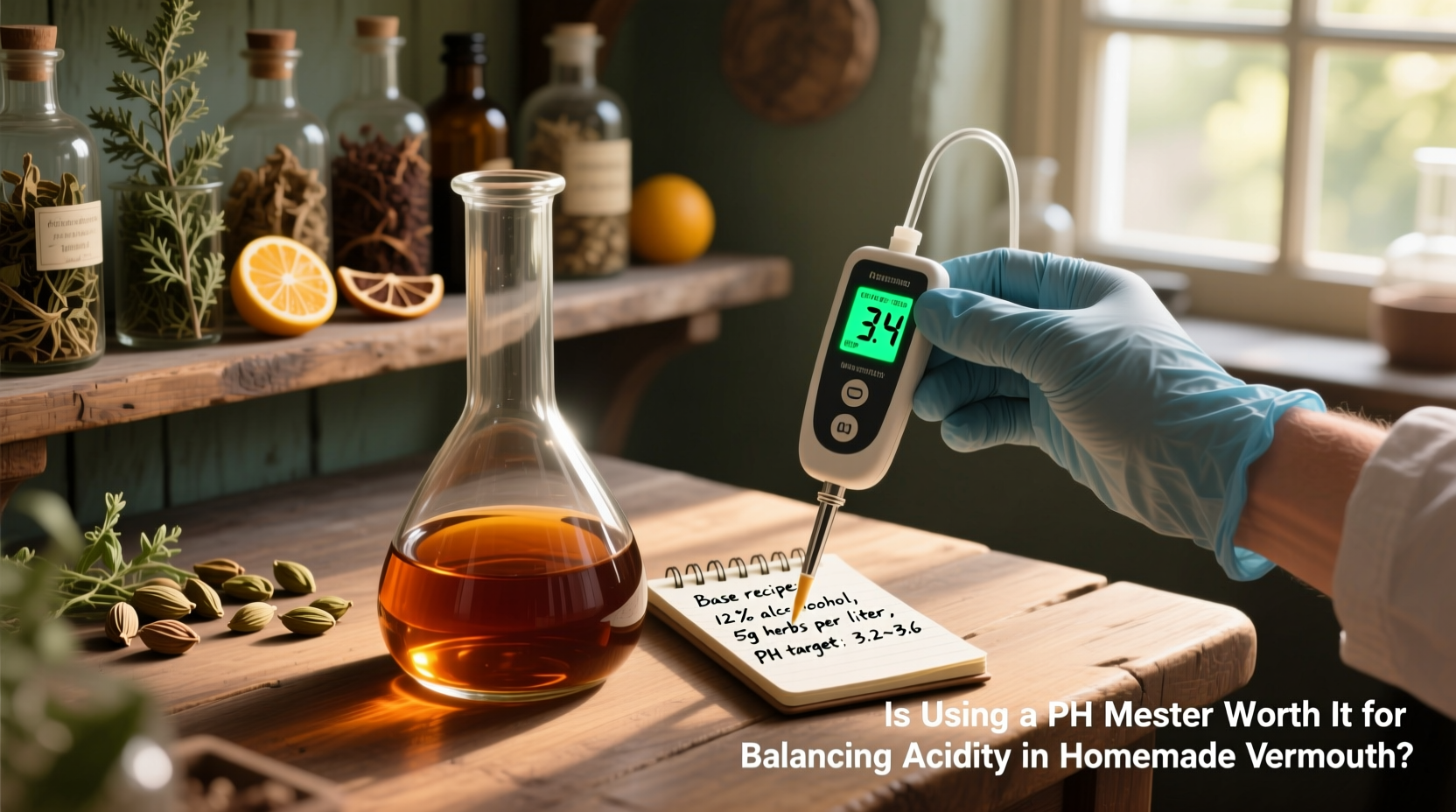
Vermouth is a fortified, aromatized wine—but unlike still wine, it contains added sugar (often 10–18% residual), botanical extracts, and sometimes caramel or glycerin. That high sugar content creates an ideal environment for spoilage microbes if acidity falls below safe thresholds. The U.S. Alcohol and Tobacco Tax and Trade Bureau (TTB) requires vermouth with >15% sugar to maintain a pH ≤ 3.7 to inhibit Acetobacter and lactic acid bacteria. In practice, most successful artisanal vermouths land between pH 3.2 and 3.6. Within that narrow band, small shifts dramatically affect perception: a drop from 3.5 to 3.3 adds brightness and cut without sourness; rising to 3.7 softens the finish but risks flabbiness and microbial instability over time.
Wine’s natural acidity—primarily tartaric and malic—degrades during maceration and aging. Botanical infusions introduce unpredictable variables: citrus peels add citric acid; rhubarb contributes oxalic; gentian root imparts tannic astringency that mimics acidity on the palate. Taste alone cannot distinguish between true hydrogen-ion concentration (pH) and perceived sourness from tannins or volatile acids. As master vermouth maker Alessandro Bocci of Cocchi notes, “The tongue lies when fatigue sets in after six batches. The pH meter doesn’t.”
“The difference between a vermouth that holds its balance for 18 months and one that oxidizes or sours at month six often comes down to hitting pH 3.42—not ‘around 3.4.’ It’s not pedantry. It’s preservation.” — Dr. Elena Rossi, Enologist & Fermentation Scientist, University of Turin Department of Food Science
The Practical Reality of pH Measurement Tools
Three methods dominate home use: litmus or pH indicator strips, titratable acidity (TA) kits, and digital pH meters. Each has trade-offs in accuracy, repeatability, and context relevance.
| Method | Accuracy | Cost (USD) | Best For | Key Limitation |
|---|---|---|---|---|
| pH Indicator Strips (e.g., 3.0–6.0 range) | ±0.3–0.5 pH units | $8–$20 per 100 strips | Rough pre-checks; confirming extreme deviations | Color interpretation varies under lighting; useless near 3.4 where precision matters |
| Titratable Acidity (TA) Kit | ±0.1 g/L tartaric acid equivalent | $25–$45 | Tracking total acid mass; useful for blending decisions | Doesn’t measure actual pH—high TA ≠ low pH if buffering is present (e.g., from potassium salts) |
| Digital pH Meter (calibrated, temperature-compensated) | ±0.01–0.02 pH units | $99–$299 (lab-grade); $45–$85 (food-grade) | Final blend verification, stability testing, recipe replication | Requires calibration, storage solution, and electrode care—neglect ruins accuracy fast |
Crucially, pH and TA measure different things. TA quantifies *how much* acid is present; pH measures *how active* those hydrogen ions are in solution—a function of both acid concentration *and* the wine’s buffering capacity (its resistance to pH change). A vermouth with high TA but elevated potassium (from aged wine or certain botanicals) may read pH 3.7 despite abundant acid—because potassium salts neutralize free H⁺ ions. Only a pH meter detects this invisible buffering effect.
A Real-World Case Study: The Batch That Nearly Failed
In spring 2023, Portland-based home vermouth producer Maya Chen formulated her first barrel-aged rosé vermouth. She used a well-regarded dry rosé (pH 3.52), infused dried hibiscus, rose petals, and orange peel, then sweetened with honey syrup to 14% RS. Relying solely on taste and pH strips, she adjusted with lemon juice until the strip read “3.5”—but the final product tasted dull and developed a faint vinegar note by week six.
When she tested the batch with a calibrated pH meter, the reading was 3.68—well above the 3.65 safety threshold for her sugar level. Retrospective analysis revealed two issues: (1) the hibiscus infusion raised potassium levels, increasing buffering; (2) her lemon juice additions were inconsistent—each squeeze varied in citric acid concentration, and she’d stopped adjusting once the strip color matched her target. After rebatching with meter-guided adjustments (adding 0.8 g/L tartaric acid in two increments, retesting each time), she achieved pH 3.44. That version remained sensorially stable for 11 months, with no oxidation or souring.
Maya now uses her $69 food-grade pH meter for every batch—before and after sweetening, post-maceration, and again before bottling. “It didn’t make me a better taster,” she says. “It made me stop guessing where the line between ‘bright’ and ‘unstable’ actually is.”
Tip: Calibrate your pH meter daily before use—with both pH 4.01 and 7.01 buffers—and rinse the probe with distilled water between readings. Never store the electrode dry; always use storage solution.When a pH Meter Delivers Clear ROI—and When It Doesn’t
A pH meter justifies its cost only when it solves a specific, recurring problem. For hobbyists making one 750mL batch per quarter, the return is marginal. But for anyone operating at scale—even modestly—the math shifts quickly.
- Consistency across batches: If you’re sharing vermouth with friends, entering competitions, or selling at farmers’ markets, repeatable pH means repeatable flavor profiles. A 0.05 pH variance changes perceived acidity more than a 1.5 g/L TA shift.
- Reduced waste: One failed 3-gallon batch due to microbial spoilage costs ~$45 in materials and 6 weeks of labor. A $75 meter pays for itself after preventing two such losses.
- Recipe development speed: Testing new botanical combinations requires isolating variables. Without pH data, you can’t tell if bitterness stems from wormwood concentration or insufficient acidity masking it.
- Safety documentation: If you ever consider commercial licensing, TTB requires pH logs for high-sugar products. Starting the habit early avoids retrofitting systems later.
Conversely, a meter adds little value if you exclusively use low-sugar recipes (<10% RS), rely on preservatives like potassium sorbate (which mask but don’t solve underlying instability), or lack basic lab hygiene (e.g., sanitizing probes, avoiding cross-contamination).
Step-by-Step: Integrating pH Measurement Into Your Workflow
Here’s how to embed pH testing meaningfully—not as an extra step, but as a control point:
- Baseline your base wine: Measure pH of the unsweetened, uninfused wine. Record temperature (pH is temperature-sensitive). Note if it’s below 3.3 (risk of excessive tartness) or above 3.6 (likely needs acid adjustment pre-maceration).
- Post-maceration check: After botanical infusion and filtration—but before sweetening—measure pH. This reveals how maceration shifted acidity. If it rose >0.15 units, plan acid addition.
- Pre-sweetening adjustment: Add acid (tartaric recommended for stability; avoid citric in long-term aging) in 0.2 g/L increments. Stir thoroughly, wait 2 minutes, retest. Stop when pH reaches your target (e.g., 3.42 for 15% RS).
- Post-sweetening verification: Sugar dilutes acidity slightly. Test again after syrup integration. A rise of ≤0.03 units is normal; >0.05 means buffering is stronger than expected—re-adjust.
- Bottling sign-off: Final pH must be within ±0.02 of your target. Log it with date, batch ID, and temperature. Store logs digitally for trend analysis.
FAQ: Addressing Common Concerns
Can I trust inexpensive pH meters under $70?
Yes—if they include automatic temperature compensation (ATC), a replaceable electrode, and come from reputable food-science brands (e.g., Hanna Instruments, Oakton, or Bluelab). Avoid generic “kitchen” meters without calibration options. Spend $5–$10 more for a starter calibration kit (pH 4.01 + 7.01 buffers) and storage solution. These components are non-negotiable for accuracy.
Won’t tasting tell me everything I need to know?
No. Fatigue, ambient temperature, palate conditioning (e.g., tasting multiple batches), and individual sensitivity variations make taste an unreliable quantitative tool. Professional vermouth houses use pH meters *alongside* sensory panels—not instead of them. The meter tells you *what* the acidity is; your palate tells you *how it feels*. Both are essential, but only the meter provides actionable, reproducible data.
Do I need to adjust pH if my vermouth tastes balanced already?
Possibly. Balance is subjective and contextual. A vermouth tasting “perfect” today may degrade in 3 months if pH sits at 3.68. Stability testing—holding a sample at 25°C for 14 days and retesting pH—reveals buffering capacity. If pH drops >0.1 units during that period, your formulation lacks resilience. Adjust downward initially to compensate.
Conclusion: Precision as an Expression of Respect
Using a pH meter isn’t about chasing laboratory sterility or abandoning intuition—it’s about honoring the complexity of what you’re making. Vermouth sits at the intersection of botany, chemistry, microbiology, and artistry. When you measure pH, you’re not reducing craft to numbers; you’re acknowledging that the finest expressions of tradition—whether in Turin, Barcelona, or your garage—rest on foundations of intentionality and control. You’re choosing to protect your work from preventable failure, to share something that evolves gracefully rather than deteriorates unexpectedly, and to build knowledge that compounds with every batch.
If you’ve hesitated because “it’s just a hobby,” consider this: the most respected home vermouth makers aren’t those who own the most expensive gear—they’re the ones who treat their process with the same disciplined curiosity as professionals. Start small. Borrow a meter. Run one controlled test comparing strip vs. digital readings on your next batch. Notice where the gap lives. Then decide—not based on cost alone, but on what reliability, consistency, and longevity mean to *your* vision of vermouth.
💬 Your experience matters. Have you used a pH meter for vermouth—or skipped it and succeeded? Share your method, mistakes, and breakthroughs in the comments. Let’s build a smarter, more grounded community of home aromatizers.