In 2023, U.S. canned wine sales surged 27% year-over-year, with spritzers—rosé-based, low-ABV, ready-to-drink cocktails—accounting for nearly 65% of that growth. At the same time, still rosé bottle sales dipped 3.4% in volume, marking the first multi-year decline since the category’s 2010s boom. On the surface, this looks like a zero-sum shift: consumers trading a $22 Provence bottle for a $14 four-pack of sparkling rosé spritzers. But dig deeper—and look beyond shelf placement, price points, and point-of-sale data—and a more nuanced story emerges. The real question isn’t whether spritzers are replacing rosé. It’s whether they’re redefining what “rosé” means to a new generation of drinkers, and in doing so, widening the category’s cultural and commercial footprint.
The Cannibalization Narrative: Why It Feels True
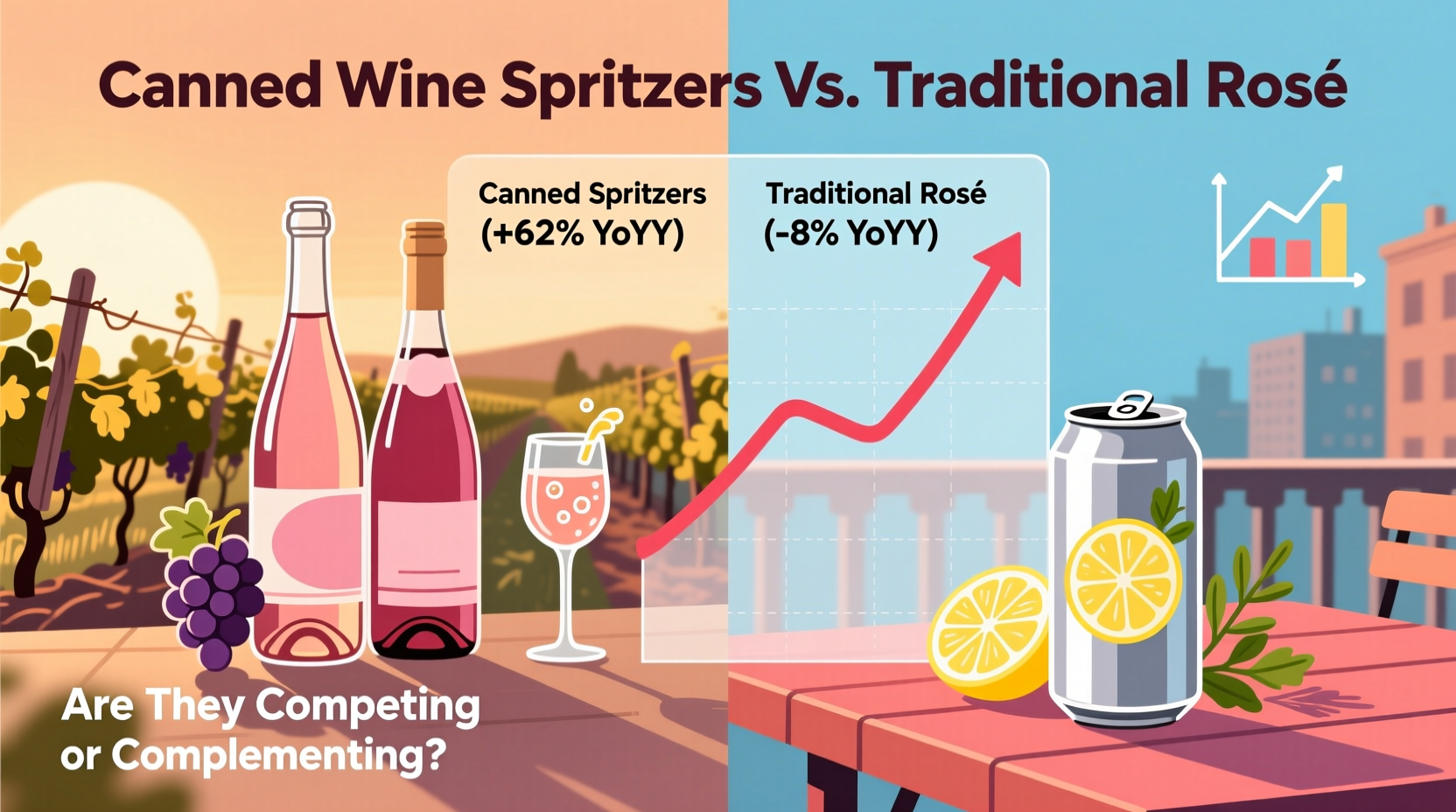
Conventional retail metrics support the cannibalization thesis. NielsenIQ data shows that in off-premise channels (grocery, convenience, liquor stores), 42% of canned rosé spritzer buyers also purchased bottled rosé in the prior 90 days—but only 18% did so in the following quarter. That attrition pattern suggests substitution, not addition. Further, the average transaction value for a four-pack of premium spritzers ($13.99–$16.99) is nearly identical to the average price of a 750ml bottle of mid-tier rosé ($14.99–$17.99). When convenience, no-cork-needed portability, and Instagrammable packaging enter the equation, the trade-off becomes rational—even habitual.
Wine retailers report behavioral shifts: younger shoppers (ages 25–34) now spend 68% of their “rosé budget” on RTD formats, compared to just 12% among consumers 55+. And in venues where space and speed matter—beach clubs, rooftop bars, music festivals—the spritzer has displaced by-the-glass rosé pours, not because it tastes identical, but because it delivers consistent flavor, faster service, and lower labor cost per unit.
Tip: If you're a rosé brand owner or importer, track “cross-format loyalty” using your DTC email cohort analytics—not just total sales. Look at repeat purchase rates across bottles, cans, and single-serve formats over 6-month windows to identify true cannibalization vs. expansion.The Expansion Argument: How Spritzers Are Growing the Pie
Cannibalization assumes a fixed pool of rosé drinkers. But industry data increasingly contradicts that assumption. According to the Wine Market Council’s 2024 Consumer Study, 53% of regular canned rosé spritzer consumers *had not purchased any wine—bottled or otherwise—in the prior 12 months* before trying their first can. These are not former rosé fans switching formats; they’re new entrants—largely Gen Z and young millennials—who view wine as “complicated,” “intimidating,” or “not for me”—until they encounter a 5.5% ABV, fruit-forward, carbonated rosé spritzer labeled “No Cork. No Glass. No Stress.”
That demographic bridge matters. In 2023, 29% of all new wine drinkers entered via RTD formats, per IWSR Beverage Market Insights. Of those, 61% went on to purchase bottled wine within 12 months—including 38% who bought rosé specifically. This isn’t substitution. It’s onboarding. As one sommelier told VinePair: “I used to pour rosé by the glass to convert lager drinkers. Now I hand them a chilled can of grapefruit-rosé spritzer—and three weeks later, they’re ordering Bandol at the bar. The can was the gateway, not the destination.”
“The idea that canned spritzers are ‘killing’ rosé is like saying espresso machines killed coffee culture. They didn’t—they lowered the barrier to entry, attracted new users, and ultimately expanded demand for higher-quality beans, roasters, and brewing methods.” — Dr. Laura Chen, Director of Beverage Innovation, UC Davis Department of Viticulture & Enology
A Tale of Two Consumers: A Mini Case Study
Consider Maya, 28, a graphic designer in Portland. She began drinking wine seriously in 2021 after a friend introduced her to dry Provençal rosé. She joined a wine club, attended tastings, and built a small cellar. By 2022, she bought 12–14 bottles of rosé annually—mostly imported, $20–$30 range. In early 2023, she tried a local winery’s canned rosé spritzer at a farmers’ market. She liked its brightness and ease. Within six months, she was buying two four-packs monthly—but her bottled rosé purchases dropped from 14 to 8 bottles/year. For Maya, spritzers replaced part of her rosé habit. This is cannibalization—at the individual level.
Now consider Javier, 24, a rideshare driver in Miami. He’d never bought wine before 2023. His first exposure was a viral TikTok showing friends cracking open a neon-pink rosé spritzer on a sunset paddleboard. He bought a four-pack at a bodega, loved the low-alcohol buzz and zero prep, and started grabbing them weekly. Six months later, he bought his first bottle of rosé—$12 domestic, chilled at the grocery store—because “it tasted kinda like the can, but fancier.” He hasn’t bought another bottle since—but he’s also never bought red or white wine. For Javier, the spritzer wasn’t a substitute. It was his first legal alcoholic beverage purchase outside of beer or spirits.
Maya and Javier represent coexisting dynamics: some displacement, yes—but far more importantly, demographic expansion. And crucially, Javier’s behavior is replicable at scale. The Wine Institute estimates that each new consumer acquired via RTD formats generates an average lifetime wine spend of $2,100—nearly double that of legacy consumers entering via traditional channels.
Structural Differences: Format ≠ Category
It’s critical to recognize that “canned rosé spritzer” and “traditional rosé” operate in fundamentally different product ecosystems—with distinct production, distribution, pricing, and consumption contexts. A comparison reveals why treating them as direct competitors oversimplifies reality:
| Dimension | Traditional Bottled Rosé | Canned Rosé Spritzer |
|---|---|---|
| Typical ABV | 12–13.5% | 4.5–6.5% |
| Production Process | Fermented dry rosé, often estate-grown, minimal intervention | Base rosé wine + carbonation + juice concentrate + stabilizers + sometimes added sugar |
| Shelf Life (unopened) | 12–24 months (optimal within 18) | 18–36 months (stabilized, nitrogen-flushed) |
| Primary Distribution Channel | Specialty wine shops, fine dining, direct-to-consumer | Grocery, convenience, mass retail, e-commerce subscription boxes |
| Price Per Standard Drink (14g alcohol) | $2.40–$3.10 | $1.60–$2.00 |
| Key Purchase Triggers | Vintage, region, varietal, food pairing, occasion | Convenience, social sharing, low-commitment tasting, lifestyle alignment |
This table underscores a key insight: spritzers aren’t “rosé in a can.” They’re a hybrid category—part wine, part cocktail, part functional beverage—that serves different needs. They succeed not by mimicking traditional rosé, but by solving problems rosé doesn’t address: portability, consistency, speed, and approachability. As such, they expand the *functional definition* of rosé—not just its format.
What the Data Says: Growth, Not Decline, in the Broader Category
Zooming out past the bottle-versus-can debate reveals a stronger truth: the broader “rosé ecosystem” is growing—not shrinking. Consider these indicators:
- Total rosé-related volume (bottles + cans + kegs + single-serve): Up 9.2% from 2021 to 2023 (IWSR)
- Consumer awareness of rosé as a year-round option: Increased from 31% to 54% among adults 21–39 (Wine Market Council, 2022–2024)
- Number of U.S. wineries producing rosé (any format): Grew from 1,842 to 2,317 between 2020 and 2023 (TTB data)
- Restaurant menu mentions of “rosé spritzer” (as a prepared drink): Up 140% since 2021 (Technomic MenuMonitor)
Importantly, the growth isn’t evenly distributed. While premium still rosé (>$25/bottle) saw flat-to-slight decline, the $12–$20 tier—the sweet spot for both entry-level bottled rosé and high-end spritzers—grew 11.7%. This signals healthy churn: consumers moving *into* the category at accessible price points, then graduating upward—not abandoning rosé altogether.
Further evidence lies in innovation pipelines. Wineries once focused solely on still rosé are now launching dedicated spritzer lines (Tablas Creek, Bonny Doon, Charles Smith Wines), while craft brewers and spirit companies (like Cutwater Spirits and High Noon) are investing in rosé-forward RTDs—not to replace wine, but to capture adjacent occasions. This cross-category investment reflects confidence in rosé’s versatility, not its fragility.
Practical Implications: What This Means for Producers, Retailers, and Drinkers
Understanding the dual dynamic—cannibalization *and* expansion—changes how stakeholders should act. Here’s how to respond strategically:
For Winemakers & Brands
- Don’t treat spritzers as competition—treat them as a marketing channel. Offer limited-edition canned versions of your flagship rosé to introduce new drinkers to your house style.
- Invest in education, not just promotion. Use QR codes on cans linking to short videos about your vineyard, harvest timing, or why Provence rosé is pale—building familiarity without requiring bottle commitment.
- Protect your core equity. Reserve your most expressive, terroir-driven rosés for bottle format. Let spritzers carry your “everyday” expression.
For Retailers
- Place spritzers near beer coolers *and* wine aisles—not just one or the other—to capture both audiences.
- Train staff to say “This spritzer uses real rosé wine from [region]—try the bottle next time you want to explore the full flavor profile.”
- Bundle: “Try Both” shelf tags pairing a can and a bottle at a slight discount.
For Consumers
Tip: Treat canned spritzers as an exploration tool—not a replacement. Use them to discover styles (Provence vs. Spanish vs. California rosé) and flavor profiles (strawberry-dominant vs. citrus-driven) before investing in a full bottle.FAQ
Do canned rosé spritzers contain real wine?
Yes—by law in the U.S., any beverage labeled “rosé spritzer” must contain at least 51% wine. Most premium brands use 70–90% base rosé wine, with the remainder being carbonated water, natural fruit juice, and minimal stabilizers. Always check the label: “wine, carbonated water, grapefruit juice concentrate” indicates authenticity; “wine product, natural flavors, citric acid” may signal lower wine content.
Is rosé spritzer healthier than bottled rosé?
Not inherently—but it often results in lower overall alcohol and calorie intake per session. A standard 250ml can contains ~100–120 calories and 10–12g alcohol, versus 125 calories and ~14g alcohol in a 5oz glass of rosé. However, added sugars in some spritzers (up to 6g per can) can offset calorie advantages. Opt for brands listing “no added sugar” or under 2g per serving.
Will traditional rosé ever regain dominance?
Dominance is the wrong framing. Rosé is evolving from a seasonal, varietal-specific category into a multifaceted beverage platform—like coffee or tea. Bottled rosé will remain essential for connoisseurs, collectors, and food-focused experiences. Canned spritzers serve spontaneity, mobility, and social ease. The future isn’t one format winning—it’s consumers fluidly choosing the right expression for the moment.
Conclusion
The rise of canned rosé spritzers isn’t erasing traditional rosé—it’s forcing the entire category to mature. It’s pushing producers to articulate their values more clearly, retailers to rethink placement and storytelling, and consumers to ask better questions about origin, process, and intention. What looked like cannibalization at first glance is proving to be diversification: the same grape, the same color, the same summer spirit—expressed through new vessels, new contexts, and new voices. Rosé was never just a wine. It was always a mood, a moment, a mindset. Now, it’s also a can, a cocktail shaker, a picnic blanket, and a DM thread. That’s not decline. That’s evolution.
💬 Your turn: Have you discovered rosé through a spritzer? Did it lead you to bottles—or keep you happily in the can? Share your story in the comments. Real experiences shape better conversations—and better wine.